Appearance
6.3 — Simultaneity, Contraction and the Twins
The Lorentz transformation of Chapter 6.2 is four lines of algebra. What it says about the world is deeply strange, and the strangeness is not in the \gamma factors — those are just numbers. It is in the -vx/c^2 term in the time equation, which says that when something happens depends on where it happens.
Start there, because every apparent paradox in relativity dissolves once you have it.
Simultaneity is not absolute
Two events happen at the same time in frame S: same t, different positions x_1 and x_2. What does S' say?
t'_1 = \gamma\left(t - \frac{vx_1}{c^2}\right), \qquad t'_2 = \gamma\left(t - \frac{vx_2}{c^2}\right)
\Delta t' = t'_2 - t'_1 = -\frac{\gamma v(x_2-x_1)}{c^2} = -\frac{\gamma v\Delta x}{c^2}
This is zero only if \Delta x = 0. Two events at the same place and the same time are simultaneous for everybody. Two events at different places, simultaneous in one frame, are not simultaneous in any other.
And the sign matters: which one happens first depends on which way you are moving.
Einstein's train
The standard demonstration, and it is worth walking through carefully.
A train moves at speed v. Lightning strikes both ends simultaneously as judged by an observer standing on the embankment at the midpoint. The light from both strikes reaches her at the same instant, and since she is equidistant from both ends, she concludes they were simultaneous.
Now the passenger sitting at the middle of the train. During the time the light is travelling, the train has carried him towards the front strike and away from the rear one.
So the light from the front reaches him first.
He is at the midpoint of the train, and by postulate 2 the light travelled at c in his frame too, and it had equal distances to cover in his frame. Front light arrived first, so the front strike happened first. That is the only conclusion available to him.
Both are right. Neither is making a mistake about signal delays — both have already corrected for those. The events genuinely have no absolute time ordering, because there is no absolute time.
Worked number. A 300 m train at 0.6c, with the strikes simultaneous on the embankment. In the train's frame:
\Delta t' = \frac{\gamma v\Delta x}{c^2}, \qquad \gamma = \frac{1}{\sqrt{1-0.36}} = 1.25
Using the train's own length, we need \Delta x in the embankment frame, which is the contracted length 300/1.25 = 240 m:
\Delta t' = \frac{(1.25)(0.6\times3\times10^{8})(240)}{(3\times10^{8})^2} = \frac{(1.25)(1.8\times10^{8})(240)}{9\times10^{16}} = \frac{5.4\times10^{10}}{9\times10^{16}} = 6.0\times10^{-7}\ \text{s}
0.6 microseconds apart in the train's frame, and exactly zero on the embankment.
Causality is safe
If the ordering of events can flip, can an effect precede its cause?
No, and the reason is precise. Flipping the order requires:
\left|\frac{v\Delta x}{c^2}\right| > |\Delta t| \quad\Longrightarrow\quad \frac{\Delta x}{\Delta t} > \frac{c^2}{v} > c
The order can only flip for events separated by more than light could travel between them. Such events cannot influence each other — no signal can get from one to the other — so there is no cause and effect to reverse. Chapter 6.5 makes this exact with the invariant interval.
Time dilation, stated carefully
From Chapter 6.2's light clock:
\boxed{\Delta t = \gamma\,\Delta t_0}
Proper time \Delta t_0 is the interval measured by a clock present at both events — a single clock, at rest relative to them. Everybody else measures a longer interval.
"Moving clocks run slow" is a correct slogan and a dangerous one, because it invites the question "moving relative to what?" and the answer is "relative to whoever is measuring". There is no fact about which clock is really slow.
The symmetry is complete. A sees B's clock running slow. B sees A's clock running slow. Both are right, and this is not a contradiction because they are comparing different pairs of events — the comparison requires two clocks in one frame and one in the other, and which frame supplies the pair is exactly what differs.

The muon experiment
This is the measurement that removes any possibility of relativity being a mathematical curiosity.
Muons are unstable particles produced when cosmic rays strike the upper atmosphere at about 15 km altitude. Their half-life at rest is $1.56\ \mu$s, and they travel at about 0.998c.
Classical prediction. In $1.56\ \mu$s a muon covers:
d = (0.998)(3\times10^{8})(1.56\times10^{-6}) = 467\ \text{m}
From 15 km, that is 15000/467 = 32 half-lives. The surviving fraction:
\left(\frac{1}{2}\right)^{32} = 2.3\times10^{-10}
Essentially none should reach the ground. For every ten billion muons made at 15 km, about two would arrive.
What is measured. Roughly 5 % arrive. About one in twenty. Off by a factor of two hundred million.
Relativity's prediction. At v = 0.998c:
\gamma = \frac{1}{\sqrt{1-0.996}} = \frac{1}{\sqrt{0.004}} = \frac{1}{0.0632} = 15.8
In our frame the muon's half-life is dilated to $15.8\times1.56 = 24.6\ \mu$s, so it travels 15.8\times467 = 7380 m per half-life. From 15 km:
\frac{15000}{7380} = 2.03\ \text{half-lives}
\left(\frac{1}{2}\right)^{2.03} = 0.245
Around a quarter, before accounting for the spread of muon energies and production heights, which brings the prediction down into agreement with the measured few percent. The order of magnitude is right and the classical answer is wrong by ten orders of magnitude.
Now the muon's point of view, which is the part that makes it click. In its own frame the muon lives $1.56\ \mu$s and no longer — its half-life is a proper time and does not change. So how does it get down?
Because the atmosphere is contracted. In the muon's frame the 15 km is:
\frac{15000}{15.8} = 949\ \text{m}
and covering 949 m at 0.998c takes $3.17\ \mu$s, or 2.03 half-lives. The same answer.
Two observers, two completely different explanations — one says the clock ran slow, the other says the distance was short — and identical predictions. That is the pattern throughout relativity, and it is what postulate 1 guarantees.
Bruno Rossi and David Hall did this measurement on Mount Washington in 1941, comparing muon counts at 1900 m and at sea level. Frisch and Smith repeated it definitively in 1963.
Length contraction
\boxed{L = \frac{L_0}{\gamma} = L_0\sqrt{1-v^2/c^2}}
where L_0 is the proper length, measured in the object's rest frame.
Deriving it from the transformation. To measure a moving rod's length you must locate both ends at the same time in your frame. That is the whole subtlety: length is defined by a simultaneity choice, and simultaneity is frame-dependent.
Set \Delta t = 0 in the transformation for \Delta x':
\Delta x' = \gamma(\Delta x - v\Delta t) = \gamma\Delta x
Here \Delta x' is the rod's proper length L_0 (it is at rest in S') and \Delta x is what you measure:
L_0 = \gamma L \quad\Longrightarrow\quad L = \frac{L_0}{\gamma}
Only along the direction of motion. Transverse dimensions are unchanged, by the ring argument of Chapter 6.2. A spacecraft passing at 0.9c is squashed front-to-back by a factor of 2.29 and unchanged in width.
The ladder and the barn
A 10 m ladder is carried at 0.87c (\gamma = 2) towards a 5 m barn with doors at both ends. In the barn's frame the ladder is contracted to 5 m, so it fits, and both doors can be shut simultaneously with the ladder entirely inside.
In the ladder's frame the barn is contracted to 2.5 m and the ladder is 10 m. It cannot possibly fit. Four times too long.
Both are correct, and the resolution is simultaneity. "Both doors shut at the same time" is a statement about two events at different places, and it does not survive a change of frame.
In the barn's frame: back door shuts, front door shuts, both while the ladder is inside, then both open.
In the ladder's frame: the back door shuts and opens again while the front of the ladder is still approaching it. Later, the front door shuts and opens after the back of the ladder has passed in. The two closings are not simultaneous at all — they are separated by exactly the \gamma v\Delta x/c^2 from the start of this chapter.
Nothing is crushed and no door is smashed. Every observer agrees on the physical events: which door was shut when the ladder's tip was where. They disagree only on the labelling of "at the same time".
Is contraction real?
Yes, in the only sense that matters: it is measurable and it has consequences. A charged particle's electric field is genuinely compressed into a pancake at high speed, which changes how it interacts, and accelerator physicists design magnets around it. Heavy-ion collisions at the LHC are modelled as two flattened discs colliding, not two spheres, because at \gamma = 2700 the nuclei really are 2700 times thinner.
What contraction is not is "an optical illusion". But there is a separate optical effect worth separating out. A fast-moving object photographed does not look contracted — it looks rotated. Light from the far side of the object left earlier than light from the near side, so the picture assembles parts of the object from different moments, and the net visual effect (worked out by Terrell and Penrose in 1959) is a rotation rather than a squashing. Contraction is what you get by measuring both ends simultaneously; the Terrell rotation is what a camera records. They are different questions.
The twin paradox
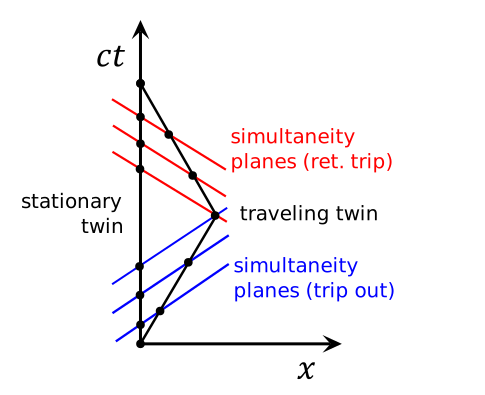
Alice stays on Earth. Bob flies to a star 8 light years away at 0.8c and returns.
\gamma = \frac{1}{\sqrt{1-0.64}} = \frac{1}{0.6} = 1.667
Alice's accounting. The round trip is 16 light years at 0.8c:
T_{\text{Alice}} = \frac{16}{0.8} = 20\ \text{years}
Bob's clock ran slow by \gamma:
T_{\text{Bob}} = \frac{20}{1.667} = 12\ \text{years}
Bob's accounting. For him the distance is contracted:
d = \frac{8}{1.667} = 4.8\ \text{light years each way}
T_{\text{Bob}} = \frac{2\times4.8}{0.8} = 12\ \text{years}
They agree. Bob is 8 years younger.
Where is the paradox?
The objection: motion is relative, so from Bob's point of view Alice was the one moving, so she should be younger. Both cannot be right, so the theory is inconsistent.
The resolution is that the situation is not symmetric, and it is easy to say why in one sentence: Bob turned around and Alice did not.
Bob's journey is not one inertial frame; it is two, joined by an acceleration. He feels that acceleration — he is thrown against his seat, an accelerometer on the wall reads a number, everything unbolted flies forward. Alice feels nothing at any point. There is an absolute, frame-independent fact about which twin accelerated, and it breaks the symmetry completely.
The naive argument "each sees the other's clock run slow" is valid only while both are inertial. It is valid on Bob's outbound leg, valid on his return leg, and invalid across the turnaround.
What Bob actually sees at the turnaround
This is the part that makes the resolution concrete rather than a lawyer's answer.
Outbound, Bob's line of simultaneity — his notion of "what Alice is doing right now" — is tilted one way. In his 6 years of outbound travel, his "now" on Earth advances by 6/1.667 = 3.6 years.
Inbound, his line of simultaneity is tilted the other way. His return 6 years also correspond to 3.6 years of Alice's "now".
Total from the two legs: 7.2 years. But Alice aged 20.
The missing 12.8 years happen during the turnaround. As Bob's velocity reverses, his plane of simultaneity swings through a large angle, and it sweeps across a huge slice of Alice's worldline. In the idealised instantaneous turnaround, Alice ages 12.8 years in an instant of Bob's time.
That is not a trick of bookkeeping. It is what the -vx/c^2 term does when v changes sign at large x: the "now" line pivots about Bob's position, and at 8 light years away the pivot sweeps enormously.
With a realistic gradual turnaround, nothing jumps — Alice's clock simply runs fast in Bob's frame during the deceleration and re-acceleration, and the same total comes out. Chapter 6.6 explains why: an accelerating observer sees clocks ahead of them run fast, which is the equivalence principle at work.
It has been measured
Hafele and Keating, 1971. Four caesium atomic clocks were flown around the world on commercial airliners, twice — once eastward, once westward — and compared with clocks left at the US Naval Observatory.
The prediction combines two effects, and they pull in opposite directions:
- Velocity time dilation, from this chapter, which slows the flying clocks.
- Gravitational time dilation, from Chapter 6.6, which speeds them up at altitude.
Predicted and measured, in nanoseconds:
| Predicted | Measured | |
|---|---|---|
| Eastward | −40 ± 23 | −59 ± 10 |
| Westward | +275 ± 21 | +273 ± 7 |
Agreement within the errors. The eastward and westward results differ because the Earth's rotation adds to or subtracts from the aircraft's speed relative to the non-rotating frame.
Modern versions are far more precise. In 2010 a team at NIST measured time dilation for a clock raised by 33 cm and for one moving at 10 m/s — walking pace — using optical clocks accurate to one part in 10^{17}. Both matched prediction. Relativity is now an effect visible on a laboratory bench at speeds a person can produce by walking.
Relativistic Doppler
Chapter 2.5 found the sound Doppler formula and noted it is asymmetric: a moving source and a moving observer give different answers, because the medium provides an absolute reference. Light has no medium, so its formula must depend only on the relative speed.
Derive it. A source approaching at v emits pulses at proper interval T_0. In the observer's frame the interval between emissions is dilated to \gamma T_0. During that interval the source moves v\gamma T_0 closer, so each pulse has less distance to cover, arriving earlier by v\gamma T_0/c:
T_{\text{obs}} = \gamma T_0\left(1-\frac{v}{c}\right) = \gamma T_0(1-\beta)
Frequency is the reciprocal:
f = \frac{f_0}{\gamma(1-\beta)} = \frac{f_0\sqrt{1-\beta^2}}{1-\beta} = f_0\frac{\sqrt{(1-\beta)(1+\beta)}}{1-\beta}
\boxed{f = f_0\sqrt{\frac{1+\beta}{1-\beta}}\ \text{(approaching)}, \qquad f = f_0\sqrt{\frac{1-\beta}{1+\beta}}\ \text{(receding)}}
Symmetric in v alone, exactly as it had to be. The asymmetry of the sound formula was a fingerprint of the medium, and its absence here is another piece of evidence that there is no ether.
And there is an effect with no classical analogue. Set \beta along a direction perpendicular to the line of sight, so there is no approach or recession at all. Classically, no shift. Relativistically:
f = \frac{f_0}{\gamma}
Transverse Doppler shift — a pure time-dilation effect, always a redshift. Ives and Stilwell measured it in 1938 using a beam of hydrogen ions, and it is direct experimental proof of time dilation independent of any two-way argument.
Where this shows up in your life
GPS. Satellite clocks run slow by 7 μs/day from their orbital speed and fast by 45 μs/day from being higher in Earth's gravitational field, for a net gain of 38 μs/day. Untreated, positions would drift by about 11 km per day. Chapter 6.9 computes both numbers.
Particle accelerators. At the LHC, protons run at \gamma = 7460. Their lifetimes, their fields, and the timing of everything in the machine are computed relativistically, and the machine would not work at all on Newtonian design.
Muons reaching the ground. About one passes through your hand every few seconds, and every one of them is here because of time dilation.
Old CRT televisions accelerated electrons to about 0.3c, where \gamma = 1.05. The deflection coils had to account for the 5 %, so relativity was in the design of a household appliance from the 1950s onwards.
Gold is yellow because of relativity. Its innermost electrons move at about 0.58c, where \gamma = 1.23, which contracts their orbitals and shifts the energy levels enough to move gold's absorption from the ultraviolet into the blue. Absorbing blue leaves yellow. Silver, being lighter, has slower inner electrons and stays white. The colour of a wedding ring is a relativistic effect. So is the fact that mercury is liquid at room temperature, for a closely related reason.
What the next chapter fixes
Space and time have been reorganised. Nothing has been said about mass, momentum or energy — and they cannot survive unchanged, because momentum conservation as Newton wrote it is not preserved by the Lorentz transformation. A collision that conserves momentum in one frame would not conserve it in another, which is unacceptable. Chapter 6.4 finds the redefinition that fixes it, discovers that a stationary object has energy simply for existing, and derives E = mc^2 — then puts real numbers into a nuclear reaction to show what the equation is worth.