Appearance
10.2 — Molecular Shape, Hybridisation and Molecular Orbitals
A Lewis structure tells you which atoms are joined and nothing about where they sit. Shape decides almost everything that matters.
Water is bent, so its bond dipoles do not cancel, so it is polar, so it is a liquid at room temperature, so life exists. Carbon dioxide is straight, so its dipoles cancel, so it is a gas. Same number of atoms, same kind of bonds, entirely different substance because of an angle.
VSEPR
Valence Shell Electron Pair Repulsion, developed by Gillespie and Nyholm in 1957, and it is one of the most useful simple rules in chemistry.
Electron pairs around a central atom arrange themselves as far apart as possible.
The reasoning: electron pairs repel electrostatically, and by the exclusion principle two pairs cannot occupy the same region. So they spread out.

The base geometries:
| Pairs | Arrangement | Angle |
|---|---|---|
| 2 | Linear | 180° |
| 3 | Trigonal planar | 120° |
| 4 | Tetrahedral | 109.5° |
| 5 | Trigonal bipyramidal | 90°, 120° |
| 6 | Octahedral | 90° |
Where 109.5° comes from. Put four points on a sphere as far apart as possible and they form a tetrahedron. Place the central atom at the origin and two vertices at (1,1,1) and (1,-1,-1):
\cos\theta = \frac{\vec{a}\cdot\vec{b}}{|a||b|} = \frac{1-1-1}{\sqrt{3}\sqrt{3}} = -\frac{1}{3}
\theta = \arccos(-1/3) = 109.47°
A number that appears throughout chemistry and biology, and it is pure geometry.
Lone pairs change the shape
The arrangement counts all pairs. The shape names only the atoms, because lone pairs are invisible to structural methods.
Worked example: the four-pair series.
| Molecule | Bonds | Lone pairs | Shape | Angle |
|---|---|---|---|---|
| CH₄ | 4 | 0 | Tetrahedral | 109.5° |
| NH₃ | 3 | 1 | Trigonal pyramidal | 107° |
| H₂O | 2 | 2 | Bent | 104.5° |
Why the angle shrinks. A lone pair is held by only one nucleus, so it spreads out more and takes up more angular room than a bonding pair, which is pulled in by two nuclei.
\text{lone–lone} > \text{lone–bond} > \text{bond–bond}
Each lone pair squeezes the bond angle by about 2.5°, and the pattern 109.5 → 107 → 104.5 is exactly that.
And this is why water is polar. If water were linear, its two O–H dipoles would cancel like CO₂'s. The two lone pairs force it to 104.5°, the dipoles add to 1.85 D, and every anomalous property of water follows (Chapter 10.3).
Multiple bonds
A double or triple bond counts as one region, because all its electrons occupy roughly the same direction.
CO₂: two double bonds, two regions, linear, 180°. Non-polar despite polar bonds.
H₂C=O (formaldehyde): three regions, trigonal planar, 120°.
Multiple bonds are fatter than single ones and push others away slightly, which is why formaldehyde's H–C–H angle is 116° rather than 120°.
Five and six pairs
Trigonal bipyramidal is the odd one, because it has two inequivalent positions: three equatorial at 120° in a plane, and two axial at 90° to them.
Lone pairs always go equatorial. An equatorial position has two neighbours at 90°; an axial position has three. Fewer close contacts, so less repulsion.
| Molecule | Bonds | Lone pairs | Shape |
|---|---|---|---|
| PCl₅ | 5 | 0 | Trigonal bipyramidal |
| SF₄ | 4 | 1 | See-saw |
| ClF₃ | 3 | 2 | T-shaped |
| XeF₂ | 2 | 3 | Linear |
XeF₂ being linear is the striking one — three lone pairs occupy all three equatorial positions, leaving the two fluorines axial and opposite. A xenon compound with a shape you can predict from a rule, forty years after xenon was declared inert.
For six pairs, all positions are equivalent, and lone pairs go opposite each other:
| Molecule | Bonds | Lone pairs | Shape |
|---|---|---|---|
| SF₆ | 6 | 0 | Octahedral |
| BrF₅ | 5 | 1 | Square pyramidal |
| XeF₄ | 4 | 2 | Square planar |
Hybridisation
VSEPR predicts shapes and does not explain them in orbital terms. Here is the problem it leaves.
Carbon's ground state is 2s^22p^2 — two paired s electrons and two unpaired p electrons. That predicts two bonds at 90°, since p orbitals are perpendicular.
Methane has four identical bonds at 109.5°.
The resolution
Promotion. Move one 2s electron to the empty 2p, giving 2s^12p^3 — four unpaired electrons. This costs about 400 kJ/mol.
Mixing. Combine the one s and three p orbitals into four equivalent hybrids.
\text{4 orbitals in} \to \text{4 orbitals out}
The four sp^3 hybrids point to the corners of a tetrahedron.
And the promotion is repaid. Four C–H bonds at 413 kJ/mol give 1652 kJ/mol against two bonds giving 826. The extra 826 kJ/mol far exceeds the 400 spent.
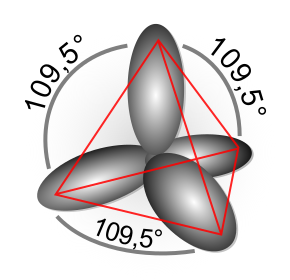
Why hybrids bond better is visible in the picture. The s and p orbitals add constructively on one side and destructively on the other, so the hybrid has one large lobe. That lobe points at the bonding partner and gives far more overlap than a symmetric p orbital, whose two equal lobes waste half the electron density pointing away.
The three types
| Hybridisation | Mix | Geometry | Angle | Example |
|---|---|---|---|---|
| sp | 1s + 1p | Linear | 180° | BeCl₂, C₂H₂ |
| sp^2 | 1s + 2p | Trigonal planar | 120° | BF₃, C₂H₄ |
| sp^3 | 1s + 3p | Tetrahedral | 109.5° | CH₄, H₂O |
Note that in sp and sp^2, unhybridised p orbitals are left over, and those form the pi bonds of multiple bonds.
Sigma and pi
Sigma (\sigma) bonds form by head-on overlap along the internuclear axis. Strong, and rotation about them is free.
Pi (\pi) bonds form by sideways overlap of parallel p orbitals, giving density above and below the axis. Weaker, and rotation about them is blocked because it would break the overlap.
Ethene, H₂C=CH₂. Each carbon is sp^2, giving three sigma bonds in a plane, and the leftover p orbitals overlap sideways for the pi bond.
The consequence is that ethene is flat and rigid. You cannot twist one CH₂ group relative to the other without breaking the pi bond, which costs about 270 kJ/mol.
And that rigidity is what makes vision work. The retina contains retinal, a molecule with a chain of alternating double bonds. A photon supplies exactly the energy to twist one double bond from cis to trans, changing the molecule's shape, which changes the shape of the protein around it, which triggers a nerve signal. Sight is a photon breaking a pi bond.
It also makes trans fats different from cis fats. Same atoms, same formula, different geometry across a double bond that cannot rotate — and the body's enzymes, which recognise shape, treat them completely differently.
Ethyne, HC≡CH. Each carbon is sp, giving one sigma bond and two perpendicular pi bonds. Linear and very rigid.
Is hybridisation real?
It is a mathematical convenience, not a physical process. Nothing "promotes" and nothing "mixes" — the true wavefunction is what it is, and hybrid orbitals are one convenient basis for describing it.
It is chosen because it makes chemical intuition work. The alternative descriptions give the same total electron density and the same energy, and are far harder to reason with.
It also fails in specific ways. Water's bond angle of 104.5° is not really 109.5° squeezed by lone pairs; a full calculation shows the oxygen uses nearly pure p orbitals for bonding, with the s character concentrated in the lone pairs. The hybridisation story gets the right answer for a slightly wrong reason, which is worth knowing when it stops working.
Molecular orbital theory
Where hybridisation fails badly, MO theory succeeds, and the standard example is oxygen.
The idea
Atomic orbitals combine to form molecular orbitals spread over the whole molecule. N atomic orbitals give N molecular orbitals.
For two 1s orbitals:
Bonding combination, \psi_A+\psi_B. Constructive interference between the nuclei, so electron density is concentrated where it is attracted by both. Lower energy.
Antibonding combination, \psi_A-\psi_B. Destructive interference, with a node exactly between the nuclei. Higher energy, marked with a star: \sigma^*.
Crucially, the antibonding orbital is raised more than the bonding one is lowered. This asymmetry is why filled shells do not bond.
Bond order
\boxed{\text{Bond order} = \frac{(\text{bonding electrons})-(\text{antibonding electrons})}{2}}
Worked examples:
H₂: 2 bonding, 0 antibonding. Order 1. Stable, 436 kJ/mol.
He₂: 2 bonding, 2 antibonding. Order 0. Does not exist, and now there is a reason rather than an assertion.
He₂⁺: 2 bonding, 1 antibonding. Order 0.5 — and this species has been observed spectroscopically, with a bond energy of 250 kJ/mol. MO theory predicts a half-bond and it exists. No Lewis structure can represent it.
Oxygen: the decisive case

The Lewis structure O=O shows all electrons paired, which predicts a diamagnetic molecule that is pushed out of a magnetic field.
Pour liquid oxygen between the poles of a magnet and it sticks there. O₂ is paramagnetic (Chapter 4.8), so it has unpaired electrons.
Lewis theory is simply wrong here, and MO theory gets it right.
Fill the diagram with O₂'s 12 valence electrons:
\sigma_{2s}^2\ \sigma_{2s}^{*2}\ \sigma_{2p}^2\ \pi_{2p}^4\ \pi_{2p}^{*2}
The last two electrons go into \pi^*_{2p}, and there are two degenerate \pi^* orbitals. By Hund's rule (Chapter 9.3) they occupy them singly with parallel spins.
\boxed{\text{O}_2\ \text{has two unpaired electrons.}}
Bond order:
\frac{8-4}{2} = 2
A double bond, matching Lewis — and with two unpaired electrons, which Lewis cannot produce.
This is the single clearest demonstration that molecular orbital theory is more than a reformulation. It predicts a measurable property that the older theory gets flatly wrong, and the measurement is a bar magnet and a flask of liquid oxygen.
The same diagram explains the oxygen series:
| Species | Electrons | Bond order | Length (pm) | Energy (kJ/mol) |
|---|---|---|---|---|
| O₂⁺ | 11 | 2.5 | 112 | 643 |
| O₂ | 12 | 2.0 | 121 | 498 |
| O₂⁻ (superoxide) | 13 | 1.5 | 128 | 393 |
| O₂²⁻ (peroxide) | 14 | 1.0 | 149 | 204 |
Adding electrons to antibonding orbitals weakens and lengthens the bond, monotonically. The trend is exact.
And superoxide's biological importance follows from that weak, reactive half-broken bond. It is produced as a by-product of respiration, damages cells, and every aerobic organism carries the enzyme superoxide dismutase to destroy it. Ageing and oxidative stress research is largely about this one radical, which exists because of an electron in a \pi^* orbital.
Delocalisation and benzene
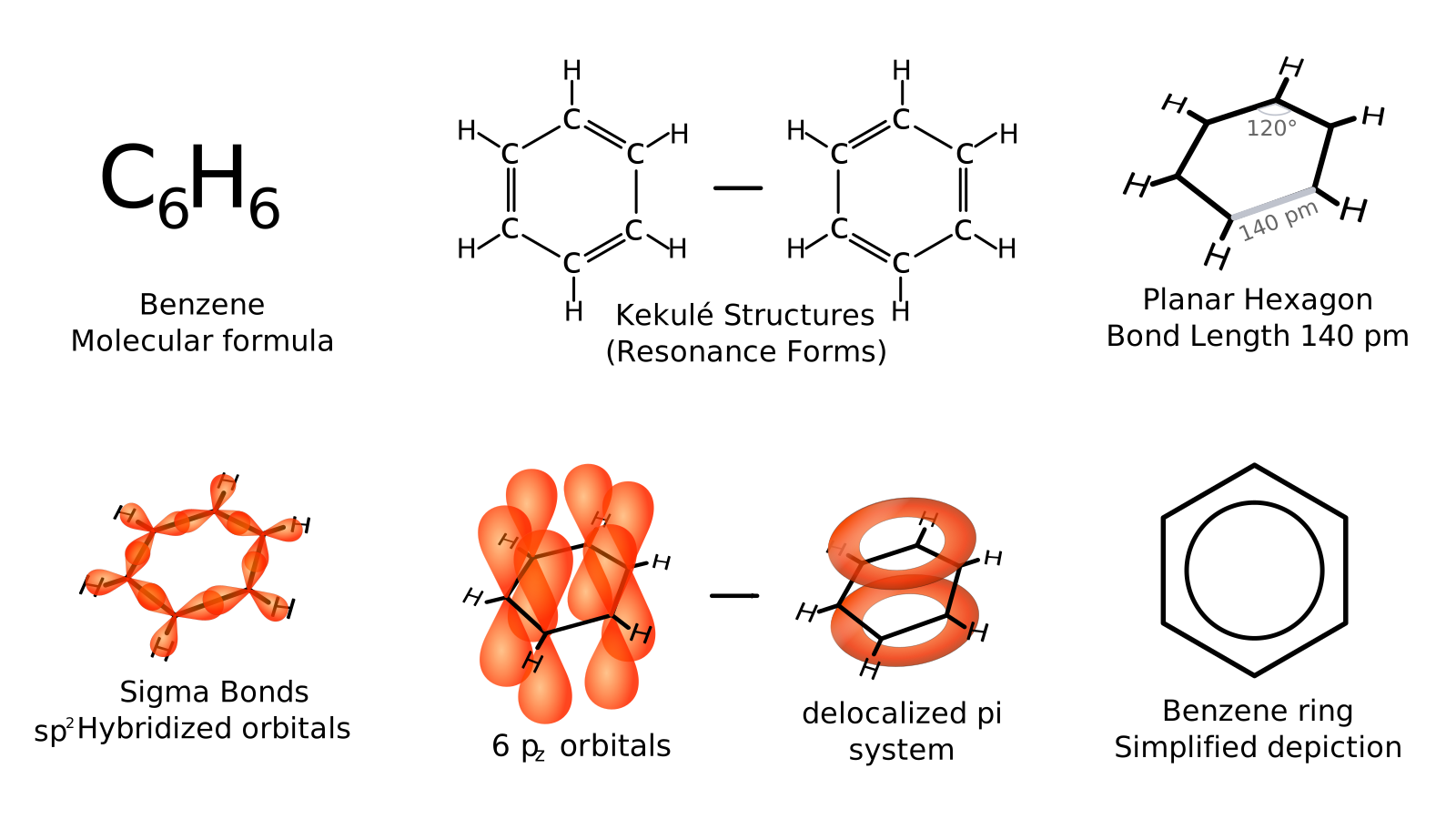
Benzene, C₆H₆. Kekulé proposed alternating single and double bonds in 1865, reportedly after dreaming of a snake biting its tail.
But all six C–C bonds are identical, at 139 pm — between a single bond's 154 and a double bond's 134.
MO theory explains it directly. Each carbon is sp^2, forming the ring's sigma framework, and each has one leftover p orbital perpendicular to the ring. Six p orbitals combine into six molecular orbitals spread over the whole ring, and the six pi electrons fill the three bonding ones.
The delocalisation energy is 150 kJ/mol — benzene is that much more stable than three isolated double bonds would be. This is why benzene does not undergo addition reactions the way ethene does: adding across a double bond would destroy the delocalisation and cost that 150 kJ/mol.
Hückel's rule: a planar ring is aromatic if it has 4n+2 pi electrons. Benzene has 6 (n=1). Cyclobutadiene has 4, is not aromatic, and is violently unstable.
And graphite and graphene (Chapter 9.6) are aromatic rings fused into infinite sheets — which is why graphite conducts within its planes.
Isomerism
Same formula, different arrangement, different substance.
Structural isomers differ in connectivity. C₄H₁₀ is either butane (a straight chain, boiling at −0.5 °C) or isobutane (branched, boiling at −11.7 °C).
The number explodes with size. C₅H₁₂ has 3 isomers, C₁₀H₂₂ has 75, C₂₀H₄₂ has 366,319, and C₃₀H₆₂ has over four billion. This is a large part of why carbon chemistry is so vast.
Geometric isomers differ across a rigid double bond — cis and trans, as in the retinal and trans fat examples above.
Optical isomers are non-superimposable mirror images.

A carbon with four different substituents is chiral. The two forms — enantiomers — have identical melting points, boiling points, densities and spectra. They differ in exactly two ways: they rotate polarised light in opposite directions (Chapter 5.5), and they react differently with other chiral molecules.
And biology is entirely chiral. All amino acids in proteins are the L form; all sugars in DNA are the D form. Nobody knows why that particular handedness was chosen, and it is one of the genuine open questions about the origin of life.
The consequence is that enantiomers can have completely different biological effects. One form of carvone smells of spearmint and its mirror image of caraway. One form of limonene smells of oranges and the other of lemons. Your nose is a chiral detector.
And thalidomide. Prescribed in the late 1950s as a racemic mixture for morning sickness, one enantiomer is an effective sedative and the other causes severe birth defects. Around 10,000 affected children were born before it was withdrawn in 1961.
The tragedy is worse than "they should have separated them", and it is worth being exact. The two forms interconvert in the body, so administering the pure safe enantiomer would not have prevented it. What the disaster changed was drug regulation: it created the modern requirement for reproductive toxicity testing and separate evaluation of enantiomers, and it is the reason the US FDA — whose reviewer Frances Kelsey had refused approval — gained the powers it has.
Where this shows up in your life
Every drug that works does so because its shape fits a protein's binding site. Modern drug design is molecular geometry, and the computational tools solve approximate versions of the Schrödinger equation to predict it.
Enzymes are shape-selective catalysts, and the "lock and key" metaphor is about geometry.
Soap works because it has a polar head and a non-polar tail — a shape consequence.
Non-stick coating. PTFE's carbon chain is completely surrounded by fluorine atoms, which are small, highly electronegative and hold their electrons so tightly that nothing sticks to them.
Vision is a cis–trans isomerisation.
Smell and taste are shape recognition, including chirality.
And the 109.5° tetrahedral angle determines the shape of water, of DNA's backbone, of diamond, and of every organic molecule in you.
What the next chapter fixes
Bonds within molecules are now understood. What happens between molecules decides whether a substance is a gas, a liquid or a solid, and it is the reason water behaves unlike anything else. Chapter 10.3 works through hydrogen bonding and van der Waals forces, explains water's dozen anomalies from one mechanism, and covers how solids are actually arranged — crystals, glasses and the structures behind everyday materials.