Appearance
10.8 — Where Chemistry Becomes Biology
Everything in a cell obeys the chemistry of the last seven chapters. There is no additional force, no special substance, no new principle. A living cell is a bag of the reactions in Chapter 10.6, running in water, catalysed by molecules built from the functional groups of Chapter 10.7.
And yet something is clearly different.
This chapter covers the four families of molecule that living things are made of, how a cell actually moves energy around, and where the boundary between chemistry and biology sits — which turns out to be harder to locate than it looks.
The vitalism question, settled
Until 1828 it was widely held that organic compounds could only be made by living things, animated by a vital force absent from ordinary matter.
Friedrich Wöhler destroyed this by accident. Trying to make ammonium cyanate, an unambiguously inorganic salt, he heated it and got urea — a substance previously known only from urine.
\text{NH}_4\text{OCN} \to (\text{NH}_2)_2\text{CO}
He wrote to Berzelius: "I must tell you that I can make urea without the use of kidneys, either man or dog."
The same atoms, rearranged, and no vital force anywhere.
Vitalism died slowly, and Wöhler's synthesis is usually credited as the first blow. The modern position is that there is no chemical distinction between living and non-living matter, only an organisational one.
The four families
Almost every molecule in you belongs to one of four groups, and each is a polymer built from a small set of units.
| Family | Monomer | Linkage | Job |
|---|---|---|---|
| Proteins | Amino acids | Amide (peptide) | Structure, catalysis, signalling |
| Nucleic acids | Nucleotides | Phosphodiester | Information |
| Carbohydrates | Sugars | Glycosidic | Energy, structure |
| Lipids | (not polymers) | — | Membranes, storage |
All four use the chemistry of Chapter 10.7, and three of them are condensation polymers — each link formed by losing a water molecule.
Proteins
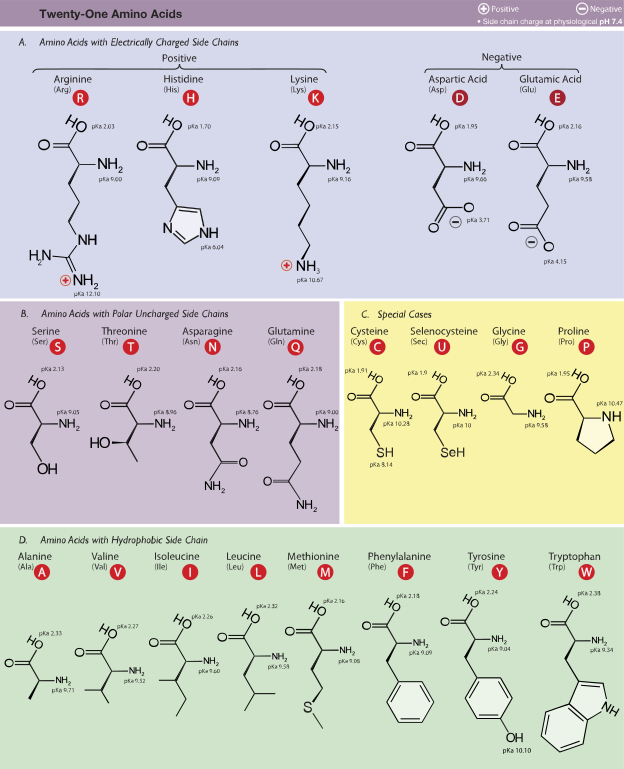
An amino acid has a carboxylic acid, an amine, a hydrogen and a side chain, all on one carbon.
That carbon has four different groups, so it is chiral (Chapter 10.2) — and every amino acid in every protein on Earth is the L form. Why life chose one handedness is genuinely unknown, and it is one of the standing questions about the origin of life.
Twenty standard amino acids, and they sort by side chain chemistry:
Hydrophobic (leucine, valine, phenylalanine): these end up buried in the protein's interior, away from water.
Polar (serine, threonine, asparagine): on the surface, hydrogen bonding to water.
Charged (aspartate, glutamate negative; lysine, arginine positive): on the surface, and often in active sites where they do the catalytic work.
Special cases: proline's side chain loops back to the backbone, which kinks the chain and breaks helices. Cysteine can form disulphide bridges, the only covalent cross-links in a protein. Glycine has just a hydrogen, so it is small and flexible enough to fit where nothing else does.
The peptide bond
\text{H}_2\text{N-CHR-COOH}+\text{H}_2\text{N-CHR}'\text{-COOH} \to \text{H}_2\text{N-CHR-CO-NH-CHR}'\text{-COOH}+\text{H}_2\text{O}
An amide (Chapter 10.7), and its rigidity is the key structural fact. The nitrogen's lone pair delocalises into the carbonyl, giving about 40 % double bond character, so the six atoms around the peptide link are coplanar and rotation is blocked.
Only two backbone rotations remain free per residue, and plotting the allowed combinations gives the Ramachandran plot — which shows that most of the conformational space is forbidden by steric clash. That restriction is why proteins fold reproducibly instead of adopting one of an astronomical number of random shapes.
Four levels of structure
Primary — the sequence.
Secondary — local patterns held by backbone hydrogen bonds. Pauling predicted both the alpha helix and the beta sheet in 1951 from bond geometry, before either had been seen (Chapter 10.3).
Tertiary — the overall three-dimensional fold, driven mainly by the hydrophobic effect and fixed by hydrogen bonds, salt bridges and disulphides.
Quaternary — several folded chains assembling. Haemoglobin is four.
Levinthal's paradox. A 100-residue protein with three possible states per residue has 3^{100} \approx 5\times10^{47} conformations. Sampling them at 10^{-13} s each would take 10^{27} years. Real proteins fold in milliseconds to seconds.
The resolution: folding is not a random search. The energy landscape is funnel-shaped, so partly correct structures are already lower in energy and the protein slides downhill, forming local structure first and assembling it.
And AlphaFold, in 2021, largely solved the prediction problem — given a sequence, predicting the fold to near-experimental accuracy. The structures of essentially every known protein have now been predicted and released. It is one of the clearest cases of machine learning solving a fifty-year-old scientific problem, and it does not explain the folding process, only its outcome.
Enzymes
Chapter 10.6 covered the mechanism: enzymes bind the transition state more tightly than the substrate, lowering the barrier by up to 100 kJ/mol and accelerating reactions by factors up to 10^{17}.
What makes them different from industrial catalysts:
Specificity. An enzyme typically acts on one substrate and often on one enantiomer of it.
Mild conditions. Body temperature, neutral pH, atmospheric pressure. Compare the Haber process at 450 °C and 200 atm (Chapter 10.4) — nitrogenase does the same job in a root nodule at 25 °C.
Regulation. Enzymes can be switched on and off, by allosteric binding at a site away from the active site, by phosphorylation, or by controlling how many are made.
Michaelis–Menten kinetics:
v = \frac{V_{\max}[\text{S}]}{K_M+[\text{S}]}
K_M is the substrate concentration at half maximum rate, and it measures how tightly the enzyme binds. At high substrate the enzyme saturates and the rate becomes independent of concentration — which is the zero-order alcohol elimination from Chapter 10.6.
Nucleic acids

A nucleotide has three parts: a phosphate, a five-carbon sugar (deoxyribose in DNA, ribose in RNA), and a nitrogenous base.
Four bases in DNA: adenine and guanine (purines, two rings), cytosine and thymine (pyrimidines, one ring). RNA uses uracil in place of thymine.
The backbone is a polyester of phosphoric acid with the sugars — the phosphodiester link.
Why the pairing is specific
A–T pairs with two hydrogen bonds. G–C pairs with three.
The specificity is geometric. A purine paired with a pyrimidine gives a total width of about 2.0 nm, the same for both pairs, so the helix has a constant diameter. Two purines would be too wide and two pyrimidines too narrow.
And within that constraint, only A–T and G–C put the donors and acceptors in matching positions. A–C would put two donors facing each other.
Chargaff's rule, found in 1950, is the experimental fingerprint: in any organism's DNA, %A = %T and %G = %C. Watson and Crick's 1953 structure explained why, and Chargaff's data was one of the essential clues, alongside Rosalind Franklin's X-ray diffraction photograph 51, which gave the helical parameters directly.
The strength is exactly right (Chapter 10.3): stable enough to store information for a cell's lifetime, weak enough for a helicase to unzip using a few ATP.
And the complementarity is the replication mechanism. Watson and Crick's paper ends with one of the most restrained sentences in science: "It has not escaped our notice that the specific pairing we have postulated immediately suggests a possible copying mechanism for the genetic material."
The central dogma
\text{DNA} \xrightarrow{\text{transcription}} \text{RNA} \xrightarrow{\text{translation}} \text{protein}
The genetic code reads three bases at a time. Why three? Because there are 20 amino acids to specify, and 4^1 = 4 is too few, 4^2 = 16 is still too few, and 4^3 = 64 is enough.
64 codons for 20 amino acids plus a stop signal, so the code is degenerate — most amino acids have several codons, differing usually in the third base.
That degeneracy is protective. A mutation in the third position often changes nothing, and the code is arranged so that when a change does occur, the substituted amino acid usually has similar chemistry. The code is measurably better at minimising the damage from mutations than almost any random alternative, which is strong evidence it was itself shaped by selection.
And it is nearly universal. The same codons mean the same amino acids in bacteria, plants and humans, with a handful of minor exceptions in mitochondria and some protists. That universality is the single strongest piece of evidence for common descent, and it is also why a human gene can be expressed in a bacterium — which is how insulin is made.
Carbohydrates
(\text{CH}_2\text{O})_n, hence the name — literally hydrates of carbon, though the formula is a coincidence of composition rather than structure.
Glucose, C₆H₁₂O₆, is the central molecule of energy metabolism.
It exists mostly as a ring, formed when the C5 hydroxyl attacks the C1 aldehyde. Two ring forms result, alpha and beta, differing only in which side the C1 hydroxyl points.
That single difference has enormous consequences.
Starch is glucose linked alpha-1,4. The alpha link gives a helical chain, and human amylase can hydrolyse it.
Cellulose is glucose linked beta-1,4. The beta link gives a straight chain that hydrogen bonds to its neighbours into rigid sheets, and no human enzyme can break it.
\boxed{\text{Starch is food. Cellulose is wood. Same monomer, opposite orientation at one carbon.}}
Cellulose is the most abundant organic molecule on Earth, about 10^{12} tonnes. Cows digest it only because their rumen hosts bacteria that make cellulase; termites do the same with gut symbionts.
And this is the entire chemistry of dietary fibre.
Lipids
Defined by not dissolving in water rather than by structure, so the category is chemically diverse.
Triglycerides are the storage fats — three fatty acids esterified to glycerol.
Saturated fats have no double bonds, so the chains are straight and pack closely, giving solids like butter. Unsaturated fats have cis double bonds that kink the chain, preventing close packing, giving liquids like olive oil.
Trans fats have the double bond in the trans configuration, which does not kink the chain, so they behave like saturated fats while being technically unsaturated. Industrial hydrogenation produces them, and they are now largely banned because they raise LDL and lower HDL cholesterol.
Energy density. Fat provides 37 kJ/g against carbohydrate's 17. The reason is oxidation state: fat's carbons are more reduced, so more energy is released oxidising them. This is why animals store energy as fat, and why a gram of fat is worth two of sugar.
Phospholipids are the important ones structurally. Replace one fatty acid with a phosphate group and you have a molecule with a polar head and two non-polar tails.
In water they self-assemble into a bilayer, tails inward and heads out, with no energy input and no template. The hydrophobic effect drives it (Chapter 10.3), and the result is a sheet about 5 nm thick that is impermeable to ions and to most polar molecules.
Every cell membrane on Earth is this structure, and it forms spontaneously from the right molecules in water. That spontaneity matters for the origin of life: compartments are not hard to make.
Cholesterol sits between phospholipids and modulates membrane fluidity — stiffening it at high temperature and preventing it from freezing at low. And it is the precursor for all steroid hormones, including testosterone, oestrogen and cortisol, which are all made from the same four-ring skeleton by minor modifications.
Energy: ATP

\text{ATP}+\text{H}_2\text{O} \to \text{ADP}+\text{P}_i, \qquad \Delta G^\circ = -30.5\ \text{kJ/mol}
Under cellular conditions it is closer to -50 kJ/mol, because the concentrations are far from standard.
Why so much energy? Three reasons, and the common phrase "high-energy phosphate bond" is misleading, because the energy is not stored in the bond.
Charge repulsion. Three phosphates carry four negative charges packed together. Splitting one off relieves that repulsion.
Resonance stabilisation. The released inorganic phosphate has more resonance structures than it did when attached, so it is more stable.
Hydration. The two products are better solvated than the one reactant.
All three are properties of the products, not of the bond.
ATP is a currency, not a store. A human contains about 250 g of ATP at any moment and turns over roughly 50–75 kg of it per day. Each molecule is recycled hundreds of times daily, which is why ATP is not a battery — it is small change, made and spent continuously.
And it drives unfavourable reactions by coupling (Chapter 10.6).
Making ATP
Glycolysis. Glucose → 2 pyruvate, net 2 ATP. Anaerobic, and it is present in essentially every organism, which suggests it is very old — older than atmospheric oxygen.
Citric acid cycle. Pyruvate is fully oxidised to CO₂, generating NADH and FADH₂ — electron carriers rather than ATP directly.
Oxidative phosphorylation. This is where nearly all the ATP is actually made, and the mechanism is genuinely surprising.
The electron transport chain passes electrons from NADH down a series of protein complexes to oxygen, which is reduced to water. Each transfer releases energy, and that energy is used to pump protons across the inner mitochondrial membrane.
The result is a proton gradient — about 1.4 pH units and 140 mV of membrane potential, together giving roughly 220 mV of driving force.
Then ATP synthase. Protons flow back down the gradient through a molecular machine that physically rotates, at up to 130 revolutions per second, and each rotation mechanically forces conformational changes that make three ATP molecules.
This is chemiosmosis, proposed by Peter Mitchell in 1961 and rejected for over a decade because everyone was looking for a chemical intermediate rather than a gradient. He was right and received the Nobel Prize in 1978.
And ATP synthase is a rotary motor. Its structure was solved in 1994 and the rotation was directly observed in 1997 by attaching a fluorescent filament to the shaft and watching it spin under a microscope. It is the smallest known rotary engine, about 10 nm across, and there are thousands in every one of your cells.
Total yield: roughly 30–32 ATP per glucose, of which about 26 come from the proton gradient.
Efficiency. Glucose oxidation releases 2870 kJ/mol; 32 ATP at 50 kJ/mol captures about 1600 kJ.
\eta = \frac{1600}{2870} = 56\ \%
Better than any heat engine operating between comparable temperatures (Chapter 3.4), because it is not a heat engine — it does not go through a thermal step at all, so the Carnot limit does not apply.
Photosynthesis, in one line
6\text{CO}_2+6\text{H}_2\text{O}+\text{light} \to \text{C}_6\text{H}_{12}\text{O}_6+6\text{O}_2
The reverse of respiration, driven by photons. Chlorophyll absorbs red and blue light and reflects green, which is why plants are green — and it is a slightly odd choice, since the Sun peaks in the green (Chapter 3.7), so plants are reflecting the most abundant wavelength.
Two stages. Light reactions split water, releasing O₂ as waste and generating ATP and NADPH. The Calvin cycle then uses those to fix CO₂ into sugar, with the enzyme RuBisCO doing the fixing.
RuBisCO is the most abundant protein on Earth — roughly 0.7 kg per person alive — and it is remarkably bad at its job, processing about 3 molecules per second where a typical enzyme manages thousands. It also mistakes O₂ for CO₂ about a quarter of the time, wasting energy in photorespiration. Plants compensate by making enormous quantities of it.
Overall efficiency is 3–6 % for most crops, against 20 % for a silicon solar panel.
Where is the boundary?
There is no chemical line. Every reaction above is ordinary chemistry.
What is different is organisation:
Self-replication with heritable variation.
Metabolism — maintaining a low-entropy state by consuming free energy and exporting entropy (Chapter 3.5).
Compartmentation — a boundary separating inside from outside.
Information — a stored, copyable description.
And the boundary is genuinely fuzzy. Viruses have information and no metabolism, and are not usually counted as alive. Prions are misfolded proteins that catalyse their own misfolding — replication with no nucleic acid at all. Mycoplasma genitalium manages with 525 genes, and a synthetic minimal cell has been made with 473.
The origin of life is unsolved, and the pieces that are understood are worth stating.
Miller and Urey, 1953, showed that amino acids form readily from methane, ammonia, hydrogen and water with an electrical discharge. Later analysis of their sealed samples found over 20 amino acids. The assumed atmosphere was probably wrong, and the result holds for more realistic mixtures and for hydrothermal conditions.
Amino acids are found in meteorites, including the Murchison meteorite, which contains over 90 — with a slight excess of the L form, which may be a clue about biological handedness.
RNA can catalyse reactions, which was discovered in 1982 and won a Nobel Prize. This suggests an RNA world in which one molecule did both jobs — information and catalysis — before the division of labour between DNA and protein.
Membranes form spontaneously, as noted above.
What is missing is the transition from chemistry that happens to chemistry that copies itself with variation. Nobody has bridged it in a laboratory, and it is one of the largest open questions in science.
What Part 10 established
Atoms bond when the result is lower in energy, and the mechanism is partly electrostatic and partly the quantum-mechanical gain from an electron having more room to spread.
Three bonding types — ionic, covalent, metallic — are corners of a continuum, and ionic compounds exist because of the lattice rather than because electron transfer is favourable on its own.
Shape is decided by electron pair repulsion, and water's 104.5° bond angle is why it is polar, which is why it is a liquid, which is why there is life.
Molecular orbital theory beats Lewis structures where it matters, and the proof is oxygen sticking to a magnet.
Intermolecular forces decide phase, and water's ability to make four hydrogen bonds produces every one of its anomalies.
Equilibrium says where a reaction goes and kinetics says how fast, and confusing them is the standard error. Gibbs free energy links thermodynamics to the equilibrium constant, and Arrhenius links the activation barrier to the rate.
Carbon's four properties give ten million compounds organised into a dozen functional group families, and mechanisms explain the rules rather than the rules being memorised.
And the same chemistry, organised into self-replicating compartments, is alive — with no additional principle required and no clear line to point at.
What the next Part fixes
Chemistry has been done at the scale of molecules. Part 11 goes to the other extreme: the mechanics of things in orbit. It derives Kepler's laws from Newton and then Newton's law back from Kepler so the loop closes, solves the two-body problem completely, computes geostationary altitude from scratch, works out a real satellite mission's fuel budget, derives the rocket equation and the Lagrange points, and finishes with the mathematics a booster uses to land itself on a barge.