Appearance
6.10 — Gravitational Waves
On 14 September 2015 at 09:50:45 UTC, two detectors 3000 km apart in Louisiana and Washington State registered the same signal 7 milliseconds apart: a rising warble climbing from 35 Hz to 250 Hz over two tenths of a second, then stopping.
It was the collision of two black holes, 29 and 36 times the Sun's mass, 1.3 billion light years away. The peak power radiated exceeded the light output of every star in the observable universe combined, and the arriving signal stretched a 4 km detector arm by 4\times10^{-18} m — a thousandth of the diameter of a proton.
This chapter derives why such waves must exist, what they do, and how a length change that small is measured.
Waves must exist
Maxwell's equations produced waves because a changing \vec{E} makes a \vec{B} and vice versa (Chapter 4.7). Einstein's equations do the same thing, and the argument for expecting them is simpler still.
Newtonian gravity is instantaneous, and Chapter 6.5 showed that instantaneous action at a distance permits causal loops. So gravity must propagate at a finite speed, and a propagating disturbance in a field is a wave.
Deriving it. Take the field equations in near-flat spacetime:
g_{\mu\nu} = \eta_{\mu\nu}+h_{\mu\nu}, \qquad |h_{\mu\nu}| \ll 1
where \eta is the flat Minkowski metric of Chapter 6.7 and h is a small ripple on top of it. Keep only terms linear in h, choose convenient coordinates (the harmonic gauge, which is the gravitational analogue of the Lorenz gauge in electromagnetism), and the Einstein equations collapse to:
\boxed{\Box \bar{h}_{\mu\nu} = -\frac{16\pi G}{c^4}T_{\mu\nu}}
where \Box (called the d'Alembertian) is:
\Box = \frac{1}{c^2}\frac{\partial^2}{\partial t^2}-\nabla^2
This is a wave equation with a source, exactly the same form as the electromagnetic one. In vacuum, T_{\mu\nu} = 0:
\Box\bar{h}_{\mu\nu} = 0
Ripples in spacetime, travelling at c. The speed comes out of the equation with no adjustable parameter — the same way c fell out of Maxwell's equations.
Was the speed measured? Yes, and spectacularly. On 17 August 2017, the merger of two neutron stars (GW170817) produced a gravitational wave signal and, 1.7 seconds later, a gamma-ray burst, from a source 130 million light years away. Over that journey the two signals stayed within 1.7 s of each other, constraining the difference between the speed of gravity and the speed of light to:
-3\times10^{-15} < \frac{v_g-c}{c} < +7\times10^{-16}
Three parts in a thousand million million. That single observation eliminated a large class of modified-gravity theories overnight.
Why gravitational waves are quadrupole, not dipole
Electromagnetic radiation is dominated by dipole emission — an oscillating charge separation. Gravitational radiation has no dipole term at all, and the reason is conservation laws.
No monopole radiation. The gravitational "charge" is mass–energy, and it is conserved. A pulsating spherical star has a changing radius and a constant mass, so its external field never changes — that is Birkhoff's theorem from Chapter 6.9. A spherically symmetric motion radiates nothing.
No dipole radiation. The mass dipole moment is \sum m_i\vec{r}_i, and its time derivative is the total momentum, which is conserved. So the second derivative — which is what would source dipole radiation — is exactly zero.
Quadrupole is the first term that survives. The mass quadrupole moment measures how the mass distribution deviates from spherical, and its second derivative can be nonzero. So:
h \sim \frac{2G}{c^4 r}\ddot{Q}
where Q is the quadrupole moment and \ddot{Q} its second time derivative.
Physical consequence: you need an asymmetric, accelerating mass distribution. A spinning perfectly symmetric sphere radiates nothing. Two masses orbiting each other radiate. A spinning neutron star with a mountain a centimetre high radiates.
The c^4 in the denominator is why this is hard. c^4 = 8.1\times10^{33}, so the coupling is 2G/c^4 = 1.65\times10^{-44} — the same tiny number that appeared in the field equations of Chapter 6.8.
What a wave does
A gravitational wave is a strain: it stretches space in one direction and squeezes it in the perpendicular direction, then reverses.
h = \frac{\Delta L}{L}
Dimensionless. A strain of 10^{-21} means a 1 m ruler changes length by 10^{-21} m.
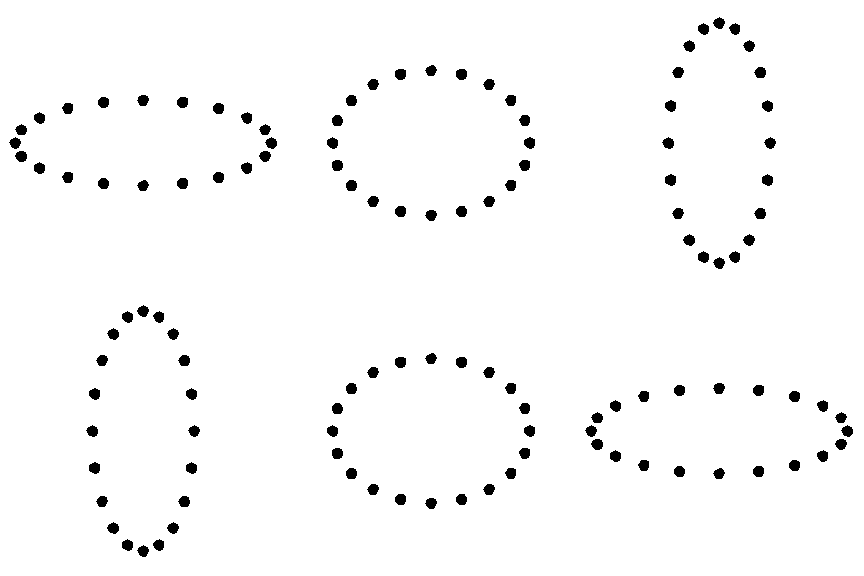
Two polarisations, called plus (+) and cross (\times), oriented at 45° to each other. This differs from light, whose two polarisations are at 90°, and the factor of two comes from the wave being described by a rank-2 tensor rather than a vector — which in quantum language means the graviton has spin 2, while the photon has spin 1.
The wave stretches space itself, not the objects in it. A rigid ruler resists the stretch through its internal electromagnetic forces, so it barely changes length, while the distance between two freely floating masses changes fully. That is why detectors use free-hanging mirrors and measure with light rather than with a rod.
Energy loss and the binary pulsar
Two masses in orbit radiate, lose energy, and spiral together. The rate:
\frac{dE}{dt} = -\frac{32}{5}\frac{G^4}{c^5}\frac{(m_1m_2)^2(m_1+m_2)}{a^5}
The a^{-5} is what makes this dramatic. Halve the separation and the radiated power goes up by a factor of 32. So the inspiral starts imperceptibly slowly and ends catastrophically fast.
Earth and Sun
m_1 = 1.99\times10^{30},\quad m_2 = 5.97\times10^{24},\quad a = 1.496\times10^{11}
Working through:
\frac{dE}{dt} \approx -200\ \text{W}
Two hundred watts. The Earth–Sun system radiates gravitational waves at the power of two light bulbs, and the resulting orbital decay is about 10^{-15} m per year. The Sun will die long before it matters.
The Hulse–Taylor binary pulsar
In 1974 Russell Hulse and Joseph Taylor found PSR B1913+16: two neutron stars, each about 1.4 solar masses, orbiting every 7.75 hours with a separation of about 2 million km. One is a pulsar, a rotating neutron star whose beam sweeps past Earth 17 times a second, which makes it a clock of extraordinary precision.
General relativity predicts the orbit should shrink, so the orbital period should decrease at:
\frac{dP}{dt} = -2.40263\times10^{-12}\ \text{s/s}
Measured:
\frac{dP}{dt} = -2.4025(3)\times10^{-12}\ \text{s/s}
Agreement to 0.2 %, and after four decades of accumulated timing the agreement is now better than 0.1 %.
This was the first proof that gravitational waves exist, obtained by watching their effect rather than the waves themselves, and it won the 1993 Nobel Prize. The orbit shrinks by about 3.5 m per year, and the two stars will merge in roughly 300 million years.
Detecting the wave itself
Why it is so hard
Estimate the strain from a merger. For two objects of mass M merging at distance r:
h \sim \frac{G M}{c^2 r}\cdot\frac{v^2}{c^2}
For 30 solar masses at 1.3 billion light years (1.2\times10^{25} m), with v \approx 0.5c near merger:
h \sim \frac{(6.674\times10^{-11})(6\times10^{31})}{(9\times10^{16})(1.2\times10^{25})}\times0.25 \approx 10^{-21}
Over LIGO's 4 km arm:
\Delta L = hL = 10^{-21}\times4000 = 4\times10^{-18}\ \text{m}
A proton is 10^{-15} m across. The measurement is a thousandth of a proton diameter, over four kilometres.
Two comparisons make it concrete. It is like measuring the distance to Alpha Centauri to within the width of a human hair. Or measuring the Earth's diameter to within a ten-thousandth of an atomic nucleus.
How LIGO does it
LIGO is a Michelson interferometer (Chapter 5.3), with everything about it pushed to a physical limit.
1. Long arms. 4 km each, at right angles. A wave stretching one arm squeezes the other, so the signal is differential and doubles.
2. Fabry–Pérot cavities. Each arm is an optical resonator in which the light bounces about 300 times before recombining, making the effective path length 1200 km. This multiplies the phase shift by 300.
3. Power recycling. The laser injects 200 W. Because the interferometer is held on a dark fringe, almost all the light comes back towards the laser, so a mirror sends it back in. The circulating power in each arm reaches 750 kW. High power matters because the fundamental noise floor at high frequency is shot noise — the random arrival statistics of photons — and its relative size falls as 1/\sqrt{N}, so more photons means a quieter measurement.
4. Seismic isolation. The mirrors hang from four-stage pendulums on an actively controlled platform. Ground motion at 10 Hz is suppressed by a factor of 10^{10}. Below about 10 Hz nothing works and that sets the low-frequency limit; space-based detectors are needed for lower frequencies.
5. Ultra-high vacuum. The beam tubes hold 10^{-9} mbar over 4 km — a total volume of 10,000 cubic metres, one of the largest vacuum systems in existence — because a fluctuating number of gas molecules would change the optical path.
6. Test masses. 40 kg fused silica cylinders, polished to an atomic-scale flatness, with dielectric coatings so good they absorb less than one photon in a million. Thermal vibration of the coating atoms is a limiting noise source, which is why the coatings are a subject of active research.
7. Two detectors, and now more. A real signal must appear at both LIGO sites within the 10 ms light travel time between them, with consistent waveforms. Virgo in Italy and KAGRA in Japan add sky localisation by triangulation.
8. Quantum squeezing. Since 2019 the detectors inject "squeezed" light, which redistributes quantum uncertainty between the phase and amplitude of the light so that the phase — the measured quantity — is quieter than the vacuum limit at the cost of a noisier amplitude. This is a direct engineering application of the uncertainty principle of Chapter 7.5.
GW150914

The signal. 0.2 seconds long, sweeping from 35 Hz to 250 Hz, with the amplitude growing and then cutting off abruptly. Detected at Livingston first and at Hanford 6.9 ms later, consistent with a wave crossing the continent at c.
The shape is called a chirp, and it is what an inspiral must look like: as the orbit shrinks, the frequency rises and the amplitude rises, both accelerating, until the two objects touch.
What the parameters are, extracted by matching against a bank of numerically computed waveforms:
| Quantity | Value |
|---|---|
| Primary mass | 36^{+5}_{-4}\,M_\odot |
| Secondary mass | 29^{+4}_{-4}\,M_\odot |
| Final black hole | 62^{+4}_{-4}\,M_\odot |
| Energy radiated | 3.0\pm0.5\,M_\odot c^2 |
| Peak power | 3.6\times10^{49} W |
| Distance | 410^{+160}_{-180} Mpc |
| Peak strain | 1.0\times10^{-21} |
Read the mass line. 36 + 29 = 65, and the final hole is 62. Three solar masses vanished, converted entirely into gravitational waves in a fifth of a second.
E = 3\times(1.989\times10^{30})\times(9\times10^{16}) = 5.4\times10^{47}\ \text{J}
The peak power, 3.6\times10^{49} W, exceeds the combined light output of every star in the observable universe — roughly 10^{49} W — by a factor of several. For that fifth of a second, this one event outshone the visible universe, and no photon was emitted at all.
How the frequency gives the masses. During the inspiral the frequency evolution depends on a single combination called the chirp mass:
\mathcal{M} = \frac{(m_1m_2)^{3/5}}{(m_1+m_2)^{1/5}}
and the relation is:
\frac{df}{dt} = \frac{96}{5}\pi^{8/3}\left(\frac{G\mathcal{M}}{c^3}\right)^{5/3}f^{11/3}
Measure f and df/dt from the recording, solve for \mathcal{M}, and the individual masses follow from the later part of the waveform. The amplitude then gives the distance, because for a known chirp mass the intrinsic strain is known and the measured strain falls as 1/r. This makes a merger a standard siren — a distance measurement requiring no calibration against anything else, which is why gravitational waves offer an independent route to the Hubble constant (Chapter 12.5).
Why the signal ends. The final black hole rings down like a struck bell, with a frequency and damping time fixed entirely by its mass and spin — the "no hair" property, which says a black hole retains no memory of what fell in beyond mass, spin and charge. The measured ringdown matched.
And nobody knew such black holes existed. Stellar black holes found by X-ray astronomy are typically 5 to 15 solar masses. A 36-solar-mass one was a surprise, and it told astrophysicists something specific: such holes form from massive stars with very low metal content, which lose less mass to stellar winds before collapsing.
What has been found since
Over 200 mergers have been catalogued through the fourth observing run, and a few stand out.
GW170817 — two neutron stars, 17 August 2017. The signal lasted 100 seconds, and 1.7 s after it ended a gamma-ray burst arrived from the same patch of sky. Within 11 hours, telescopes worldwide found the optical counterpart in galaxy NGC 4993, and seventy observatories tracked it across every wavelength.
This one event settled several questions at once. It confirmed that short gamma-ray bursts come from neutron star mergers. Its spectrum showed the signature of rapid neutron capture, and the fading glow was powered by the radioactive decay of freshly made heavy elements — establishing that mergers are a major source of the gold, platinum and uranium in the universe. Roughly ten Earth masses of gold were made in that single event. The gold in a wedding ring was made in a neutron star collision. And the 1.7 s delay gave the speed-of-gravity constraint quoted earlier.
GW190521 — 142 solar masses. The final object landed squarely in the mass range that stellar evolution says should be impossible, because stars between roughly 130 and 250 solar masses are destroyed completely by a pair-instability explosion (Chapter 12.2) and leave nothing. The likely explanation is that it was itself a merger of two earlier merger products.
GW190814 — a 2.6-solar-mass mystery object. Too heavy for the heaviest known neutron star, too light for the lightest known black hole. It sits in the "mass gap" and nobody is sure which it is.
And the pulsar timing arrays. In 2023, NANOGrav and three partner collaborations reported evidence for a stochastic background at nanohertz frequencies — a hum rather than individual chirps — by timing dozens of millisecond pulsars across the galaxy for fifteen years and finding correlated deviations. The most likely source is the combined signal of millions of supermassive black hole binaries throughout cosmic history. The galaxy is being used as a detector 10,000 light years across.
What comes next
LISA, planned for the 2030s, will be three spacecraft in a triangle 2.5 million km on a side, trailing Earth's orbit around the Sun. Freed from seismic noise, it will observe millihertz frequencies — supermassive black hole mergers, white dwarf binaries in our own galaxy, and stellar-mass objects spiralling into supermassive holes over years.
Einstein Telescope and Cosmic Explorer, ground-based, with 10–40 km arms, would see stellar-mass mergers throughout the observable universe rather than the nearby fraction.
And the prize nobody has yet claimed: primordial gravitational waves from inflation. These would be imprinted as a distinctive swirl pattern in the polarisation of the cosmic microwave background, and finding them would be direct evidence about physics at 10^{-35} seconds after the Big Bang. Chapter 12.6 explains what is at stake and why a 2014 claim to have found them turned out to be galactic dust.
Why this matters beyond the physics
Gravitational waves are a genuinely new sense. Every previous observation of the universe used electromagnetic radiation, and light is blocked by dust, absorbed by gas, and cannot escape from inside a star or from before recombination at 380,000 years after the Big Bang.
Gravitational waves pass through everything. The waves from GW150914 crossed 1.3 billion light years of intervening galaxies, gas and dust with no measurable absorption whatsoever, because the coupling that makes them so hard to detect also makes them impossible to block.
That means they can carry information from places light cannot leave: the interiors of collapsing stars, the merger of black holes, and potentially the first fraction of a second of the universe.
Where this shows up in your life
The gold and platinum in jewellery was made in neutron star mergers, and gravitational wave astronomy is how that was established.
Squeezed light, developed for LIGO, is now used in quantum sensing and quantum computing.
LIGO's mirror coatings and vibration isolation have found applications in precision manufacturing and semiconductor lithography.
And the technique of matched filtering — burying a known waveform in noise and pulling it out by correlation — is the same mathematics used in radar, in mobile phone reception, and in medical imaging.
What Part 6 established
Part 6 began with a wave that had no medium and ended with waves in spacetime itself.
Special relativity came from two postulates. Give up the idea that everybody shares one clock, and everything falls into place: the Lorentz transformation, time dilation measured on cosmic-ray muons, length contraction, the twin who returns younger, and E = mc^2 with 200 MeV coming out of every uranium nucleus that splits. Newtonian mechanics survives intact as the low-speed limit.
General relativity came from one observation — that a falling person feels no gravity. Follow it through and gravity stops being a force and becomes the shape of spacetime. Matter tells spacetime how to curve; spacetime tells matter how to move. The equation that says so, in Chapter 6.8, has ten components and one free constant, and it has produced Mercury's 43 arcseconds, light bending by 1.75″, the 38 microseconds a day in every GPS satellite, black holes, the expanding universe, and a chirp lasting a fifth of a second from 1.3 billion years ago.
Nothing in a hundred and ten years has contradicted it.
And it is incomplete. It predicts singularities where its own equations stop making sense, and it cannot be reconciled with quantum mechanics. Part 7 develops the other half of twentieth-century physics, and Part 8 confronts the fact that the two do not fit together.
What the next Part fixes
Chapter 3.7 left a hot cavity radiating infinite energy, which is absurd. Chapter 5.6 needed atoms with discrete energy levels and light in packets of hf, with no justification. Chapter 3.2 found gas heat capacities behaving as if degrees of freedom could switch off. All three are the same crack in classical physics, and Part 7 opens it. What comes through is a theory in which particles are waves, measurement changes what is measured, the universe is irreducibly probabilistic, and two particles can be correlated in a way no local description permits — and which is, by a wide margin, the most precisely tested theory in the history of science.