Appearance
1.11 — Fluids
A steel ship floats and a steel nail sinks. The ship weighs fifty thousand tonnes and the nail weighs three grams. Whatever decides this, it is not weight, and it is not the material.
A fluid is anything that flows — liquid or gas. What separates fluids from the solids of the last chapter is that they cannot resist a shearing force at all: push a solid sideways and it deforms a little and stops, push a fluid sideways and it keeps going. That single property forces a different set of tools, because you can no longer talk about the force on an object; you have to talk about the force on every square metre of its surface.
Pressure
Pressure is force per unit area, acting perpendicular to a surface:
P = \frac{F}{A}
The unit is the pascal, one newton per square metre. A pascal is tiny — a sheet of paper resting on a table exerts about one pascal — so real pressures are quoted in kilopascals or in atmospheres, where
1\ \text{atm} = 101\,325\ \text{Pa} \approx 100\ \text{kPa}
The crucial property, which distinguishes a fluid from a solid: pressure in a static fluid acts equally in all directions. A solid can push in one direction only; a fluid at a point pushes outward on everything around it with the same force per unit area. This is why a balloon inflates into a sphere and why a submarine hull is squeezed uniformly rather than crushed from above.
It is also why pressure is a scalar even though force is a vector. The pressure at a point is one number; the force it produces on a given surface is that number times the area, directed along the surface's normal.
Pressure increases with depth
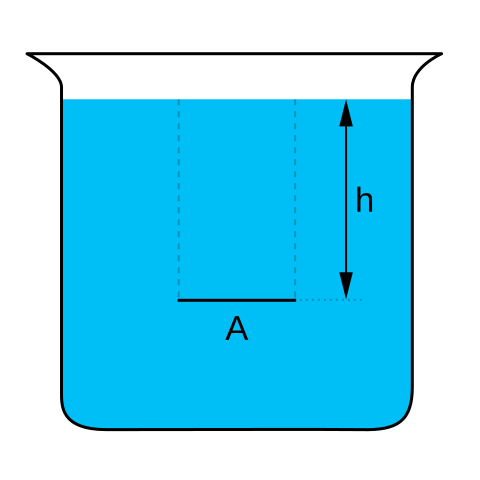
Take an imaginary column of fluid of cross-sectional area A, extending from the surface down to depth h. That column is not moving, so by Chapter 1.10's first equilibrium condition the forces on it balance.
The forces are: atmospheric pressure pushing down on the top, P_0A; the column's own weight, mg; and the pressure of the fluid below pushing up on the bottom, PA.
PA = P_0A + mg
The column's mass is its density times its volume, m = \rho V = \rho Ah:
PA = P_0A + \rho Ahg
Divide through by A:
\boxed{P = P_0 + \rho gh}
Read it plainly: the pressure at depth h is the pressure at the surface plus the weight of the fluid column above you, per unit area.
Three consequences follow immediately, and all three surprise people.
The shape of the container is irrelevant. A cancelled. A narrow tube and a wide lake filled to the same depth have identical pressure at the bottom. This is the hydrostatic paradox: a few grams of water in a thin tall tube can burst a barrel, because the pressure depends on the height of the column and not on how much water is in it. Pascal is said to have demonstrated exactly that in 1646.
Pressure is the same at every point on the same horizontal level in a connected fluid. This is why water finds its level, why a spirit level works, and why a header tank on the roof pressurises every tap in the house.
The numbers get large fast. Water has \rho = 1000\ \text{kg/m}^3, so:
\rho g = 1000\times9.81 = 9810\ \text{Pa per metre}
Ten metres of water is 98\,100 Pa, which is very nearly one atmosphere. So every 10 m of depth adds one atmosphere. A diver at 30 m is under four atmospheres total — one from the air, three from the water. This is why scuba divers must never hold their breath while ascending: air in the lungs expands as the pressure drops, and lungs tear.
The atmosphere itself is a fluid column, and its total weight per unit area is one atmosphere. Since air's density falls with height rather than staying constant, the pressure falls exponentially rather than linearly, halving roughly every 5.5 km. At the summit of Everest, 8850 m, it is about a third of sea level, which is why the air feels thin: the oxygen is the same 21% fraction, but there is a third as much of everything.
Gauge pressure versus absolute pressure
A tyre gauge reading 220 kPa is reading the pressure above atmospheric. The actual pressure inside the tyre is 220 + 101 = 321 kPa.
P_{\text{absolute}} = P_{\text{gauge}} + P_{\text{atmospheric}}
Nearly every pressure instrument reads gauge pressure, because nearly every instrument has the atmosphere on its other side. A blood pressure of "120 over 80" is 120 mmHg gauge, which is 16 kPa above atmospheric, not an absolute pressure of 16 kPa — which would be a near vacuum.
Pascal's principle and the hydraulic press
A pressure change applied anywhere in an enclosed fluid is transmitted undiminished to every point in the fluid.
This works because liquids are almost incompressible — Chapter 1.10's bulk modulus for water is 2.2 GPa, so squeezing it does not absorb the pressure, it passes it on.
Push a small piston of area A_1 with force F_1. The pressure created is P = F_1/A_1. That same pressure acts on a large piston of area A_2:
F_2 = PA_2 = F_1\frac{A_2}{A_1}
Force is multiplied by the area ratio. A car jack with a 1 cm² input piston and a 100 cm² output piston multiplies your force by 100.
Nothing is free, and the accounting is energy. The fluid is incompressible, so the volume pushed out of the small cylinder must equal the volume pushed into the large one:
A_1 d_1 = A_2 d_2 \quad\Longrightarrow\quad d_2 = d_1\frac{A_1}{A_2}
The large piston moves 100 times less far. Multiply force by 100, divide distance by 100, and the work Fd is identical on both sides. A hydraulic press is a lever made of liquid, and it obeys the same conservation law as a lever made of wood.
Every car's brakes are this device. Your foot produces perhaps 400 N; the master cylinder and the much larger caliper pistons multiply that into several kilonewtons at each wheel. It also explains why brake fluid must be kept free of air bubbles: air is compressible, so it absorbs the piston's travel instead of transmitting the pressure, and the pedal goes spongy and then to the floor.
Buoyancy and Archimedes' principle
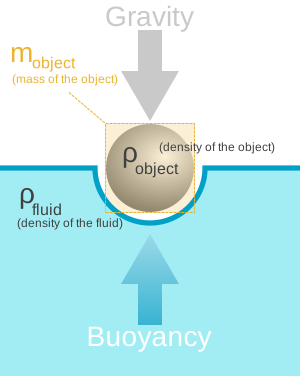
Take a rectangular block of height h and face area A, submerged with its top at depth d. The pressure on the top pushes down; the pressure on the bottom, being deeper, pushes up harder.
Downward force on the top: F_{\text{top}} = (P_0+\rho g d)A
Upward force on the bottom: F_{\text{bottom}} = (P_0+\rho g(d+h))A
The sides cancel by symmetry — each side face is matched by an opposite one at the same depths. The net upward force is the difference:
F_B = F_{\text{bottom}}-F_{\text{top}} = \rho g h A
And hA is exactly the volume of the block, which is the volume of fluid it displaced. So:
\boxed{F_B = \rho_{\text{fluid}}\,V_{\text{displaced}}\,g = W_{\text{displaced fluid}}}
The buoyant force equals the weight of the fluid displaced.
That is Archimedes' principle, and it has now been derived rather than asserted. It came out of nothing but the pressure–depth law, which came out of nothing but force balance. The derivation used a rectangular block for convenience, but the result holds for any shape: replace the object with an identically shaped blob of the fluid itself, note that the blob was in equilibrium, and conclude that the fluid around it must have been pushing up with exactly the blob's weight — and the fluid outside does not know or care what shape of thing is now sitting in that hole.
Float or sink
An object floats if the buoyant force can match its weight before it is fully submerged:
- \rho_{\text{object}} < \rho_{\text{fluid}} — floats, submerged just far enough to displace its own weight
- \rho_{\text{object}} > \rho_{\text{fluid}} — sinks
- \rho_{\text{object}} = \rho_{\text{fluid}} — hovers at any depth
Density is the whole answer, and this is what settles the ship and the nail. The nail is solid steel at 7850 kg/m³, far denser than water, so it sinks. The ship is a steel shell around an enormous volume of air, and its average density — total mass divided by total enclosed volume — is a few hundred kg/m³. The material is identical; the average density is not.
For a floating object, the fraction submerged has a clean form. At equilibrium the weight equals the buoyant force:
\rho_o V_o g = \rho_f V_{\text{sub}} g \quad\Longrightarrow\quad \frac{V_{\text{sub}}}{V_o} = \frac{\rho_o}{\rho_f}
Ice has \rho = 917\ \text{kg/m}^3 and seawater about 1025, so 917/1025 = 0.89: 89% of an iceberg is underwater, and the visible ninth is where the expression comes from.
Note also what this predicts about melting ice. A floating ice cube displaces exactly its own weight of water; when it melts it becomes exactly that weight of water, which fits precisely into the hole it was displacing. So melting sea ice does not raise sea level at all. Melting land ice — Greenland, Antarctica — does, because that water was not displacing anything.
The apparent weight trap
Submerge something and it feels lighter by exactly the buoyant force:
W_{\text{apparent}} = W - F_B
Archimedes is supposed to have used this to test a crown for gold content: weigh it in air, weigh it in water, and the ratio gives the density without melting anything down. Whether or not he shouted anything in the bath, the method works and is still used.
There is a subtlety worth knowing. You are buoyed up by air too. Air has \rho = 1.2\ \text{kg/m}^3, and a 70 kg person occupies about 0.07 m³, so the buoyant force on you is 1.2\times0.07\times9.81 = 0.82 N — you are about 84 grams lighter than you would be in a vacuum. Precision mass measurements have to correct for this, and it is why a laboratory balance certificate specifies air density.
Fluids in motion
Continuity: what goes in must come out
For an incompressible fluid in a pipe, the mass flowing past any cross-section per second must be the same everywhere, otherwise fluid would be accumulating or disappearing somewhere. So:
\boxed{A_1v_1 = A_2v_2}
Narrow the pipe and the fluid speeds up, in exact inverse proportion to the area. Halve the diameter and you quarter the area, so the speed quadruples. This is why putting a thumb over a hose nozzle makes the water shoot further, and why a river runs fast through a gorge and slow across a floodplain.
Bernoulli's equation, derived from energy
Take a fluid flowing steadily through a pipe that changes both its cross-section and its height. Apply the work–energy theorem from Chapter 1.6 to a small slug of fluid moving from point 1 to point 2.
Three energy terms are in play per unit volume, and the derivation is just the work–energy theorem written for a fluid element.
Work done by pressure. The fluid behind pushes the slug forwards with force P_1A_1 over a distance d_1, doing work P_1A_1d_1 = P_1V. The fluid ahead resists, doing work -P_2V. Net pressure work: (P_1-P_2)V.
Change in kinetic energy: \tfrac12mv_2^2 - \tfrac12mv_1^2, and with m = \rho V this is \tfrac12\rho V(v_2^2-v_1^2).
Change in gravitational potential energy: \rho Vg(y_2-y_1).
The work–energy theorem says total work equals the change in kinetic energy, and gravity's work is -\Delta U:
(P_1-P_2)V = \tfrac12\rho V(v_2^2-v_1^2) + \rho Vg(y_2-y_1)
Divide everything by V and gather the subscript-1 terms on the left:
\boxed{P_1 + \tfrac12\rho v_1^2 + \rho gy_1 = P_2 + \tfrac12\rho v_2^2 + \rho gy_2}
Or: P + \tfrac12\rho v^2 + \rho gy is constant along a streamline. This is Bernoulli's equation, published in 1738, and it is conservation of energy for a flowing fluid with every term measured per unit volume. Check the dimensions and each term is \mathrm{M\,L^{-1}\,T^{-2}}, a pressure, as it must be.
The headline consequence: at constant height, where the fluid moves faster, its pressure is lower. That is not intuition, it is bookkeeping — energy went into speed, so it had to come out of pressure.

Worked example: how fast does a tank drain?
A tank of water has a small hole in its side at depth h below the surface. How fast does water leave?
Apply Bernoulli between the top surface (point 1) and the hole (point 2). Both are open to the atmosphere, so P_1 = P_2 = P_0 and the pressure terms cancel. The tank is wide and the hole is small, so by continuity the surface drops very slowly and v_1 \approx 0.
\rho gy_1 = \tfrac12\rho v_2^2 + \rho gy_2
g(y_1-y_2) = \tfrac12 v_2^2
\boxed{v = \sqrt{2gh}}
This is Torricelli's law, from 1643, and the result is exactly the speed something would reach falling freely through height h (Chapter 1.2). It has to be: both are energy conservation, and the fluid's pressure energy at the hole has done precisely the job that gravity does for a falling stone.
What actually holds an aeroplane up
The explanation you were probably given at school says that air going over the curved top of a wing has further to travel, so it must go faster to meet the air from underneath at the trailing edge, so by Bernoulli the pressure on top is lower.
The first half of that is fine and the middle step is simply false. There is no law requiring two parcels of air that separate at the leading edge to arrive together at the back. Measurements show the air over the top arrives sooner, not simultaneously. And the explanation fails a basic test: aircraft fly inverted, and a flat plate held at an angle generates plenty of lift with no curvature at all.
What actually happens is Newton's third law from Chapter 1.4. A wing deflects a large mass of air downwards, and by the third law the air pushes the wing upwards. The wing's angle of attack and its shape both contribute to this deflection; the curvature helps by letting the air follow the surface smoothly rather than separating from it, which is what stalling is.
Bernoulli is not wrong here — the pressure on top genuinely is lower, and the pressure difference genuinely is the force on the wing. The two descriptions are the same physics from two directions: deflecting air downwards requires a pressure difference, and the pressure difference is what deflects the air. What is wrong is the "equal transit time" story used to justify the speed difference. A wing generates lift by throwing air down, and the amount of lift is the rate at which downward momentum is given to the air.
Viscosity, turbulence and terminal velocity
Real fluids have internal friction, called viscosity, and it is what Bernoulli's equation leaves out.
Viscosity is the resistance to layers of fluid sliding over one another. Honey has high viscosity, water low, air very low. It is why flow in a pipe is fastest in the middle and zero at the wall — the layer touching the wall does not move at all, which is called the no-slip condition and is observed rather than obvious.

Which regime you are in is decided by a single dimensionless number, built exactly the way Chapter 1.1 built its formulas:
\text{Re} = \frac{\rho v L}{\eta}
where \eta is the viscosity and L a characteristic size. It is the ratio of inertial effects to viscous ones. Below about 2000 the flow is smooth and layered (laminar); above about 4000 it breaks into chaotic eddies (turbulent); in between it is unpredictable.
Turbulence is, remarkably, still an unsolved problem. The equations governing fluid flow — the Navier–Stokes equations — have been known since 1845, and whether they always have smooth solutions is one of the seven Millennium Prize Problems, unclaimed since 2000. We can compute turbulent flow numerically and we cannot solve it.
Drag and terminal velocity
An object moving through a fluid feels a retarding force. At low speed and small size, where flow is laminar, the drag is proportional to speed — this is Stokes' law, F = 6\pi\eta rv for a sphere. At everyday speeds and sizes, where flow is turbulent, drag goes as the square of speed:
F_D = \tfrac12 C_D\rho A v^2
where C_D is a drag coefficient that depends on shape — about 1.0 for a flat plate, 0.47 for a sphere, 0.04 for a well-designed aerofoil, and around 0.25 for a modern car.
Falling objects therefore do not accelerate forever. Drag grows as v^2 while weight stays fixed, so there is a speed at which they balance and acceleration stops:
mg = \tfrac12C_D\rho Av_t^2 \quad\Longrightarrow\quad \boxed{v_t = \sqrt{\frac{2mg}{C_D\rho A}}}
This is terminal velocity, and it is the honest answer to Chapter 1.2's assumption of constant g.
For a skydiver of 80 kg, belly-down with A \approx 0.7\ \text{m}^2 and C_D \approx 1.0, in air of density 1.2 kg/m³:
v_t = \sqrt{\frac{2\times80\times9.81}{1.0\times1.2\times0.7}} = \sqrt{\frac{1570}{0.84}} = \sqrt{1869} = 43\ \text{m/s}
About 155 km/h, which matches reality. Pull into a head-down dive and A drops by a factor of four or so, taking v_t up past 300 km/h. Open a parachute and A jumps by a factor of fifty, dropping v_t to about 6 m/s — a survivable landing, and the whole design brief of a parachute in one equation.
The same formula explains why small things survive falls. Weight goes as volume, L^3, while drag area goes as L^2, so v_t \propto \sqrt{L}. A mouse, being a tenth the size of a cat, has a terminal velocity about a third as high and lands with a ninth of the energy per kilogram. J.B.S. Haldane put it memorably in 1926: drop a mouse down a thousand-yard mine shaft and it walks away; a rat is killed, a man is broken, and a horse splashes.
Surface tension
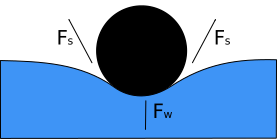
Molecules in a liquid attract each other. A molecule deep inside is pulled equally in all directions and feels no net force. A molecule at the surface has no neighbours above it, so it is pulled inward. The result is that the surface behaves like a stretched elastic skin, and the liquid acts to make its surface area as small as it can.
Surface tension \gamma is measured as energy per unit area, or equivalently force per unit length. Water's is unusually high at 0.073\ \text{N/m}, because of hydrogen bonding (Chapter 10.3).
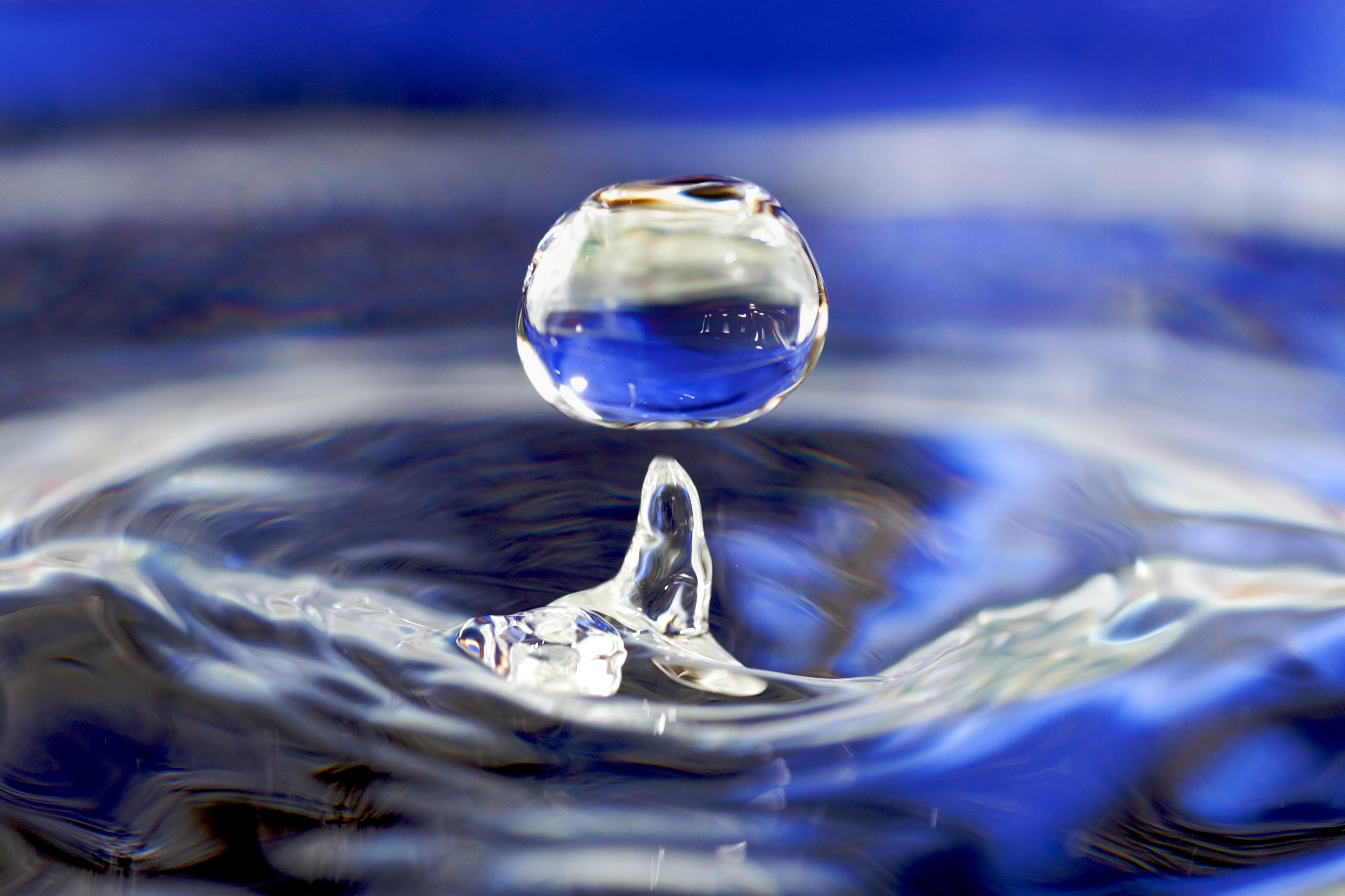
Consequences you can see:
Drops are spherical, because a sphere has the smallest surface area for a given volume.
Small insects walk on water. A pond skater's weight is supported by the surface deforming rather than breaking. This works only at small scale: weight goes as L^3 and the supporting force as L, so a beetle twice as long has eight times the weight and twice the support.
Pressure inside a bubble is higher than outside, by \Delta P = 4\gamma/r for a soap bubble with two surfaces, or 2\gamma/r for a drop with one. Note the 1/r: smaller bubbles have higher internal pressure, which is why when two bubbles merge the small one empties into the large one rather than the other way round.
That last fact is medically important. Your lungs contain about 300 million alveoli, tiny sacs of varying size. Left alone, surface tension would make every small one collapse into the larger ones and your lungs would fail. They do not, because the lungs secrete a surfactant that lowers surface tension, and lowers it more when the alveolus is small. Premature babies sometimes cannot make it yet, which causes infant respiratory distress syndrome — and the treatment is to give them artificial surfactant, an intervention that came directly from this piece of physics.
Capillary action is surface tension plus wetting. If a liquid attracts a tube's wall more strongly than itself, it climbs, to a height h = 2\gamma\cos\theta/(\rho g r) — inversely proportional to the tube radius, so narrower tubes lift further. This is how paper towels work, how ink moves through a nib, and part of how water reaches the top of a tall tree, though a redwood also needs the evaporation-driven tension in its water column to reach 100 m.
Where this shows up in your life
Your blood pressure of "120 over 80" is measured in millimetres of mercury because the original instrument was a mercury column, and \rho gh converts it: 120 mmHg is 13\,600\times9.81\times0.120 = 16\,000 Pa. It is measured at the arm because the arm is at heart height. Measure at the ankle while standing and you would add about 1.2 m of blood column, roughly 90 mmHg more, which is why standing up too fast makes you dizzy — the pressure at your head drops correspondingly.
A siphon works because the water leaving the lower end is at greater depth than the water entering the top, so the pressure difference drives the flow, and the tube keeps the column continuous. It stops if a bubble breaks the column, and it will not lift water more than about 10 m at sea level, because that is the height at which \rho gh equals one atmosphere and the water column simply pulls apart.
And every weather forecast is Bernoulli plus buoyancy plus the Coriolis effect from Chapter 1.5. Warm air is less dense, so it rises by exactly Archimedes' principle; that rising air lowers the pressure below it; air flows in to fill the gap and is deflected by the Earth's rotation into a spiral. A cyclone is this chapter and the last one, running on a planetary scale.
What the next chapter fixes
Part 1 has now covered motion, force, energy, momentum, rotation, gravity, structures and fluids — everything you need for objects that go somewhere and stay there. What it has not covered is the enormous class of motion that goes nowhere: things that swing, vibrate, bounce and repeat. That behaviour turns out to be governed by a single differential equation which shows up in a pendulum, a guitar string, an atom, a bridge in a crosswind and an electrical circuit. Part 2 starts with that equation, solves it completely, and then follows it into waves and sound.