Appearance
5.4 — Diffraction and the Limit of Every Instrument
Make the slit narrower and you expect the beam of light through it to get narrower. It does — down to a point. Squeeze past about a hundredth of a millimetre and the beam starts spreading out again, and keeps spreading more the narrower you make the slit.
That spreading is diffraction, and it is not a defect of the apparatus. It is what waves do at edges, and it sets a hard ceiling on every optical instrument that has ever been built or ever will be. The smallest thing a microscope can show you, the closest double star a telescope can split, the finest line a chip factory can print, and the sharpness of the photograph on your phone are all limited by the same calculation.
Why a wave spreads at an edge
Christiaan Huygens proposed in 1678 that every point on a wavefront acts as a source of new spherical wavelets, and the next wavefront is the envelope of all of them. For a wide, unobstructed wavefront the wavelets reinforce forwards and cancel sideways, so the wave travels straight — which is why ray optics works at all.
Block most of the wavefront with a screen and leave a small opening. Now there are no wavelets to the sides doing the cancelling, so the surviving wavelets spread. The narrower the opening, the fewer wavelets, the less cancellation, the wider the spread.
The scale that decides everything is the ratio \lambda/a, the wavelength divided by the aperture. When the aperture is enormously larger than the wavelength, spreading is negligible and light travels in straight lines. When they are comparable, the wave spreads over a wide angle.
This is why you can hear round a corner but not see round one. A doorway is about 1 m wide. Sound at 300 Hz has \lambda \approx 1.1 m, so \lambda/a \approx 1 and it diffracts through a large angle. Light has \lambda \approx 5\times10^{-7} m, so \lambda/a \approx 5\times10^{-7} and it does not bend measurably. Same physics, ratio different by a factor of two million.
The single slit, derived

The result is surprising: the way to find the dark fringes is to divide the slit into pairs of points that cancel each other.
Take a slit of width a. Look at light leaving at angle \theta.
Split the slit into two halves. Pair each point in the top half with the point exactly a/2 below it. Every such pair has a path difference of (a/2)\sin\theta.
If that path difference is exactly half a wavelength, every pair cancels, and since the pairing covers the whole slit, the total is zero:
\frac{a}{2}\sin\theta = \frac{\lambda}{2} \quad\Longrightarrow\quad a\sin\theta = \lambda
Now split into four quarters and pair each point with the one a/4 below. Cancellation when (a/4)\sin\theta = \lambda/2, giving a\sin\theta = 2\lambda.
Continuing with six, eight and more parts gives the general condition for dark fringes:
\boxed{a\sin\theta = m\lambda, \qquad m = \pm1, \pm2, \pm3,\dots}
Note that m = 0 is excluded. At \theta = 0 every wavelet arrives in phase and you get the central maximum, not a minimum.
Be careful not to confuse this with the double slit. For two slits, d\sin\theta = m\lambda gives bright fringes. For one slit, a\sin\theta = m\lambda gives dark ones. Same-looking equation, opposite meaning, because in one case you are adding two sources and in the other you are cancelling a continuous set of them.
The central maximum
The first minima sit at \sin\theta = \pm\lambda/a, so the central bright band spans:
\text{angular width} = \frac{2\lambda}{a}
and on a screen at distance L, its physical width is:
w = \frac{2\lambda L}{a}
Halve the slit and the central band doubles in width. That is the counterintuitive result from the opening paragraph, now with a formula.
The central maximum is twice as wide as any of the side maxima and carries about 90 % of the total light. The side maxima fall off quickly: the first is about 4.7 % of the central peak, the second 1.7 %.
Worked example
Light of 633 nm from a helium–neon laser passes through a slit 0.10 mm wide onto a screen 3.0 m away. How wide is the central band?
w = \frac{2\lambda L}{a} = \frac{2(633\times10^{-9})(3.0)}{0.10\times10^{-3}} = \frac{3.798\times10^{-6}}{1.0\times10^{-4}} = 3.8\times10^{-2}\ \text{m}
3.8 cm — from a slit a tenth of a millimetre wide. The beam has spread by a factor of 380.
Now narrow the slit to 0.010 mm:
w = \frac{3.798\times10^{-6}}{1.0\times10^{-5}} = 0.38\ \text{m}
38 cm. Ten times narrower, ten times wider.
Circular apertures and the Airy disc
Real instruments have round holes, not slits. The mathematics is harder — it involves a Bessel function rather than a sine — but the structure is the same: a bright central disc surrounded by faint rings.
The central disc is the Airy disc, after George Biddell Airy who solved it in 1835. Its first dark ring is at:
\boxed{\sin\theta = 1.22\frac{\lambda}{D}}
where D is the aperture diameter. The only difference from the slit is the factor 1.22, which comes from the circular geometry.
This is the number that limits every telescope, microscope and camera. A point source — a star, a fluorescent molecule, a distant streetlight — cannot be imaged as a point. It is always an Airy disc of angular radius 1.22\lambda/D, no matter how perfect the optics.
The Rayleigh criterion
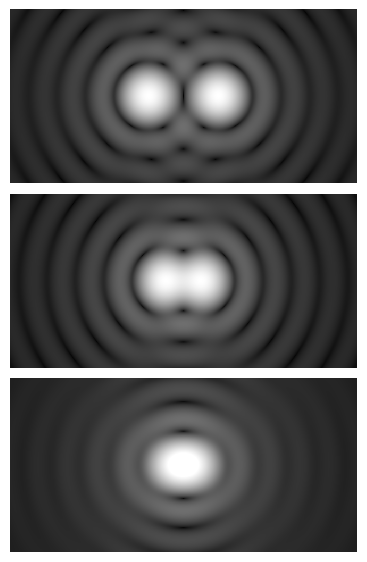
Two point sources produce two overlapping Airy discs. How close can they be and still be told apart?
Lord Rayleigh's criterion: they are just resolved when the centre of one disc falls on the first dark ring of the other:
\boxed{\theta_{\min} = 1.22\frac{\lambda}{D}}
The criterion is a convention rather than a law of physics — with high signal-to-noise and known optics you can do somewhat better — but it is the standard, and it captures the physics exactly: resolution improves with a bigger aperture and with a shorter wavelength, and with nothing else.
Read that again, because it disposes of a common misconception. Magnification does not improve resolution. Once two things are inside one Airy disc, no amount of enlargement separates them. You get a bigger blur. This is what "empty magnification" means, and it is why the 500×-on-a-60mm-telescope from Chapter 5.2 is a lie.
Worked example: the human eye
Pupil diameter in daylight is about 2 mm; take \lambda = 550 nm.
\theta_{\min} = 1.22\frac{550\times10^{-9}}{2.0\times10^{-3}} = 3.36\times10^{-4}\ \text{rad}
Convert to arcminutes: 3.36\times10^{-4}\times(180/\pi)\times60 = 1.15'.
About one arcminute, and this matches measured human visual acuity almost exactly. Normal 20/20 vision is defined as resolving one arcminute.
Two consequences. At 10 m you can just separate two objects 10\times3.36\times10^{-4} = 3.4 mm apart. And the spacing of cone cells in the fovea is about 2 μm, which subtends almost exactly this angle at the eye's focal length of 17 mm — the retina is built to precisely the resolution the pupil can deliver, and no finer. Evolution stopped adding cones at the point where diffraction made more of them useless.
Worked example: telescopes
The Hubble Space Telescope has D = 2.4 m:
\theta_{\min} = 1.22\frac{550\times10^{-9}}{2.4} = 2.80\times10^{-7}\ \text{rad} = 0.058''
0.058 arcseconds, about 20,000 times better than the eye.
Ground telescopes are much larger and usually do worse. A 10 m telescope should reach 0.014″, but atmospheric turbulence smears images to about 1″ at a good site. That gap is why Hubble was built at all, and why every large ground telescope now uses adaptive optics: a deformable mirror, adjusted hundreds of times a second by measuring the distortion on a reference star, which recovers most of the theoretical resolution.
Radio telescopes have a terrible time of it. At \lambda = 21 cm — the hydrogen line, the most important wavelength in radio astronomy — a 100 m dish gives:
\theta_{\min} = 1.22\frac{0.21}{100} = 2.6\times10^{-3}\ \text{rad} = 8.8'
Nine arcminutes — worse than the naked eye, from a dish the size of a football pitch. The wavelength is 400,000 times longer than visible light, and D cannot compensate.
The fix is interferometry: combine signals from widely separated dishes, and the resolution is set by the separation rather than the dish size. The Event Horizon Telescope combined dishes across the whole planet, giving an effective D of about 10,000 km at \lambda = 1.3 mm:
\theta_{\min} = 1.22\frac{1.3\times10^{-3}}{1.0\times10^{7}} = 1.6\times10^{-10}\ \text{rad} = 33\ \mu\text{as}
Thirty-three microarcseconds — the angle a coin on the Moon would subtend. That is how the black hole in M87 was imaged in 2019, and Chapter 12.3 discusses what the picture shows.
Worked example: microscopes
For a microscope the relevant form of the limit is:
d_{\min} = \frac{0.61\lambda}{n\sin\alpha} = \frac{0.61\lambda}{\text{NA}}
where NA is the numerical aperture, n\sin\alpha, with \alpha the half-angle of the cone of light collected and n the index of the medium between specimen and lens.
For a good dry objective, NA = 0.95, and with \lambda = 500 nm:
d_{\min} = \frac{0.61\times500}{0.95} = 321\ \text{nm}
Oil immersion raises this. Put oil with n = 1.5 between the specimen and the lens and NA can reach 1.4:
d_{\min} = \frac{0.61\times500}{1.4} = 218\ \text{nm}
About 200 nm is the hard limit of light microscopy, and it has been known since Ernst Abbe formulated it in 1873. A bacterium at 1 μm is comfortably visible. A virus at 100 nm is not. A protein at 5 nm is hopelessly beyond it.
Two ways round it exist and both won Nobel Prizes.
Electron microscopy replaces light with electrons, whose wavelength (Chapter 7.2) at 100 keV is about 0.004 nm. In practice lens aberrations limit resolution to around 0.05 nm, which is atomic.
Super-resolution fluorescence microscopy, the 2014 chemistry Nobel, cheats rather than beats the limit. If only a few isolated fluorescent molecules are switched on at a time, each produces one Airy disc, and the centre of that disc can be located to a few nanometres even though its width is 200 nm. Repeat with different random subsets and build the image up. The diffraction limit is untouched; what changed is that you never have two sources inside one disc at the same moment.
Diffraction gratings
Instead of one or two slits, use thousands, evenly spaced by d.

The condition for a bright line is the same as for two slits:
\boxed{d\sin\theta = m\lambda}
What changes is the sharpness. With two slits, moving slightly away from the peak puts them slightly out of step and the intensity falls gradually. With N slits, a small departure means slit 1 and slit N are wildly out of step, and the sum over all N collapses to nearly zero almost immediately. The maxima become very narrow lines, and their width goes as 1/N.
Resolving power — the ability to separate two nearly equal wavelengths — is:
\frac{\lambda}{\Delta\lambda} = mN
Worked number. A grating with 600 lines/mm, illuminated over 3 cm, has N = 18{,}000 lines. In second order:
\frac{\lambda}{\Delta\lambda} = 2\times18000 = 36{,}000
At 589 nm that resolves \Delta\lambda = 589/36000 = 0.016 nm. The two sodium D lines are 0.6 nm apart, so this grating separates them nearly forty times over.
This is how we know what stars are made of. Every element has a unique set of spectral lines (Chapter 7.1 explains why). Spread starlight with a grating, measure the line wavelengths, and you identify the elements — and from their Doppler shifts (Chapter 2.5) you get the star's velocity, and from line broadening its temperature and pressure and rotation. Helium was discovered in the Sun's spectrum in 1868, twenty-seven years before it was found on Earth, and named after Helios for that reason.
CDs and DVDs are reflection gratings. A CD's track pitch is 1.6 μm, giving 625 tracks per mm, which is squarely in grating territory for visible light. Tilt one and different wavelengths satisfy d\sin\theta = m\lambda at different angles, which is the rainbow you see. A DVD has 0.74 μm pitch and a Blu-ray 0.32 μm, so their colours are spread differently — you can tell the format by the colour pattern.
Diffraction in ordinary life
Why streetlights have spikes in photographs. A camera's aperture is a polygon formed by blades, and light diffracts at each straight edge, producing a streak perpendicular to it. An even number of blades gives that many spikes (each edge and its opposite produce the same streak); an odd number gives twice as many. Six blades give six spikes, seven blades give fourteen.
Why the Sun has spikes in telescope images. Big telescopes hold the secondary mirror on four thin struts, and each strut diffracts, giving the familiar four-pointed stars in Hubble images. They are an artefact of the support structure, not a property of the star.
Why the Moon sometimes has a coloured ring. Thin cloud contains water droplets of fairly uniform size, each of which diffracts light into rings whose radius depends on wavelength. That is a corona, and the tighter the ring, the larger the droplets.
Why your phone camera stops improving with more megapixels. A phone sensor's pixels are about 1 μm. The lens has an aperture around f/1.8, and the Airy disc diameter for an f-number N is roughly 2.44\lambda N = 2.44\times0.55\times1.8 = 2.4 μm. The blur is already larger than two pixels. Adding more, smaller pixels records the same blur in finer detail and gains nothing real. This is the diffraction limit arriving in consumer electronics.
Why photographs get softer at f/22. Stopping down reduces aberrations and increases depth of field, and it also increases the Airy disc, since a larger f-number means a smaller aperture. Every lens has a sweet spot — usually f/5.6 to f/8 — where the two effects balance.
Why chip fabrication is so hard. Photolithography prints circuit patterns by projecting light through a mask, and the smallest printable feature is set by exactly this limit. The industry moved from 436 nm to 365 nm to 248 nm to 193 nm ultraviolet, then spent twenty years extracting more from 193 nm using immersion in water (raising NA) and multiple patterning, and finally moved to 13.5 nm extreme ultraviolet — which requires a vacuum, because air absorbs it, and mirrors instead of lenses, because nothing transmits it. A single EUV machine costs around 150 million dollars, and the reason it exists is the equation d_{\min} = k\lambda/\text{NA}.
Where this shows up in your life
Every photograph you have ever taken is diffraction-limited somewhere, and on a phone it is limited almost everywhere.
Spectroscopy — grating-based — is behind pulse oximeters, blood analysers, food quality testing, forensic drug identification, and the atmospheric measurements that track carbon dioxide concentration.
Holographic security stickers on banknotes and credit cards are diffraction gratings with spatially varying spacing, producing an image that shifts as you tilt it and is very hard to photocopy.
The 200 nm limit of light microscopy is why medicine could see bacteria from the 1670s and could not see viruses until the electron microscope arrived in the 1930s. Everything known about viral structure came after that.
What the next chapter fixes
Chapter 4.7 established that light is a transverse wave, which means the field can oscillate in either of two independent directions perpendicular to travel. Nothing so far has used that fact. It turns out to explain why the sky is blue and the sunset red, why polarised sunglasses cut glare off water but not off metal, how every LCD screen produces an image, and how photographers darken a sky without touching the clouds. Chapter 5.5 takes the second direction seriously.