Appearance
6.9 — The Schwarzschild Solution: Black Holes, Mercury and GPS
In December 1915, weeks after Einstein published the field equations, a letter arrived from the Russian front. Karl Schwarzschild, a 42-year-old astronomer serving in the German artillery, had solved them exactly for the spacetime around a spherical mass.
Einstein had not expected an exact solution to exist. He replied that he had not thought the problem could be attacked so simply. Schwarzschild died four months later of an autoimmune disease contracted in the trenches.
His solution is the most useful equation in gravitational physics. It describes the space around the Sun, the Earth, a neutron star and a black hole, and everything in this chapter comes out of it.
The solution
For empty space outside a spherical, non-rotating, uncharged mass M:
\boxed{ds^2 = \left(1-\frac{r_s}{r}\right)c^2dt^2 - \frac{dr^2}{1-\frac{r_s}{r}} - r^2\left(d\theta^2+\sin^2\theta\,d\phi^2\right)}
where:
\boxed{r_s = \frac{2GM}{c^2}}
is the Schwarzschild radius.
Read the pieces. Chapter 6.7 explained that ds^2 is the invariant interval and that the coefficients are the metric. Here:
- g_{00} = 1-r_s/r multiplies the time term. Far away it is 1 and time runs normally. Closer in it shrinks, and time runs slow.
- g_{rr} = -1/(1-r_s/r) multiplies the radial term. It grows as you approach, meaning radial distances stretch.
- The angular part r^2(d\theta^2+\sin^2\theta\,d\phi^2) is exactly the sphere metric from Chapter 6.7, unchanged. Angles are untouched by gravity, which is why r can be defined cleanly: it is the radius such that the sphere at that radius has area 4\pi r^2.
Check the limit. Set M = 0, so r_s = 0:
ds^2 = c^2dt^2 - dr^2 - r^2d\Omega^2
which is flat Minkowski spacetime in spherical coordinates. The solution reduces to special relativity when the mass is removed. ✔
Check the far field. For r \gg r_s, expand g_{00}:
g_{00} = 1-\frac{2GM}{rc^2} = 1 + \frac{2\phi}{c^2}
with \phi = -GM/r, which is exactly what the Newtonian limit of Chapter 6.8 required. ✔
Birkhoff's theorem, proved in 1923, makes this far more powerful than it looks: the Schwarzschild metric is the only spherically symmetric vacuum solution. So it applies outside any spherical mass whatever it is doing inside — pulsating, collapsing, exploding — as long as the pulsation stays spherical. This is the general-relativistic version of the shell theorem from Chapter 1.9, and it has a consequence worth stating: a spherically pulsating star radiates no gravitational waves.
Schwarzschild radii
r_s = \frac{2GM}{c^2} = 2.95\ \text{km}\times\frac{M}{M_\odot}
| Object | Mass | r_s | Actual radius |
|---|---|---|---|
| Earth | 5.97\times10^{24} kg | 8.9 mm | 6371 km |
| Sun | 1.99\times10^{30} kg | 2.95 km | 696,000 km |
| Sagittarius A* | 4.3\times10^{6}\,M_\odot | 12.7 million km | — |
| M87* | 6.5\times10^{9}\,M_\odot | 19 billion km | — |
The Earth's Schwarzschild radius is 9 millimetres. Compress the entire planet to the size of a marble and it becomes a black hole. The Sun's is 3 km.
Worked derivation of r_s from Newtonian physics, which gives the right answer for the wrong reason and is worth knowing. Set escape velocity (Chapter 1.9) equal to c:
v_{\text{esc}} = \sqrt{\frac{2GM}{r}} = c \quad\Longrightarrow\quad r = \frac{2GM}{c^2}
Identical. John Michell did this calculation in 1783 and Laplace independently in 1796, both concluding that a sufficiently compact star would trap its own light. They called them dark stars. The agreement is a coincidence in the sense that the Newtonian reasoning is invalid — light does not slow down and fall back — but the number is right.
The event horizon
At r = r_s, the metric misbehaves: g_{00} \to 0 and g_{rr} \to \infty.
Is this a real physical singularity, or a coordinate artefact like the north pole?
A coordinate artefact. Compute the curvature invariant, a coordinate-independent number built from the Riemann tensor of Chapter 6.7:
R_{\mu\nu\rho\sigma}R^{\mu\nu\rho\sigma} = \frac{48G^2M^2}{c^4r^6}
At r = r_s this is 48G^2M^2/(c^4r_s^6) — finite. Nothing physical blows up. In 1958 David Finkelstein exhibited coordinates in which the horizon is perfectly smooth, settling the question that had confused people for forty years.
At r = 0 the same invariant diverges. That singularity is real.
What the horizon actually is. Look at g_{00} = 1-r_s/r and what it does to time. The relationship between proper time at radius r and coordinate time far away is:
d\tau = \sqrt{1-\frac{r_s}{r}}\,dt
At r = r_s, d\tau = 0. For a distant observer, a clock at the horizon has stopped.
And light escaping is redshifted by:
\frac{\lambda_\infty}{\lambda_{\text{emitted}}} = \frac{1}{\sqrt{1-r_s/r}}
which goes to infinity at the horizon. Infinite redshift means zero energy arriving: nothing gets out.
Falling in: two irreconcilable stories
What a distant observer sees. An astronaut falling towards the horizon appears to slow, their light reddens and dims, and their image freezes at the horizon and fades. Compute the time:
t = \frac{2r_s}{c}\ln\left(\frac{r-r_s}{\text{const}}\right) \to \infty
They never quite arrive, and their image dims exponentially with a timescale of r_s/c — 20 microseconds for a solar-mass hole — so in practice they vanish immediately.
What the astronaut experiences. Proper time is finite. Falling from rest at r_0:
\tau = \frac{\pi}{2}\sqrt{\frac{r_0^3}{2GM}}
For a solar-mass black hole, falling from 10r_s takes about 0.2 milliseconds. They cross the horizon and notice nothing locally — the equivalence principle says a freely falling observer feels no gravity, and the horizon is not a place, it is a boundary of what can be signalled.
Both accounts are correct. They are statements in different coordinate systems about different questions. The distant observer is asking "when does light from the astronaut reach me", and the answer is never. The astronaut is asking "what does my watch read", and the answer is 0.2 ms.
Spaghettification
The tidal force — which Chapter 6.7 identified as curvature — stretches a falling body along the radial direction and squeezes it transversely:
\Delta g = \frac{2GM\ell}{r^3}
for a body of length \ell.
Worked number: a solar-mass black hole. At the horizon, r = 2950 m, for a 2 m person:
\Delta g = \frac{2(6.674\times10^{-11})(1.99\times10^{30})(2)}{(2950)^3} = \frac{5.31\times10^{20}}{2.57\times10^{10}} = 2.07\times10^{10}\ \text{m/s}^2
Two billion g. You are torn apart thousands of kilometres before reaching the horizon.
Now a supermassive one, M87* at 6.5\times10^9\,M_\odot, r_s = 1.92\times10^{13} m:
\Delta g = \frac{2(6.674\times10^{-11})(1.29\times10^{40})(2)}{(1.92\times10^{13})^3} = \frac{3.44\times10^{30}}{7.08\times10^{39}} = 4.9\times10^{-10}\ \text{m/s}^2
Utterly negligible. You cross the horizon of a supermassive black hole without feeling anything at all.
The counterintuitive rule: bigger black holes are gentler. Tidal force at the horizon goes as M/r_s^3 \propto 1/M^2. This matters for Chapter 12.3's discussion of what happens to matter falling into quasars.
The photon sphere and the innermost stable orbit
Orbits in Schwarzschild spacetime differ from Newtonian ones in ways that matter.
The photon sphere at r = 1.5r_s. Here light orbits in a circle. Shine a torch sideways at that radius and the beam goes round and comes back and hits you in the back of the head. The orbit is unstable — the slightest perturbation sends the photon in or out — but its existence produces the bright ring in the black hole images of Chapter 12.3.
The innermost stable circular orbit (ISCO) at r = 3r_s. Inside this radius, no stable circular orbit exists at all. In Newtonian gravity you can orbit at any radius; here, below 3r_s, any orbit spirals in.
This is why accretion discs have an inner edge, and it is the source of the enormous efficiency mentioned in Chapter 6.4. Matter spirals inwards through the disc, radiating as it goes, until it reaches the ISCO and then plunges. The binding energy released getting to the ISCO is:
\frac{\Delta E}{mc^2} = 1-\sqrt{\frac{8}{9}} = 0.057
5.7 % of rest mass for a non-rotating hole — seven times better than fusion's 0.7 %. For a maximally rotating Kerr black hole, the ISCO moves inwards and the figure rises to 42 %, which is why quasars are the brightest steady objects in the universe.
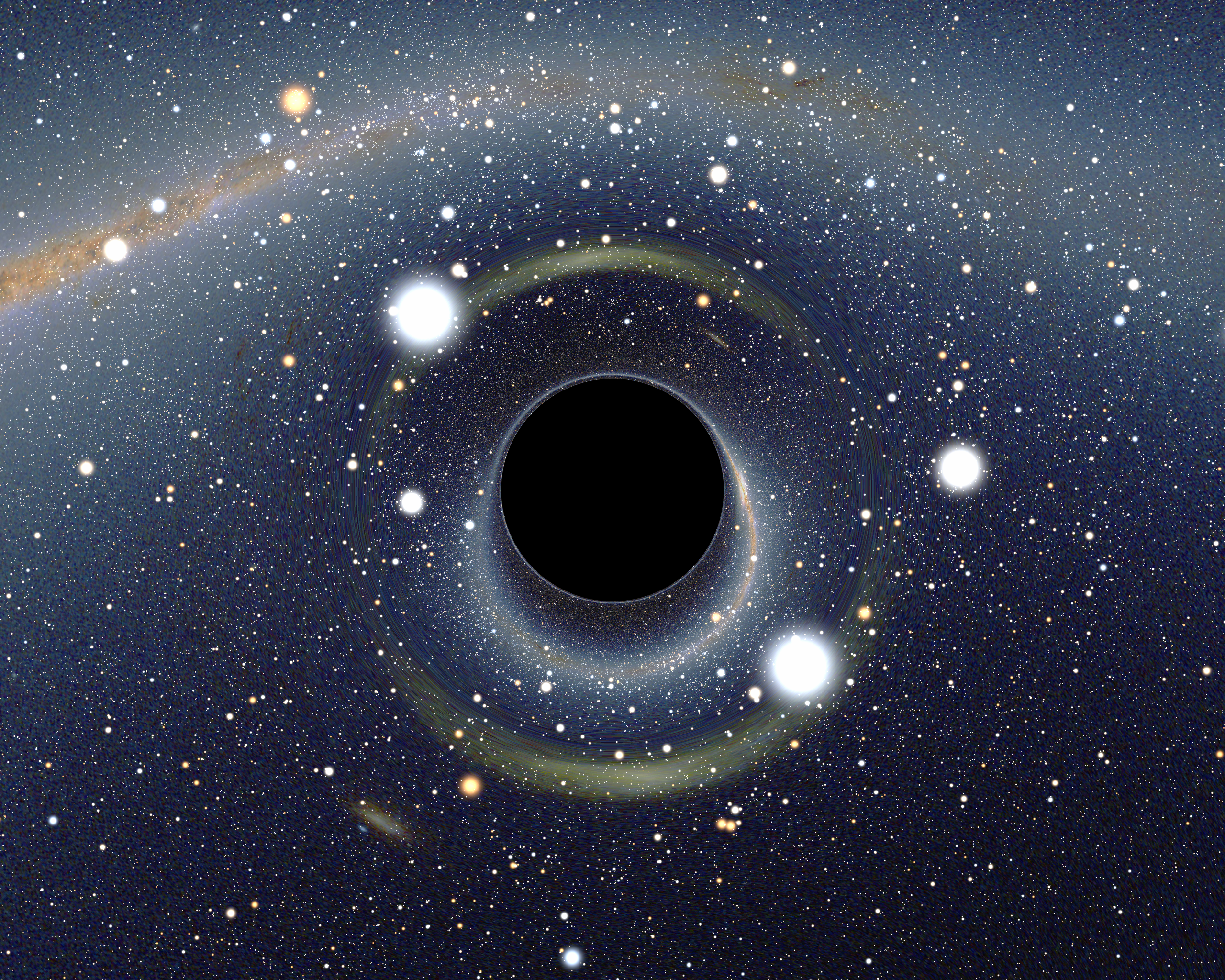
The dark disc in that image is \sqrt{27}/2 \approx 2.6 Schwarzschild radii in radius — larger than the horizon, because rays that would have missed a Newtonian object are bent in. This apparent size is what the Event Horizon Telescope measured.
Mercury's perihelion: the 43 arcseconds
This is the calculation that convinced Einstein his theory was right, and it is worth doing properly.
The problem
Newton's inverse-square law gives closed ellipses. That is a special property of the exponent 2 — Bertrand's theorem says only 1/r^2 and r forces give closed orbits. Any deviation makes the ellipse precess: the perihelion, the closest point, shifts a little each orbit.
Mercury's perihelion advances by 5600 arcseconds per century as observed. Almost all of it is accounted for:
| Source | Arcsec/century |
|---|---|
| Precession of Earth's equinoxes (a coordinate effect) | 5025 |
| Pull of Venus | 277 |
| Pull of Jupiter | 153 |
| Pull of Earth | 90 |
| Other planets | 11 |
| Total predicted by Newton | 5557 |
| Observed | 5600 |
| Unexplained | 43 |
Urbain Le Verrier found this discrepancy in 1859. He had already discovered Neptune by exactly this method — an unexplained residual in Uranus's orbit — so he proposed another planet, closer to the Sun, and named it Vulcan. It was searched for intensively for fifty years and does not exist.
The derivation
The orbit equation in general relativity is obtained from the geodesic equation in the Schwarzschild metric. Two conserved quantities come from the metric's symmetries — energy from its independence of t, angular momentum from its independence of \phi:
E = \left(1-\frac{r_s}{r}\right)c^2\frac{dt}{d\tau}, \qquad L = r^2\frac{d\phi}{d\tau}
Substituting into the interval and writing u = 1/r gives, after some algebra:
\boxed{\frac{d^2u}{d\phi^2}+u = \frac{GM}{L^2} + \frac{3GM}{c^2}u^2}
Compare with Newton, which gives:
\frac{d^2u}{d\phi^2}+u = \frac{GM}{L^2}
One extra term, 3GMu^2/c^2, and everything follows from it.
Step 1: the Newtonian solution. With only the constant term, the solution is:
u_0 = \frac{GM}{L^2}\left(1+e\cos\phi\right)
which is the equation of an ellipse of eccentricity e with perihelion at \phi = 0. It returns to perihelion after exactly 2\pi: a closed orbit.
Step 2: treat the extra term as a small correction. Substitute u_0 into the small term:
\frac{3GM}{c^2}u_0^2 = \frac{3GM}{c^2}\left(\frac{GM}{L^2}\right)^2\left(1+e\cos\phi\right)^2
Expand the square: 1 + 2e\cos\phi + e^2\cos^2\phi. The constant terms only shift the orbit's size slightly; the \cos^2 term averages out. The term that matters is 2e\cos\phi, because it drives the equation at its own resonant frequency, and a resonantly driven oscillator's response grows steadily rather than staying bounded.
Step 3: solve the driven equation. For:
\frac{d^2u_1}{d\phi^2}+u_1 = A\cos\phi
the resonant solution is u_1 = \frac{A}{2}\phi\sin\phi, with \phi appearing outside the trigonometric function — the signature of resonance.
Adding it to the Newtonian solution:
u \approx \frac{GM}{L^2}\left[1+e\cos\phi + \frac{3G^2M^2e}{c^2L^2}\phi\sin\phi\right]
Step 4: recognise the result as a slowly rotating ellipse. Using \cos(\phi-\delta) \approx \cos\phi + \delta\sin\phi for small \delta, the bracket is:
1 + e\cos\left[\phi\left(1-\frac{3G^2M^2}{c^2L^2}\right)\right]
So perihelion recurs not at \phi = 2\pi but at:
\phi = \frac{2\pi}{1-\frac{3G^2M^2}{c^2L^2}} \approx 2\pi\left(1+\frac{3G^2M^2}{c^2L^2}\right)
The advance per orbit is:
\Delta\phi = \frac{6\pi G^2M^2}{c^2L^2}
Using L^2 = GMa(1-e^2) for an ellipse of semi-major axis a:
\boxed{\Delta\phi = \frac{6\pi GM}{c^2a(1-e^2)}}
Putting the numbers in
Mercury: a = 5.791\times10^{10} m, e = 0.2056, M_\odot = 1.989\times10^{30} kg.
1-e^2 = 1-0.04227 = 0.95773
GM = (6.674\times10^{-11})(1.989\times10^{30}) = 1.3275\times10^{20}
\Delta\phi = \frac{6\pi(1.3275\times10^{20})}{(8.988\times10^{16})(5.791\times10^{10})(0.95773)}
Numerator: 6\pi\times1.3275\times10^{20} = 2.5022\times10^{21}.
Denominator: (8.988\times10^{16})(5.791\times10^{10}) = 5.204\times10^{27}, times 0.95773 = 4.984\times10^{27}.
\Delta\phi = \frac{2.5022\times10^{21}}{4.984\times10^{27}} = 5.020\times10^{-7}\ \text{rad per orbit}
Convert to arcseconds per century. Mercury's year is 87.969 days, so orbits per century:
N = \frac{36525}{87.969} = 415.2
\Delta\phi_{\text{century}} = (5.020\times10^{-7})(415.2) = 2.084\times10^{-4}\ \text{rad}
= 2.084\times10^{-4}\times206265 = 43.0''
\boxed{43.0\ \text{arcseconds per century}}
Observed: 43.1 \pm 0.1.
Einstein wrote to a friend that for a few days he was "beside himself with joyous excitement". This was not a fitted parameter — the formula contains only G, M, c, a and e, all known independently — and it resolved a fifty-six-year-old anomaly exactly.
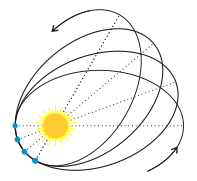
Other bodies precess too, and all have been measured: Venus 8.6″/century, Earth 3.8″, and the asteroid Icarus 10.0″. Mercury shows it best because it is closest to the Sun and has the most eccentric orbit of the inner planets.
And the binary pulsar PSR B1913+16 precesses by 4.2° per year — 35,000 times Mercury's rate per century — because two neutron stars orbit each other in 7.75 hours. Hulse and Taylor's measurement of it won the 1993 Nobel Prize and is one of the strongest tests of general relativity in a strong field.
GPS: relativity in your pocket
The Global Positioning System is the clearest everyday demonstration that both relativities are real, because it does not work without them.
How GPS works. Each of 24+ satellites broadcasts its position and the time, from an atomic clock. A receiver picks up four or more signals, and from the travel times computes four unknowns: three position coordinates and its own clock error. Position accuracy depends directly on timing accuracy:
\Delta x = c\,\Delta t
One nanosecond of timing error is 30 cm of position error.
Effect 1: special relativistic time dilation
Satellites orbit at r = 26{,}560 km from Earth's centre (altitude 20,200 km) with orbital speed:
v = \sqrt{\frac{GM}{r}} = \sqrt{\frac{3.986\times10^{14}}{2.656\times10^{7}}} = \sqrt{1.5008\times10^{7}} = 3874\ \text{m/s}
From Chapter 6.3, the fractional slowing is:
\frac{\Delta t}{t} = -\frac{v^2}{2c^2} = -\frac{(3874)^2}{2(8.988\times10^{16})} = -\frac{1.5008\times10^{7}}{1.7976\times10^{17}} = -8.349\times10^{-11}
Per day (86400 s):
\Delta t = -8.349\times10^{-11}\times86400 = -7.21\times10^{-6}\ \text{s}
Satellite clocks run slow by 7.2 μs/day from their speed.
Effect 2: gravitational time dilation
From Chapter 6.6, a clock at radius r runs at rate 1 - GM/rc^2 relative to infinity. Compare satellite with ground:
\frac{\Delta t}{t} = \frac{GM}{c^2}\left(\frac{1}{R_E}-\frac{1}{r}\right)
= \frac{3.986\times10^{14}}{8.988\times10^{16}}\left(\frac{1}{6.371\times10^{6}}-\frac{1}{2.656\times10^{7}}\right)
= 4.435\times10^{-3}\left(1.5696\times10^{-7} - 3.765\times10^{-8}\right) = 4.435\times10^{-3}\times1.1931\times10^{-7}
= 5.291\times10^{-10}
Per day:
\Delta t = 5.291\times10^{-10}\times86400 = +4.57\times10^{-5}\ \text{s}
Satellite clocks run fast by 45.7 μs/day from being higher in the well.
The net, and what it costs
\Delta t_{\text{net}} = +45.7 - 7.2 = +38.5\ \mu\text{s per day}
Satellite clocks gain 38 microseconds every day. Left uncorrected, the position error accumulates at:
\Delta x = c\,\Delta t = (3\times10^{8})(38.5\times10^{-6}) = 11{,}550\ \text{m per day}
Eleven and a half kilometres per day. After a week, 80 km. GPS would be useless within two hours of switch-on.
How it is fixed. The satellite clocks are deliberately manufactured to run at 10.22999999543 MHz instead of the nominal 10.23 MHz, so that once in orbit they tick at exactly the right rate as seen from the ground. The correction is built into the hardware.
There is a piece of history here worth knowing. When GPS was designed in the 1970s, some engineers were not convinced the relativistic effects were real, so the first satellite, launched in 1977, carried a frequency synthesiser that could switch the correction on and off. It was launched with the correction off. The clock drifted at exactly the predicted rate, the correction was switched on, and it has been on ever since.
Further corrections that are also applied: the eccentricity of each orbit (a periodic term up to 45 ns), the Sagnac effect from Earth's rotation during signal travel (up to 130 ns), and the delay of the signal passing through the Sun's and Earth's curved spacetime — the Shapiro delay — which is small for GPS and large for interplanetary navigation.
The Shapiro delay
One more classical test, proposed by Irwin Shapiro in 1964 and often overlooked.
Radio signals passing near a massive body take longer than the straight-line distance implies, because the coordinate speed of light is reduced in curved spacetime:
\Delta t = \frac{2GM}{c^3}\ln\left(\frac{4r_1r_2}{d^2}\right)
where d is the closest approach to the mass.
Worked number: radar bounced off Venus at superior conjunction, passing close to the Sun. With r_1 \approx 1 AU, r_2 \approx 0.72 AU, d \approx R_\odot:
\frac{2GM_\odot}{c^3} = \frac{2(1.3275\times10^{20})}{2.6973\times10^{25}} = 9.843\times10^{-6}\ \text{s}
\ln\left(\frac{4(1.496\times10^{11})(1.077\times10^{11})}{(6.96\times10^{8})^2}\right) = \ln\left(\frac{6.44\times10^{22}}{4.84\times10^{17}}\right) = \ln(1.33\times10^{5}) = 11.8
\Delta t = (9.843\times10^{-6})(11.8) = 1.16\times10^{-4}\ \text{s}
About 200 microseconds for the round trip, and Shapiro measured it in 1966–67 to 20 %. The Cassini spacecraft measurement in 2002 confirmed general relativity's prediction to one part in 100,000, which remains the most precise test of the theory in the solar system.
Rotating black holes: the Kerr solution
Schwarzschild assumed no rotation. Real objects rotate, and the rotating solution took until 1963, when Roy Kerr found it — forty-seven years after Schwarzschild, and by a method Chandrasekhar described as the most shattering experience of his scientific life.
Two features have no Schwarzschild analogue:
Frame dragging. A rotating mass drags spacetime around with it, so an object dropped straight in acquires angular motion whether it wants to or not. Gravity Probe B measured this for Earth (Chapter 6.8).
The ergosphere. Outside the horizon there is a region where the dragging is so strong that nothing can remain stationary — you cannot hover, no matter how much thrust you have, because standing still relative to distant stars would require moving faster than light locally. You must orbit with the hole.
The ergosphere allows energy extraction. Roger Penrose showed in 1969 that an object entering the ergosphere and splitting in two, with one piece falling in on a retrograde orbit, lets the other piece escape with more energy than the original had. The energy comes from the hole's rotation, which slows. Up to 29 % of a maximally rotating black hole's mass–energy is extractable this way, and the magnetic version of the process — the Blandford–Znajek mechanism — is the leading explanation for the enormous jets shot out of quasars.
Kerr black holes have a maximum spin, a = GM/c. Spin faster and the horizon would vanish, exposing the singularity. Whether nature forbids this — the cosmic censorship conjecture, proposed by Penrose in 1969 — is still an open mathematical question, and it is one of the deepest unsolved problems in general relativity.
Where this shows up in your life
GPS, at 38 microseconds a day.
Sat-nav in your car, aircraft navigation, precision agriculture, container tracking, and the timing signal that synchronises mobile phone networks and financial trading all run on the same corrected clocks.
Gravitational lensing surveys use the Schwarzschild deflection to weigh galaxy clusters and map dark matter (Chapter 12.4).
The Event Horizon Telescope images show the photon sphere and the ISCO computed above (Chapter 12.3).
What the next chapter fixes
Schwarzschild's solution describes a static field. Einstein noticed in 1916 that the field equations also admit wave solutions — ripples in spacetime itself, travelling at c. He then spent decades unsure whether they were physically real or an artefact of coordinates, and the argument was not fully settled until 1957. Detecting them required measuring a length change of one part in 10^{21}, which was considered impossible for most of the twentieth century. Chapter 6.10 derives the wave solution, explains what LIGO actually measures, and works through the first detection.