Appearance
4.3 — Potential, Voltage and Capacitance
Nobody sells a field. Every battery, every socket, every specification sheet is labelled in volts, and the volt is not a field, not a force and not an energy. It is energy per unit charge, and understanding why that particular ratio is the useful one is most of what makes circuits comprehensible.
The reason is the same reason height is useful in mechanics. A hill has a gravitational field at every point, a vector with a magnitude and a direction, and doing anything with it means keeping track of components. Or you can say "this point is 200 m above that one" — a single number — and get the energy of any object by multiplying by its weight. Potential is the electrical version of height, and voltage is a difference in height.
Work done by an electric field
Push a charge q through a small displacement d\vec{s} in a field \vec{E}. The force is q\vec{E}, so the work done by the field is:
dW = q\vec{E}\cdot d\vec{s}
Over a path from A to B:
W_{A\to B} = q\int_A^B\vec{E}\cdot d\vec{s}
Here is the crucial fact: this work does not depend on the path taken. Only on the endpoints.
Why? Because the field of a point charge is radial, and moving perpendicular to a radial field does no work — \vec{E}\cdot d\vec{s} = 0 when they are at right angles. So any path can be broken into radial steps, which cost work, and circular steps, which are free. Two different paths between the same two points involve the same net radial travel, and therefore the same work. Since any field is a superposition of point-charge fields, the result holds generally.
A force with this property is called conservative (Chapter 1.6), and it means a potential energy can be defined. Gravity is conservative; friction is not, which is why you cannot define a "friction potential energy".
Equivalently: the work done going around any closed loop is zero.
\oint\vec{E}\cdot d\vec{s} = 0
This is worth flagging now because it is one of Maxwell's four equations, and Chapter 4.6 will find that it is false when magnetic fields change — which is the discovery that makes electric generators possible.
Potential energy and potential
Since the work is path-independent, define a potential energy U such that the work done by the field equals the drop in potential energy:
W_{A\to B} = U_A - U_B, \qquad \Delta U = -W
For two point charges, integrate Coulomb's force from infinity in to separation r. This is the same integral done for gravity in Chapter 1.9:
U = \frac{1}{4\pi\varepsilon_0}\frac{q_1q_2}{r} = \frac{kq_1q_2}{r}
taking U = 0 at infinite separation, which is the natural choice because the charges do not interact when infinitely far apart.
Note the sign carefully. Two like charges have positive U: they were pushed together against repulsion, and energy was stored, which will be released if they are let go. Two unlike charges have negative U: they fell together, energy came out, and you would have to put energy in to separate them. A hydrogen atom has U < 0 for this reason, and that is what "bound" means.
Now strip out the test charge, exactly as Chapter 4.1 stripped it out to define the field:
\boxed{V = \frac{U}{q}}
V is the electric potential, measured in joules per coulomb, which is given the name volt after Alessandro Volta, who built the first battery in 1800. For a single point charge:
\boxed{V = \frac{kQ}{r}}
Compare with the field, E = kQ/r^2. Potential falls off as 1/r, one power slower than the field. And potential is a scalar — a single number with no direction — which is the entire reason it is easier to work with. To find the potential from several charges you add numbers; to find the field you add vectors.
V_{\text{total}} = \sum_i \frac{kq_i}{r_i}
Voltage is a difference
The zero of potential is arbitrary, exactly as the zero of height is. Only differences are physical:
V_{AB} = V_A - V_B
and this difference is what everybody calls voltage. A 9 V battery does not mean either terminal is at 9 volts; it means the terminals differ by 9 volts. In circuits the zero is usually chosen as "ground" or "earth" — the chassis, or an actual connection to the planet — purely so that everyone has a common reference.
The practical meaning of one volt: moving one coulomb through a potential difference of one volt exchanges one joule of energy.
\Delta U = q\Delta V
A 9 V battery moving 1 C from one terminal to the other through a circuit delivers 9 J. A phone battery rated 3000 mAh at 3.7 V holds 3\times3600 = 10800 C at 3.7 V, so about 40,000 J, which is the energy in a gram of sugar.
The electron-volt
For single particles the joule is absurdly large, so particle physics uses a unit built from this definition. One electron-volt is the energy an electron gains falling through one volt:
1\ \text{eV} = (1.602\times10^{-19}\ \text{C})(1\ \text{V}) = 1.602\times10^{-19}\ \text{J}
This unit runs through the rest of the book. Chemical bonds are a few eV. Visible light photons are 2–3 eV. X-rays are keV. Nuclear binding energies are MeV. The Large Hadron Collider reaches TeV. Whenever you see one of those, it is this definition being used.
Getting the field back from the potential
If V is a kind of height, then E should be a kind of slope. It is, and the relationship is:
E_x = -\frac{dV}{dx}
or in three dimensions, \vec{E} = -\nabla V, where \nabla V (read "grad V") is the vector pointing in the direction of steepest increase (Volume II, Chapter 5.7).
Read it in words: the field points downhill on the potential, and its strength is the steepness. The minus sign is the word "downhill" — a positive charge released in a field moves towards lower potential, the same way a ball rolls to lower ground.
This also gives E a second, more common unit. Since E = -dV/dx, its units are volts per metre, and V/m is identical to N/C. Both are used; V/m is more usual in engineering because voltage is what you measure.
Worked check. For a point charge, V = kQ/r, so:
E = -\frac{dV}{dr} = -kQ\frac{d}{dr}\left(\frac{1}{r}\right) = -kQ\left(-\frac{1}{r^2}\right) = \frac{kQ}{r^2}\ \checkmark
And for a capacitor, whose field Chapter 4.2 found to be uniform: a uniform field means a constant slope, so the potential falls linearly across the gap. With plate separation d:
V = Ed \quad\Longrightarrow\quad E = \frac{V}{d}
This is the most-used equation in practical electrostatics. A 9 V battery across plates 1 mm apart gives E = 9/0.001 = 9000 V/m. Air breaks down at about 3\times10^6 V/m, so you would need to get the plates down to 3 μm before a 9 V battery could produce a spark — which is why 9 V batteries do not spark across their own terminals but a 30,000 V spark plug gap of 1 mm does.
Equipotentials
An equipotential surface is a set of points all at the same potential. On a map of a hill these are contour lines, and everything you know about contour lines transfers.
Equipotentials are always perpendicular to field lines. If they were not, the field would have a component along the surface, and moving along the surface would take work, so the potential would change — contradiction.
No work is done moving a charge along an equipotential, for the same reason.
The surface of any conductor in equilibrium is an equipotential. The field inside is zero, so the potential is the same everywhere in the metal, so the whole conductor — surface included — sits at one potential. This is why "the chassis is ground" is a sensible thing to say about a circuit.
For a point charge, equipotentials are spheres. For a capacitor, they are planes parallel to the plates. For a dipole, they are a rather beautiful family of curved surfaces, and the plane exactly halfway between the two charges is the V = 0 surface.
Capacitance
Put charge on an isolated conductor and its potential rises. Put twice the charge on and the potential doubles, because everything in the problem is linear. So the ratio is a constant for a given object:
\boxed{C = \frac{Q}{V}}
C is the capacitance, measured in coulombs per volt, which is called the farad (F) after Faraday. It measures how much charge a device holds per volt applied — its electrical roominess.
The farad is a very large unit. Typical capacitors are picofarads (10^{-12}) to microfarads (10^{-6}). The Earth itself, treated as an isolated sphere, has a capacitance of about 710 μF.
The parallel-plate capacitor, derived
Two plates of area A separated by d, carrying +Q and -Q. From Chapter 4.2, the field between them is E = \sigma/\varepsilon_0 with \sigma = Q/A:
E = \frac{Q}{\varepsilon_0 A}
The potential difference is V = Ed:
V = \frac{Qd}{\varepsilon_0 A}
So:
C = \frac{Q}{V} = \frac{Q\varepsilon_0 A}{Qd}
\boxed{C = \frac{\varepsilon_0 A}{d}}
Capacitance depends only on geometry — the area and the gap — and not at all on the charge or the voltage. Bigger plates hold more; a smaller gap holds more.
Why does a smaller gap help? Because C = Q/V and halving d halves V for the same charge, since the field is unchanged and you are crossing it over a shorter distance. The plates are "less far apart in voltage", so the same charge costs less potential.
Worked number. Two plates of 1 cm² separated by 0.1 mm:
C = \frac{(8.854\times10^{-12})(1\times10^{-4})}{1\times10^{-4}} = 8.854\times10^{-12}\ \text{F} = 8.9\ \text{pF}
Tiny. To reach 1 μF at that spacing you would need 11 m² of plate, which is why real capacitors are made of long metallised plastic films rolled into a cylinder, and why electrolytic capacitors — which achieve a gap of a few nanometres using a chemically grown oxide layer — reach thousands of microfarads in a thumb-sized can.
Other geometries
A spherical capacitor, inner radius a, outer b. The field between them is kQ/r^2 by Gauss's law, so:
V = \int_a^b\frac{kQ}{r^2}dr = kQ\left[-\frac{1}{r}\right]_a^b = kQ\left(\frac{1}{a}-\frac{1}{b}\right) = kQ\frac{b-a}{ab}
C = \frac{Q}{V} = \frac{ab}{k(b-a)} = \frac{4\pi\varepsilon_0 ab}{b-a}
Let b \to \infty and this becomes C = 4\pi\varepsilon_0 a, the capacitance of an isolated sphere. For the Earth, a = 6.37\times10^6 m:
C = 4\pi(8.854\times10^{-12})(6.37\times10^{6}) = 7.09\times10^{-4}\ \text{F} = 709\ \mu\text{F}
A cylindrical capacitor (coaxial cable), inner radius a, outer b, length L. From the line-charge result of Chapter 4.2, E = \lambda/2\pi\varepsilon_0 r:
V = \int_a^b\frac{\lambda}{2\pi\varepsilon_0 r}dr = \frac{\lambda}{2\pi\varepsilon_0}\ln\frac{b}{a}
C = \frac{\lambda L}{V} = \frac{2\pi\varepsilon_0 L}{\ln(b/a)}
Typical coaxial cable runs about 100 pF per metre, and this formula is why the ratio b/a — not the absolute size — is what a cable's specification fixes.
Energy stored in a capacitor
Charging a capacitor means moving charge from one plate to the other. The first bit is free, because both plates start neutral. Each subsequent bit is harder, because it must be pushed against the charge already moved.
At an intermediate stage with charge q on the plates, the voltage is q/C, so moving the next dq costs:
dW = V\,dq = \frac{q}{C}dq
Integrate from 0 to Q:
W = \int_0^Q\frac{q}{C}dq = \frac{1}{C}\left[\frac{q^2}{2}\right]_0^Q = \frac{Q^2}{2C}
And using Q = CV, the same thing in three equivalent forms:
\boxed{U = \frac{Q^2}{2C} = \frac{1}{2}CV^2 = \frac{1}{2}QV}
The factor of one half is where the physics is. You might expect U = QV: charge times voltage. It is half that, because the voltage was not V the whole time — it climbed from 0 to V as the charging proceeded, and the average was V/2.
This is the same one-half that appears in the energy of a stretched spring, \frac{1}{2}kx^2, for exactly the same reason: a linearly increasing resistance means the average is half the final value.
Where is the energy?
Here is a genuinely deep question with a genuinely surprising answer.
Take the capacitor result and rewrite it using C = \varepsilon_0A/d and V = Ed:
U = \frac{1}{2}CV^2 = \frac{1}{2}\cdot\frac{\varepsilon_0A}{d}\cdot(Ed)^2 = \frac{1}{2}\varepsilon_0E^2(Ad)
Now Ad is exactly the volume between the plates. So the energy per unit volume is:
\boxed{u = \frac{1}{2}\varepsilon_0E^2}
The energy is stored in the field, at a density proportional to the square of the field strength, everywhere the field exists. Not on the plates, not in the charges — in the space between them.
This was derived here for a capacitor, and it is completely general. Anywhere there is an electric field, there is this much energy per cubic metre. The idea is what makes the field a physical object rather than a bookkeeping device, and Chapter 4.7 finds the magnetic twin of this formula and then shows that a light wave carries energy in both, in equal amounts, travelling through nothing at all.
Worked number. Air breaks down at 3\times10^6 V/m, so the maximum energy density you can store in air is:
u = \frac{1}{2}(8.854\times10^{-12})(3\times10^{6})^2 = \frac{1}{2}(8.854\times10^{-12})(9\times10^{12}) = 39.8\ \text{J/m}^3
Forty joules per cubic metre. A litre of petrol holds about 3.5\times10^{7} J, or 3.5\times10^{10} J/m³ — nearly a billion times more. This is the whole story of why capacitors are not batteries. Capacitors charge and discharge in microseconds and survive millions of cycles, and they store almost nothing per kilogram. Supercapacitors close some of the gap by using enormous surface areas and nanometre gaps, reaching a few percent of a battery's energy density, and no capacitor will ever approach chemical fuel.
Dielectrics
Put an insulating material between the plates and the capacitance goes up, by a factor called the dielectric constant or relative permittivity, \kappa (kappa):
C = \kappa\frac{\varepsilon_0 A}{d}
Typical values: vacuum exactly 1, air 1.0006, paper 3.7, glass 5, water 80, and some ceramics several thousand.
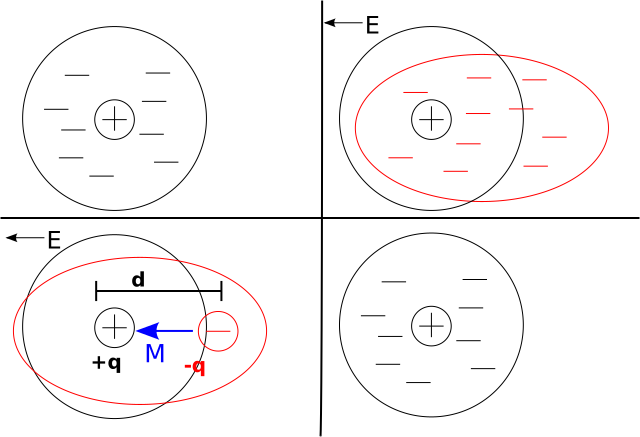
The mechanism. The material's molecules are either already dipoles (water) or become dipoles when a field is applied (everything else — the field pulls electrons one way and nuclei the other). Either way, the field lines them up.
Now look at the interior of the slab in the figure. Every molecule's positive end is adjacent to the next molecule's negative end, so they cancel. Only at the two faces is there anything left over: a layer of negative charge facing the positive plate and a layer of positive charge facing the negative plate.
Those induced layers produce their own field, pointing opposite to the applied one. So the net field inside the dielectric is reduced:
E = \frac{E_0}{\kappa}
With the same charge on the plates and a smaller field, the voltage V = Ed is smaller, and since C = Q/V, the capacitance is larger. That is the whole explanation, and \kappa is simply the factor by which the material weakens the field inside itself.
Water's \kappa = 80 is why water dissolves salt. The electrostatic attraction between a sodium ion and a chloride ion is cut eightyfold when water gets between them, which is enough for thermal motion to pull them apart. This is one of the reasons water is the solvent of life, and Chapter 10.3 develops it.
Dielectrics have a second job: they hold off breakdown. A capacitor's voltage rating is set by the field at which its insulator conducts, and good dielectrics tolerate much higher fields than air. Mylar handles about 4\times10^8 V/m, more than a hundred times air's limit.
Where this shows up in your life
Every touchscreen you own is a capacitor. A capacitive screen has a grid of transparent electrodes with a small field above the surface. Your finger is mostly water, \kappa = 80, and bringing it close changes the capacitance at that spot by a fraction of a picofarad. The controller measures the change across the grid and works out where you touched — which is also why gloves do not work, and why a wet screen misbehaves.
Camera flashes store energy in a capacitor and dump it in a millisecond. A battery cannot supply hundreds of watts instantly; a capacitor can, because it is a purely electrical store with no chemistry to wait for. The whine you hear before the flash is a converter charging that capacitor to a few hundred volts.
Defibrillators are the same idea at 200 joules, delivered through the chest in a few milliseconds.
Condenser microphones — the "condenser" is the old word for capacitor — use one plate as a thin diaphragm. Sound moves it, changing d, changing C, and with fixed charge on the plates the voltage changes in step with the sound.
Digital memory is capacitors. Every bit in a DRAM chip is a tiny capacitor holding about 30,000 electrons; charged is a 1, discharged is a 0. They leak, which is why DRAM must be read and rewritten thousands of times per second — the "dynamic" in the name — and why memory contents vanish when the power goes off. Volume I, Chapter 1.6 covers what that means for a computer.
What the next chapter fixes
Everything so far has been static — charges sitting still, fields not changing, conductors in equilibrium. That covers a lot, and it does not cover anything that does useful work. The moment charges are allowed to flow continuously, there is a current, and a whole new set of questions opens: what makes charges keep moving, what resists them, how fast do they actually travel, and why does a wire get hot. Chapter 4.4 answers those from the microscopic picture, and derives Ohm's law rather than quoting it.