Appearance
5.2 — Mirrors, Lenses and the Eye
A single ray obeying Snell's law is not an image. An image happens when every ray leaving one point on an object is bent so that they all meet again at one other point. That is a strong demand — it says a curved surface must apply a different amount of bending to every ray depending on where it strikes — and it is a small miracle that a simple spherical surface does it well enough to build eyes and telescopes out of.
This chapter derives the mirror and lens equations, explains the difference between an image you can catch on a screen and one you cannot, and works out exactly what a pair of glasses does.
Two kinds of image
A real image forms where light rays actually converge and cross. Put a piece of paper there and a picture appears on it. The light is genuinely arriving at that point.
A virtual image forms where rays only appear to have come from, when traced backwards. No light passes through that location at all. Put paper there and nothing appears. Your reflection in a bathroom mirror is virtual — the light never went behind the wall.
You can see both kinds with your eye, because your eye's own lens takes diverging rays and forms a real image on the retina either way. The difference matters when you want to project something.
The plane mirror
The simplest case, and it establishes the language. Light from a point on your face hits the mirror and reflects with equal angles (Chapter 5.1). Trace the reflected rays backwards and they all appear to come from a point exactly as far behind the mirror as you are in front.
Three properties, each with a reason:
Same size. The geometry is a simple reflection, so no scaling occurs.
Virtual. No light goes behind the mirror.
Left–right "reversed" — except it is not. A mirror does not swap left and right. It swaps front and back. Your reflection's nose is closer to the mirror than the back of its head, and so is yours, but your reflection is facing you. Because you interpret the image as a person who has turned around, and turning around swaps left and right, you attribute the swap to the mirror. Test it: lie on your side facing a mirror and your image is now "reversed" top to bottom instead. The mirror did not change; your idea of which way you would have to turn did.
A related question with a clean answer: how tall must a mirror be for you to see all of yourself? Half your height, mounted with its top edge halfway between your eyes and the top of your head. The ray from your feet must reflect at a point halfway between your feet and your eyes, and the ray from the top of your head at a point halfway between your eyes and your crown. Everything between is covered. And the answer does not depend on how far away you stand, which surprises almost everybody. Step back and the mirror subtends a smaller angle, and so do you, in exactly the same proportion.
Curved mirrors

Take a sphere of radius R and use a small cap of it as a mirror.
Concave (curving away from you, like the inside of a bowl) converges light. Convex (bulging towards you) diverges it.
Send in rays parallel to the axis. For a concave mirror they all cross at a point called the focus, at distance:
f = \frac{R}{2}
Deriving that factor of two takes three lines. A ray parallel to the axis at height h strikes the mirror at a point where the normal is the radius, which makes angle \alpha with the axis, where \sin\alpha = h/R. The reflected ray turns by 2\alpha from the incoming direction. It crosses the axis at distance d where \tan 2\alpha = h/d. For small angles, \alpha \approx h/R and \tan 2\alpha \approx 2h/R, so:
\frac{h}{d} = \frac{2h}{R} \quad\Longrightarrow\quad d = \frac{R}{2}
Notice the phrase for small angles. The result depends on it. Rays far from the axis cross closer to the mirror, and the failure to meet at one point is called spherical aberration. A parabola focuses all parallel rays exactly, which is why serious telescope mirrors and satellite dishes are parabolic, and why a spherical shaving mirror gives a slightly soft image at the edges.
The mirror equation
Put an object at distance u from the mirror and its image forms at distance v:
\boxed{\frac{1}{u} + \frac{1}{v} = \frac{1}{f} = \frac{2}{R}}
Deriving it from similar triangles. Take an object of height h_o at distance u on the axis. Two rays are enough to locate the image:
- A ray parallel to the axis, which reflects through the focus.
- A ray through the centre of curvature, which hits the mirror along a normal and reflects straight back.
Where those two cross is the image. Writing down the two pairs of similar triangles they create and eliminating the heights gives the equation above. The full algebra is standard and the geometric statement is the part worth holding: the image position is fixed once you know the object position and the focal length, and nothing else about the mirror matters.
Magnification:
m = \frac{h_i}{h_o} = -\frac{v}{u}
with the minus sign meaning an inverted image.
Sign conventions matter and they are a source of endless confusion. This book uses the real-is-positive convention:
- u is positive for a real object in front of the mirror.
- v is positive for a real image in front of the mirror, negative for a virtual image behind it.
- f is positive for a concave (converging) mirror, negative for a convex one.
Worked example: the shaving mirror
A concave mirror has f = 20 cm. Where is the image of a face at (a) 50 cm and (b) 10 cm?
(a) u = 50 cm:
\frac{1}{v} = \frac{1}{20} - \frac{1}{50} = \frac{5-2}{100} = \frac{3}{100} \quad\Longrightarrow\quad v = 33.3\ \text{cm}
m = -\frac{33.3}{50} = -0.67
Real, inverted, two thirds size. Hold a shaving mirror at arm's length and you are indeed upside down — most people have noticed this without ever asking why.
(b) u = 10 cm:
\frac{1}{v} = \frac{1}{20} - \frac{1}{10} = \frac{1-2}{20} = -\frac{1}{20} \quad\Longrightarrow\quad v = -20\ \text{cm}
m = -\frac{-20}{10} = +2.0
Virtual, upright, twice as large. Negative v means it is behind the mirror.
So the mirror flips behaviour at u = f. Closer than the focal length it magnifies and stays upright; further away it inverts. That is why a shaving mirror must be used close to the face, and why moving slowly backwards past the focal point makes your reflection swell, blur into nothing, and reappear upside down.
Convex mirrors have negative f, which makes v always negative and |m| < 1: the image is always virtual, upright and reduced. That gives a wide field of view, which is why they are used as shop security mirrors and vehicle wing mirrors — and why the wing mirror is stamped "objects in mirror are closer than they appear", since the reduced image reads to the brain as a more distant object.
Lenses
A lens does with refraction what a mirror does with reflection. Light bends at both surfaces, and if the surfaces are curved correctly, all rays from a point meet again.

The three construction rays are all you ever need, and each is justified by the definition of the focus:
- A ray parallel to the axis leaves through the far focus.
- A ray through the near focus leaves parallel to the axis.
- A ray through the centre of a thin lens continues undeviated, because the two surfaces are parallel there and the small sideways shift is negligible for a thin lens.
Any two of them locate the image; the third is a check.
The thin lens equation has exactly the same form as the mirror equation:
\boxed{\frac{1}{u}+\frac{1}{v} = \frac{1}{f}}
which is not a coincidence — both come from the same small-angle geometry.
The lens-maker's formula, derived
Where does f come from? From the two surface curvatures and the glass.
Refraction at a single spherical surface between media n_1 and n_2, radius R, gives (from Snell's law with small angles):
\frac{n_1}{u} + \frac{n_2}{v} = \frac{n_2-n_1}{R}
Apply this twice. At the first surface, going from air into glass, the image forms at some intermediate distance v_1:
\frac{1}{u} + \frac{n}{v_1} = \frac{n-1}{R_1}
That intermediate image acts as the object for the second surface, going from glass back into air. For a thin lens the two surfaces are at the same place:
\frac{-n}{v_1} + \frac{1}{v} = \frac{1-n}{R_2}
Add the two equations. The v_1 terms cancel exactly:
\frac{1}{u}+\frac{1}{v} = (n-1)\left(\frac{1}{R_1}-\frac{1}{R_2}\right)
Comparing with the thin lens equation:
\boxed{\frac{1}{f} = (n-1)\left(\frac{1}{R_1}-\frac{1}{R_2}\right)}
This is the lens-maker's formula, and it says three useful things.
The focal length depends on the glass. Higher n gives a shorter f for the same shape, which is why high-index plastic makes thinner spectacle lenses for the same prescription.
It depends on both surfaces. A lens with one flat side (R_2 = \infty) has 1/f = (n-1)/R_1.
A lens in water is much weaker. Replace the surrounding medium and (n-1) becomes (n/n_{\text{medium}} - 1). For glass in water that is (1.52/1.33 - 1) = 0.14 instead of 0.52 — a factor of 3.6 weaker. This is why you cannot see clearly underwater without goggles: your eye's cornea does most of its focusing at the air–tissue boundary, and immersing it in water with a similar index nearly switches that off. Goggles restore an air gap and your vision comes back.
Power is the reciprocal of focal length, in dioptres:
P = \frac{1}{f\ \text{(in metres)}}
so a 50 cm lens is +2 D. Powers of thin lenses in contact simply add, which is why opticians work in dioptres rather than focal lengths.
Worked example: a projector
A projector must throw a 30× magnified real image on a screen 6.0 m away, using a lens of what focal length, with the slide how far from the lens?
Magnification -30 means v/u = 30, and v = 6.0 m, so:
u = \frac{6.0}{30} = 0.20\ \text{m}
\frac{1}{f} = \frac{1}{0.20}+\frac{1}{6.0} = 5.0 + 0.167 = 5.167 \quad\Longrightarrow\quad f = 0.1935\ \text{m} = 19.4\ \text{cm}
The slide sits just outside the focal length — 19.4 cm focus, 20 cm object distance. That is the general rule for projection: to get a large real image far away, put the object barely outside f. Move it 1 mm and the image moves tens of centimetres, which is why focusing a projector is fiddly.
The eye
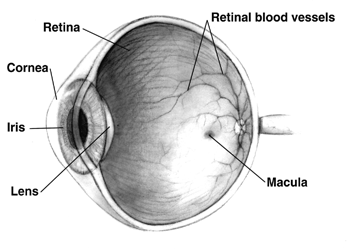
Total power of a relaxed adult eye is about +60 dioptres, and the split is the surprising part:
- Cornea: about +43 D. The big bend happens at the air–cornea boundary, because that is where the refractive index jumps from 1.00 to 1.376. This is fixed and cannot be adjusted.
- Lens: about +17 D, adjustable up to roughly +25 D in a young eye.
The lens is surrounded by fluid of similar index, so it contributes far less than its shape suggests — the same effect as a lens in water above.
Accommodation is the process of changing the lens's power. The ciliary muscle contracts, which releases tension in the suspensory ligaments, which lets the elastic lens bulge into a more curved, more powerful shape. Relax the muscle and the ligaments pull the lens flat again. It is the opposite of what most people guess: the muscle works to see close, and distance vision is the resting state, which is why staring at a screen all day is tiring.
The range of accommodation falls steadily with age, as the lens stiffens:
| Age | Accommodation | Near point |
|---|---|---|
| 10 | 14 D | 7 cm |
| 25 | 10 D | 10 cm |
| 45 | 3.5 D | 29 cm |
| 60 | 1 D | 100 cm |
This is presbyopia, and it is universal — everybody's near point retreats past comfortable reading distance somewhere in their forties, which is why reading glasses arrive on schedule regardless of how good your distance vision has always been.
Myopia and hypermetropia
Short sight (myopia) means the eye is too powerful for its length — usually because the eyeball is too long, by a millimetre or two. Distant light converges to a focus in front of the retina.
The fix is a diverging lens to weaken the system. If the far point (the furthest distance that can be seen clearly) is at distance d, the corrective lens must take an object at infinity and produce a virtual image at d:
\frac{1}{\infty}+\frac{1}{-d} = \frac{1}{f} \quad\Longrightarrow\quad f = -d
Worked number. A far point of 50 cm needs f = -0.50 m, so P = -2.0 D. A prescription reading −2.00 means exactly this: the wearer cannot see clearly beyond 50 cm unaided.
Long sight (hypermetropia) is the opposite — the eye is too weak or too short, and the fix is a converging lens with positive power.
Astigmatism is a different fault: the cornea is not spherical but slightly cylindrical, so it has different focal lengths in different directions. A person with astigmatism sees vertical lines sharp and horizontal ones blurred, or some intermediate axis. The correction is a cylindrical lens, which is why a prescription has three numbers — sphere, cylinder and axis. The axis in degrees says which direction the cylinder is oriented.
Laser eye surgery reshapes the cornea directly, removing tissue to flatten it for myopia. Since the cornea supplies +43 D of the eye's +60 D, a very small change in its curvature makes a large change in power — which is what makes the procedure possible and also what makes precision essential.
Aberrations
A single spherical lens does not form a perfect image, and there are two main reasons.
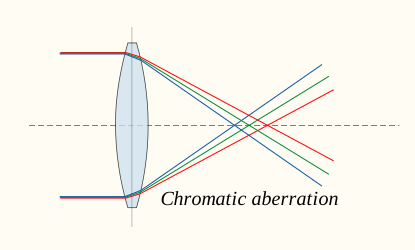
Chromatic aberration comes straight from the lens-maker's formula: f depends on n, and n depends on wavelength (Chapter 5.1). So blue focuses closer than red, and an image has coloured fringes.
The fix is an achromatic doublet, invented by Chester Moore Hall in 1733 and patented by John Dollond in 1758: cement a converging crown-glass lens to a diverging flint-glass one. Flint has a much stronger dispersion for its refractive index, so a weak flint element can cancel the colour spread of a strong crown element while leaving net converging power. Nearly every camera lens, binocular and microscope objective contains one.
Spherical aberration is the small-angle assumption failing, as noted for mirrors. Rays through the edge focus closer than rays through the centre. Fixes include stopping the lens down with an aperture (which is why photographs are sharper at f/8 than wide open), using aspheric surfaces, or combining elements whose aberrations cancel.
Newton built the first reflecting telescope in 1668 specifically to escape chromatic aberration, since a mirror reflects all colours identically and has none at all. Every large telescope since has been a reflector, for that reason and because a mirror can be supported from behind while a lens can only be held at its rim — which sets a practical size limit around one metre for lenses and none in practice for mirrors.
Instruments
Magnifying glass. Hold a converging lens closer than f to an object and you get an enlarged upright virtual image. Angular magnification, for an image at the near point D = 25 cm:
M = 1 + \frac{D}{f}
So a 5 cm lens gives 1 + 25/5 = 6\times. Beyond about 20× a single lens is hopeless because aberrations dominate.
Microscope. Two lenses in series. The objective, of very short focal length, forms a magnified real image inside the tube; the eyepiece then magnifies that as a magnifying glass:
M_{\text{total}} = M_{\text{objective}}\times M_{\text{eyepiece}} = \frac{L}{f_o}\times\frac{D}{f_e}
where L is the tube length. Typical: f_o = 4 mm, f_e = 25 mm, L = 160 mm gives 40\times10 = 400\times.
The limit is not magnification but resolution. Chapter 5.4 shows that no optical microscope can separate details closer than about half a wavelength — roughly 200 nm — no matter how many lenses you stack. Beyond that, magnifying gives you a bigger blur, which is called empty magnification.
Telescope. Objective and eyepiece separated by f_o + f_e, giving angular magnification:
M = \frac{f_o}{f_e}
So a long objective and a short eyepiece. But magnification is the least important specification of a telescope. What matters is aperture, for two reasons: light gathering goes as the area, so a 200 mm mirror collects four times as much as a 100 mm one, and resolution improves with diameter as Chapter 5.4 derives. A cheap telescope advertising "500× magnification" on a 60 mm lens is selling a number that its optics cannot support.
Where this shows up in your life
Your phone camera contains five to seven plastic aspheric elements in a stack a few millimetres tall, designed by computer optimisation to cancel each other's aberrations. The physics is entirely in this chapter; the engineering is the hard part.
Contact lenses versus glasses give slightly different prescriptions for the same eye, because the lens sits at a different distance from the cornea and the effective power changes. Opticians call this vertex distance compensation, and it matters above about ±4 D.
Anti-reflective coating on glasses uses thin-film interference, which is Chapter 5.3.
Reading glasses in a shop are labelled +1.5, +2.0, +2.5 and so on — those are dioptres, and the number you need is roughly the accommodation you have lost.
A drop of water on a leaf magnifies it, because a droplet is a short-focal-length converging lens. The first microscopes were essentially single tiny glass spheres, and Antonie van Leeuwenhoek's, in the 1670s, reached 270× and revealed bacteria with a single bead of glass.
What the next chapter fixes
Everything so far treated light as rays travelling in straight lines and bending at surfaces. That model is spectacularly successful and it is wrong, and the way it fails is instructive: shine light through two very narrow slits and you do not get two bright lines. You get a whole pattern of bright and dark bands, including darkness at places where each slit alone would have given light. Rays cannot produce darkness by adding light to light. Chapter 5.3 takes the wave picture from Chapter 4.7 seriously and shows what interference does, which explains the colours of soap bubbles and oil films and also settles a two-century argument about what light is.