Appearance
5.5 — Polarisation, and Why the Sky is Blue
Chapter 4.7 showed that light is a transverse wave: the electric field oscillates at right angles to the direction of travel. "At right angles" leaves two independent directions to choose from, and which one the field picks is the light's polarisation.
Ordinary light from the Sun or a lamp is unpolarised — a mixture of every orientation, changing randomly a hundred million times a second, because each atom emits independently. Your eye cannot tell the difference. Almost every other detector can, and a great deal of everyday technology depends on it.
Polarising filters
A polarising filter passes only the component of the field along one direction, its transmission axis, and absorbs the perpendicular component.
The usual mental picture is a picket fence passing a rope wave shaken vertically and blocking one shaken horizontally. That picture gives the right answer and the wrong mechanism. In a real polariser — Edwin Land's Polaroid sheet, invented in 1929 when he was a nineteen-year-old undergraduate — long polymer chains are stretched into alignment and doped with iodine so that electrons can move freely along the chains. Light with its field parallel to the chains drives those electrons, loses its energy to them, and is absorbed. Light with its field perpendicular cannot move them and passes.
So the transmission axis is perpendicular to the wires, which is the opposite of the picket-fence intuition. The picture is a useful mnemonic as long as you remember it is upside down.
Unpolarised light through one filter
Unpolarised light contains every orientation equally. Resolve each into components along and across the transmission axis, and on average half the intensity is in each. So:
I = \frac{I_0}{2}
Exactly half, always, regardless of how the filter is turned. This is why the world looks half as bright through one polarising filter, and why rotating a single filter in front of ordinary light produces no visible change.
Malus's law
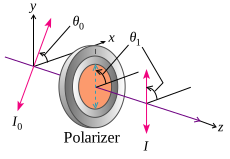
Now send already polarised light through a second filter whose axis is at angle \theta to the polarisation.
The filter passes the component of the field along its axis. Resolving a vector gives:
E_{\text{transmitted}} = E_0\cos\theta
Intensity goes as the square of the field (Chapter 4.7):
\boxed{I = I_0\cos^2\theta}
Malus's law, found by Étienne-Louis Malus in 1809. Check the extremes: \theta = 0 gives full transmission, \theta = 90° gives zero — crossed polarisers are black — and \theta = 45° gives half.
The three-polariser paradox
Here is a result that looks impossible and is not.
Cross two polarisers at 90°. No light gets through. Now slide a third polariser between them at 45°.
Light appears. Adding a filter increased the transmission from zero to something.
Compute it. Take unpolarised light of intensity I_0.
After the first filter: I_1 = I_0/2, polarised vertically.
After the 45° filter: I_2 = I_1\cos^2 45° = (I_0/2)(0.5) = I_0/4, now polarised at 45°.
After the horizontal filter, which is 45° from the light's current polarisation: I_3 = I_2\cos^2 45° = (I_0/4)(0.5) = I_0/8.
One eighth of the original, where before there was nothing.
Why is this not paradoxical? Because a polariser does not merely select light that was already there — it changes the polarisation of what passes. After the middle filter, the light is genuinely polarised at 45°, and 45° light has a horizontal component. The middle filter rotated part of the light into a direction the last filter accepts.
This is not a curiosity. The same logic in quantum mechanics is what makes measurement change a system's state, and photon polarisation is the standard worked example for it (Chapter 7.8). Polaroid filters and quantum measurement have the identical mathematics, which is one of the reasons entanglement experiments are usually done with polarised photons.
Making polarised light without a filter
Reflection, and Brewster's angle
Light reflecting off a non-metallic surface — water, glass, road, paint, leaves — comes back partially polarised parallel to the surface, meaning horizontally polarised for reflection off a horizontal surface.
The mechanism is in Chapter 4.1's dipoles. The incoming light drives the electrons in the surface into oscillation, and those oscillating dipoles re-radiate — that is the reflected beam. A dipole radiates nothing along its own axis, so the component of oscillation pointing towards the observer contributes nothing. What survives is the component parallel to the surface.
At one specific angle the effect is total. When the reflected and refracted rays are exactly 90° apart, the dipoles responsible for one polarisation are oscillating precisely along the reflected direction, so that polarisation is completely absent from the reflection.
Derive the angle. Let the reflected ray be at \theta_B and the refracted at \theta_r, with \theta_B + \theta_r = 90°, so \theta_r = 90° - \theta_B. Snell's law:
n_1\sin\theta_B = n_2\sin(90°-\theta_B) = n_2\cos\theta_B
\boxed{\tan\theta_B = \frac{n_2}{n_1}}
Brewster's angle, from David Brewster in 1815.
For air to water, \tan\theta_B = 1.333, so \theta_B = 53.1°. For air to glass, \tan\theta_B = 1.52, so \theta_B = 56.7°.
This is exactly why polarised sunglasses work. Glare off a wet road, a lake or a car bonnet arrives at close to Brewster's angle for a standing person, so it is strongly horizontally polarised. Sunglasses with a vertical transmission axis block it while passing the diffusely scattered light that carries the actual image.
Two consequences follow immediately and both are checkable.
Tilt your head 90° and the glare comes back. The lens axis is now horizontal.
Polarised sunglasses do nothing about glare off metal. Metals reflect by a different mechanism — free electrons responding as a sheet rather than as individual dipoles — and the reflection stays unpolarised. Chrome bumpers and aluminium are as dazzling as ever.
Birefringence

Some crystals have different refractive indices for the two polarisations, because their atomic structure is not the same in all directions. Calcite has n = 1.658 for one polarisation and 1.486 for the other — a difference of 0.17, which is huge — so a single ray splits into two that emerge separately.
Vikings may have used this. Iceland spar is a clear calcite, and a "sunstone" mentioned in Norse sagas would let a navigator find the Sun's direction through overcast by locating where the sky's polarisation pattern (below) makes the two images equally bright. A calcite crystal was recovered from a 1592 English shipwreck alongside navigational instruments, which is at least suggestive.
Stress makes ordinary materials birefringent, which is the basis of a real engineering technique. Squeeze a clear plastic and its molecules align slightly along the stress, giving it a small birefringence proportional to the stress. Put the object between crossed polarisers and coloured fringes appear wherever there is stress, mapping it directly. Photoelastic stress analysis was how bridge, dam and gear-tooth designs were checked before finite-element software existed, and it is still used as a check on the software. You can see it in the corner of any plastic ruler held between two polarising filters, or in a car windscreen viewed through polarised sunglasses, where the toughening stresses show as a pattern of blotches.
Liquid crystal displays
Every LCD screen you have ever looked at is a polarisation device, and its operation is worth walking through because it uses everything above.
The stack, from back to front:
- A backlight, producing unpolarised white light.
- A polariser, cutting it in half and making it, say, vertical.
- A layer of twisted nematic liquid crystal — rod-shaped molecules that align with each other, and which the manufacturer has anchored so that the alignment rotates by 90° from back to front of the layer.
- Transparent electrodes above and below that layer.
- A second polariser, crossed at 90° to the first.
With no voltage: the twisted molecules guide the polarisation round with them, so light arrives at the front polariser rotated by 90° — aligned with it — and passes. The pixel is bright.
With a voltage: the electric field pulls the rod-shaped molecules into alignment with itself, straightening out the twist. Light passes through unrotated, arrives still vertical at a horizontal polariser, and is blocked. The pixel is dark.
Intermediate voltage gives partial untwisting and a grey level. Colour comes from red, green and blue filters over three subpixels.
Two things fall out of this that you have certainly noticed.
LCD screens have viewing-angle problems because the light path through the liquid crystal layer changes with angle, so the rotation is no longer exactly 90°.
An LCD screen viewed through polarised sunglasses goes black at some angles. The screen's output is polarised, and if your sunglasses are crossed with it, Malus's law does the rest. Phone screens are often oriented at 45° specifically so that this happens in neither portrait nor landscape orientation, which is a design decision made for exactly this equation.
OLED screens emit unpolarised light and do not have this problem — although many include a circular polariser on the front to kill reflections, which brings it back in a different form.
Scattering, and the colour of the sky

When light passes molecules much smaller than its wavelength, they act as tiny dipoles, driven into oscillation by the field and re-radiating in all directions. That re-radiation is scattering.
How strongly does it scatter? Lord Rayleigh worked it out in 1871 and the answer is startlingly steep:
\boxed{I_{\text{scattered}} \propto \frac{1}{\lambda^4}}
The reasoning: an oscillating dipole radiates power proportional to the square of its acceleration (Chapter 4.7), the acceleration of a driven oscillator well below resonance goes as \omega^2, so the radiated power goes as \omega^4 — and \omega \propto 1/\lambda.
Compute the ratio for blue against red. Blue at 450 nm, red at 700 nm:
\frac{I_{\text{blue}}}{I_{\text{red}}} = \left(\frac{700}{450}\right)^4 = (1.556)^4 = 5.9
Blue is scattered about six times more strongly than red.
Why the sky is blue
Sunlight enters the atmosphere. Blue light is scattered out of the beam far more than red, and it bounces around from molecule to molecule until it reaches you from every direction. You see blue coming from all over the sky, and that is scattered sunlight.
Two natural follow-up questions, both worth answering.
Why not violet, since violet has an even shorter wavelength? Three reasons together. The Sun emits less violet than blue (its 5778 K black-body peak is in the green, Chapter 3.7). The upper atmosphere absorbs some violet. And human cone cells are far less sensitive to violet than to blue — the eye's response is the largest factor. The physical scattering really is strongest at the violet end; our perception of the result is blue.
Why is the sky not blue on the Moon? No atmosphere, no scattering, black sky with the Sun in it. Astronauts on the Moon see stars in daylight if they shield their eyes.
Why sunsets are red
At sunset the light travels a much longer path through the atmosphere — roughly 38 times longer at the horizon than straight overhead. Along that path nearly all the blue is scattered away, and what reaches you directly is what is left: red and orange.
The deepest sunsets follow volcanic eruptions and large fires, because extra particles increase the scattering and remove even more of the short wavelengths. The eruption of Krakatoa in 1883 produced vivid red sunsets worldwide for years, and Edvard Munch's description of the sky in The Scream is often attributed to them.
Why clouds are white
Cloud droplets are 10–50 μm across — far larger than the wavelength of light. Rayleigh's 1/\lambda^4 applies only to scatterers much smaller than \lambda. For larger particles the correct treatment is Mie scattering, and its key feature is that it is nearly independent of wavelength.
So all colours scatter equally, and a cloud looks white.
And a thick cloud looks grey or black because light has been scattered so many times that most of it never gets through to the bottom. Nothing about the droplets changed; there are simply more of them in the way.
Milk is white for the same reason — fat globules of a micrometre or so. And fog, mist, steam, and the white of a breaking wave are all Mie scattering off particles bigger than a wavelength.
Sky polarisation
Here is where the two halves of this chapter join up.
The scattering molecule is a dipole driven by the incoming sunlight, oscillating perpendicular to the Sun's direction. And a dipole radiates nothing along its own axis. So light scattered at 90° from the Sun can only be oscillating in one direction — it is strongly polarised, perpendicular to the line to the Sun.
So the sky is polarised, most strongly in a band 90° from the Sun, and up to about 75 % polarised in clear conditions.
You can see this. Put on polarised sunglasses on a clear day, look at the sky 90° away from the Sun, and tilt your head: the sky darkens and lightens. Photographers use exactly this with a rotating polarising filter to deepen a blue sky, and the effect is strongest at right angles to the Sun and absent when shooting towards or away from it.
Bees, ants and many other insects navigate by it. Their compound eyes contain polarisation-sensitive cells, and the sky's polarisation pattern gives the Sun's direction even through cloud or with the Sun below the horizon. Karl von Frisch established this in the 1940s, in the work that also decoded the honeybee's waggle dance, and it earned a Nobel Prize.
Where this shows up in your life
3D cinema. Two projectors show slightly different images through oppositely polarised filters, and your glasses have matching filters, so each eye sees only its own image. Modern systems use circular polarisation, in which the field direction rotates as the wave travels, so that tilting your head does not break the separation.
Photographic polarising filters cut reflections off water and glass, saturate skies, and reduce haze. They are one of the few photographic effects that genuinely cannot be reproduced in software, because the information they remove was never recorded.
Stress analysis in transparent plastics, using the birefringence above.
Sugar concentration measurement. Sugar solutions rotate the plane of polarisation by an amount proportional to concentration — a property called optical activity, arising from the handedness of the sugar molecule. A polarimeter measuring that rotation is the standard way of assaying sugar in industry, and the units for it are still called degrees sugar.
Liquid crystal screens in every phone, laptop, television, calculator and car dashboard.
Checking whether a screen is LCD or OLED: look at it through a polarising filter and rotate. LCD goes black somewhere; OLED usually does not.
What the next chapter fixes
Every source of light so far — the Sun, a lamp, a candle — has been a hot object radiating a broad spectrum in all directions with random phases, which is exactly the incoherent light that Chapter 5.3 said could not produce interference. Yet Chapter 5.3 relied on coherence, Chapter 5.4's holography needs it, and fibre optics needs a source that can be pushed down a 9 μm core. Chapter 5.6 explains how to make light where every photon is in step with every other one, which required a quantum mechanical idea of Einstein's from 1917 and took forty-three years to build.