Appearance
7.1 — Five Experiments Classical Physics Could Not Explain
By 1900 physics looked finished. Newton handled motion, Maxwell handled light and electricity, thermodynamics handled heat, and the combination explained essentially everything anyone could measure. Lord Kelvin is often quoted as saying only two small clouds remained on the horizon.
The two clouds were the Michelson–Morley result, which became relativity, and the black-body spectrum, which became quantum mechanics. Neither was small.
This chapter works through five measurements that classical physics got wrong, and in each case the failure is not a matter of precision. The classical prediction is off by an infinite amount, or predicts the wrong variable entirely, or predicts a smooth curve where nature gives discrete lines.
1. The ultraviolet catastrophe
Chapter 3.7 introduced the black-body spectrum and stopped short of the crisis. Here it is in full.
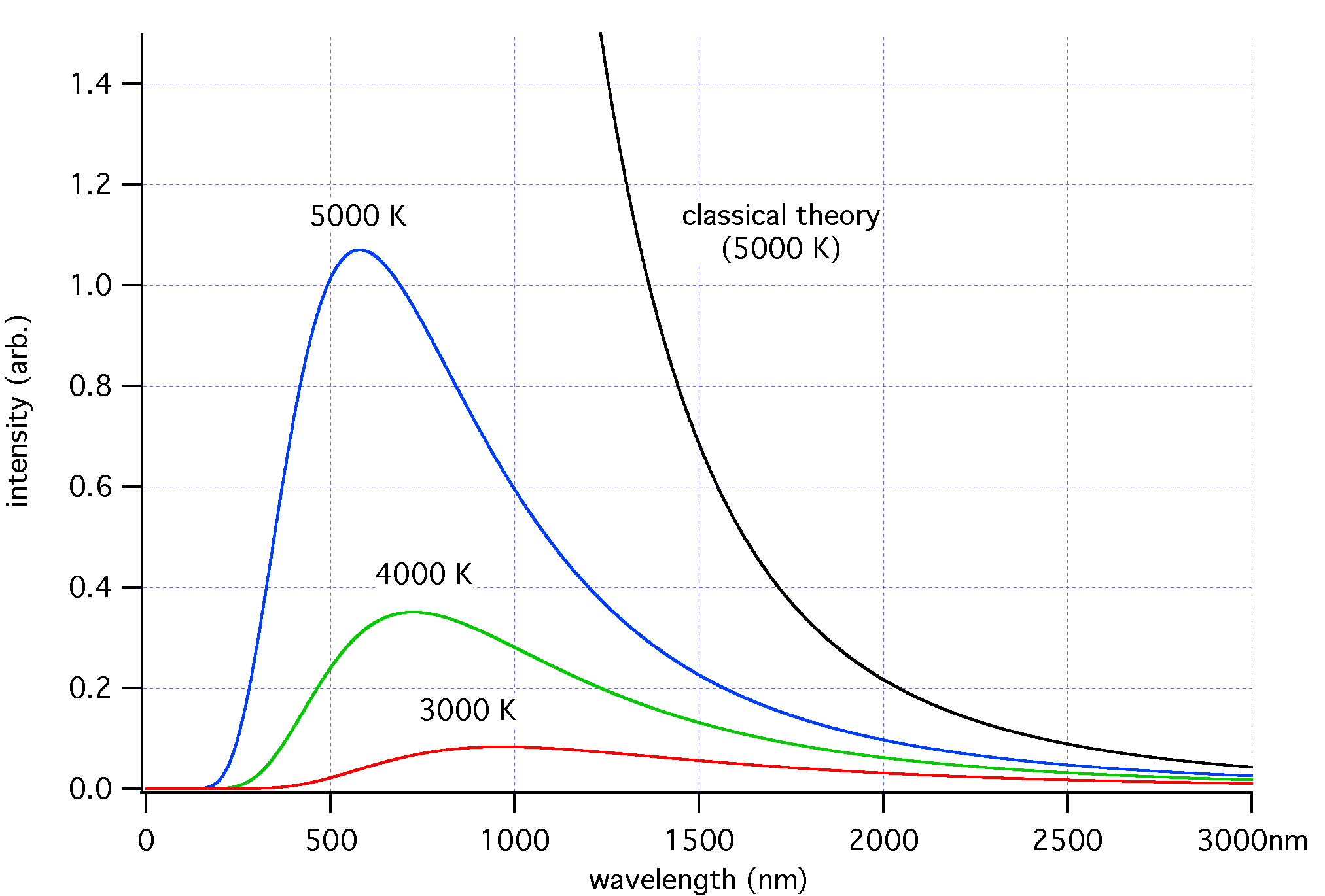
The measured curve rises from zero at short wavelengths, peaks somewhere set by Wien's law, and falls away at long wavelengths. Every hot object produces it, and the curve depends only on temperature.
The classical derivation. Treat a hot cavity as full of standing electromagnetic waves — modes, exactly like the standing waves on a string in Chapter 2.4. Two steps:
Step 1: count the modes. In a cubical cavity of side L, a standing wave must fit a whole number of half-wavelengths along each axis. Counting how many such modes fall between \lambda and \lambda + d\lambda gives:
dN = \frac{8\pi V}{\lambda^4}d\lambda
The \lambda^{-4} is the problem in embryo. Shorter wavelengths mean more modes, without limit, because you can always subdivide further.
Step 2: give each mode its energy. Equipartition (Chapter 3.2) says every degree of freedom that appears squared in the energy gets \frac{1}{2}k_BT. An electromagnetic mode has electric and magnetic energy, so it gets k_BT.
Multiply:
u(\lambda)\,d\lambda = \frac{8\pi k_BT}{\lambda^4}d\lambda
This is the Rayleigh–Jeans law, and it matches the measurement beautifully at long wavelengths. At short wavelengths it diverges. Integrating over all wavelengths:
U = \int_0^\infty\frac{8\pi k_BT}{\lambda^4}d\lambda = \left[-\frac{8\pi k_BT}{3\lambda^3}\right]_0^\infty = \infty
Infinite energy in any cavity at any temperature above absolute zero. Open an oven door and you should be sterilised by gamma rays. Paul Ehrenfest named it the ultraviolet catastrophe in 1911.
The derivation is not sloppy. Both steps are standard classical physics, tested elsewhere, and both are correct within their own framework. That is what makes the failure fundamental rather than technical.
Planck's fix
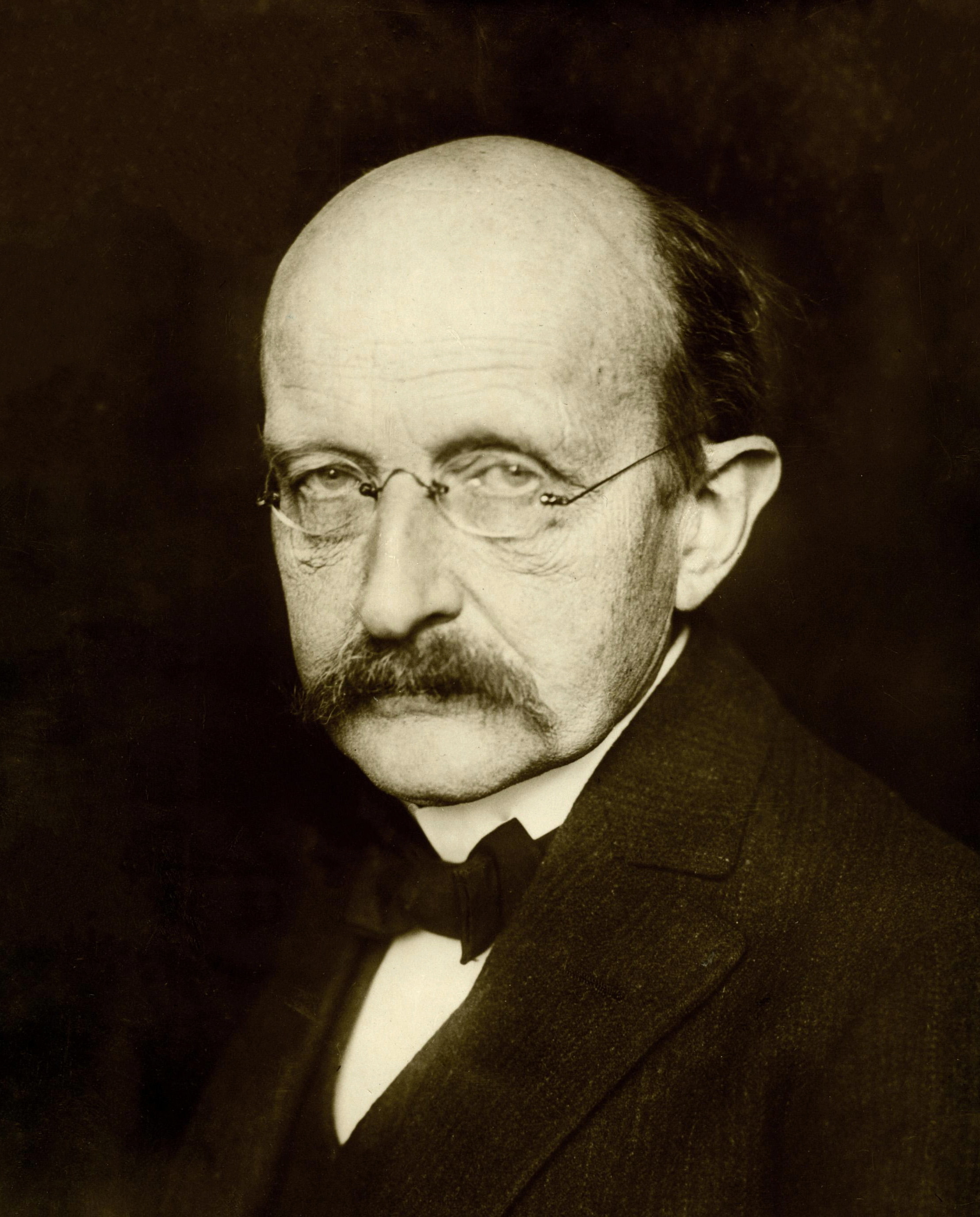
Max Planck found the answer on 19 October 1900 by fitting the data, and then spent two months trying to justify the formula. The justification required one assumption he found repugnant:
The energy of a mode of frequency f comes only in whole multiples of hf.
E_n = nhf, \qquad n = 0,1,2,3,\dots
with h a new constant of nature:
h = 6.62607015\times10^{-34}\ \text{J s}
Why this kills the catastrophe. Equipartition assumed a mode could take any energy, however small, so every mode gets its k_BT share. If energy comes in lumps of hf, then a mode with hf \gg k_BT cannot be excited at all — there is not enough energy available in a typical thermal exchange to buy even one lump. High-frequency modes are frozen out, exactly as the vibrational degrees of freedom were in Chapter 3.2.
The derivation. The average energy of a mode, using Boltzmann statistics over the allowed values nhf:
\langle E\rangle = \frac{\sum_{n=0}^{\infty}nhf\,e^{-nhf/k_BT}}{\sum_{n=0}^{\infty}e^{-nhf/k_BT}}
Write x = hf/k_BT. The denominator is a geometric series:
\sum_{n=0}^\infty e^{-nx} = \frac{1}{1-e^{-x}}
The numerator is hf times \sum n e^{-nx}, and differentiating the geometric series gives \sum ne^{-nx} = e^{-x}/(1-e^{-x})^2. Dividing:
\langle E\rangle = hf\cdot\frac{e^{-x}}{1-e^{-x}} = \frac{hf}{e^{hf/k_BT}-1}
Compare with the classical k_BT. For small x — low frequency — expand e^x \approx 1+x and the denominator becomes x, so \langle E\rangle \to hf/x = k_BT. Classical physics recovered at low frequency. For large x the exponential dominates and \langle E\rangle \to hfe^{-hf/k_BT}, which is exponentially suppressed. The catastrophe is cut off.
Multiply by the mode count:
\boxed{u(\lambda,T) = \frac{8\pi hc}{\lambda^5}\cdot\frac{1}{e^{hc/\lambda k_BT}-1}}
Planck's law. It fits every measurement exactly, at every wavelength and every temperature.
And Stefan–Boltzmann and Wien fall out of it, rather than being separate empirical rules. Integrating over all wavelengths gives \sigma T^4 with:
\sigma = \frac{2\pi^5k_B^4}{15h^3c^2} = 5.670\times10^{-8}
and maximising it gives Wien's constant b = hc/4.965k_B = 2.898\times10^{-3} m·K. Two constants that had been measured empirically are now computed from h, c and k_B.
Planck did not believe it. He called the quantum hypothesis "an act of desperation" and spent a decade trying to derive the formula without it. He regarded h as a mathematical trick, not a statement about nature.
2. The photoelectric effect
Shine light on a metal and electrons come out. Heinrich Hertz noticed it in 1887 while doing the experiments that confirmed Maxwell's waves — a nice irony, since the effect would help overthrow the pure wave picture.

Four observations, and classical physics gets all four wrong.
(a) There is a threshold frequency. Below it, no electrons emerge at all, no matter how intense the light or how long you wait.
Classical prediction: intensity is what carries energy, so a bright enough beam of any colour should eventually free electrons. Wrong.
(b) Above threshold, the maximum electron energy depends on frequency, not intensity.
Classical prediction: brighter light means a stronger field means a harder push means faster electrons. Wrong.
(c) Intensity controls the number of electrons, not their energy.
Classical prediction: no reason for that split. Wrong.
(d) Emission is immediate — under 10^{-9} s even for very dim light.
Classical estimate: the light's energy is spread over the whole surface, and an atom presents a target of about 10^{-20} m². For a dim source of 10^{-6} W/m², the atom collects 10^{-26} W, and freeing an electron needs a few eV, about 10^{-19} J. That takes 10^{7} seconds — about four months. Measured: instantaneous. Wrong by fourteen orders of magnitude.
Einstein's explanation
In 1905 Einstein proposed that Planck's quantisation was not a property of the cavity walls but of light itself:
Light consists of discrete packets of energy E = hf.
Lewis named them photons in 1926.
The photoelectric effect becomes trivial. One photon hits one electron and gives it all its energy, or nothing.
\boxed{KE_{\max} = hf - \phi}
where \phi (the work function) is the minimum energy needed to remove an electron from that metal.
Every observation follows:
- (a) If hf < \phi, no electron escapes. Threshold at f_0 = \phi/h.
- (b) KE depends on f linearly, with slope h.
- (c) Intensity means more photons, so more electrons, each with the same energy.
- (d) The transaction is a single collision — instantaneous.
Typical work functions: caesium 2.1 eV, sodium 2.3, zinc 4.3, gold 5.1, platinum 5.6. Caesium's low value is why it is used in photocathodes: its threshold at f_0 = 2.1\times1.602\times10^{-19}/6.626\times10^{-34} = 5.08\times10^{14} Hz corresponds to 590 nm, so ordinary yellow light works.
Worked example. 400 nm light on sodium, \phi = 2.3 eV.
E = \frac{hc}{\lambda} = \frac{(6.626\times10^{-34})(3\times10^{8})}{400\times10^{-9}} = 4.97\times10^{-19}\ \text{J} = 3.10\ \text{eV}
KE_{\max} = 3.10-2.30 = 0.80\ \text{eV}
Millikan hated it. He spent ten years, from 1906 to 1916, trying to disprove Einstein's equation, and in the process measured h from the slope to within 0.5 %. He wrote that the theory was "wholly untenable" even as his own data confirmed it exactly. Einstein's Nobel Prize in 1921 was awarded specifically for this, not for relativity.
3. The Compton effect
If a photon is a particle with energy hf, it should also carry momentum p = E/c = hf/c = h/\lambda (Chapter 6.4). And a particle with momentum should behave like a billiard ball in a collision.
Arthur Compton tested it in 1923 by firing X-rays at graphite and measuring the scattered wavelength.

The classical prediction: the electron oscillates at the incoming frequency and re-radiates at the same frequency. The wavelength should not change.
The measurement: the scattered X-rays have a longer wavelength, and the shift depends on the scattering angle.
The derivation
Treat it as a relativistic collision (Chapter 6.4). Photon of wavelength \lambda hits an electron at rest, scatters at angle \theta with wavelength \lambda'; the electron recoils.
Conservation of energy:
\frac{hc}{\lambda}+m_ec^2 = \frac{hc}{\lambda'}+E_e
Conservation of momentum, in components:
\frac{h}{\lambda} = \frac{h}{\lambda'}\cos\theta + p_e\cos\varphi
0 = \frac{h}{\lambda'}\sin\theta - p_e\sin\varphi
Rearrange to isolate the electron terms, square both momentum equations and add — which eliminates \varphi since \cos^2+\sin^2 = 1:
p_e^2 = \left(\frac{h}{\lambda}\right)^2 + \left(\frac{h}{\lambda'}\right)^2 - \frac{2h^2}{\lambda\lambda'}\cos\theta
From the energy equation, E_e = hc(1/\lambda - 1/\lambda') + m_ec^2, and using E_e^2 = p_e^2c^2 + m_e^2c^4 to eliminate E_e and p_e, the algebra collapses to:
\boxed{\Delta\lambda = \lambda'-\lambda = \frac{h}{m_ec}(1-\cos\theta)}
The Compton wavelength of the electron:
\lambda_C = \frac{h}{m_ec} = \frac{6.626\times10^{-34}}{(9.109\times10^{-31})(3\times10^{8})} = 2.426\times10^{-12}\ \text{m}
2.43 picometres, and it depends on nothing but h, m_e and c.
Check the limits. At \theta = 0 (no deflection), \Delta\lambda = 0. At \theta = 180° (straight back), \Delta\lambda = 2\lambda_C = 4.85 pm — the maximum.
Compton measured exactly this, and it settled the argument. Light carries momentum in discrete parcels, and it collides. He shared the 1927 Nobel Prize.
Why X-rays and not visible light? The shift is a fixed 2.4 pm regardless of the incoming wavelength. For 500 nm light that is a fractional change of 5\times10^{-6} — unmeasurable. For a 71 pm X-ray it is a 3.4 % change, easily seen. The effect was always there and needed the right probe.
4. Atomic spectra
Heat a gas and it emits light, but not a continuous spectrum. It emits a set of sharp lines at particular wavelengths, and the set is a fingerprint unique to the element.

Hydrogen's visible lines are at 656.3, 486.1, 434.0 and 410.2 nm. In 1885 a Swiss schoolteacher named Johann Balmer, with no theory whatever, found they fit:
\lambda = B\frac{n^2}{n^2-4}, \qquad n = 3,4,5,6
Johannes Rydberg generalised it in 1888:
\boxed{\frac{1}{\lambda} = R_H\left(\frac{1}{n_1^2}-\frac{1}{n_2^2}\right)}
with R_H = 1.09737\times10^{7} m⁻¹, the Rydberg constant. Every hydrogen line in every part of the spectrum fits, for integer n_1 < n_2: the Lyman series (n_1 = 1, ultraviolet), Balmer (n_1 = 2, visible), Paschen (n_1 = 3, infrared).
A formula of extraordinary accuracy, built entirely of integers, with no explanation of any kind.
Classical physics does worse than fail to explain the lines — it says atoms cannot exist. Rutherford's 1911 experiment (Chapter 9.1) established that an atom is a tiny nucleus with electrons around it. An electron in orbit is accelerating, and Maxwell's equations say an accelerating charge radiates (Chapter 4.7). It loses energy, spirals in, and hits the nucleus.
How fast? Computing the radiated power for an electron in a hydrogen-sized orbit and integrating gives a collapse time of about 1.6\times10^{-11} s.
Sixteen picoseconds. Classical physics predicts that no atom survives for a hundredth of a nanosecond, and that during its brief life it emits a continuous smear of radiation as the orbit shrinks. Reality: atoms are stable for billions of years and emit sharp lines.
Bohr's model
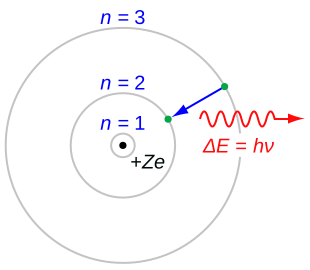
Niels Bohr, in 1913, made three assumptions with no justification beyond that they worked:
- Electrons occupy only certain allowed orbits, and do not radiate while in them. (Simply forbidding the classical catastrophe.)
- Light is emitted only when an electron jumps between orbits, with hf = E_2-E_1.
- Angular momentum is quantised: L = m_evr = n\hbar, where \hbar = h/2\pi = 1.055\times10^{-34} J·s.
Derive the orbits. Coulomb attraction supplies the centripetal force:
\frac{ke^2}{r^2} = \frac{m_ev^2}{r} \quad\Longrightarrow\quad m_ev^2 = \frac{ke^2}{r}
From assumption 3, v = n\hbar/m_er. Substitute:
m_e\frac{n^2\hbar^2}{m_e^2r^2} = \frac{ke^2}{r} \quad\Longrightarrow\quad \frac{n^2\hbar^2}{m_er} = ke^2
\boxed{r_n = \frac{n^2\hbar^2}{m_eke^2} = n^2a_0}
with the Bohr radius:
a_0 = \frac{\hbar^2}{m_eke^2} = \frac{(1.055\times10^{-34})^2}{(9.109\times10^{-31})(8.988\times10^{9})(1.602\times10^{-19})^2} = 5.29\times10^{-11}\ \text{m}
0.529 ångström — the size of a hydrogen atom, derived from \hbar, m_e, k and e.
Now the energy. Total energy is kinetic plus potential:
E = \frac{1}{2}m_ev^2 - \frac{ke^2}{r} = \frac{ke^2}{2r}-\frac{ke^2}{r} = -\frac{ke^2}{2r}
Substituting r_n:
\boxed{E_n = -\frac{m_ek^2e^4}{2\hbar^2}\cdot\frac{1}{n^2} = -\frac{13.606\ \text{eV}}{n^2}}
13.6 eV is hydrogen's ionisation energy, measured independently and matching exactly.
And the spectrum. A jump from n_2 to n_1 emits:
hf = E_{n_2}-E_{n_1} = 13.606\left(\frac{1}{n_1^2}-\frac{1}{n_2^2}\right)\ \text{eV}
\frac{1}{\lambda} = \frac{m_ek^2e^4}{4\pi c\hbar^3}\left(\frac{1}{n_1^2}-\frac{1}{n_2^2}\right)
The coefficient evaluates to 1.0974\times10^{7} m⁻¹ — the Rydberg constant, previously a fitted number, now computed from fundamental constants to five significant figures.
Where Bohr fails
Bohr's model is one of the great successes in physics and it is wrong, and it is important to be precise about how.
It works only for one electron. Hydrogen, He⁺, Li²⁺ — anything with a single electron. For helium, with two electrons, it fails completely and no patching rescues it.
It cannot predict line intensities. Some transitions are strong, some are weak, some are forbidden. Bohr's model has nothing to say.
It does not explain fine structure. Under high resolution, single lines split into several. Bohr predicts one line.
Its assumptions are unjustified. Why is angular momentum quantised? Why does an orbiting electron not radiate? Bohr had no answer, and said so.
And its central picture is wrong. Electrons do not travel in circular orbits. Chapter 7.6 shows the ground state of hydrogen has zero orbital angular momentum, which Bohr's model says is impossible since n = 1 gives L = \hbar. The right answer for the energies came from a wrong picture.
5. Specific heats at low temperature
The fifth failure is quieter and it was in front of everyone for decades. Chapter 3.2 covered it: the heat capacity of hydrogen gas falls from \frac{7}{2}R to \frac{5}{2}R to \frac{3}{2}R as it cools, as though degrees of freedom were switching off.
Classically impossible. Equipartition gives each degree of freedom \frac{1}{2}k_BT at every temperature.
Quantum-mechanically obvious. Rotational and vibrational energies are quantised, and when k_BT falls below the first energy step, collisions cannot excite that mode at all.
Einstein applied the same idea to solids in 1907, treating each atom as a quantum oscillator, and explained why the specific heat of every solid falls to zero as T \to 0 — which the classical Dulong–Petit law says is impossible.
What the five have in common
| Experiment | Classical prediction | Reality | What is quantised |
|---|---|---|---|
| Black body | Infinite energy | Finite curve | Mode energy, nhf |
| Photoelectric | Any colour works | Threshold frequency | Light, in hf packets |
| Compton | No wavelength shift | Shift of \lambda_C(1-\cos\theta) | Photon momentum |
| Atomic spectra | Continuous smear, atom dies in 16 ps | Sharp lines, stable atoms | Electron energy levels |
| Specific heats | Constant with temperature | Falls in steps | Rotation and vibration |
One constant runs through all five, and it is the same number every time:
h = 6.62607015\times10^{-34}\ \text{J s}
Since 2019 it is exact by definition, and the kilogram is defined from it (Chapter 1.1). A quantity introduced as a desperate fitting parameter in 1900 now defines the unit of mass.
How small is h? A 100 W bulb emits about 10^{20} photons per second. A tennis ball has an action of 10^{34} in units of h. This is why nobody noticed until they looked at very small things, and it is the exact analogue of c being so large that relativity stayed hidden.
What the next chapter fixes
Light was a wave for a hundred years, on the evidence of interference and diffraction in Part 5. It is now also a particle, on the evidence of the photoelectric and Compton effects. Both are true, both are supported by decisive experiments, and they appear to contradict each other.
In 1924 a French graduate student asked whether the reverse might also hold — whether electrons, which everyone knew were particles, might also be waves. His thesis committee had no idea what to make of it and sent it to Einstein, who recognised it immediately. Chapter 7.2 follows what happened when they checked.