Appearance
2.4 — Superposition, Standing Waves and Why Instruments Sound Different
Two people talking at once do not merge into a third voice. The pressure at your eardrum is genuinely the sum of both, moment by moment, and your ear pulls them apart again. Two water ripples cross and emerge unchanged, each carrying on as though the other had not been there.
That is the principle of superposition, and it is not obvious. It holds because the wave equation of Chapter 2.3 is linear: every term contains y to the first power, never y^2. If y_1 and y_2 are both solutions, then so is y_1+y_2, because differentiating a sum gives the sum of the derivatives. Waves add and then go their separate ways.
When two waves overlap, the displacement at every point is the sum of what each wave would produce alone.
Every result in this chapter is that one sentence applied to a particular pair of waves.
Superposition is an approximation, and a good one. At very large amplitudes the medium stops responding proportionally, the equation acquires nonlinear terms, and waves start to interact — which is why a sonic boom steepens into a shock and why a loudspeaker driven too hard distorts.
Interference
Add two waves of the same frequency and see what the phase difference does.
In phase, crest on crest:
y = A\sin(kx-\omega t) + A\sin(kx-\omega t) = 2A\sin(kx-\omega t)
Double the amplitude, and since intensity goes as amplitude squared, four times the intensity. This is constructive interference.
Exactly out of phase, crest on trough — a phase difference of \pi radians, half a wavelength:
y = A\sin(kx-\omega t) + A\sin(kx-\omega t+\pi) = A\sin(\theta) - A\sin(\theta) = 0
Nothing. Silence, or darkness. Destructive interference.
The energy question this raises is worth answering, because "where did it go?" is the right instinct. Energy is not destroyed at a point of cancellation; it is redistributed. Wherever there is a dark or silent patch there is a correspondingly brighter or louder one elsewhere, and adding up over the whole pattern gives back exactly the energy that was put in. Chapter 5.3 does that sum explicitly for Young's double slit.
Path difference
For two identical sources, what usually creates the phase difference is that the waves have travelled different distances to reach you. A path difference of one whole wavelength puts them back in step, so:
\text{constructive:}\quad \Delta L = n\lambda \qquad (n = 0,1,2,\dots)
\text{destructive:}\quad \Delta L = \left(n+\tfrac12\right)\lambda
This is the equation behind Chapter 5.3's double slit, behind antenna arrays, and behind the following everyday example.
Worked example. Two speakers 3.0 m apart both play a 680 Hz tone in phase. You stand 4.0 m directly in front of one of them. Constructive or destructive?
\lambda = \frac{v}{f} = \frac{343}{680} = 0.504\ \text{m}
Distance to the near speaker: 4.0 m. Distance to the far one, by Pythagoras:
\sqrt{4.0^2+3.0^2} = 5.0\ \text{m}
\Delta L = 5.0-4.0 = 1.0\ \text{m}, \qquad \frac{\Delta L}{\lambda} = \frac{1.0}{0.504} = 1.98 \approx 2
Very nearly two whole wavelengths, so this is close to constructive — a loud spot. Walk sideways and you pass through quiet and loud patches, and at 680 Hz they are about half a metre apart. This is a real and slightly irritating effect in rooms with two speakers, and it is why serious listening rooms are set up carefully and why bass is more forgiving (longer wavelength, wider spacing between the patches).
Noise-cancelling headphones are destructive interference on purpose. A microphone samples the incoming sound, the electronics invert it, and the speaker plays the inverse so that the sum at your eardrum is near zero. It works far better on low frequencies than high ones, because the timing has to be accurate to a fraction of a period — at 100 Hz you have milliseconds, at 5 kHz you have microseconds and the wavelength is comparable to the distance between the microphone and your ear.
Standing waves
Now the special case that makes music possible. Send a wave along a string and let it reflect off the far end, so an identical wave comes back the other way:
y = A\sin(kx-\omega t) + A\sin(kx+\omega t)
Use the identity \sin P + \sin Q = 2\sin\frac{P+Q}{2}\cos\frac{P-Q}{2}. Here \frac{P+Q}{2} = kx and \frac{P-Q}{2} = -\omega t, and cosine is even so the minus sign disappears:
\boxed{y = 2A\sin(kx)\cos(\omega t)}
Look at what happened to the structure. The original waves had x and t locked together inside one bracket, which is what made the shape travel. Now they are in separate factors. The shape in space, \sin(kx), is fixed; only its overall size breathes in and out as \cos(\omega t).
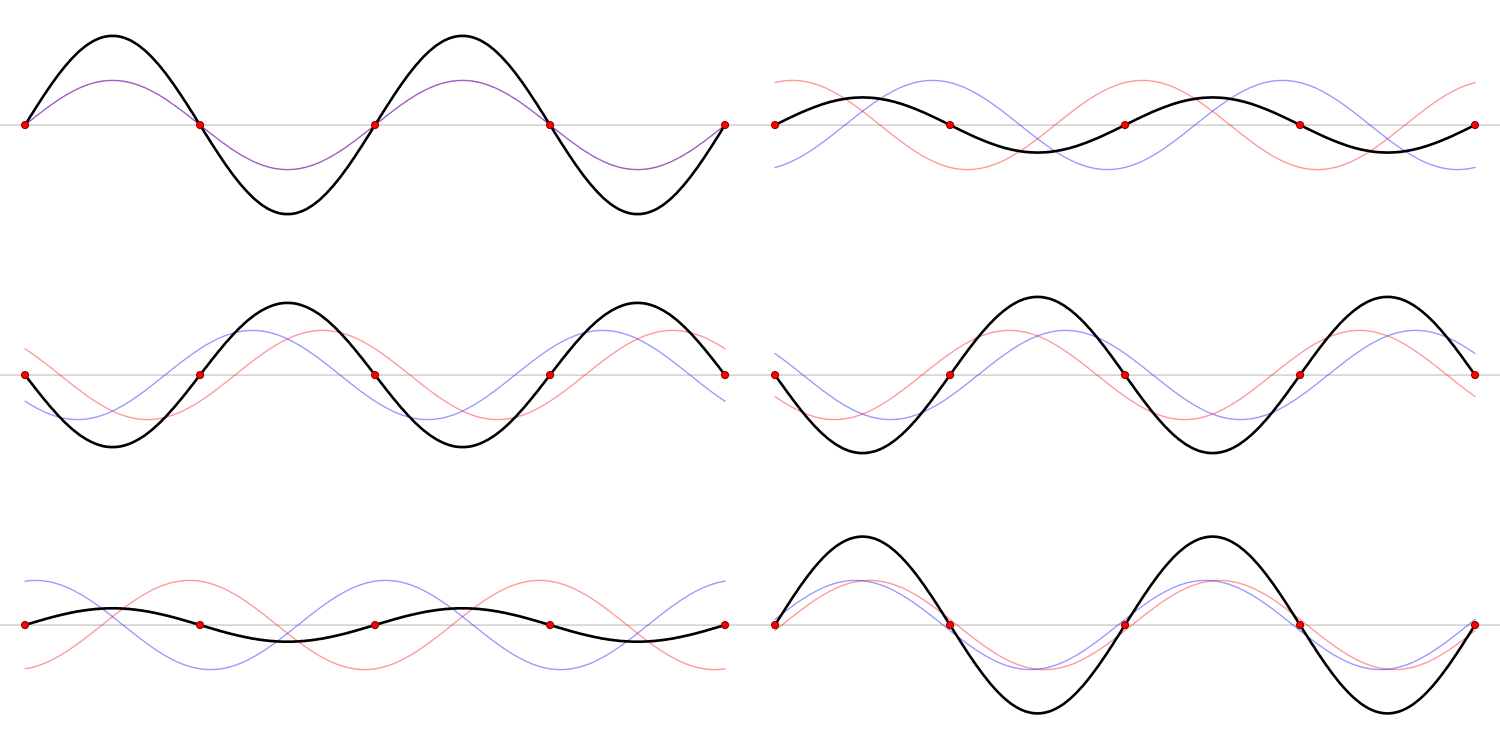
The wave no longer travels. It is a standing wave, and it has two kinds of special point:
- Nodes, where \sin(kx) = 0, so that point never moves at all, ever. They occur at x = 0, \lambda/2, \lambda, \dots — spaced half a wavelength apart.
- Antinodes, where \sin(kx) = \pm1 and the motion is largest. Halfway between the nodes, also half a wavelength apart.
Since nodes are \lambda/2 apart, the distance from a node to the neighbouring antinode is \lambda/4. That quarter-wavelength turns up constantly in acoustics and antenna design.
Why a string plays a particular note
A guitar string is clamped at both ends, so both ends are forced to be nodes. That is a boundary condition, and it is what turns a continuum of possible waves into a discrete set.
If nodes sit half a wavelength apart and there must be one at each end, the string's length L has to be a whole number of half-wavelengths:
L = n\frac{\lambda}{2} \quad\Longrightarrow\quad \lambda_n = \frac{2L}{n}, \qquad n = 1,2,3,\dots
Combined with v = f\lambda and the string speed from Chapter 2.3:
\boxed{f_n = \frac{nv}{2L} = \frac{n}{2L}\sqrt{\frac{F}{\mu}}}
Only these frequencies can survive on the string. Anything else interferes destructively with its own reflections and dies within milliseconds. This is the first appearance in this book of a phenomenon that will dominate Chapter 7: confinement produces quantisation. Trap a wave between boundaries and it can only have certain discrete frequencies. Trap an electron in an atom and exactly the same argument gives it discrete energies, and that is why atoms have spectral lines.
The n = 1 case is the fundamental:
f_1 = \frac{1}{2L}\sqrt{\frac{F}{\mu}}
and it is what your ear reports as the pitch. The higher ones, f_n = nf_1, are the harmonics, and they are all present at once.
Every part of playing a stringed instrument is in that formula:
- Fretting shortens L, raising the pitch. Halving L doubles f, which is one octave — which is why the twelfth fret sits at the midpoint of the string.
- Tuning changes F. Since f \propto \sqrt{F}, raising the pitch by an octave needs four times the tension, which is why strings break when you overtighten them and why tuning up is done gently.
- String gauge changes \mu. The low E string on a guitar is about six times the mass per length of the high E, and \sqrt{6} = 2.45, which is close to the ratio of their frequencies. Without that, the low string would have to be four times as long.
- Harmonics are played by touching the string lightly at a node position — say the midpoint — which kills every mode that needs motion there (n odd) and leaves the even ones. The note jumps up an octave and takes on a glassy quality.
Pipes: open and closed
Air columns work the same way with one twist: an open end must be a pressure antinode (the air can move freely) and a closed end must be a node (the air cannot move).
Open at both ends — a flute, an organ flue pipe. Antinodes at both ends, so the same condition as the string:
f_n = \frac{nv}{2L}, \qquad n = 1,2,3,\dots
All harmonics present.
Closed at one end — a clarinet, a stopped organ pipe, a bottle you blow across. Node at the closed end, antinode at the open one. The shortest wave that fits has a quarter wavelength in the tube:
L = \frac{\lambda}{4} \quad\Longrightarrow\quad f_1 = \frac{v}{4L}
and the next one that fits has three quarters, then five quarters:
f_n = \frac{nv}{4L}, \qquad n = 1,3,5,\dots \quad\textbf{odd only}
Two consequences follow immediately, and both are audible.
A closed pipe plays an octave lower than an open pipe of the same length, because v/4L is half of v/2L. This is why a stopped organ pipe saves half the height, and it is why a clarinet sounds far lower than a flute of similar size.
A closed pipe has only odd harmonics, and that is a large part of why a clarinet sounds hollow and reedy while a flute sounds pure and open. It also explains the clarinet's famous awkwardness: to jump to the next register the player must overblow to the third harmonic, an interval of a twelfth, rather than the octave every other woodwind gets. That single fact is why clarinet fingering is harder to learn than flute fingering.
Worked example. How long is an organ pipe that plays middle C (262 Hz) if it is open at both ends? If closed at one end?
Open:
L = \frac{v}{2f} = \frac{343}{524} = 0.65\ \text{m}
Closed:
L = \frac{v}{4f} = \frac{343}{1048} = 0.33\ \text{m}
And notice that both depend on v, which depends on temperature. A cold organ plays flat: dropping from 20 °C to 10 °C takes v from 343 to 337 m/s, which flattens every pipe by about 1.8% — a third of a semitone, badly audible. This is why churches heat the organ loft before a concert, and why an orchestra tunes after the players have warmed up, not before.
Timbre: why two instruments playing the same note sound different
Play middle C on a violin and on a flute and you can tell them apart instantly, even though both are producing 262 Hz. The pitch is identical. What differs is the mixture of harmonics — how much of 2f_1, 3f_1, 4f_1 and so on rides along with the fundamental. That mixture is called the timbre, and it is what an instrument's identity actually is.
- A flute is close to a pure sine wave — strong fundamental, weak harmonics. It sounds smooth and slightly hollow.
- A violin is rich in harmonics right up to the tenth and beyond, which is what makes it sound bright and cutting and able to sit on top of an orchestra.
- A clarinet has strong odd harmonics and weak even ones, for the closed-pipe reason above.
- A square wave from a synthesiser is odd harmonics with amplitudes falling as 1/n, which is why early video-game music has that particular buzz.
Which harmonics an instrument produces depends on where and how it is excited. Pluck a guitar string near the middle and you strongly excite the fundamental and suppress the even harmonics (whose node is there), giving a mellow tone. Pluck it near the bridge and you excite the high harmonics, giving a thin bright twang. Guitarists move their picking hand for exactly this reason and rarely think of it as physics.
The deep result behind all of this is Fourier's theorem: any periodic waveform, however complicated, is a sum of sine waves at integer multiples of its fundamental frequency. That means a note's shape and its harmonic content are two descriptions of the same thing, and converting between them is what your inner ear does mechanically (Chapter 2.2) and what every audio equaliser, MP3 encoder and voice assistant does numerically. Volume II, Part 9 develops the mathematics and Volume III, Part 5 turns it into the FFT algorithm.
Beats
Add two waves of nearly the same frequency, at a fixed point in space:
y = A\cos(2\pi f_1t) + A\cos(2\pi f_2t)
Use \cos P + \cos Q = 2\cos\frac{P+Q}{2}\cos\frac{P-Q}{2}:
y = 2A\cos\!\left[2\pi\frac{f_1+f_2}{2}t\right]\cos\!\left[2\pi\frac{f_1-f_2}{2}t\right]
Read the two factors separately.
The first oscillates at the average of the two frequencies. If they are 440 and 444 Hz, this is 442 Hz — a tone you hear at essentially the intended pitch.
The second oscillates at half the difference, 2 Hz here, which is far too slow to hear as a pitch. Instead it acts as a slowly changing amplitude on the first — an envelope.
The ear hears loudness, and loudness peaks whenever that envelope reaches either +1 or -1, which happens twice per cycle of the envelope. So the throbbing you hear is at the full difference:
\boxed{f_{\text{beat}} = |f_1-f_2|}
Two notes 4 Hz apart produce four throbs per second.
This is how every instrument in the world gets tuned by ear. Play your string against a reference and listen for the beats; adjust until they slow down and stop. The method is astonishingly sensitive — a beat every ten seconds means you are within 0.1 Hz, which is 0.02% at 440 Hz, far better than anyone can judge pitch directly. Piano tuners still work this way, and they deliberately leave small controlled beat rates in some intervals, because equal temperament requires it.
The same trick runs radio. A superheterodyne receiver mixes the incoming signal with a locally generated one and keeps the difference frequency, which lands the signal at a fixed intermediate frequency no matter which station was tuned. That means the fiddly amplification and filtering stages can be built once, for one frequency, instead of having to work across the whole band. Volume III, Chapter 7.2 builds it.
Where this shows up in your life
Anti-reflection coating on your glasses is destructive interference by design. A thin transparent layer is deposited so that light reflecting off its top surface and light reflecting off its bottom surface differ by half a wavelength and cancel. It works perfectly at one wavelength only, so the coating is tuned to the middle of the visible band and the extremes leak — which is the faint purple or green sheen you see on a coated lens. Chapter 5.3 does the thickness calculation.
Every wireless router with more than one antenna uses interference deliberately. By feeding the antennas with controlled phase differences, the constructive direction can be steered towards your device — this is beamforming, and it is why modern Wi-Fi holds up in a crowded flat where older kit did not.
And a microwave oven has hot and cold spots because its cavity supports standing waves, with nodes where the field is always zero. The turntable exists to drag your food through the antinodes. You can find the nodes: melt a tray of chocolate without the turntable, measure between the melted patches, and that distance is \lambda/2. Multiplying by the 2.45 GHz on the label gives you the speed of light in your kitchen, usually within a few percent.
What the next chapter fixes
Everything so far has assumed the source and the listener stay put. When either moves, the frequency you hear is not the frequency that was emitted — and the four cases (source approaching, source receding, observer approaching, observer receding) are not the same formula with a sign flipped, which is the trap. Chapter 2.5 derives all four from scratch, explains shock waves and sonic booms as the limiting case, and closes Part 2 with what happens when the source outruns its own sound.