Appearance
11.1 — The Sky Itself
Everything in this Part is built on measurements people made by looking up, with no instruments, over thousands of years. The positions of stars, the wandering of planets, the timing of eclipses and the slow drift of the pole were all recorded to remarkable precision long before anyone knew what any of it was.
This chapter covers what you can actually see and why it moves the way it does, because the orbital mechanics of the rest of the Part is easier once the geometry is clear.
The celestial sphere
Project every star onto an imaginary sphere centred on the Earth. It is not a physical object and it is not a belief about the universe — it is a coordinate system, and it works because the stars are so far away that only their directions matter.
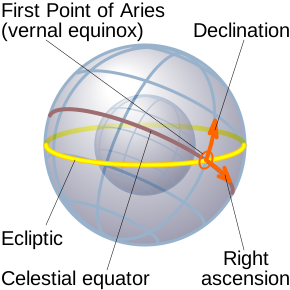
Declination (\delta) is celestial latitude, from -90° to +90°. The Earth's equator projected outwards is the celestial equator at \delta = 0.
Right ascension (\alpha) is celestial longitude, measured in hours from 0 to 24 rather than in degrees, because the sky turns 15° per hour. The zero point is the vernal equinox — where the Sun crosses the celestial equator going north.
Two immediate practical results.
Your latitude equals the altitude of the celestial pole. Stand at latitude \phi and Polaris sits \phi degrees above the northern horizon. This is why celestial navigation works, and it is the oldest instrument-based measurement in existence.
A star at declination \delta is circumpolar — never setting — if \delta > 90°-\phi. From London at 51.5°N, everything above \delta = 38.5° circles the pole and never touches the horizon. From the equator nothing is circumpolar and you can see the entire sky over a year. From the pole you see exactly half of it, forever.
And a star's maximum altitude as it crosses the meridian is:
h = 90°-\phi+\delta
Worked example. Sirius has \delta = -16.7°. From London:
h = 90-51.5-16.7 = 21.8°
Low in the southern sky, which is why it twinkles so dramatically from northern latitudes — its light passes through far more atmosphere.
Two kinds of day
The sidereal day is one rotation relative to the stars: 23h 56m 4.1s.
The solar day is one rotation relative to the Sun: 24h 00m exactly, on average.
The difference is orbital motion. In one day the Earth moves about 1° along its orbit, so it must turn about 1° extra to bring the Sun back to the meridian.
\frac{1°}{360°}\times24\ \text{h} = 4\ \text{minutes}
Which is exactly the 3m 56s difference.
The practical consequence: the stars rise four minutes earlier each night, so a given constellation returns to the same place two hours earlier each month, and the sky at midnight in January is the sky at 8 pm in March. Over a year the whole cycle repeats.
And solar days are not all equal, which is why "on average" appears above. Two effects make the true Sun run ahead of or behind clock time:
The orbit is elliptical, so the Earth moves faster near perihelion in early January.
The axis is tilted, so the Sun's motion along the ecliptic is not parallel to the equator.
Together they give the equation of time, which swings between about -14 minutes in February and +16 minutes in November. Plot the Sun's position at the same clock time all year and you get a figure-of-eight called an analemma — and it is why the earliest sunset does not fall on the shortest day.
Why we have seasons
Not because of distance. The Earth is closest to the Sun on about 3 January — during northern winter — and the variation is only 3.4 %, giving a 7 % change in received energy. If distance were the cause, both hemispheres would have summer together.

The cause is the 23.44° axial tilt, and it acts through two mechanisms that reinforce each other.
1. Angle of incidence. Sunlight arriving at angle \theta from the vertical spreads its energy over a larger area:
\text{Intensity} \propto \cos\theta
Worked example. At London's 51.5°N at midsummer noon, the Sun is 90-51.5+23.4 = 61.9° up, so \theta = 28.1° and \cos\theta = 0.882. At midwinter noon it is 90-51.5-23.4 = 15.1° up, so \theta = 74.9° and \cos\theta = 0.260.
\frac{0.882}{0.260} = 3.4
Three and a half times the intensity per square metre.
2. Day length. Summer days at 51.5°N run about 16.6 hours against winter's 7.8.
\frac{16.6}{7.8} = 2.1
Combined: about seven times the daily energy in summer. That is the seasons, and neither factor alone would be enough.
The Arctic Circle at 66.56°N is exactly 90°-23.44°, the latitude at which the Sun does not set at midsummer. The Tropics at 23.44° are where it can be directly overhead.
And the seasons lag the solstices by about six weeks — the hottest weather is in late July, not late June — because the ground and oceans take time to warm. That is thermal inertia, and it is water's heat capacity from Chapter 3.1 acting on a planetary scale.
Eclipses

Why not every month? The Moon's orbit is tilted 5.1° to the ecliptic, so it usually passes above or below the Sun–Earth line. Eclipses happen only when a new or full Moon coincides with the Moon crossing the ecliptic plane — at one of the two nodes.
And this is the origin of the word "eclipse season", which occurs twice a year and lasts about 34 days.
The most remarkable coincidence in the sky. The Sun is 400 times the Moon's diameter and 400 times further away, so both subtend almost exactly half a degree.
\theta_{\text{Sun}} = \frac{1.392\times10^{9}}{1.496\times10^{11}} = 9.30\times10^{-3}\ \text{rad} = 0.533°
\theta_{\text{Moon}} = \frac{3.475\times10^{6}}{3.844\times10^{8}} = 9.04\times10^{-3}\ \text{rad} = 0.518°
Almost identical, and there is no physical reason for it. It is why total solar eclipses show the corona — the Moon covers the photosphere and nothing more — and no other planet in the solar system has this.
And it is temporary. Lunar laser ranging (Chapter 5.1) shows the Moon receding at 3.8 cm per year, so total eclipses will cease in about 600 million years. We happen to be alive during the era when they are possible.
Because the orbits are elliptical, the Moon sometimes appears slightly smaller than the Sun, giving an annular eclipse with a ring of Sun visible around it. About 33 % of solar eclipses are total, 35 % annular, and the rest partial or hybrid.
The saros cycle. Eclipses repeat with a period of 6585.32 days — 18 years, 11 days, 8 hours — because three separate lunar periods happen to come into near-alignment after that interval. The Babylonians knew this by about 500 BC and could predict eclipses without any model of what was happening.
The 8-hour remainder means each repeat is visible 120° further west, so a given saros series returns to the same region only every three cycles — 54 years.
Precession

The Earth is not a sphere. Its rotation makes it bulge at the equator by about 21 km, and because the axis is tilted, the Sun and Moon pull on that bulge unevenly and exert a torque.
A torque on a spinning body causes precession (Chapter 1.8) — the axis traces a cone rather than tipping over.
Period: 25,772 years.
Hipparchus discovered it in 127 BC by comparing his own star positions with Babylonian records from 150 years earlier and finding the whole sky shifted by about 2°. A 2° discrepancy in old data, correctly attributed.
Consequences:
The pole star changes. Polaris is within 0.7° of the pole now and will be closest around 2100. In 3000 BC it was Thuban in Draco; in 14,000 AD it will be Vega. The Egyptians aligned pyramid shafts on Thuban.
The equinoxes drift through the constellations at about 1° per 72 years, so the astrological signs no longer match the constellations they were named for. The Sun is in Ophiuchus in early December, a constellation astrology does not use.
And it drives ice ages, in combination with two other cycles. The Milankovitch cycles are precession (26,000 years), obliquity variation between 22.1° and 24.5° (41,000 years), and orbital eccentricity variation (100,000 and 413,000 years). Together they modulate the summer sunlight reaching high northern latitudes, which controls whether ice sheets survive the summer. The 100,000-year rhythm of the last million years of glacial cycles matches the eccentricity period, though why that weak forcing dominates is still debated.
Magnitudes
The brightness scale is inherited from Hipparchus, who ranked stars from 1 (brightest) to 6 (faintest visible). It was formalised in 1856 once it was realised that the eye's response is logarithmic.
m_1-m_2 = -2.5\log_{10}\frac{F_1}{F_2}
A difference of 5 magnitudes is exactly a factor of 100 in brightness, so each magnitude is 100^{1/5} = 2.512.
And smaller means brighter, which is a persistent nuisance.
| Object | Apparent magnitude |
|---|---|
| Sun | -26.7 |
| Full Moon | -12.7 |
| Venus at brightest | -4.9 |
| Sirius | -1.46 |
| Vega | 0.03 |
| Naked-eye limit | ~6 |
| Binocular limit | ~10 |
| Hubble limit | ~31 |
The Sun is 25 magnitudes brighter than the naked-eye limit, which is a factor of 10^{10}.
Absolute magnitude removes distance by defining the brightness a star would have at 10 parsecs:
M = m-5\log_{10}\left(\frac{d}{10\ \text{pc}}\right)
Worked example: the Sun. At d = 4.848\times10^{-6} pc:
M = -26.74-5\log_{10}(4.848\times10^{-7}) = -26.74-5(-6.314) = -26.74+31.57 = +4.83
Absolute magnitude 4.83. Move the Sun to 10 parsecs and it would be a barely noticeable star, invisible from any city.
Distances
Parallax is the only direct method, and everything else is calibrated against it.
As the Earth orbits, a nearby star appears to shift against the distant background. Measure the angle and the geometry gives the distance:
d\ (\text{parsecs}) = \frac{1}{p\ (\text{arcseconds})}
This is the definition of the parsec — the distance at which a star shows one arcsecond of parallax. It equals 3.26 light years, or 3.086\times10^{16} m.
Worked example: Proxima Centauri, the nearest star, with p = 0.7687'':
d = \frac{1}{0.7687} = 1.301\ \text{pc} = 4.24\ \text{light years}
Nobody could measure it for two thousand years, and this was the strongest argument against Copernicus. If the Earth moved, the stars should shift — and no shift could be found, so either the Earth was stationary or the stars were unimaginably far away.
Tycho Brahe, the best naked-eye observer in history, could measure to about 1 arcminute and found nothing. Since 1 arcminute of parallax corresponds to 60 parsecs, his null result put the stars beyond 60 parsecs, which he found absurd — so he rejected Copernicus.
Bessel finally measured one in 1838 — 61 Cygni, at 0.314 arcseconds — 295 years after Copernicus.
Gaia, the European space observatory, has measured parallaxes for about 1.5 billion stars to a precision of tens of microarcseconds, reaching to tens of thousands of parsecs. It has transformed the entire distance scale, and Chapter 11.9 covers the rest of the ladder.
Where this shows up in your life
Every calendar is an attempt to reconcile three incommensurable periods: the day, the lunar month (29.53 days) and the year (365.2422 days). None divides into another, which is why calendars are complicated.
The Gregorian reform of 1582 dropped ten days and changed the leap rule to omit centuries not divisible by 400. The resulting year of 365.2425 days is off by 26 seconds, giving one day of error in 3300 years. Britain adopted it in 1752 and skipped eleven days.
Time zones exist because local solar noon differs by four minutes per degree of longitude.
Sundials must be corrected by the equation of time and aligned to the celestial pole, not vertically.
Solar panel installation angles use the declination formulas above, and the optimum tilt is roughly the latitude.
And celestial navigation still works, is still taught, and is still carried on ships as a backup — because it needs no satellite, no power and no infrastructure.
What the next chapter fixes
The sky has been described from the Earth's point of view. Chapter 11.2 goes to the objects themselves — each planet and what makes it strange, the moons that are more interesting than most planets, the asteroids and comets, and the model of how the whole system formed from a collapsing cloud, including the parts of that model that have been overturned in the last twenty years by finding planetary systems that look nothing like ours.