Appearance
7.3 — The Wavefunction and the Schrödinger Equation
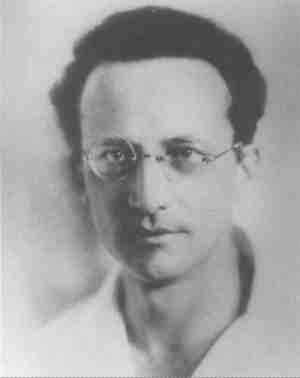
Over Christmas 1925, Erwin Schrödinger went to a chalet in Arosa in the Swiss Alps with a girlfriend whose identity has never been established, and came back with an equation.
Peter Debye had provoked him at a seminar in Zurich a few weeks earlier. Schrödinger had presented de Broglie's matter waves, and Debye said something to the effect that talking about waves without a wave equation was childish. Schrödinger took the criticism seriously.
The wavefunction
The state of a quantum system is described by a wavefunction:
\psi(x,t)
Read as psi of x and t. It is a complex-valued function of position and time — meaning at each point it has a real part and an imaginary part.
Complex numbers are not a calculational convenience here; they are essential. In electrical engineering (Volume III, Chapter 1.6) complex numbers are used to keep track of phase and the physical answer is the real part. Here, \psi itself is complex and there is no "take the real part at the end". The imaginary unit i appears in the fundamental equation and cannot be removed.
Why? Because interference requires amplitudes that can cancel, and because i is what makes a wave evolve by rotating its phase rather than by growing or decaying. Chapter 7.2 showed that adding amplitudes Ae^{i\phi_1}+Ae^{i\phi_2} gives the interference term. Real numbers cannot do this while keeping probabilities positive.
The Born rule
\psi itself is not observable. What is:
\boxed{P(x)\,dx = |\psi(x)|^2dx = \psi^*\psi\,dx}
where \psi^* is the complex conjugate (i \to -i). The probability of finding the particle between x and x+dx.
The squared magnitude is always real and non-negative, which is exactly what a probability density needs to be. For a complex number z = a+bi, |z|^2 = a^2+b^2.
Max Born proposed this in 1926 — famously in a footnote added in proof, having first written something slightly different in the main text. Einstein never accepted it, and this is the context of his "God does not play dice" remark, written to Born in 1926.
Normalisation
The particle must be somewhere, so the total probability is 1:
\boxed{\int_{-\infty}^{\infty}|\psi(x)|^2dx = 1}
This is not automatic; it is a condition imposed on any physically acceptable \psi, and it fixes the overall scale of the function.
Worked example. A particle has \psi(x) = Ae^{-x^2/2a^2}. Find A.
\int_{-\infty}^{\infty}A^2e^{-x^2/a^2}dx = A^2\,a\sqrt{\pi} = 1
using the standard Gaussian integral \int e^{-x^2/a^2}dx = a\sqrt{\pi}.
A = \frac{1}{\sqrt{a\sqrt{\pi}}} = (\pi a^2)^{-1/4}
Conditions on a physical wavefunction:
- Single-valued — one probability per place.
- Continuous — no jumps, or the momentum would be infinite.
- Its first derivative continuous, except where the potential is infinite.
- Square-integrable — the integral above must converge, which means \psi \to 0 at infinity.
These sound like technicalities and they are exactly what forces quantisation. Chapter 7.4 shows that requiring a solution to satisfy the boundary conditions eliminates all but a discrete set of energies.
Phase is real, global phase is not
Multiply \psi by e^{i\theta} for a constant \theta and nothing measurable changes, since |e^{i\theta}\psi|^2 = |\psi|^2. Global phase is unobservable.
Relative phase between two parts of a wavefunction is entirely observable, because that is what produces interference. This distinction runs through all of quantum mechanics and it is why \psi is not simply a probability distribution wearing a disguise.
Deriving the Schrödinger equation
There is no derivation from more basic principles — the equation is a postulate, in the same way Newton's second law is. But there is a construction that makes it look inevitable, and it is worth following.
Step 1: write down a free-particle wave. A wave travelling in the +x direction with wavenumber k = 2\pi/\lambda and angular frequency \omega = 2\pi f:
\psi(x,t) = Ae^{i(kx-\omega t)}
Step 2: bring in de Broglie and Planck. From Chapter 7.2, p = h/\lambda = \hbar k, and from Chapter 7.1, E = hf = \hbar\omega. So:
\psi = Ae^{i(px-Et)/\hbar}
Step 3: differentiate and see what comes out.
\frac{\partial\psi}{\partial t} = -\frac{iE}{\hbar}\psi \quad\Longrightarrow\quad E\psi = i\hbar\frac{\partial\psi}{\partial t}
\frac{\partial\psi}{\partial x} = \frac{ip}{\hbar}\psi \quad\Longrightarrow\quad p\psi = -i\hbar\frac{\partial\psi}{\partial x}
\frac{\partial^2\psi}{\partial x^2} = -\frac{p^2}{\hbar^2}\psi \quad\Longrightarrow\quad p^2\psi = -\hbar^2\frac{\partial^2\psi}{\partial x^2}
These are the operator correspondences, and they are the heart of the construction:
E \to i\hbar\frac{\partial}{\partial t}, \qquad p \to -i\hbar\frac{\partial}{\partial x}
Step 4: impose energy conservation. For a particle in a potential V(x):
E = \frac{p^2}{2m}+V
Replace each quantity by its operator and let both sides act on \psi:
\boxed{i\hbar\frac{\partial\psi}{\partial t} = -\frac{\hbar^2}{2m}\frac{\partial^2\psi}{\partial x^2}+V(x)\psi}
The time-dependent Schrödinger equation.
Reading it term by term
\underbrace{i\hbar\frac{\partial\psi}{\partial t}}_{\text{how the state changes}} = \underbrace{-\frac{\hbar^2}{2m}\frac{\partial^2\psi}{\partial x^2}}_{\text{kinetic energy}} + \underbrace{V(x)\psi}_{\text{potential energy}}
Left side: the rate of change of the wavefunction. The i means the change is a rotation of phase rather than growth or decay, which is what keeps the total probability at 1.
First term on the right: the kinetic energy operator. The second derivative measures curvature, so the more sharply the wavefunction bends, the more kinetic energy it has. That is a genuinely useful intuition: a wave squeezed into a small box must bend sharply and therefore carries a lot of kinetic energy, which is why confinement costs energy and why atoms do not collapse.
Second term: the potential energy, multiplying the wavefunction point by point. This is where the physics of the particular problem enters — Coulomb attraction for hydrogen, a square well for a quantum dot, a barrier for tunnelling.
How it differs from a classical wave equation
Compare with Chapter 2.3's wave equation:
\frac{\partial^2y}{\partial t^2} = v^2\frac{\partial^2y}{\partial x^2}
Two differences, and both matter.
First order in time, not second. So specifying \psi at one instant determines it forever after — you do not need an initial "velocity" as well. This is why the wavefunction is the complete description of the state.
It contains i. So the solutions are irreducibly complex. A classical wave equation has real solutions; this one does not.
The time-independent equation
Most problems have a potential that does not change with time, and then the equation separates.
Try \psi(x,t) = \phi(x)T(t). Substituting and dividing by \phi T:
i\hbar\frac{1}{T}\frac{dT}{dt} = \frac{1}{\phi}\left[-\frac{\hbar^2}{2m}\frac{d^2\phi}{dx^2}+V\phi\right]
The left depends only on t, the right only on x, so both must equal the same constant. Call it E — and it will turn out to be the energy.
Time part:
i\hbar\frac{dT}{dt} = ET \quad\Longrightarrow\quad T(t) = e^{-iEt/\hbar}
Space part:
\boxed{-\frac{\hbar^2}{2m}\frac{d^2\phi}{dx^2}+V(x)\phi = E\phi}
The time-independent Schrödinger equation, and it is what gets solved in practice.
Stationary states
Solutions of the form \psi = \phi(x)e^{-iEt/\hbar} are called stationary states, and the name deserves explanation because the wavefunction is very clearly changing.
|\psi(x,t)|^2 = |\phi(x)|^2\left|e^{-iEt/\hbar}\right|^2 = |\phi(x)|^2
The probability density does not change with time, because the time dependence is a pure phase of magnitude 1. The wavefunction rotates in the complex plane; the observable distribution stands still.
This answers a question Bohr could not. Chapter 7.1 noted that classical physics says an orbiting electron must radiate and spiral in. In a stationary state, the charge distribution is genuinely static — there is nothing oscillating to radiate. Atoms are stable because their ground states are stationary.
And the energy is definite. These states have one exact energy E, unlike general states which are superpositions with a spread.
Superposition
The Schrödinger equation is linear: if \psi_1 and \psi_2 are solutions, so is a\psi_1+b\psi_2 for any complex a and b.
This is the superposition principle, and it is where the strangeness lives.
\psi = a\psi_1+b\psi_2
with |a|^2+|b|^2 = 1 for normalisation.
Measure the energy and you get E_1 with probability |a|^2 or E_2 with probability |b|^2. Never anything in between. And after the measurement, the state is whichever one you found — the other term is gone.
This is not ignorance. A state that is "either \psi_1 or \psi_2, we do not know which" behaves differently from a\psi_1+b\psi_2, and the difference is measurable. The superposition produces interference terms; the ignorance does not. That is exactly the double-slit result of Chapter 7.2.
Schrödinger's cat was Schrödinger's own objection to this, published in 1935 and intended as a reduction to absurdity. Put a cat in a box with a device that kills it if a radioactive atom decays. The atom is in a superposition of decayed and not-decayed. If the linearity of the equation applies to everything, the cat is in a superposition of alive and dead.
Schrödinger thought this obviously ridiculous and therefore a proof that something was missing. The modern answer is decoherence (Chapter 7.8): the cat is a macroscopic object in constant contact with its environment, air molecules and photons scatter off it continuously, and the which-state information leaks into the surroundings within about 10^{-30} seconds. The superposition is destroyed faster than any measurement could catch it, not by observation but by the sheer number of interactions.
Expectation values
Measure position on many identically prepared systems and average:
\langle x\rangle = \int_{-\infty}^{\infty}\psi^*x\psi\,dx = \int x|\psi|^2dx
which is the ordinary average of x weighted by the probability.
For momentum, replace p by its operator, and the position of the operator between \psi^* and \psi matters:
\langle p\rangle = \int\psi^*\left(-i\hbar\frac{\partial}{\partial x}\right)\psi\,dx
The general rule: for an observable with operator \hat{A},
\langle A\rangle = \int\psi^*\hat{A}\psi\,dx
Chapter 7.5 develops the operator formalism.
Ehrenfest's theorem
Compute how \langle x\rangle and \langle p\rangle change in time and you find:
\frac{d\langle x\rangle}{dt} = \frac{\langle p\rangle}{m}, \qquad \frac{d\langle p\rangle}{dt} = \left\langle -\frac{dV}{dx}\right\rangle = \langle F\rangle
These are Newton's laws, for the averages. Velocity is momentum over mass; rate of change of momentum is force.
So classical mechanics is recovered as a statement about expectation values. A baseball's wavefunction is so sharply peaked, and its de Broglie wavelength so tiny, that the spread is undetectable and the average is the trajectory. Paul Ehrenfest proved this in 1927, and it is the quantum version of the correspondence check that Chapter 6.2 did for relativity.
Probability current and conservation
If probability is conserved, there should be a continuity equation like the one for charge or fluid. There is.
Define the probability current:
j = \frac{\hbar}{2mi}\left(\psi^*\frac{\partial\psi}{\partial x}-\psi\frac{\partial\psi^*}{\partial x}\right)
Then, from the Schrödinger equation directly:
\frac{\partial|\psi|^2}{\partial t}+\frac{\partial j}{\partial x} = 0
Read it: the probability density at a point changes only because probability flows in or out. Nothing is created or destroyed. This is why normalisation, once imposed, stays true forever — and it is a direct consequence of the i in the equation, which is one concrete reason the complex number is not optional.
For a plane wave \psi = Ae^{i(kx-\omega t)}, working it through gives:
j = |A|^2\frac{\hbar k}{m} = |A|^2v
Density times velocity, exactly as for a flowing fluid. Chapter 7.4 uses this to compute what fraction of particles get through a barrier.
What the equation is worth
The Schrödinger equation, applied to real problems, gives:
- The hydrogen atom exactly, including all its energy levels and the shapes of its orbitals (Chapter 7.6).
- The periodic table, once electron spin is added (Chapter 9.3).
- Chemical bonding, from which all of chemistry follows (Chapter 10.1).
- The energy bands of solids, from which semiconductors and transistors follow.
- Tunnelling, and hence radioactive decay, flash memory and fusion in the Sun (Chapter 7.4).
- Superconductivity, lasers, and quantum computing.
Quantum electrodynamics, its relativistic descendant, predicts the electron's magnetic moment to twelve significant figures and agrees with experiment at every one. It is the most precisely tested theory in the history of science, by a considerable margin.
And it is not relativistic. The equation above uses E = p^2/2m, which is the Newtonian kinetic energy. Making it relativistic gives first the Klein–Gordon equation and then, correctly for electrons, the Dirac equation of 1928 — which predicted antimatter as an unavoidable consequence, and which Chapter 7.10 covers.
Where this shows up in your life
Every transistor. Its behaviour is computed from the Schrödinger equation applied to a periodic crystal lattice, and modern devices with 3 nm features are firmly in the regime where the wave nature dominates.
Flash memory stores a bit by tunnelling electrons through an insulating barrier, computed directly from this equation (Chapter 7.4).
Every drug designed in the last thirty years was screened with computational chemistry software that solves an approximate version of this equation to predict how a molecule binds to a protein.
LEDs and solar cells are band-structure calculations.
MRI, atomic clocks, and GPS's timing all rest on transition frequencies computed from it.
What the next chapter fixes
The equation is written down and not yet solved for anything. Chapter 7.4 solves it for the cases that matter: a particle in a box, which produces quantised energy levels from nothing but boundary conditions and explains the colour of a quantum dot; a barrier, which produces tunnelling and therefore radioactive decay, the fusion that powers the Sun, and the memory in your phone; and the harmonic oscillator, which turns out to be the single most important solved problem in physics because everything near a stable equilibrium looks like one.