Appearance
4.1 — Charge and the Electric Field
Rub a balloon on your hair and it sticks to a wall. Pull a jumper off in the dark and you see sparks. Walk across a carpet and get a shock from a doorknob. These are the same phenomenon, they were known to the Greeks — the word electron is Greek for amber, which is what Thales rubbed in about 600 BC — and nobody understood them for two thousand three hundred years.
What was missing was the idea that there is a quantity involved, something that can be measured, that comes in two kinds, and that is never created or destroyed. That quantity is charge, and this Part builds everything from it: the force between charges, the fields they make, the currents they form when they move, the magnetism that appears when they move, and finally four equations that contain the whole subject and predict light.
Charge: two kinds, conserved, and quantised
There are exactly two kinds of charge. Benjamin Franklin named them positive and negative in the 1750s, and his choice was arbitrary and, as it turned out, unlucky — he decided that the thing which flows in a wire is positive, and it is actually the electron, which is negative. Every circuit diagram in the world still draws current flowing from plus to minus while the electrons go the other way. It makes no difference to any calculation and it confuses every student.
Like charges repel and unlike charges attract. That single rule explains the balloon: rubbing transfers electrons from your hair to the balloon, leaving the balloon negative and your hair positive, and the negative balloon then pushes electrons in the wall slightly away from the surface, leaving the near surface positive, so the two attract.
Charge is conserved. In every process ever observed, the total charge before equals the total charge after. Rubbing does not create charge; it moves it. When a photon of light converts into an electron and a positron — which really happens, and Chapter 7.10 explains it — the electron's -e and the positron's +e add to zero, exactly matching the photon's zero. There is no known exception.
Charge is quantised. It comes in multiples of a fundamental unit:
e = 1.602176634\times10^{-19}\ \text{C}
The unit is the coulomb, and since the 2019 SI redefinition (Chapter 1.1) that number is exact by definition. An electron carries -e, a proton +e, and every free particle ever measured carries an integer multiple of e. Quarks carry \pm\frac{1}{3}e and \pm\frac{2}{3}e, but they are never found alone (Chapter 8.3 explains why), so everything you can hold in your hand comes in whole units of e.
Robert Millikan measured e in 1909 by suspending tiny charged oil drops between two charged plates and adjusting the voltage until a drop hung motionless. At that moment the electric force upwards balanced gravity downwards, and since he could measure the drop's mass from how fast it fell with the field off, he could solve for its charge. Every drop gave a multiple of the same number.
The coulomb is enormous. One coulomb is 1/1.602\times10^{-19} = 6.24\times10^{18} elementary charges. A lightning bolt carries perhaps 15 C. The static charge on a balloon is around 10^{-8} C. Two 1 C charges one metre apart would repel with a force of nine billion newtons, which is the weight of a million tonnes. You will never see one coulomb of net static charge anywhere, and the reason the unit is so unwieldy is historical: it was defined from the ampere, which was defined from a magnetic force that was convenient to measure.
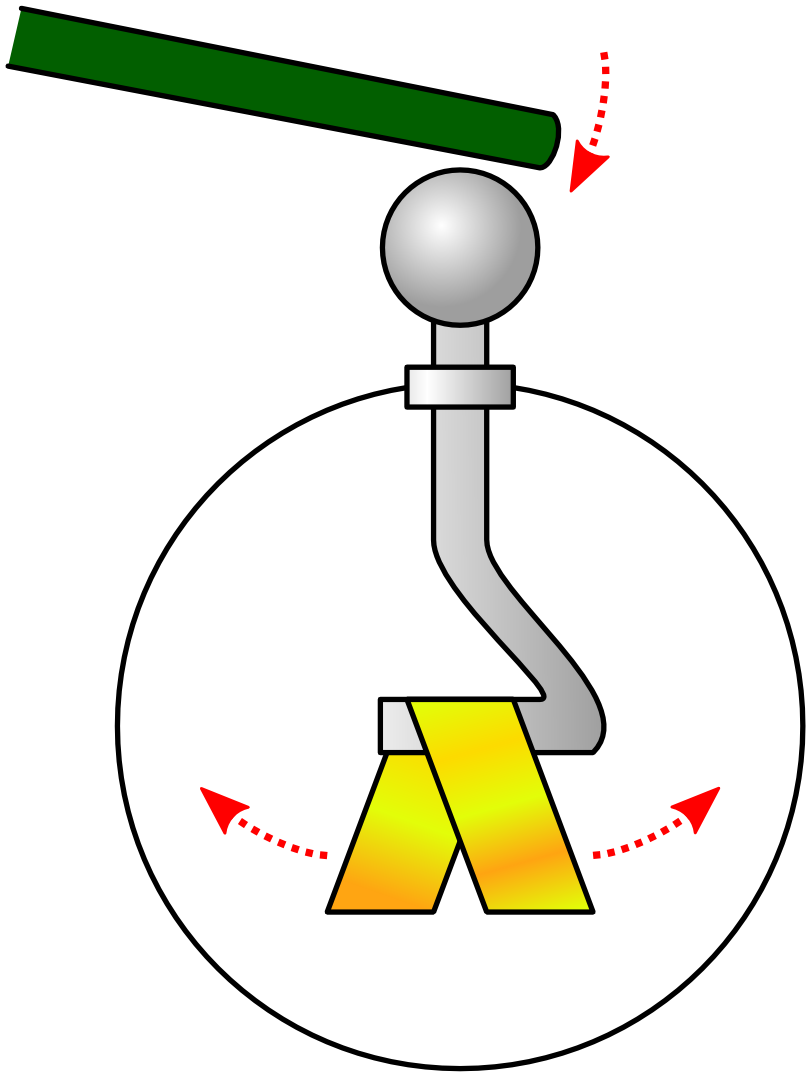
This device is worth understanding because it is the whole of electrostatics in one object. Touch a charged rod to the knob and charge spreads over the conductor, including onto the two leaves. Both leaves now carry the same sign, so they repel and stand apart. Bring a charged object near without touching, and the leaves still move — charge inside the conductor rearranges itself in response, a process called induction, which is the key to Chapter 4.2.
Coulomb's law
Charles-Augustin de Coulomb measured the force between charges in 1785 using a torsion balance: a light rod hung from a fine wire, with a charged ball at each end, so that a tiny force twists the wire by a readable angle. It is essentially the same instrument Cavendish later used to measure G (Chapter 1.9), and the results look strikingly similar:
\boxed{F = k\frac{q_1q_2}{r^2}}
Read aloud: F equals k q-one q-two over r-squared — the force between two point charges is proportional to the product of the charges and inversely proportional to the square of the distance between them.
The constant is:
k = \frac{1}{4\pi\varepsilon_0} = 8.988\times10^{9}\ \text{N m}^2\text{C}^{-2}
where \varepsilon_0 (epsilon-nought) is the permittivity of free space, 8.854\times10^{-12} C² N⁻¹ m⁻². The 4\pi in the denominator looks like an ugly convention, and it is there for a good reason that Chapter 4.2 makes obvious: a point charge spreads its influence over a sphere, and the surface area of a sphere is 4\pi r^2, so putting the 4\pi into the constant makes it cancel out of the more fundamental equations.

How similar is this to gravity, and how different?
Put the two force laws side by side:
F_{\text{grav}} = G\frac{m_1m_2}{r^2}, \qquad F_{\text{elec}} = \frac{1}{4\pi\varepsilon_0}\frac{q_1q_2}{r^2}
Both fall off as the inverse square. Both act along the line joining the two objects. Both have a constant out front. The mathematics is identical, which is why every result derived for one — the shell theorem, potential energy, orbits — transfers directly.
Two differences matter enormously.
Gravity has one sign; electricity has two. Mass is always positive so gravity always attracts, and it therefore accumulates: pile up more matter and the force grows without limit, which is why gravity runs the universe at large scales. Charge comes in two signs that cancel, so large objects are almost exactly neutral and their electric forces cancel to nothing.
Electricity is stupendously stronger. Compare the two forces between a single proton and a single electron in a hydrogen atom, 5.3\times10^{-11} m apart.
Electric:
F_e = \frac{(8.988\times10^{9})(1.602\times10^{-19})^2}{(5.3\times10^{-11})^2} = \frac{(8.988\times10^{9})(2.566\times10^{-38})}{2.809\times10^{-21}} = 8.21\times10^{-8}\ \text{N}
Gravitational, with m_p = 1.673\times10^{-27} kg and m_e = 9.109\times10^{-31} kg:
F_g = \frac{(6.674\times10^{-11})(1.673\times10^{-27})(9.109\times10^{-31})}{2.809\times10^{-21}} = 3.62\times10^{-47}\ \text{N}
\frac{F_e}{F_g} = \frac{8.21\times10^{-8}}{3.62\times10^{-47}} = 2.3\times10^{39}
Two thousand billion billion billion billion times stronger. Writing that out: the electric force is 2{,}300{,}000{,}000{,}000{,}000{,}000{,}000{,}000{,}000{,}000{,}000{,}000{,}000 times gravity's between the same pair.
That ratio explains the structure of everyday life. Every force you meet that is not gravity — the floor holding you up, friction, tension in a rope, the hardness of a table, chemical bonds, muscle contraction — is electromagnetic, arising from charges in atoms pushing and pulling on charges in neighbouring atoms. Gravity only competes because a planet has 10^{50} atoms all pulling the same way while their charges cancel.
It also explains why the ratio is a famous unsolved problem. There is no accepted reason why gravity should be 10^{39} times weaker than electromagnetism rather than, say, ten times. This is the hierarchy problem, and Chapter 8.7 covers the attempts to explain it.
Worked example: three charges in a line
Charges $q_1 = +3.0\ \mu$C, $q_2 = -2.0\ \mu$C and $q_3 = +5.0\ \mu$C sit on a straight line at x = 0, x = 0.20 m and x = 0.50 m. Find the net force on q_2.
Forces from separate charges simply add as vectors — this is the principle of superposition, and it is an experimental fact rather than a logical necessity, though it holds to extraordinary precision.
Force from q_1 on q_2. They are opposite signs, so it is attractive, pulling q_2 towards q_1, which is in the -x direction. Separation 0.20 m.
F_{12} = \frac{(8.988\times10^{9})(3.0\times10^{-6})(2.0\times10^{-6})}{(0.20)^2} = \frac{(8.988\times10^{9})(6.0\times10^{-12})}{0.040} = \frac{5.393\times10^{-2}}{0.040} = 1.348\ \text{N}
Direction: -x.
Force from q_3 on q_2. Also opposite signs, so attractive, pulling q_2 towards q_3, which is +x. Separation 0.30 m.
F_{32} = \frac{(8.988\times10^{9})(5.0\times10^{-6})(2.0\times10^{-6})}{(0.30)^2} = \frac{8.988\times10^{-2}}{0.090} = 0.999\ \text{N}
Direction: +x.
Net:
F = -1.348 + 0.999 = -0.349\ \text{N}
0.349 N in the -x direction, towards q_1.
Note the size of it. Three microcoulombs is a substantial static charge, hard to produce and harder to hold, and the force is a third of a newton — the weight of a small apple. Now recall that this is the force that is 10^{39} times stronger than gravity. The reason electric forces are not tearing the world apart is entirely that charge cancels.
The field: getting rid of action at a distance
Coulomb's law says charge 1 exerts a force on charge 2 across empty space, instantaneously, with nothing in between. That bothered people from the beginning, and it should. How does charge 2 know charge 1 is there? What carries the message? And what happens in the gap while the message is in transit?
Michael Faraday, who had almost no mathematics but exceptional physical imagination, proposed a different picture in the 1830s. A charge fills the space around it with a condition — a field — and any other charge responds to the field at its own location, not to the distant charge.
Define the electric field at a point as the force a unit positive charge would feel if placed there:
\boxed{\vec{E} = \frac{\vec{F}}{q_0}}
with units of newtons per coulomb. The field exists whether or not there is anything at that point to feel it. For a single point charge Q, put a test charge q_0 at distance r, use Coulomb's law and divide:
E = \frac{1}{4\pi\varepsilon_0}\frac{Qq_0/r^2}{q_0} = \frac{1}{4\pi\varepsilon_0}\frac{Q}{r^2}
\boxed{E = \frac{kQ}{r^2}}
pointing away from Q if Q is positive, towards it if negative. And to get the force back on any charge q:
\vec{F} = q\vec{E}
Is the field real, or just bookkeeping? For static charges it is a matter of taste — you can compute everything with Coulomb's law alone. The field becomes unavoidable the moment things move. Wiggle a charge here and a charge a metre away does not respond for 1/c seconds, about 3 nanoseconds. During that interval, where is the energy? Not in either charge. It is in the field, travelling. Chapter 4.7 shows that the field can detach entirely and fly off on its own, carrying energy and momentum with nothing to attach it to, which is exactly what light is. A thing that carries energy and momentum through empty space is real by any standard worth using.
Field lines
Faraday drew fields as lines, and the convention has three rules:
- Lines start on positive charges and end on negative ones.
- The direction of the line at any point is the direction of \vec{E} there — the direction a positive test charge would be pushed.
- Where lines are crowded, the field is strong; where they are sparse, it is weak.
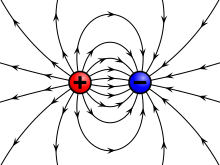
Rule 3 is not an artistic convention; it is geometrically exact. Draw N lines from a point charge. At distance r they are spread over a sphere of area 4\pi r^2, so the number of lines per unit area is N/4\pi r^2 — which falls off as 1/r^2, exactly like the field. The inverse-square law is the statement that space is three-dimensional and nothing leaks. That observation is the whole idea behind Gauss's law in the next chapter.
Two more properties follow.
Field lines never cross. If they did, the field at the crossing point would have two directions at once, which is meaningless.
Field lines are not paths of motion. A charge released in a field accelerates along the line only if it starts at rest and the line is straight. A charge with sideways velocity follows a curve, exactly as a thrown ball does not follow a vertical gravitational field line.
The dipole
Two equal and opposite charges separated by a small distance form an electric dipole, and it is worth its own section because most of chemistry is dipoles.
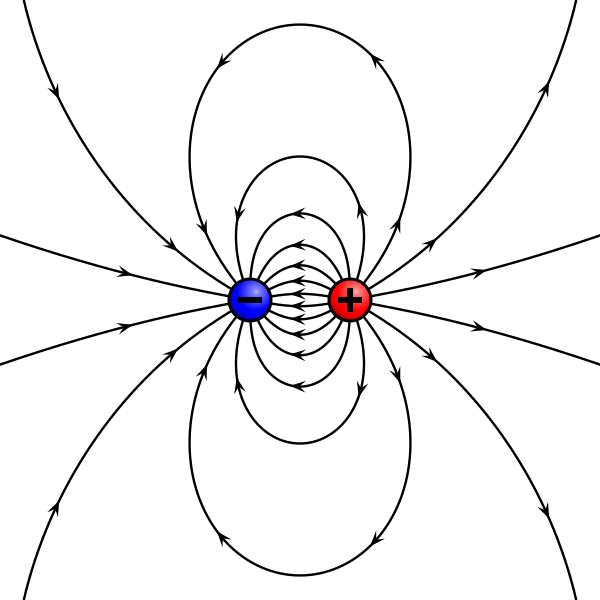
Define the dipole moment:
\vec{p} = q\vec{d}
a vector of magnitude charge times separation, pointing from the negative charge to the positive one. (Chemists usually draw it the other way; the physics is the same.)
The far field of a dipole falls off as 1/r^3, not 1/r^2. Here is why, without heavy algebra. Far away along the axis, at distance r, the two charges are at r - d/2 and r + d/2. Their fields nearly cancel, and what survives is the difference:
E = kq\left[\frac{1}{(r-d/2)^2} - \frac{1}{(r+d/2)^2}\right]
Put both over a common denominator. The numerator is (r+d/2)^2 - (r-d/2)^2 = 2rd, and the denominator is approximately r^4 when d \ll r:
E \approx kq\frac{2rd}{r^4} = \frac{2kqd}{r^3} = \frac{2kp}{r^3}
The faster falloff is the mathematical statement of "the charges cancel". Anything with zero net charge but separated positive and negative parts behaves this way, which includes every neutral molecule that is not perfectly symmetric.
A dipole in a uniform field
Put a dipole in a uniform field \vec{E}. The positive end feels q\vec{E} one way, the negative end feels q\vec{E} the other way. The net force is zero — but the two forces are not along the same line, so they produce a torque (Chapter 1.8):
\tau = pE\sin\theta \qquad\text{or}\qquad \vec{\tau} = \vec{p}\times\vec{E}
where \theta is the angle between the dipole and the field. The torque is zero when the dipole is aligned with the field and maximum when it is perpendicular. So a dipole in a uniform field rotates to line up but does not move.
In a non-uniform field it does move, because the end sitting in the stronger part of the field feels a larger force than the other end. That is the balloon on the wall and the comb picking up paper. Neither the wall nor the paper is charged. The charged object's field polarises them — pushes their electrons slightly to one side — turning each molecule into a small dipole aligned with the field, and since the field is stronger nearer the charged object, the near end is pulled more than the far end is pushed. Net attraction, always, regardless of the sign of the original charge. This is why a charged rod attracts scraps of paper whether it was rubbed with silk or with fur.
Continuous charge distributions
Real objects have charge spread over them, not concentrated at points. The method is always the same: chop the object into pieces small enough to count as point charges, find each piece's contribution, and add them up with an integral.
\vec{E} = \frac{1}{4\pi\varepsilon_0}\int\frac{dq}{r^2}\hat{r}
The hardest part is usually not the calculus but the geometry — deciding which components cancel by symmetry before integrating anything.
Worked example: a ring of charge
A thin ring of radius R carries total charge Q spread evenly. Find the field at a point on the axis, distance x from the centre.
First, use symmetry. Take any small piece of the ring. Its field at the axis point has a component along the axis and a component perpendicular to it. Now take the piece diametrically opposite: its perpendicular component points exactly the other way and cancels. Pair up the whole ring this way and every perpendicular component cancels. Only the axial components survive, and they all point the same way.
That single observation turns a vector integral into a scalar one.
Each element dq is at distance \sqrt{R^2+x^2} from the point, so its field magnitude is:
dE = \frac{k\,dq}{R^2+x^2}
Its axial component is dE\cos\theta, where \theta is the angle between the element's field and the axis. From the geometry of the right triangle with legs R and x:
\cos\theta = \frac{x}{\sqrt{R^2+x^2}}
So:
dE_x = \frac{k\,dq}{R^2+x^2}\cdot\frac{x}{\sqrt{R^2+x^2}} = \frac{kx\,dq}{(R^2+x^2)^{3/2}}
Everything except dq is the same for every element, so the integral is trivial — \int dq = Q:
\boxed{E_x = \frac{kQx}{(R^2+x^2)^{3/2}}}
Check the limits, always.
At the centre, x = 0, so E = 0. Correct — every element's field is cancelled by the one opposite.
Far away, x \gg R, so (R^2+x^2)^{3/2} \to x^3 and E \to kQx/x^3 = kQ/x^2. Correct — from far enough away a ring looks like a point charge.
And the field has a maximum somewhere between. Differentiating and setting to zero gives x = R/\sqrt{2}, which is a good sanity check on the shape: the field grows from zero at the centre, peaks at about 0.707 radii out, then dies away.
Worked example: an infinite sheet of charge
A flat sheet carries charge \sigma per unit area (sigma, the surface charge density, in C/m²), spread evenly and extending forever. Find the field near it.
This can be built out of rings. Slice the sheet into concentric rings centred on the point directly below your observation point. A ring of radius R and thickness dR has area 2\pi R\,dR and therefore charge dq = \sigma 2\pi R\,dR. Plug into the ring result and integrate from R = 0 to infinity:
E = \int_0^\infty \frac{kx\,\sigma 2\pi R\,dR}{(R^2+x^2)^{3/2}} = 2\pi k\sigma x\int_0^\infty\frac{R\,dR}{(R^2+x^2)^{3/2}}
Substitute u = R^2 + x^2, so du = 2R\,dR:
\int_0^\infty\frac{R\,dR}{(R^2+x^2)^{3/2}} = \frac{1}{2}\int_{x^2}^{\infty}u^{-3/2}du = \frac{1}{2}\left[-2u^{-1/2}\right]_{x^2}^{\infty} = \frac{1}{x}
E = 2\pi k\sigma x\cdot\frac{1}{x} = 2\pi k\sigma = \frac{\sigma}{2\varepsilon_0}
\boxed{E = \frac{\sigma}{2\varepsilon_0}}
The x cancelled. The field of an infinite sheet does not depend on distance at all — it is the same one millimetre away and one kilometre away.
That sounds impossible until you see the mechanism. Move twice as far away and each patch of the sheet contributes four times less field, by the inverse square. But you can now "see" four times as much sheet at any given angle. The two effects cancel exactly, and they cancel exactly because the field falls as 1/r^2 and area grows as r^2 — the same coincidence of dimensionality that made field lines work.
No sheet is truly infinite, of course. The result holds as long as you are much closer to the sheet than to its edges. That condition is easily met inside a capacitor, which is the next chapter's main application, and it is why a capacitor's field is uniform between its plates.
Where this shows up in your life
A photocopier and a laser printer are Coulomb's law machines. A drum is charged uniformly, a laser discharges the parts that should stay white, charged toner powder is attracted to the parts that stayed charged, the powder is transferred to paper by charging the paper more strongly still, and heat fuses it. Every step is charge attracting or repelling charge.
Air filters and industrial smokestack scrubbers charge dust particles and then pull them onto oppositely charged plates. This removes over 99 % of particulates, and it works precisely because the particles are so light that a tiny electric force overwhelms gravity.
Spray painting uses the dipole effect. Charge the paint droplets and earth the object, and the droplets are attracted around the far side rather than flying past, so far less paint is wasted.
Lightning is charge separation on a colossal scale. Ice crystals and hail colliding in a storm cloud transfer charge, leaving the cloud base negative and the ground beneath it positive by induction. The field grows until air breaks down at about 3 million volts per metre, and a channel of ionised air carries perhaps 30,000 amps for a few tens of microseconds.
A photocopier will not work well on a humid day, and neither will your balloon stick as long. Water molecules are strongly polar dipoles, so humid air conducts slightly, and charge leaks away. This is also why static shocks are a winter phenomenon: cold air holds little water.
What the next chapter fixes
The integrals above were manageable because the geometry was simple. Try to find the field inside a charged sphere, or between two plates, or around a long charged wire, by chopping the object up and integrating, and the calculus quickly becomes miserable. Chapter 4.2 introduces Gauss's law, which takes the observation made about field lines — that they spread over a sphere and nothing leaks — and turns it into a tool that produces those answers in three lines each, with no integration at all when the symmetry is right.