Appearance
12.1 — How Stars Work
A star is a ball of gas that has been falling inwards for four and a half billion years and has not got anywhere.
That is the whole of stellar structure in one sentence. Gravity pulls in, pressure pushes out, and a star is what you get when the two balance for a very long time.
And every element in you heavier than helium was made inside one.
Hydrostatic equilibrium
Take a thin shell of gas at radius r, thickness dr, density \rho, with area A.
Weight of the shell:
dW = g\,dm = \frac{GM(r)}{r^2}\rho A\,dr
where M(r) is the mass enclosed within r.
Pressure difference across it:
dF = -A\,dP
Balance them:
\boxed{\frac{dP}{dr} = -\frac{GM(r)\rho(r)}{r^2}}
Read it: pressure falls with radius, and it falls fastest where gravity is strongest and the gas densest. The star holds itself up by being denser and hotter towards the centre.
Estimating the Sun's central pressure
Approximate crudely by taking dP/dr \approx -P_c/R, M \approx M_\odot, and \rho \approx \bar{\rho}:
P_c \approx \frac{GM_\odot\bar{\rho}}{R_\odot}
\bar{\rho} = \frac{M_\odot}{\frac{4}{3}\pi R_\odot^3} = \frac{1.989\times10^{30}}{\frac{4}{3}\pi(6.96\times10^{8})^3} = \frac{1.989\times10^{30}}{1.412\times10^{27}} = 1409\ \text{kg/m}^3
P_c \approx \frac{(6.674\times10^{-11})(1.989\times10^{30})(1409)}{6.96\times10^{8}} = \frac{1.870\times10^{23}}{6.96\times10^{8}} = 2.7\times10^{14}\ \text{Pa}
The true value is 2.5\times10^{16} Pa — about a hundred times more, because the real density profile is far more centrally concentrated than the average.
Either way: about 10^{11} atmospheres.
And the central temperature
From the ideal gas law (Chapter 3.2), with the Sun's core density of 1.5\times10^{5} kg/m³ and a mean particle mass of about 0.6m_p for ionised hydrogen and helium:
T = \frac{P\mu m_p}{\rho k_B} = \frac{(2.5\times10^{16})(0.6)(1.673\times10^{-27})}{(1.5\times10^{5})(1.381\times10^{-23})}
= \frac{2.51\times10^{-11}}{2.072\times10^{-18}} = 1.2\times10^{7}\ \text{K}
About 12 million kelvin, against the accepted 15.7 million. A one-line estimate landing within a factor of 1.3, from nothing but balancing gravity against gas pressure.
This is why stars are hot. Not because they are burning — because gravity compresses them, and a compressed gas is hot. The fusion is a consequence, not a cause, and it acts as a thermostat rather than a furnace.
Why fusion should be impossible
Chapter 7.4 set this up and it is worth doing with numbers.
Two protons must approach to about 1 fm for the strong force to grab them. The Coulomb barrier at that separation:
V = \frac{ke^2}{r} = \frac{1.44\ \text{MeV fm}}{1\ \text{fm}} = 1.44\ \text{MeV}
The available thermal energy at 1.57\times10^{7} K:
k_BT = (8.617\times10^{-5}\ \text{eV/K})(1.57\times10^{7}) = 1353\ \text{eV} = 1.35\ \text{keV}
\frac{V}{k_BT} = \frac{1.44\times10^{6}}{1.35\times10^{3}} = 1067
The barrier is a thousand times the typical energy.
Can the Maxwell–Boltzmann tail close it? The fraction of particles with energy above E goes as e^{-E/k_BT}:
e^{-1067} \approx 10^{-463}
There are about 10^{56} protons in the Sun's core. A fraction of 10^{-463} means zero, by an unimaginable margin.
\boxed{\text{Classically, the Sun cannot shine.}}
Tunnelling closes the gap (Chapter 7.4). The probability of penetrating the barrier is governed by the Gamow factor:
P \propto e^{-\sqrt{E_G/E}}, \qquad E_G = 493\ \text{keV for two protons}
The reaction rate is the product of two competing exponentials — the Maxwell–Boltzmann tail rising with energy and the tunnelling probability falling with it. Their product peaks at the Gamow window, around 6 keV for the Sun, well above the mean thermal energy and far below the barrier.
The result is a rate that is fantastically small and not zero.
The proton–proton chain

Step 1:
p+p \to d+e^++\nu_e, \qquad Q = 0.42\ \text{MeV}
This step is the bottleneck, and it is worth understanding why.
Two protons cannot bind. The diproton is unbound — the strong force is just barely too weak, given the exclusion principle's requirement that two identical protons in the same spatial state have opposite spins. So to make deuterium, one proton must convert to a neutron during the collision.
That requires the weak force (Chapter 8.3), and the weak force is weak.
The consequence: the average proton in the Sun's core waits about 9 billion years to undergo this reaction.
\boxed{\text{The Sun burns slowly because a proton must become a neutron, and only the weak force can do it.}}
This is why the Sun has a ten-billion-year lifetime rather than a ten-million-year one, and therefore why there has been time for evolution. If the diproton were bound — if the strong force were about 2 % stronger — hydrogen would fuse without waiting for the weak interaction and stars would burn out in millions of years.
Step 2:
d+p \to ^3\text{He}+\gamma, \qquad Q = 5.49\ \text{MeV}
Fast — about 1 second, because it is a strong interaction. Deuterium never accumulates.
Step 3:
^3\text{He}+^3\text{He} \to ^4\text{He}+2p, \qquad Q = 12.86\ \text{MeV}
About 400 years.
Net:
4p \to ^4\text{He}+2e^++2\nu_e, \qquad Q = 26.73\ \text{MeV}
The neutrinos carry away about 0.6 MeV, leaving 26.1 MeV as heat and light.
Chapter 6.4 computed the mass deficit: 0.71 % of the mass converted.
How much hydrogen the Sun burns
\frac{dm}{dt} = \frac{L_\odot}{0.0071c^2} = \frac{3.85\times10^{26}}{0.0071\times9\times10^{16}} = \frac{3.85\times10^{26}}{6.39\times10^{14}} = 6.0\times10^{11}\ \text{kg/s}
600 million tonnes of hydrogen per second, becoming 596 million tonnes of helium, with 4.3 million tonnes converted to energy (Chapter 6.4).
Lifetime. About 10 % of the Sun's hydrogen — the part in the core, hot enough to fuse — is available:
t = \frac{0.1\times0.74\times1.989\times10^{30}}{6.0\times10^{11}} = \frac{1.47\times10^{29}}{6.0\times10^{11}} = 2.45\times10^{17}\ \text{s}
= 7.8\ \text{billion years}
And it is 4.6 billion years old, so roughly halfway through, which matches the standard figure.
The CNO cycle
A second route, dominant in stars above about 1.3 solar masses.
^{12}\text{C}+p \to ^{13}\text{N}+\gamma
^{13}\text{N} \to ^{13}\text{C}+e^++\nu_e
^{13}\text{C}+p \to ^{14}\text{N}+\gamma
^{14}\text{N}+p \to ^{15}\text{O}+\gamma
^{15}\text{O} \to ^{15}\text{N}+e^++\nu_e
^{15}\text{N}+p \to ^{12}\text{C}+^4\text{He}
The carbon is a catalyst — it comes back unchanged at the end (Chapter 10.6). Net effect is identical: four protons to helium, 26.7 MeV.
The crucial difference is the temperature dependence:
| Cycle | Rate |
|---|---|
| pp chain | \propto T^{4} |
| CNO cycle | \propto T^{20} |
The CNO's T^{20} is extraordinary. A 10 % temperature rise increases the rate by 1.1^{20} = 6.7.
Why so steep: the Coulomb barrier against carbon (Z = 6) is six times higher than against a proton, so the tunnelling probability is far more sensitive to energy.
The crossover is at about 1.8\times10^{7} K. The Sun's core at 1.57\times10^{7} K runs 99 % pp chain. Sirius, at 2.4 solar masses, runs almost entirely CNO.
And it needs carbon to exist. The very first stars had none, so they could only use the pp chain — one of several reasons the first generation was different.
Borexino measured solar CNO neutrinos in 2020, confirming the 1 % contribution directly and settling a question open since Bethe proposed the cycle in 1939.
The thermostat
Why does a star not explode or collapse?
Because the fusion rate is exquisitely temperature-sensitive and the star is self-regulating.
Suppose the core gets slightly hotter. The fusion rate rises as T^4 or T^{20}, so more energy is released, the pressure rises, the core expands — and expansion cools it (Chapter 3.3). The rate drops back.
Suppose it cools. Fusion slows, pressure drops, the core contracts, contraction heats it, and the rate rises.
\boxed{\text{Negative feedback. The star is a thermostat with gravity as the setpoint.}}
This is why stars are stable for billions of years and why the Sun's output has varied by only a few percent over the age of the Earth.
And it is why an ordinary star cannot explode. A runaway requires the feedback to fail, which happens only when the pressure stops depending on temperature — that is, when the gas becomes degenerate (Chapter 7.7). Then heating does not expand the core, and the runaway proceeds, which is exactly what a Type Ia supernova and a helium flash are.
Getting the energy out
Energy made in the core must reach the surface, and it takes a long time.
Radiative transfer dominates in the Sun's inner 70 %. A photon travels a mean free path of about 1 mm before being absorbed and re-emitted in a random direction.
The random walk (Chapter 3.2) means covering distance R takes N = (R/\lambda)^2 steps:
N = \left(\frac{7\times10^{8}}{10^{-3}}\right)^2 = (7\times10^{11})^2 = 4.9\times10^{23}
t = \frac{N\lambda}{c} = \frac{(4.9\times10^{23})(10^{-3})}{3\times10^{8}} = 1.6\times10^{12}\ \text{s} = 52{,}000\ \text{years}
More careful calculations give 10,000 to 170,000 years, depending on the opacity model.
So the sunlight on your face was made in the core when Neanderthals were alive.
And it changed completely on the way. A core gamma ray at 1 MeV becomes, by the time it emerges, roughly 100,000 photons of visible light — because the energy is repeatedly shared with the gas and re-emitted at the local temperature, which falls from 1.57\times10^{7} K to 5778 K.
Convection takes over in the outer 30 %, where the gas becomes opaque enough that radiation cannot carry the flux. Hot gas rises, cools, sinks.
You can see the convection cells. The Sun's surface granulation is a pattern of cells about 1000 km across, each lasting 8 to 20 minutes, with hot gas rising in the bright centres and cool gas sinking in the dark lanes.
And the neutrinos leave immediately. Chapter 8.5 covered them: they interact so weakly that they cross the entire Sun in 2.3 seconds. They are the only direct view of the core, and they are why the solar model can be tested at all.
The Hertzsprung–Russell diagram
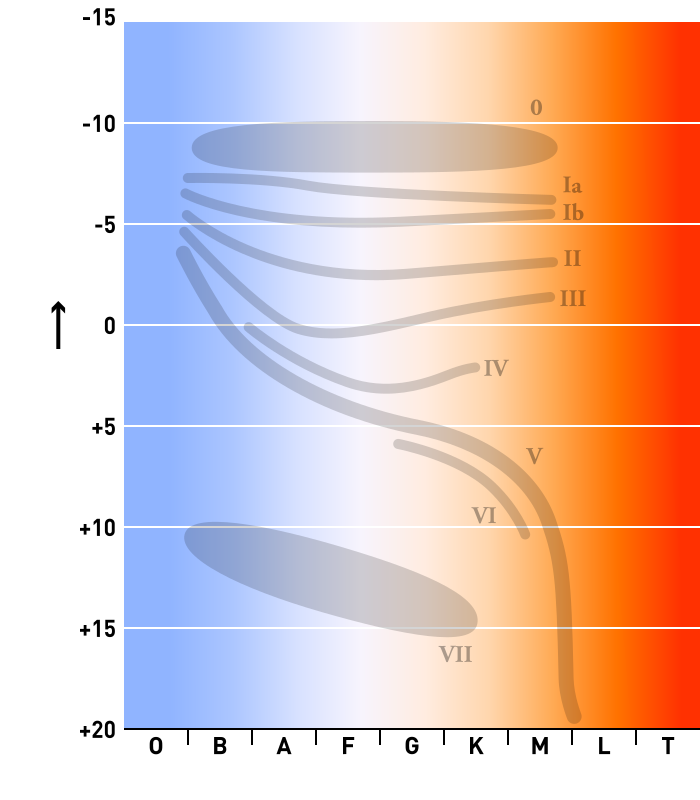
Plot luminosity against surface temperature — with temperature increasing to the left, a convention inherited from the spectral sequence.
Ejnar Hertzsprung and Henry Norris Russell did it independently around 1910, and it immediately revealed structure that nobody expected.
The main sequence runs diagonally from hot and bright to cool and faint. About 90 % of stars lie on it, including the Sun.
It is not an evolutionary track. It is the locus of stars burning hydrogen in their cores, and a star's position on it is fixed almost entirely by its mass.
Giants and supergiants sit above and to the right — cool and yet luminous, which from the Stefan–Boltzmann law (Chapter 3.7) means enormous:
L = 4\pi R^2\sigma T^4 \quad\Longrightarrow\quad R = \sqrt{\frac{L}{4\pi\sigma T^4}}
Worked example: Betelgeuse. L = 1.26\times10^{5}L_\odot, T = 3600 K.
\frac{R}{R_\odot} = \sqrt{\frac{L/L_\odot}{(T/T_\odot)^4}} = \sqrt{\frac{1.26\times10^{5}}{(3600/5778)^4}} = \sqrt{\frac{1.26\times10^{5}}{0.1511}}
= \sqrt{8.34\times10^{5}} = 913
913 solar radii — about 4.2 AU. Put Betelgeuse where the Sun is and its surface would reach past Jupiter's orbit.
White dwarfs sit below and to the left — hot and faint, so tiny. Sirius B at T = 25{,}000 K and L = 0.026L_\odot:
\frac{R}{R_\odot} = \sqrt{\frac{0.026}{(25000/5778)^4}} = \sqrt{\frac{0.026}{350.7}} = \sqrt{7.4\times10^{-5}} = 0.0086
Under 1 % of the Sun's radius — smaller than the Earth, with the Sun's mass (Chapter 6.P).
The mass–luminosity relation
On the main sequence, luminosity depends steeply on mass:
\boxed{\frac{L}{L_\odot} \approx \left(\frac{M}{M_\odot}\right)^{3.5}}
Worked examples:
| Mass | Luminosity | Lifetime |
|---|---|---|
| 0.1M_\odot | 3\times10^{-4}L_\odot | 10^{13} y |
| 0.5M_\odot | 0.09L_\odot | 5\times10^{10} y |
| 1M_\odot | 1L_\odot | 10^{10} y |
| 5M_\odot | 280L_\odot | 1.8\times10^{8} y |
| 20M_\odot | 3.6\times10^{4}L_\odot | 5\times10^{6} y |
And the lifetime scales as:
t \propto \frac{M}{L} \propto \frac{M}{M^{3.5}} = M^{-2.5}
A 20-solar-mass star has 20 times the fuel and burns it 36,000 times faster, so it lives 2000 times less long.
\boxed{\text{Massive stars are spectacular and brief. Small stars are dim and nearly eternal.}}
No red dwarf has ever died. Their lifetimes exceed the age of the universe by a factor of a thousand, so every one ever formed is still burning.
Mass limits
Minimum: about 0.08M_\odot.
Below that, the core never reaches the 3\times10^{6} K needed to fuse hydrogen. Electron degeneracy pressure (Chapter 7.7) halts the contraction before it gets hot enough.
Objects between about 13 and 80 Jupiter masses are brown dwarfs — they fuse deuterium briefly and then cool forever. They are neither stars nor planets, and the first was confirmed in 1995.
Maximum: about 150M_\odot, though a few candidates up to 300 are claimed.
The limit is radiation pressure. Chapter 4.7 established that light carries momentum. In a very massive star the outward radiation pressure approaches the inward gravity, and the star sheds its outer layers.
The Eddington limit is where they exactly balance:
L_{\text{Edd}} = \frac{4\pi GMm_pc}{\sigma_T}
where \sigma_T = 6.65\times10^{-29} m² is the Thomson scattering cross-section.
L_{\text{Edd}} = \frac{4\pi(6.674\times10^{-11})M(1.673\times10^{-27})(3\times10^{8})}{6.65\times10^{-29}}
= 6.32\times10^{4}\left(\frac{M}{M_\odot}\right)L_\odot
Set that equal to L = (M/M_\odot)^{3.5}L_\odot:
\left(\frac{M}{M_\odot}\right)^{2.5} = 6.32\times10^{4} \quad\Longrightarrow\quad \frac{M}{M_\odot} = (6.32\times10^{4})^{0.4} = 80
About 80 solar masses, which is the right order. Real limits are somewhat higher because the mass–luminosity relation flattens at high mass.
The Eddington limit also caps how fast a black hole can grow by accretion (Chapter 12.3), which is why the existence of billion-solar-mass quasars in the first billion years is a genuine puzzle.
Where this shows up in your life
The Sun's stability over four billion years is why complex life had time to evolve, and it is a consequence of the fusion thermostat.
The weak force's feebleness is why that stability lasted billions rather than millions of years.
Solar neutrinos pass through you at 65 billion per square centimetre per second (Chapter 8.5).
Solar variability — the 11-year sunspot cycle — changes the total output by about 0.1 %, enough to be measurable in climate records but far too small to explain modern warming.
And the Sun is slowly brightening. As helium accumulates the core contracts and heats, and the Sun is about 30 % brighter than when it formed. In roughly a billion years the increase will make Earth uninhabitable, long before the Sun leaves the main sequence.
What the next chapter fixes
The thermostat works while there is hydrogen. When the core runs out, the balance fails, and what happens then depends almost entirely on the star's mass. Chapter 12.2 follows the ladder: red giants, the helium flash, the Chandrasekhar limit derived properly, neutron stars, and the supernovae that made every atom in your body heavier than helium.