Appearance
4.6 — Induction: Getting Current from Magnetism
Ørsted showed in 1820 that a current makes a magnetic field. The obvious next question — can a magnetic field make a current? — took eleven years and defeated several good physicists, because the obvious experiment does not work.
Wrap a coil around a magnet, connect a meter, and nothing happens. Bring a magnet up to a coil and hold it there: the needle kicks while you are moving it and returns to zero the instant you stop. Leave the magnet sitting inside the coil for a week and the meter reads zero the whole time.
Michael Faraday found the pattern in 1831. It is not the magnetic field that produces a current. It is the field changing.
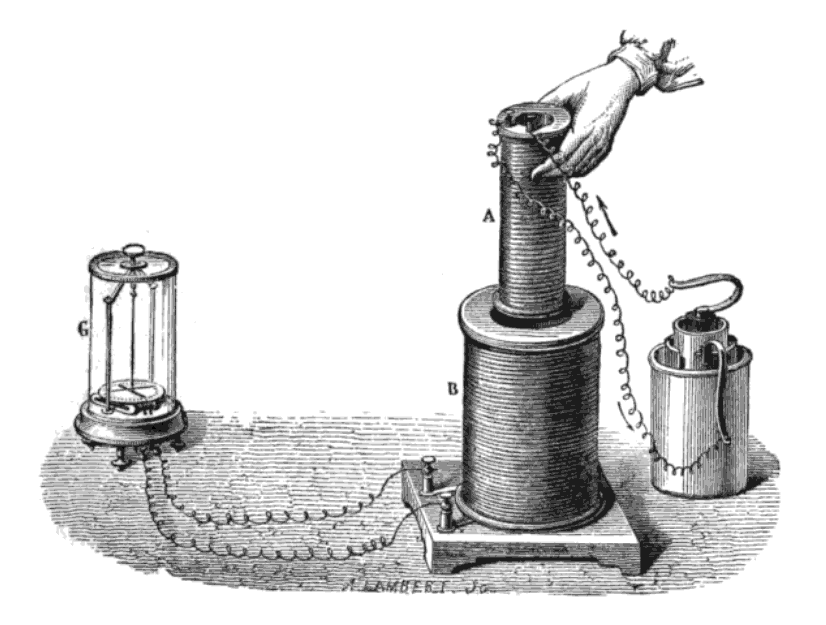
That apparatus is the first transformer, and the observation that the meter kicks only at switch-on and switch-off is the whole of this chapter in one sentence.

Magnetic flux
To say "the field is changing" precisely you need a quantity that captures both how strong the field is and how much of a circuit it passes through. That is magnetic flux, defined exactly like electric flux in Chapter 4.2:
\Phi_B = \int\vec{B}\cdot d\vec{A} = BA\cos\theta
for a uniform field through a flat loop, where \theta is the angle between the field and the loop's normal. The unit is the weber (Wb), and one weber is one tesla-metre-squared.
The flux through a loop can change in three completely different ways, and all three produce the same effect:
- B changes — move a magnet closer, or change the current in a nearby coil.
- A changes — stretch, squash or crumple the loop.
- \theta changes — rotate the loop in a fixed field. This is a generator.
Faraday's law
\boxed{\mathcal{E} = -\frac{d\Phi_B}{dt}}
Read aloud: the EMF equals minus the rate of change of magnetic flux.
The symbol \mathcal{E} is the electromotive force, which is a bad name kept for historical reasons — it is not a force, it is measured in volts, and it means the work done per unit charge in driving current around the loop. For a coil of N turns, each turn contributes, so:
\mathcal{E} = -N\frac{d\Phi_B}{dt}
This one equation explains everything Faraday saw. A stationary magnet gives constant flux, so d\Phi/dt = 0 and no EMF. Moving it changes the flux and produces one. Moving it faster produces more. The law does not care about the field's value, only its rate of change.
The minus sign is Lenz's law, and it is not a convention
The minus sign says: the induced current flows in whatever direction opposes the change that produced it. Heinrich Lenz stated it in 1834, and it is a consequence of energy conservation, not an extra assumption.
Here is the proof, and it is worth reading slowly because it is one of the cleanest arguments in physics.
Suppose the sign were positive, so the induced current helped the change. Push a magnet's north pole towards a coil. The induced current would create a field pulling the magnet in faster. Faster motion means a bigger d\Phi/dt, means a bigger current, means a bigger pull, means faster still. You would have a runaway: infinite current and infinite kinetic energy, from a single nudge, forever. That is a perpetual motion machine, and the second law of Chapter 3.4 forbids it.
So the induced current must oppose. Push a north pole towards a coil and the coil's near face becomes a north pole, pushing back. Pull it away and the near face becomes a south pole, pulling it back. Either way you have to do work against a force, and that work is exactly the electrical energy that appears in the circuit. The minus sign is the conservation of energy, written as a sign.
Where the energy comes from
This is worth making concrete. Drop a strong magnet down a copper pipe and it falls in slow motion — visibly, absurdly slowly, taking several seconds to fall a metre while a non-magnetic slug of the same mass takes half a second.
The copper is not magnetic. What happens is that the falling magnet changes the flux through each ring of copper it passes, driving circulating currents in the pipe wall, and those currents produce fields that oppose the magnet's motion — pushing up on it as it approaches and pulling back as it leaves. The magnet's gravitational potential energy is not becoming kinetic energy; it is becoming electrical energy in the copper, which becomes heat through the resistance of Chapter 4.4.
The pipe gets very slightly warmer. Energy is conserved exactly.
Motional EMF: the same law from the magnetic force
There is a second route to induction that uses no new physics, and comparing the two is illuminating.
Take a straight conducting rod of length L sliding at speed v along rails, perpendicular to a field \vec{B}.
Each free electron in the rod is moving with the rod at velocity v, so it feels a magnetic force qvB from Chapter 4.5, directed along the rod. The electrons pile up at one end, leaving the other end positive, and the resulting electric field grows until it balances the magnetic push. At equilibrium:
qE = qvB \quad\Longrightarrow\quad E = vB
The potential difference along the rod is E times its length:
\boxed{\mathcal{E} = BLv}
Now check it against Faraday's law. The circuit's area grows at Lv per second as the rod slides, so the flux grows at:
\frac{d\Phi}{dt} = B\frac{dA}{dt} = BLv
Identical. Two apparently different mechanisms — a magnetic force on charges in a moving conductor, and a changing flux through a circuit — give the same answer.
That agreement is not obviously necessary, and Einstein said so. The opening paragraph of his 1905 relativity paper points at exactly this: if you move the magnet and keep the coil still, the explanation is a changing field creating an electric field. If you move the coil and keep the magnet still, the explanation is a magnetic force on moving charges. Two different stories, same measurable result — and no experiment can tell you which one is "really" happening, because only the relative motion is observable. Einstein took that as a clue that the split between electric and magnetic fields depends on who is looking, and Chapter 6.3 shows he was right: they are two aspects of one field, mixed differently by different observers.
Worked example: an aircraft wing
A Boeing 747 has a wingspan of 65 m and cruises at 250 m/s. The vertical component of the Earth's field is about 5\times10^{-5} T. What voltage appears between the wingtips?
\mathcal{E} = BLv = (5\times10^{-5})(65)(250) = 0.81\ \text{V}
Just under a volt, and it is genuinely there. It drives no current because there is no circuit — the air is an insulator — but the potential difference exists. The same effect in the ocean lets you measure current flow: seawater is a conductor moving through the Earth's field, and the induced voltages are measurable and are used by oceanographers.
The generator
Rotate a coil of N turns and area A at angular velocity \omega in a uniform field B. The angle between the coil's normal and the field is \theta = \omega t, so:
\Phi_B = BA\cos(\omega t)
\mathcal{E} = -N\frac{d}{dt}\left[BA\cos\omega t\right] = NBA\omega\sin(\omega t)
\boxed{\mathcal{E} = \mathcal{E}_0\sin\omega t, \qquad \mathcal{E}_0 = NBA\omega}
A rotating coil in a steady field produces a sinusoidal voltage. Not because anyone chose a sine wave, but because rotation means cosine, and the derivative of cosine is sine.
This is the origin of alternating current, and of the 50 or 60 Hz mains frequency. A generator turning at 3000 rpm is turning at 50 revolutions per second, and with one pole pair that gives 50 Hz. The turbines in every power station in Europe are locked to that speed.

A motor and a generator are physically the same machine. Feed current in and it turns; turn it and it produces current. In fact a running motor is simultaneously generating: as its coil rotates it produces an EMF opposing the supply, called back-EMF, and that back-EMF is what limits the current a motor draws.
This has a practical consequence. At the instant of switch-on a motor is not turning, so there is no back-EMF, and it draws a very large stall current — several times its running current. That surge is why the lights dim briefly when a fridge compressor starts, and why large motors need soft starters. It is also why a jammed motor burns out: with the shaft held still, the back-EMF never appears and the full stall current flows continuously.
Inductance
A changing current in a coil changes its own flux, which induces an EMF in itself. This is self-inductance.
Define it by:
\Phi_{\text{total}} = LI \quad\Longrightarrow\quad \mathcal{E} = -L\frac{dI}{dt}
where L is the inductance, measured in henries (H) after Joseph Henry, who discovered induction independently of Faraday and slightly earlier but published later.
Derive it for a solenoid. From Chapter 4.5, B = \mu_0 nI inside a solenoid with n turns per metre. The flux through one turn is BA, and there are N = nl turns:
\Phi_{\text{total}} = N(BA) = (nl)(\mu_0 nI)(A) = \mu_0n^2lAI
\boxed{L = \mu_0 n^2 lA}
Note n^2: doubling the turns per metre quadruples the inductance, because it doubles both the field produced and the number of turns linking it.
What an inductor does, in one sentence: it resists changes in current, exactly as a capacitor resists changes in voltage and as mass resists changes in velocity. An inductor is electrical inertia. Volume III, Chapter 1.5 works out the circuit behaviour in detail.
Energy stored in a magnetic field
Building up a current in an inductor takes work against the back-EMF. Power is P = \mathcal{E}I = LI\,dI/dt, so the energy is:
U = \int_0^I LI'\,dI' = \frac{1}{2}LI^2
Substituting the solenoid's L and B = \mu_0nI so I = B/\mu_0 n:
U = \frac{1}{2}(\mu_0n^2lA)\left(\frac{B}{\mu_0n}\right)^2 = \frac{B^2}{2\mu_0}(lA)
and lA is the solenoid's volume, so the energy density is:
\boxed{u = \frac{B^2}{2\mu_0}}
Set this beside the electric result from Chapter 4.3, u = \frac{1}{2}\varepsilon_0E^2. The two are exact structural twins, and Chapter 4.7 shows that a light wave carries precisely equal amounts of each.
The inductor's stored energy has a dangerous consequence. Open a switch on a circuit carrying current through an inductor and dI/dt is enormous — the current is trying to go from its running value to zero in microseconds. From \mathcal{E} = -L\,dI/dt, the induced voltage can be thousands of volts, and it appears across the opening switch contacts as an arc.
That is a nuisance in a relay and it is the working principle of a car's ignition coil: deliberately interrupt the current in an inductor and use the resulting kilovolt spike to fire a spark plug. It is also why every relay coil and motor winding in a circuit gets a diode across it, wired to conduct only in the spike's direction, giving the current somewhere to go.
Eddy currents
Change the flux through a solid block of metal and currents circulate within it in closed loops. There is no wire, so the loops arrange themselves wherever the induced electric field drives them. These are eddy currents.
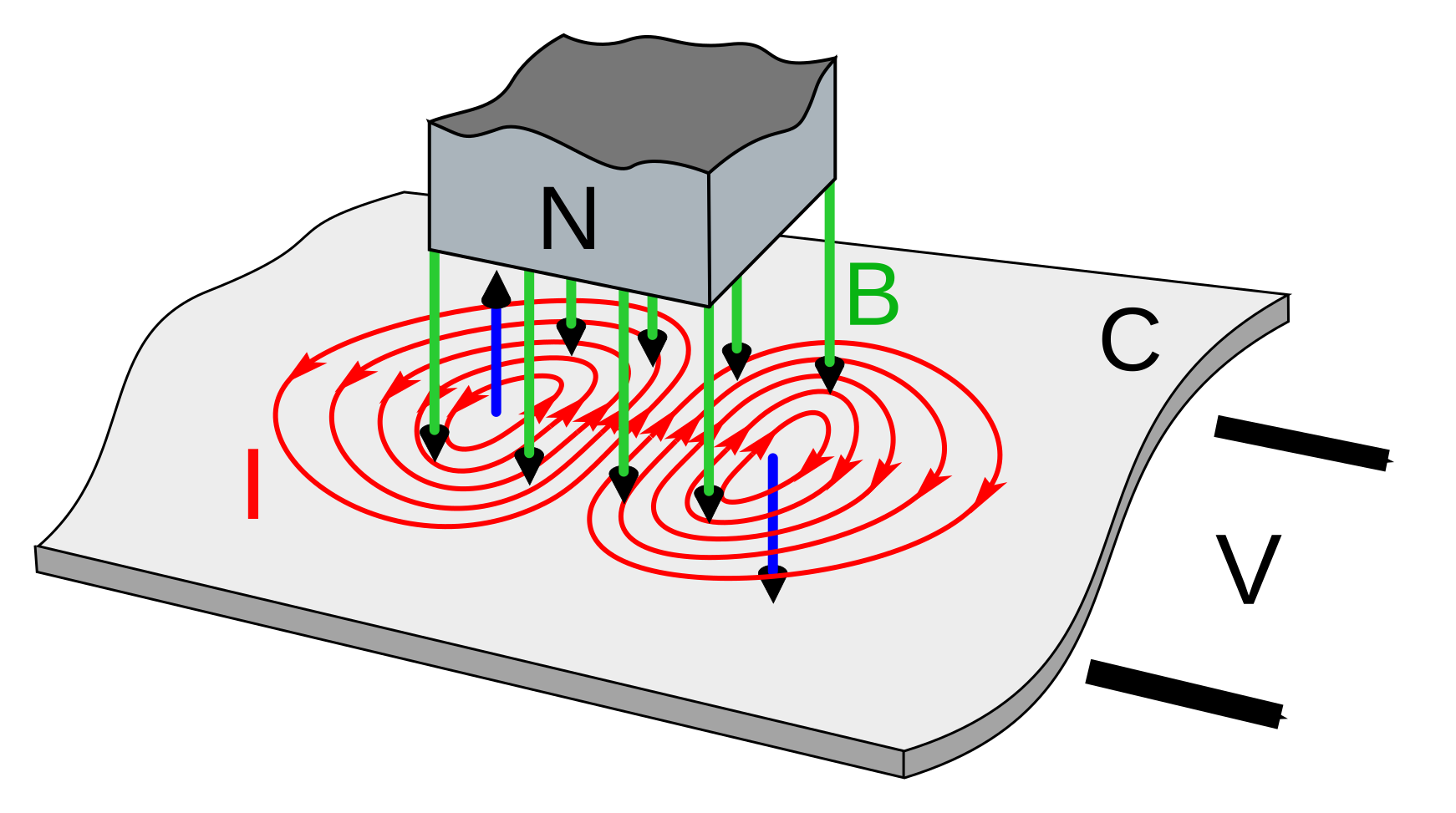
Sometimes they are the enemy. A transformer's iron core sits in a changing field, so eddy currents circulate in it and dissipate energy as heat by I^2R. The fix is to build the core from thin sheets — laminations — each varnished on both sides so it is insulated from its neighbours. The loops are then confined to individual sheets, where their small area means small EMF and small current. This is why every transformer core you have ever seen is made of stacked plates, and it typically cuts eddy losses by a factor of a hundred.
Sometimes they are the point.
Induction hobs put a coil under a glass surface carrying 20–50 kHz current. The rapidly changing field induces eddy currents directly in the iron base of the pan, and the pan's own resistance turns them into heat. The hob surface stays cool because glass does not conduct; only the pan heats. Aluminium and copper pans work poorly because their low resistivity means low I^2R, which is a rare case of good conductivity being a disadvantage.
Metal detectors transmit a changing field, and any conductor nearby responds with eddy currents that produce their own field, which the detector picks up. Airport security, treasure hunting and buried-cable locating all work this way.
Eddy current braking stops trains and roller coasters with no contact and no wear. Move a conductor through a strong field and Lenz's law produces a retarding force proportional to speed. The force falls to zero as the vehicle stops, so it cannot hold anything stationary, which is why these systems are always paired with friction brakes for the final stop and for parking.
Induction furnaces melt metal by driving eddy currents in the charge itself — no flame, no contact, no contamination, which matters for aerospace alloys.
The transformer
Two coils sharing a magnetic core. An alternating current in the primary makes an alternating flux; the core guides essentially all of it through the secondary; the changing flux induces an EMF there.
If the same flux \Phi threads every turn of both coils:
V_p = -N_p\frac{d\Phi}{dt}, \qquad V_s = -N_s\frac{d\Phi}{dt}
Divide:
\boxed{\frac{V_s}{V_p} = \frac{N_s}{N_p}}
Voltage ratio equals turns ratio. More turns on the secondary means higher voltage out.
Energy conservation fixes the current. An ideal transformer wastes nothing, so power in equals power out:
V_pI_p = V_sI_s \quad\Longrightarrow\quad \frac{I_s}{I_p} = \frac{N_p}{N_s}
Step voltage up and current goes down in exactly the same proportion. A transformer trades one for the other and creates neither.
This is what makes the power grid possible, and it closes the argument begun in Chapter 4.4. Transmission losses go as I^2R, so you want high voltage and low current on the long wires. Appliances want a low, safe voltage. A transformer converts between them at 98–99 % efficiency, in a device with no moving parts.
And it only works on AC. A transformer needs d\Phi/dt, and direct current gives none. That single fact settled the war of the currents in the 1890s: Edison's DC could not be transformed and so could not be transmitted more than about a mile, while Tesla and Westinghouse's AC could be stepped up for transmission and back down for use. Every grid on Earth is AC because of Faraday's minus sign and this ratio.
Where this shows up in your life
Wireless phone charging is a transformer with an air gap. A coil in the pad, a coil in the phone, and about 100–200 kHz to make d\Phi/dt large enough that a small coil can transfer 10 W across a few millimetres.
Contactless cards and passports take it further: the reader's field induces enough current in the card's coil to power the chip and carry the data, so the card needs no battery at all.
Electric guitar pickups are a magnet with a coil around it. The magnet magnetises the steel string; the vibrating string changes the flux through the coil; the coil produces a voltage that is the sound. A nylon string produces silence, which is why an electric guitar cannot be strung with them.
Regenerative braking in electric cars runs the drive motor backwards as a generator, so the car's kinetic energy goes back into the battery instead of into brake dust. This recovers 15–30 % of urban driving energy.
Induction cooktops, metal detectors, and the loop in the road at traffic lights that senses your car — all eddy currents.
And the electricity in your wall was made by rotating a coil in a magnetic field, in a machine whose principle Faraday demonstrated with a magnet and a coil of wire in 1831. When asked what use it was, he is supposed to have replied, "What use is a newborn baby?"
What the next chapter fixes
Four laws now exist: Gauss's law for electricity, Gauss's law for magnetism, Ampère's law, and Faraday's law. Written side by side they look nearly symmetric — a changing magnetic field makes an electric field, and one term is missing that would let a changing electric field make a magnetic field. Chapter 4.7 finds the gap by noticing that Ampère's law is actually inconsistent for a charging capacitor, adds the term that fixes it, and then shows that the four completed equations have a solution which travels through empty space at a speed built from \varepsilon_0 and \mu_0 — two constants measured with capacitors and wires — and that the speed comes out to 3\times10^8 m/s.