Appearance
9.1 — The Atom's Story, and Rutherford's Argument
The idea that matter is made of indivisible pieces is 2500 years old and was, for 2200 of those years, a philosophical position with no evidence. Democritus called them atomos, uncuttable. Aristotle disagreed, preferred four continuous elements, and won the argument for two millennia because he was more influential rather than more correct.
What changed it was weighing things.
Dalton and the whole numbers
John Dalton, a Manchester schoolteacher, noticed in 1803 that when two elements form more than one compound, the mass ratios come out in small whole-number proportions.
Carbon and oxygen. In one compound, 12 g of carbon combines with 16 g of oxygen. In another, 12 g of carbon combines with 32 g of oxygen. The ratio of oxygen masses is exactly 1:2.
Nitrogen and oxygen gives ratios of 1:2:3:4:5, corresponding to N₂O, NO, N₂O₃, NO₂ and N₂O₅.
This is the law of multiple proportions, and it is very hard to explain if matter is continuous. If atoms exist, it is trivial: one carbon atom takes either one or two oxygen atoms, and you cannot have one and a half.
Dalton's postulates, all essentially right and one wrong:
- Elements are made of atoms.
- All atoms of an element are identical. (Wrong — isotopes.)
- Atoms cannot be created, destroyed or converted. (Wrong for nuclear reactions.)
- Compounds form from fixed whole-number ratios of atoms.
And still nobody was convinced. Through the whole nineteenth century, atoms were treated by many chemists as a useful bookkeeping fiction. Ernst Mach, the physicist and philosopher, was still asking "Have you seen one?" in the 1890s, and his scepticism contributed to Boltzmann's isolation (Chapter 3.5).
The argument ended in 1905–1908. Einstein computed the statistics of Brownian motion — the jittering of pollen grains in water — assuming molecular bombardment, and Jean Perrin measured it and extracted Avogadro's number. Perrin's number agreed with values from five completely unrelated methods, and that convergence settled it. Perrin got the Nobel Prize in 1926 and Mach never accepted it.
Thomson's plum pudding
Chapter 8.1 covered the discovery of the electron in 1897. J. J. Thomson found a particle 1800 times lighter than hydrogen, negatively charged, produced identically from every cathode material.
That created a problem. Atoms are neutral and electrons are negative, so there must be positive charge somewhere, and it must carry almost all the mass.
Thomson's model, 1904: a sphere of diffuse positive charge, about 10^{-10} m across, with electrons embedded in it like currants — hence "plum pudding", though Thomson never used the phrase.
It was a serious model. Thomson worked out stable electron arrangements within the sphere and found they formed rings, which he hoped would explain the periodic table's periodicity. It was a reasonable idea, and it made a testable prediction.
The gold foil experiment
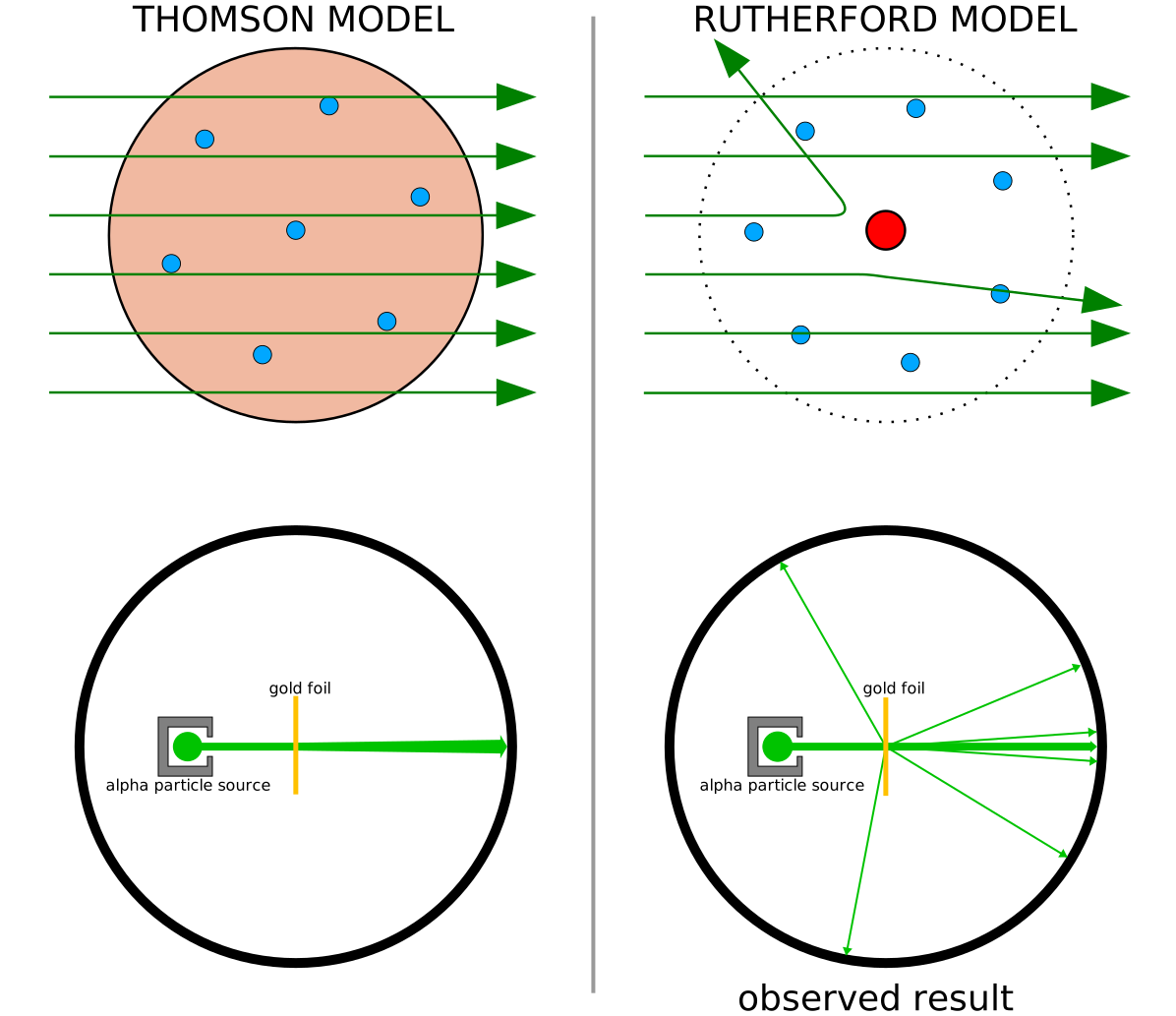
The setup, run by Hans Geiger and Ernest Marsden from 1909 under Rutherford's direction at Manchester.
A radium source emits alpha particles — helium nuclei, 7300 times an electron's mass, at about 1.5\times10^{7} m/s with 5 MeV of energy. They pass through a gold foil about 400 atoms thick. A movable zinc sulphide screen flashes when struck, and a person in a darkened room counts the flashes by eye.
The work was brutal. Geiger and Marsden spent hours in complete darkness letting their eyes adapt, then counted scintillations one at a time, for months.
What Thomson's model predicted
With charge spread over the whole atom, the field inside is weak. Chapter 4.2 gives the field inside a uniformly charged sphere as E = kQr/R^3, and the maximum is at the surface:
E_{\max} = \frac{kQ}{R^2} = \frac{(8.99\times10^{9})(79\times1.602\times10^{-19})}{(10^{-10})^2} = 1.14\times10^{13}\ \text{V/m}
The alpha spends about t = 2R/v = 2\times10^{-10}/1.5\times10^{7} = 1.3\times10^{-17} s crossing the atom, gaining transverse momentum:
\Delta p = qEt = (2\times1.602\times10^{-19})(1.14\times10^{13})(1.3\times10^{-17}) = 4.7\times10^{-23}
Its forward momentum is p = mv = (6.64\times10^{-27})(1.5\times10^{7}) = 9.96\times10^{-20}:
\theta \approx \frac{\Delta p}{p} = \frac{4.7\times10^{-23}}{9.96\times10^{-20}} = 4.7\times10^{-4}\ \text{rad} = 0.027°
Through 400 atoms, the deflections add up as a random walk, growing as \sqrt{N}:
\theta_{\text{total}} \approx 0.027\times\sqrt{400} = 0.54°
Thomson's model predicts about half a degree, and essentially zero probability of anything above a few degrees. Getting to 90° would require hundreds of deflections all happening to go the same way, with probability around 10^{-3500}.
What happened
Most alphas went essentially straight through, as expected.
About 1 in 8000 was deflected by more than 90°. Some came straight back.
Rutherford: "It was quite the most incredible event that has ever happened to me in my life. It was almost as incredible as if you fired a fifteen-inch shell at a piece of tissue paper and it came back and hit you."
The argument
Rutherford's reasoning, in 1911, is a model of how to reason from an experiment.
A single large deflection requires a single violent encounter, because multiple small scatters cannot add up to 180°.
A single violent encounter requires an enormous field, which requires the positive charge concentrated in a very small volume.
And the target must be massive, or it would recoil and absorb the momentum rather than reversing the alpha.
How small? Compute the closest approach for a head-on collision. All the kinetic energy converts to electrostatic potential energy:
\frac{1}{2}mv^2 = \frac{k(2e)(Ze)}{r_{\min}}
For a 5 MeV alpha on gold, Z = 79:
r_{\min} = \frac{k(2)(79)e^2}{E} = \frac{(8.99\times10^{9})(158)(1.602\times10^{-19})^2}{5\times1.602\times10^{-13}}
= \frac{3.645\times10^{-26}}{8.01\times10^{-13}} = 4.55\times10^{-14}\ \text{m}
About 45 femtometres, which is an upper limit on the nucleus's size — the alpha got that close without hitting anything.
Compare with the atom at 10^{-10} m. The nucleus is at most 5\times10^{-14} m, so:
\frac{r_{\text{atom}}}{r_{\text{nucleus}}} \approx 2000, \qquad \frac{V_{\text{atom}}}{V_{\text{nucleus}}} \approx 10^{10}
The atom is at least ten billion times the nucleus's volume, and essentially all of it is empty.
Scale it up. If the nucleus were a marble 1 cm across, the atom would be 200 metres across — two football pitches — with the electrons somewhere out at the edge.
The scattering formula
Rutherford derived the full angular distribution assuming a point charge and pure Coulomb repulsion:
\boxed{\frac{dN}{d\Omega} \propto \frac{Z^2}{E^2\sin^4(\theta/2)}}
Four testable predictions, and Geiger and Marsden checked every one:
- \sin^{-4}(\theta/2) dependence — verified over a factor of 250,000 in rate.
- Z^2 dependence — verified across gold, silver, copper and aluminium.
- E^{-2} dependence — verified by using different alpha sources.
- Proportional to foil thickness — verified.
The formula is one of the very few in physics that gives the same answer classically and quantum-mechanically, which is a lucky accident of the 1/r potential.
And where it breaks tells you the nuclear size. Push the alpha energy high enough and it touches the nucleus, the strong force takes over, and the scattering departs from the formula. The departure point gives the nuclear radius directly, and this technique gave:
R = R_0A^{1/3}, \qquad R_0 = 1.2\ \text{fm}
The A^{1/3} means constant density — nucleons pack like marbles in a bag rather than compressing.
Nuclear density:
\rho = \frac{Am_N}{\frac{4}{3}\pi R_0^3A} = \frac{1.67\times10^{-27}}{\frac{4}{3}\pi(1.2\times10^{-15})^3} = 2.3\times10^{17}\ \text{kg/m}^3
A teaspoon of nuclear matter weighs a billion tonnes. This is the density of a neutron star (Chapter 12.2), which is essentially one enormous nucleus.
Bohr's model, and where it fails
Chapter 7.1 derived Bohr's model in full — the quantised angular momentum, the Bohr radius a_0 = 0.529 Å, the energy levels E_n = -13.6/n^2 eV, and the Rydberg constant computed from first principles.
Here is what it fixed and what it did not.
It fixed the stability problem. Chapter 7.1 computed that a classical orbiting electron radiates and spirals in within 1.6\times10^{-11} s. Bohr simply declared that certain orbits do not radiate. An assumption, not an explanation — but it stopped the catastrophe.
It explained hydrogen's spectrum exactly, including series that had not yet been measured. The Lyman series in the ultraviolet was predicted and then found.
And it fails, in five specific ways:
1. Only one electron. Helium, with two, cannot be solved by Bohr's method and gives wrong answers however it is patched.
2. No line intensities. Some transitions are strong, some weak, some forbidden. Bohr has nothing to say.
3. No fine structure. Under resolution, lines split. Bohr predicts one line.
4. The assumptions are arbitrary. Why is L quantised in units of \hbar? Why do stationary states not radiate? Bohr had no answer and said so.
5. The picture is wrong. Chapter 7.6 showed the ground state has \ell = 0 — zero orbital angular momentum, no orbit at all. Bohr's model requires L = \hbar for n=1.
Bohr's model got the energies right from a wrong picture, which happens more often in physics than is comfortable. Chapter 7.6's exact solution replaces it entirely.
What is genuinely worth keeping from Bohr:
- Energy levels are discrete.
- Photons are emitted on transitions, with hf = \Delta E.
- E_n \propto -1/n^2 for hydrogen.
- The Bohr radius sets the scale of atoms.
What to discard: electrons in circular orbits.
The nuclear atom in numbers
| Quantity | Value |
|---|---|
| Atomic radius | \sim10^{-10} m (1 Å) |
| Nuclear radius | 1.2A^{1/3} fm |
| Ratio | \sim10^{-5} in length, 10^{-15} in volume |
| Nuclear density | 2.3\times10^{17} kg/m³ |
| Electron mass fraction | \sim1/2000 |
So the atom is a factor of 10^{15} in volume of nothing, and the "solidity" of matter comes entirely from the exclusion principle and electromagnetic repulsion between electron clouds (Chapter 7.7), not from anything being filled.
Isotopes
Dalton's second postulate is wrong. Atoms of an element are not identical.
Same Z — same number of protons, so the same chemistry, since chemistry is about electrons.
Different N — different numbers of neutrons, so different mass and different nuclear behaviour.
Notation: ^A_Z\text{X} where A = Z+N.
| Isotope | Protons | Neutrons | Abundance |
|---|---|---|---|
| $^{12}$C | 6 | 6 | 98.9 % |
| $^{13}$C | 6 | 7 | 1.1 % |
| $^{14}$C | 6 | 8 | trace, radioactive |
| $^{235}$U | 92 | 143 | 0.72 % |
| $^{238}$U | 92 | 146 | 99.27 % |
Isotopes were discovered by Frederick Soddy in 1913 and confirmed by Thomson and Aston with mass spectrometry, which is why atomic weights are not whole numbers: chlorine's 35.45 is a weighted average of 75.8 % chlorine-35 and 24.2 % chlorine-37.
And the tiny 0.72 % of uranium-235 is the entire basis of nuclear power and weapons, since it is the fissile isotope. Separating it from the chemically identical uranium-238 requires exploiting the 1 % mass difference (Chapter 3.2), which is why enrichment is an industrial-scale undertaking.
Where this shows up in your life
Smoke detectors contain americium-241, whose alpha particles ionise air in a chamber; smoke disrupts the ion current and triggers the alarm. Rutherford's alpha particles, in your ceiling.
Rutherford backscattering spectrometry is a standard materials analysis technique, using exactly the 1911 formula to determine composition and layer thickness in semiconductors and archaeological artefacts.
Ion implantation in chip manufacture fires dopant ions into silicon, and their stopping depth is computed with the same scattering physics.
Radiocarbon dating uses carbon-14, whose existence requires isotopes.
And medical imaging with technetium-99m, the most-used radioisotope in the world, depends on isotope chemistry being identical while nuclear behaviour differs.
What the next chapter fixes
Rutherford established that a nucleus exists and gave its size, and said nothing about what holds it together. Positive charges 1 fm apart repel with a force of about 230 newtons — an enormous force between two subatomic particles — and nuclei do not fly apart. Chapter 9.2 covers the strong force at nuclear scale, derives the binding energy curve that explains both fission and fusion, works through the three decay modes, derives the half-life law, and computes a carbon dating problem from scratch.