Appearance
4.8 — Magnetism in Matter
Chapter 4.5 established that there are no magnetic charges. Every magnetic field ever measured is produced by moving charge. A fridge magnet, however, sits perfectly still, has no battery, and holds a field for decades.
So where is the current?
Every magnet is a current loop
The answer is that it is inside the atoms. Electrons contribute magnetic moment in two ways.
Orbital motion. An electron circulating around a nucleus is a tiny current loop, and Chapter 4.5 showed that a current loop is a magnetic dipole with moment \mu = IA.
Spin. Every electron carries an intrinsic magnetic moment, as though it were a spinning charged ball — though it is not spinning and is not a ball, and Chapter 7.7 explains what spin really is. The size of it is one Bohr magneton:
\mu_B = \frac{e\hbar}{2m_e} = 9.274\times10^{-24}\ \text{J/T}
In most materials spin dominates, and in the strongly magnetic ones it dominates almost completely.
So a magnet is 10^{23} atomic current loops, and its field is what you get when a large fraction of them point the same way. Ampère guessed exactly this in the 1820s, before anyone knew about electrons, and called them molecular currents. He was right.
Why do most materials show no magnetism, then? Because electrons pair up. The Pauli exclusion principle (Chapter 7.7) forces two electrons sharing an orbital to have opposite spins, so their moments cancel exactly. Only atoms with unpaired electrons have a net moment, and in most solids even those point in random directions and average to nothing.
Define the magnetisation \vec{M} as the net magnetic moment per unit volume. Then in a material the total field is:
\vec{B} = \mu_0(\vec{H} + \vec{M})
where \vec{H} is the field you apply from outside with a coil. The material's response is usually written:
\vec{M} = \chi_m\vec{H}
with \chi_m (chi-m) the magnetic susceptibility — a single number saying how strongly the material responds and in which direction. Its value sorts all materials into three groups, and the three could hardly be more different.
Diamagnetism: pushed out, and universal
Every material is diamagnetic. In most it is completely swamped by something stronger, but it is always there.
The mechanism is Lenz's law from Chapter 4.6, operating inside an atom. Bring a magnet up to any atom and the flux through its electron orbits changes. That change induces a slight alteration in the orbital motion, in the direction that opposes the change — and opposing means producing a moment pointing against the applied field.
\chi_m < 0, \qquad \text{typically } -10^{-5}
So a diamagnetic material is weakly repelled by a magnet, from either pole. It is very weak, and it is the only magnetic response that is genuinely universal, because it depends on nothing but electrons having orbits.
Bismuth is the strongest ordinary diamagnet, \chi_m = -1.66\times10^{-4}. Water is -9.0\times10^{-6}. Pyrolytic graphite is -4\times10^{-4} perpendicular to its planes, strong enough that a thin flake will levitate stably over an array of ordinary neodymium magnets — a demonstration you can buy.
Water's diamagnetism has produced one of the more striking experiments in physics. In 1997 Andre Geim levitated a live frog in a 16 T magnetic field at the Nijmegen laboratory. The frog is mostly water, water is diamagnetic, and in a sufficiently strong and sufficiently non-uniform field the repulsion balances its weight. The frog was unharmed. Geim later won a Nobel Prize for graphene, and an Ig Nobel for the frog, making him the only person to hold both.
Superconductors are perfect diamagnets, \chi_m = -1, which means they expel magnetic field entirely from their interior. This is the Meissner effect mentioned in Chapter 4.4, and it is why a magnet floats stably above a cooled superconductor rather than merely being pushed away.
Paramagnetism: pulled in, weakly
Atoms with unpaired electrons have a permanent magnetic moment. With no applied field, thermal motion (Chapter 3.2) keeps them pointing in random directions and the average is zero.
Apply a field and each moment feels a torque \vec{\tau} = \vec{\mu}\times\vec{B} (Chapter 4.5) trying to line it up. Thermal agitation fights back. The result is a partial alignment — a small excess pointing along the field:
\chi_m > 0, \qquad \text{typically } +10^{-5}\ \text{to}\ +10^{-3}
Since alignment competes with thermal disorder, the effect weakens as the material warms, and the relationship is Curie's law:
\chi_m = \frac{C}{T}
Susceptibility inversely proportional to absolute temperature. Pierre Curie established this in 1895, and the 1/T is exactly the competition between the aligning energy \mu B and the disordering energy k_BT.
Aluminium is paramagnetic, \chi_m = +2.2\times10^{-5}. So is liquid oxygen, and strikingly so: pour liquid oxygen between the poles of a strong magnet and it sticks there in a visible bridge. The reason is that the O₂ molecule has two unpaired electrons, which is a genuine surprise given that oxygen is drawn in every textbook with a double bond and no unpaired electrons. Chapter 10.2 resolves it — the simple picture is wrong and molecular orbital theory gets it right, and liquid oxygen's behaviour in a magnet is the experimental proof.
Ferromagnetism: the strong one
A few materials — iron, cobalt, nickel, gadolinium, and a range of alloys and oxides — respond thousands of times more strongly than any paramagnet, and keep their magnetisation when the applied field is removed.
\chi_m \approx +10^{3}\ \text{to}\ +10^{5}
The mechanism is not classical and cannot be explained by magnetic forces between the atomic moments — those are far too weak, and a calculation shows they would be overwhelmed by thermal motion above about 1 K.
What actually aligns the spins is the exchange interaction, which is electrostatic in origin and quantum in nature. Two nearby electrons must have an overall antisymmetric quantum state (Chapter 7.7). If their spins are parallel, the spatial part must be antisymmetric, which keeps the electrons further apart on average, which lowers their electrostatic repulsion energy. So in the right materials, parallel spins are energetically cheaper, and the alignment is driven by Coulomb repulsion wearing a quantum-mechanical disguise. It is enormously stronger than any magnetic interaction, which is why ferromagnetism survives to hundreds of degrees.
Domains
If every spin in a piece of iron aligned, a nail would be a powerful permanent magnet. Most nails are not. The reason is domains.

A domain is a region, typically 1 to 100 micrometres across, in which all the spins are aligned. A piece of iron contains many domains pointing in different directions, and their fields cancel.
Why does the material split into domains at all, if aligned spins are cheaper? Because of the field outside. A single fully aligned block would produce a large external field, and the energy stored in that field (Chapter 4.6, u = B^2/2\mu_0) is substantial. Splitting into oppositely aligned domains lets the field close up on itself inside the material, and the saving outweighs the cost of the boundaries. The material adopts whatever arrangement minimises the total, exactly as a soap film adopts the minimum-area shape.

Applying a field does two things in sequence. At low fields, domain walls move — favourably aligned domains grow while others shrink. This is largely reversible. At higher fields the remaining domains rotate as a whole into alignment, which is not reversible, and eventually every spin is aligned and the material is saturated. No further field increases M; you have run out of spins.
Domain wall motion is not smooth. Walls snag on defects and impurities and then jump free, so the magnetisation increases in tiny steps. Amplify the signal from a coil around a slowly magnetised iron sample and you hear it as a rush of clicks — the Barkhausen effect, discovered in 1919, and the first direct evidence that domains exist.
Hysteresis
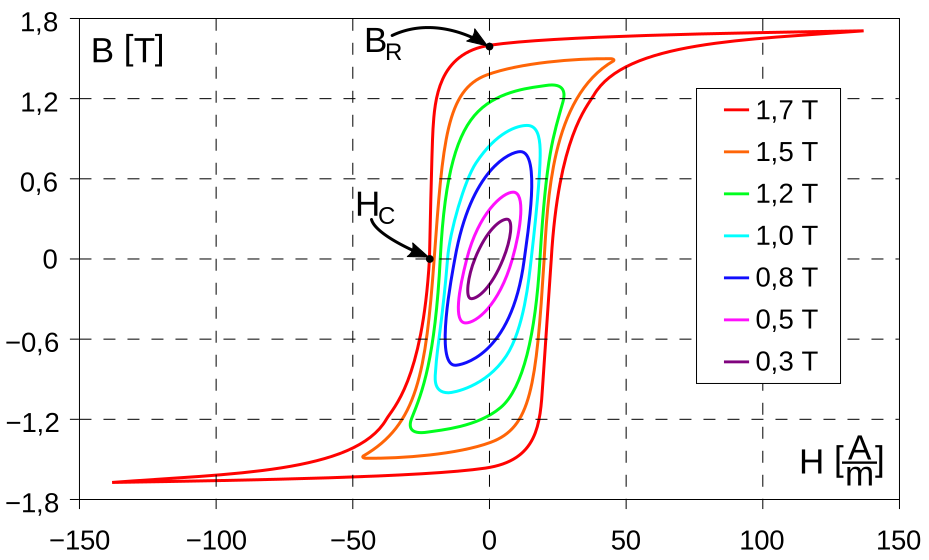
Take an unmagnetised sample and trace the curve. Raise H and B climbs steeply, then flattens at saturation. Now reduce H back to zero — and B does not return to zero. The material keeps some magnetisation, called the remanence B_r. That leftover is exactly what a permanent magnet is.
To get B back to zero you must apply a reverse field, and the size needed is the coercivity H_c. Push further and the material saturates the other way; bring it back and the loop closes.
The word hysteresis is Greek for "lagging behind", and it names the general phenomenon of a system's state depending on its history rather than only on its present input.
The area inside the loop is energy lost as heat per cycle, per unit volume. Every time round, domain walls are dragged past defects and the work done is dissipated. This immediately splits ferromagnets into two engineering families:
Soft magnetic materials have a thin loop — low coercivity, small area. Soft iron and silicon steel are the examples. They magnetise easily, demagnetise easily, and waste little energy per cycle. These are what transformer and motor cores are made of, because a transformer core is taken round the loop 50 or 60 times a second and a fat loop would cook it. Combined with the lamination trick against eddy currents from Chapter 4.6, this is why a transformer reaches 99 % efficiency.
Hard magnetic materials have a fat loop — high coercivity, large remanence. These make permanent magnets, because a large coercivity means stray fields and knocks cannot demagnetise them.
The strongest are neodymium–iron–boron magnets, NdFeB, developed in 1982, with remanence over 1.4 T. A neodymium magnet the size of a coin can lift several kilograms and can break a finger if two are allowed to snap together. They are in every hard drive, every earbud, every electric car motor and every wind turbine generator, and the supply of neodymium is a live geopolitical issue for exactly that reason.
The Curie temperature
Heat a ferromagnet and the exchange alignment competes with thermal agitation. At a definite temperature the thermal energy wins completely, the domains dissolve, and the material becomes an ordinary paramagnet.
That is the Curie temperature T_C:
| Material | T_C |
|---|---|
| Iron | 1043 K (770 °C) |
| Cobalt | 1394 K |
| Nickel | 631 K |
| Neodymium magnets | 583–673 K |
| Gadolinium | 292 K (19 °C) |
Gadolinium's is the interesting one: it is ferromagnetic in a cold room and paramagnetic in your hand.
Above T_C, Curie's law is replaced by the Curie–Weiss law:
\chi_m = \frac{C}{T - T_C}
which blows up as T approaches T_C from above — the susceptibility diverges at the transition, which is the signature of a phase transition exactly like the critical point of Chapter 3.6. Ferromagnetism is one of the most studied phase transitions in physics precisely because it is simple enough to model and rich enough to be interesting.
The Curie temperature is why a magnet dropped in a fire is ruined, and it is why heating a hard disk platter above its Curie point would erase it — which is the basis of heat-assisted magnetic recording, where a laser briefly warms a single bit's worth of material so a modest field can flip it, then lets it cool and lock in.
It is also how we know about the Earth's magnetic past. Lava contains magnetic minerals; while molten they are above their Curie point and hold no magnetisation; as they cool through it they lock in the direction of the Earth's field at that moment. Reading those directions in sea-floor rocks revealed symmetric stripes of alternating polarity either side of mid-ocean ridges — proof both that the Earth's field reverses, roughly every few hundred thousand years, and that the sea floor spreads. That single observation settled the plate tectonics debate in the 1960s.
Antiferromagnetism and ferrimagnetism
Two more arrangements exist, and both matter technologically.
Antiferromagnets have neighbouring spins that align antiparallel, so they cancel exactly and the material shows almost no external magnetism despite being perfectly ordered inside. Manganese oxide and chromium behave this way. The ordering vanishes above a temperature called the Néel temperature.
Antiferromagnets are not a curiosity: the discovery of giant magnetoresistance in 1988 — where a stack of alternating magnetic and non-magnetic layers changes its electrical resistance sharply depending on the relative alignment of the layers — gave read heads sensitive enough to detect the tiny fields of very small bits, and hard drive capacity rose by orders of magnitude in the following decade. Albert Fert and Peter Grünberg shared the 2007 Nobel Prize for it.
Ferrimagnets have antiparallel neighbours of unequal size, so they partly cancel and leave a net moment. Magnetite, Fe₃O₄, is a ferrimagnet, and it is the lodestone — the naturally magnetic rock that the Chinese were using for compasses by the eleventh century and that gave the whole subject its name, from Magnesia in Asia Minor.
Ferrites, which are ceramic ferrimagnets, are electrical insulators, so they carry no eddy currents at all. That makes them the material of choice for high-frequency work: the little cylinders moulded onto USB and monitor cables, and the cores of the transformers inside every phone charger and switch-mode power supply, are ferrite for exactly this reason.
Where this shows up in your life
Hard disk drives store bits as the magnetisation direction of tiny regions of a hard ferromagnetic film. Writing uses a miniature electromagnet; reading uses a magnetoresistive sensor. Modern drives write regions about 20 nm across, small enough that thermal energy is a genuine threat to their stability — the "superparamagnetic limit" — which is why the recording layer uses high-coercivity alloys and why heat-assisted writing became necessary.
Credit card stripes and hotel key cards are the same technology, with bits about a hundred thousand times larger.
Electric motors rely on both families at once: a hard magnet to provide a steady field, and a soft core to carry the flux from the windings without wasting energy.
MRI exploits paramagnetism at the nuclear level. Hydrogen nuclei have a magnetic moment, a strong field aligns a small excess of them, radio pulses tip them over, and the signal they give off as they relax depends on the chemical environment — which is how soft tissue is imaged without any radiation at all.
Transformer hum at 100 Hz is magnetostriction: a ferromagnetic material physically changes length very slightly when magnetised, so a core taken round its loop 50 times a second stretches and relaxes 100 times a second. That is the sound of a substation.
The Earth itself is a magnet because of moving conducting fluid in its outer core — a self-sustaining dynamo, not a permanent magnet, since the core is at about 5000 K and every candidate material is far above its Curie temperature. Chapter 11.2 comes back to it.
What Part 4 established
Part 4 began with a balloon stuck to a wall and ended with the discovery of what light is.
Four laws did all of it. Charges make electric fields that diverge from them, and the field carries energy at density \frac{1}{2}\varepsilon_0E^2. Magnetic field lines never end, because magnetic charge does not exist, so every magnetic field in the universe comes from moving charge — including the fridge magnet, whose currents are the orbits and spins of its own electrons. A changing magnetic field makes an electric field, with a minus sign demanded by energy conservation, which is the whole electrical power industry. A current or a changing electric field makes a magnetic field, and the second half of that sentence is the term Maxwell added to fix an inconsistency nobody else had noticed.
Put the four together in empty space and they produce a wave that needs no medium, carries energy and momentum, and travels at 1/\sqrt{\mu_0\varepsilon_0} — a number assembled from a capacitor measurement and a wire measurement, which came out equal to the speed of light.
Two loose threads run out of this Part, and they lead to the two revolutions of twentieth-century physics. Chapter 4.6 noted that whether an effect is "electric" or "magnetic" depends on who is moving, which Einstein turned into relativity in Part 6. And Maxwell's equations say a wave can have any frequency and any energy, which Chapter 3.7 already showed gives an infinite answer for a hot cavity — the crack through which quantum mechanics arrived, in Part 7.
What the next Part fixes
Light is now known to be an electromagnetic wave, and that is a statement about mechanism rather than about behaviour. It does not yet tell you why a lens focuses, why a rainbow has its order of colours, why a soap film is coloured, why the sky is blue, why a telescope has a resolution limit, or how a laser works. Part 5 takes light as given and works out what it does — starting with the fact that a single principle about travel time gives you both the law of reflection and the law of refraction, and that everything about mirrors and lenses follows from those two.