Appearance
9.2 — Inside the Nucleus
Two protons one femtometre apart repel each other with a force you can compute from Chapter 4.1:
F = \frac{ke^2}{r^2} = \frac{(8.99\times10^{9})(1.602\times10^{-19})^2}{(10^{-15})^2} = \frac{2.307\times10^{-28}}{10^{-30}} = 231\ \text{N}
Two hundred and thirty newtons — the weight of a 23 kg mass — between two particles each weighing 1.7\times10^{-27} kg. The acceleration would be 10^{29} g.
And nuclei do not fly apart. Something holds them, and it must be stronger than that at short range, and it must switch off quickly or it would pull the whole universe into one nucleus.
The strong force at nuclear scale
Chapter 8.3 covered the fundamental strong force: gluons binding quarks, with confinement and asymptotic freedom.
What holds nucleons together is a leftover. A proton and a neutron are each colour-neutral, so the strong force between them is a residual effect — like the van der Waals force between neutral atoms, which is a leftover of electromagnetism (Chapter 10.3). The nuclear force is the strong force's residue, and it is mediated by pion exchange (Chapter 7.10's Yukawa argument).
Its properties:
Very strong at 1 fm — about 100 times electromagnetic repulsion, which is why nuclei hold.
Very short range — negligible beyond about 2.5 fm, from R = \hbar/m_\pi c.
Charge independent. The force between two protons, two neutrons, or a proton and a neutron is essentially identical. The strong force does not care about electric charge, which is why proton and neutron are treated as two states of one particle in nuclear physics.
Repulsive below 0.7 fm. Squeeze nucleons closer and they push back hard, which is why nuclear density is constant and nuclei do not collapse.
Saturating. Each nucleon interacts only with its nearest neighbours, not with all the others. This is why binding energy per nucleon is roughly constant rather than growing with A, and it is the same reason a drop of water has surface tension proportional to area rather than volume.
Binding energy
Chapter 6.4 established that a bound system weighs less than its parts, with the difference being the binding energy divided by c^2.
\boxed{B = \left[Zm_p+Nm_n-M_{\text{nucleus}}\right]c^2}
Worked example: iron-56, the most tightly bound common nucleus. Z = 26, N = 30, atomic mass 55.934937 u.
Using atomic masses throughout (so the electron masses cancel), with m_{^1\text{H}} = 1.007825 u and m_n = 1.008665 u:
26(1.007825)+30(1.008665) = 26.20345+30.25995 = 56.46340\ \text{u}
\Delta m = 56.46340-55.93494 = 0.52846\ \text{u}
B = 0.52846\times931.494 = 492.3\ \text{MeV}
\frac{B}{A} = \frac{492.3}{56} = 8.79\ \text{MeV per nucleon}
Compare with chemical binding, a few eV. Nuclear binding is about a million times larger, which is the entire reason nuclear energy densities dwarf chemical ones.
The curve

Read the shape.
It rises steeply from hydrogen to about A = 20. Adding nucleons to a small nucleus gains a lot, because a nucleon on the surface of a tiny nucleus has few neighbours and gaining more is a large fractional improvement.
It peaks at A \approx 56–62. Nickel-62 is the maximum at 8.7945 MeV/nucleon, with iron-58 and iron-56 just behind. Iron-56 is usually called the peak and is very slightly below nickel-62.
It declines slowly beyond. Uranium-238 is at 7.57 MeV/nucleon.
Why the decline? Because the strong force saturates — each nucleon binds only to neighbours — while the electrostatic repulsion does not. Every proton repels every other proton, so the Coulomb energy grows as Z^2 while the nuclear binding grows only as A. Eventually the repulsion wins.
The consequence is the whole of nuclear energy:
\boxed{\text{Fusion of light nuclei releases energy. Fission of heavy nuclei releases energy. Both move towards iron.}}
And iron is the end of the road. You cannot get energy from iron by either route, which is why a massive star's core stops fusing when it becomes iron and collapses (Chapter 12.2).
The semi-empirical mass formula
The curve can be reproduced with a model of the nucleus as a drop of incompressible liquid, proposed by Weizsäcker in 1935:
B = a_V A - a_S A^{2/3} - a_C\frac{Z(Z-1)}{A^{1/3}} - a_A\frac{(A-2Z)^2}{A} \pm \delta
Read the five terms, because each is a piece of physics.
a_VA, the volume term (a_V = 15.8 MeV). Each nucleon binds to its neighbours, and with saturation the total is proportional to the number of nucleons.
-a_SA^{2/3}, the surface term (a_S = 18.3 MeV). Nucleons at the surface have fewer neighbours, so they are less bound. Surface area goes as R^2 \propto A^{2/3}. This is exactly surface tension in a liquid drop.
-a_CZ(Z-1)/A^{1/3}, the Coulomb term (a_C = 0.714 MeV). Every pair of protons repels, and there are Z(Z-1)/2 pairs, divided by the radius \propto A^{1/3}.
-a_A(A-2Z)^2/A, the asymmetry term (a_A = 23.2 MeV). Nucleons fill energy levels, and protons and neutrons fill separate ladders. Having very unequal numbers means stacking one kind higher up its ladder, which costs energy. This is a direct consequence of the exclusion principle (Chapter 7.7) and it is why light stable nuclei have N \approx Z.
\pm\delta, the pairing term (\delta \approx 12/\sqrt{A} MeV). Nucleons pair with opposite spins, gaining energy. Even–even nuclei are most bound, odd–odd least.
Why heavy nuclei have more neutrons than protons. The Coulomb term grows as Z^2 while the asymmetry term penalises N \neq Z. Balancing them:
\frac{Z}{A} \approx \frac{1}{2+0.0154A^{2/3}}
For A = 238: Z/A = 1/(2+0.0154\times38.2) = 1/2.588 = 0.386, giving Z = 92.
Uranium-238 has exactly 92 protons. The formula, fitted to the general trend, predicts the specific answer.
Radioactivity
Becquerel found it by accident in 1896 — uranium salts fogged a photographic plate in a drawer. Marie and Pierre Curie isolated polonium and radium and coined the word radioactivity, and Marie Curie remains the only person to win Nobel Prizes in two different sciences.
Three decay modes, distinguished by Rutherford using their penetrating power.
Alpha decay
^A_Z\text{X} \to ^{A-4}_{Z-2}\text{Y} + ^4_2\text{He}
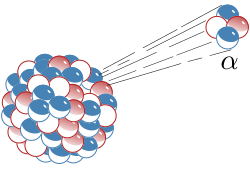
Why alpha and not a single proton? Because helium-4 is exceptionally tightly bound at 7.07 MeV/nucleon (Chapter 6.P). Ejecting it as a unit costs less than ejecting the pieces, and often the energy balance works only for the alpha.
Worked example: uranium-238.
^{238}\text{U} \to ^{234}\text{Th}+^4\text{He}
Masses: 238.050788, 234.043601, 4.002603 u.
\Delta m = 238.050788-234.043601-4.002603 = 0.004584\ \text{u}
Q = 0.004584\times931.494 = 4.27\ \text{MeV}
Positive, so it happens. The alpha carries most of it — by momentum conservation the energies split inversely as the masses, so the alpha gets 234/238 = 98.3 %, giving 4.20 MeV.
How it escapes is the tunnelling problem of Chapter 7.4, and it is worth restating because it explains a factor of 10^{24} in lifetimes. The alpha is trapped by the strong force and faces a Coulomb barrier of about 25 MeV with only 4.2 MeV of energy. Classically it can never leave. Quantum-mechanically it tunnels, with a probability exponentially sensitive to its energy — which is why polonium-212 lives 3\times10^{-7} s and thorium-232 lives 1.4\times10^{10} years while their alpha energies differ by only a factor of two.
Penetration: stopped by paper or a few centimetres of air. Harmless outside the body and extremely dangerous inside, since all the energy is deposited in a very short track. This is why polonium-210 is a poison and why radon gas — an alpha emitter that you breathe — is the second leading cause of lung cancer after smoking.
Beta decay
Beta minus:
n \to p+e^-+\bar{\nu}_e, \qquad ^A_Z\text{X} \to ^A_{Z+1}\text{Y}+e^-+\bar{\nu}_e
A neutron becomes a proton. At the quark level, d \to u via the W boson (Chapter 8.3).
Beta plus:
p \to n+e^++\nu_e
Only inside a nucleus, because a free proton is lighter than a neutron and cannot decay. The nuclear binding energy supplies the difference.
Electron capture is the competing process: the nucleus absorbs an inner electron, achieving the same transformation. It dominates in heavy nuclei where the inner electrons are close to the nucleus.
Chapter 8.5 covered why the neutrino was needed: the electrons come out with a continuous energy spectrum, so a third particle must be sharing.
Penetration: stopped by a few millimetres of aluminium.
Gamma decay
^A_Z\text{X}^* \to ^A_Z\text{X}+\gamma
No change in Z or A. The nucleus was left in an excited state by a previous decay and drops to the ground state, emitting a photon of typically 0.1 to 10 MeV.
This is the nuclear analogue of an atom emitting light, and the energies are a million times larger because nuclear level spacings are a million times larger.
Penetration: requires centimetres of lead, and is never completely stopped — the intensity falls exponentially, so shielding is specified as a halving thickness.
The half-life law, derived
The assumption: each nucleus has a fixed probability \lambda of decaying per unit time, independent of its age and of what its neighbours do. A nucleus does not get "old".
Then in time dt, out of N nuclei:
dN = -\lambda N\,dt
Separate and integrate:
\int\frac{dN}{N} = -\lambda\int dt \quad\Longrightarrow\quad \ln N = -\lambda t + C
\boxed{N(t) = N_0e^{-\lambda t}}
Half-life is when N = N_0/2:
\frac{1}{2} = e^{-\lambda t_{1/2}} \quad\Longrightarrow\quad \ln 2 = \lambda t_{1/2}
\boxed{t_{1/2} = \frac{\ln 2}{\lambda} = \frac{0.693}{\lambda}}
And the activity — decays per second, which is what a detector measures:
A = \lambda N = \lambda N_0e^{-\lambda t} = A_0e^{-\lambda t}
measured in becquerels (1 decay/s) or the older curie (3.7\times10^{10} Bq, defined as the activity of one gram of radium).
Half-lives span an extraordinary range:
| Isotope | Half-life | Use |
|---|---|---|
| Polonium-214 | 164 μs | — |
| Technetium-99m | 6.0 h | Medical imaging |
| Iodine-131 | 8.0 d | Thyroid treatment |
| Cobalt-60 | 5.3 y | Radiotherapy, sterilisation |
| Caesium-137 | 30.2 y | Fallout contaminant |
| Carbon-14 | 5730 y | Archaeological dating |
| Plutonium-239 | 24,100 y | Weapons, waste |
| Uranium-235 | 704 My | Nuclear fuel |
| Uranium-238 | 4.47 Gy | Geological dating |
| Tellurium-128 | 2.2\times10^{24} y | Double beta decay |
Tellurium-128's half-life is 10^{14} times the age of the universe, and it has been measured — by observing the accumulated decay products in ancient minerals.
Carbon dating, worked
The mechanism. Cosmic rays produce neutrons in the upper atmosphere, which convert nitrogen to carbon-14:
n+^{14}\text{N} \to ^{14}\text{C}+p
Carbon-14 mixes into atmospheric CO₂, plants take it up, animals eat plants, and every living thing maintains the atmospheric ratio:
\frac{^{14}\text{C}}{^{12}\text{C}} = 1.3\times10^{-12}
When it dies, uptake stops and the clock starts.
Worked problem. A piece of wood from a tomb gives 9.2 decays per minute per gram of carbon. Living wood gives 15.3. How old?
\frac{A}{A_0} = \frac{9.2}{15.3} = 0.6013
0.6013 = e^{-\lambda t} \quad\Longrightarrow\quad \ln(0.6013) = -\lambda t
-0.5087 = -\lambda t
\lambda = \frac{0.693}{5730} = 1.2096\times10^{-4}\ \text{y}^{-1}
t = \frac{0.5087}{1.2096\times10^{-4}} = 4205\ \text{years}
About 4200 years old — Old Kingdom Egypt.
The limits of the method. After 10 half-lives (57,300 years) only 2^{-10} = 0.1 % remains, and counting statistics become hopeless. The practical limit is about 50,000 years.
And it needs calibration. The atmospheric ratio is not constant — it varies with solar activity and the Earth's magnetic field. Tree rings provide an absolute calibration back about 12,000 years, and speleothems and corals extend it further.
Two human effects. Burning fossil fuels adds carbon with no $^{14}C, diluting the atmosphere — the **Suess effect**. And atmospheric nuclear testing in the 1950s and 60s **doubled** the atmospheric ^{14}$C, producing the "bomb pulse". That pulse has been used forensically to date recent human tissue to within a year or two.
Willard Libby developed the method in 1946 and received the Nobel Prize in 1960.
Fission

Chapter 6.4 computed the energy release. Here is the mechanism and the chain reaction.
Uranium-235 absorbs a slow neutron, becomes uranium-236 in an excited state, and the liquid drop deforms. If the deformation is large enough, the Coulomb repulsion between the two halves exceeds the surface tension holding them together and the drop splits.
^{235}\text{U}+n \to ^{236}\text{U}^* \to \text{two fragments} + 2\text{–}3\,n + 200\ \text{MeV}
Two critical details.
The extra neutrons. The fragments are on the neutron-rich side of the stability band (see the chart), because uranium's N/Z = 1.59 while the fragments' region wants about 1.3. The excess neutrons are ejected, and on average 2.4 come out. Those neutrons can cause further fissions — the chain reaction.
Why U-235 and not U-238. Uranium-235 has an odd neutron number, so adding one gives an even–even nucleus and the pairing term releases extra energy — enough to push it over the fission barrier with a zero-energy neutron. Uranium-238 has an even neutron number, gains less, and needs a neutron with over 1 MeV. This single difference in the pairing term is why enrichment is necessary.
Criticality. Define k as the average number of neutrons from one fission that cause another.
- k < 1: subcritical, the reaction dies.
- k = 1: critical, steady power. This is a reactor.
- k > 1: supercritical, exponential growth.
Reactors run at k = 1.000 exactly, and controlling it would be impossible if all neutrons appeared instantly — the response time would be microseconds. About 0.65 % of neutrons are "delayed", emitted seconds to minutes later by the decay of certain fission fragments. Reactors are operated so that they are subcritical on prompt neutrons alone and critical only with the delayed ones included, which stretches the control timescale from microseconds to tens of seconds. Every fission reactor on Earth depends on that 0.65 %.
Fusion
Light nuclei climbing the curve. Chapter 6.4 computed the energy; Chapter 7.4 explained how the Coulomb barrier is crossed by tunnelling; Chapter 12.1 works through the solar cycles.
The engineering condition is the Lawson criterion: for a self-sustaining reaction you need the triple product of density, temperature and confinement time to exceed a threshold:
n\,T\,\tau_E > 3\times10^{21}\ \text{keV s/m}^3
for the deuterium–tritium reaction.
Two approaches:
Magnetic confinement — tokamaks, holding a plasma at 1.5\times10^{8} K with magnetic fields. JET achieved 59 MJ in 2021; ITER, under construction in France, aims for 500 MW output from 50 MW input.
Inertial confinement — compressing a fuel pellet with lasers. In December 2022 the National Ignition Facility achieved ignition, releasing 3.15 MJ from 2.05 MJ of laser energy — the first time a fusion reaction released more energy than was delivered to it. The lasers themselves consumed about 300 MJ from the wall, so this is a scientific milestone rather than an energy source.
Why fusion is attractive: the fuel is abundant, there is no chain reaction to run away, the waste is short-lived, and the energy density is nine times fission's per unit mass. Why it is hard: you must hold a plasma hotter than the Sun's core in a magnetic bottle for long enough, and every instability in fluid dynamics conspires against you.
Where this shows up in your life
Nuclear medicine. Technetium-99m is used in about 30 million procedures a year — its 6-hour half-life is long enough to work with and short enough to clear quickly, and it emits a single clean 140 keV gamma.
Radiotherapy uses cobalt-60 sources or linear accelerators to deliver dose to tumours.
Smoke detectors, food irradiation, industrial radiography and sterilisation of medical equipment are all radioisotope applications.
Radon is the second leading cause of lung cancer, and testing for it is standard in many countries.
Geological dating. Uranium–lead dating gave the Earth's age as 4.54\times10^{9} years, and the same methods date meteorites and lunar samples.
Nuclear power supplies about 10 % of world electricity.
And the potassium-40 in your own body decays about 4400 times per second, which makes you measurably radioactive and always has been.
What the next chapter fixes
The nucleus is understood. What surrounds it decides everything about chemistry, and Chapter 7.6 solved that problem exactly for one electron. Chapter 9.3 extends it to many-electron atoms — where the exact solution is impossible and the approximations are what chemistry actually uses — derives the filling order and the shapes of the orbitals, and explains the exceptions like chromium and copper rather than asking anyone to memorise them.