Appearance
1.8 — Rotation
Spin a bicycle wheel, hold it by the axle, and try to tilt it. It fights you, and not in the direction you expect: push the top away from you and the wheel swings sideways. Let the same wheel hang from a rope tied to one end of its axle, spinning, and it does not fall — it hangs horizontally and slowly walks in a circle.
Nothing in Chapters 1.1 to 1.7 predicts any of that. Everything so far treated bodies as points, and a point cannot spin. This chapter builds the second half of mechanics: an angular version of every quantity you already have, with the same laws in the same shapes, and a conservation law that explains the wheel, the figure skater, and why the Earth's day is getting longer.
Angular quantities, and why radians
Rotation is measured by angle, and the angle is measured in radians for one reason: the radian is the unit that makes arc length come out clean.
Define \theta, the angle in radians, as the arc length divided by the radius:
\theta = \frac{s}{r}
A full circle has arc length 2\pi r, so a full turn is 2\pi r / r = 2\pi radians, which is where 360° = 2\pi\ \text{rad} comes from. The radian is dimensionless, being a length divided by a length, which is why Chapter 1.1's rule about trigonometric arguments is satisfied.
Rearranged, s = r\theta, and that is the equation that connects everything angular to everything linear. Differentiate it once and once more, holding r fixed:
v = r\omega, \qquad a_t = r\alpha
where:
- \omega = d\theta/dt is angular velocity, in radians per second
- \alpha = d\omega/dt is angular acceleration, in radians per second squared
- a_t is the tangential acceleration — the part that changes the speed
That subscript matters. A point on a rotating body has two accelerations at once: the tangential one r\alpha that speeds it up along its circle, and the centripetal one r\omega^2 from Chapter 1.5 that pulls it towards the axis. They are perpendicular to each other, and when the rotation rate is steady only the centripetal one survives.
Because the definitions have the same shape as the linear ones, the four equations of Chapter 1.2 carry over with the symbols swapped, valid whenever \alpha is constant:
| Linear | Angular |
|---|---|
| v = u + at | \omega = \omega_0 + \alpha t |
| s = ut + \tfrac12at^2 | \theta = \omega_0 t + \tfrac12\alpha t^2 |
| v^2 = u^2+2as | \omega^2 = \omega_0^2 + 2\alpha\theta |
Nothing new was proved. The derivations are the identical integrations with different letters, because the definitions are identical in form.
Torque: force that turns
Push a door at the handle and it swings easily. Push with the same force right next to the hinge and almost nothing happens. Force alone does not determine turning; where you apply it and which way you push both matter.
The quantity that captures all three is torque:
\tau = rF\sin\theta
where r is the distance from the axis to where the force is applied, F is the force, and \theta is the angle between the position vector and the force. In vector form it is a cross product (Volume II, Chapter 4.1):
\vec{\tau} = \vec{r}\times\vec{F}
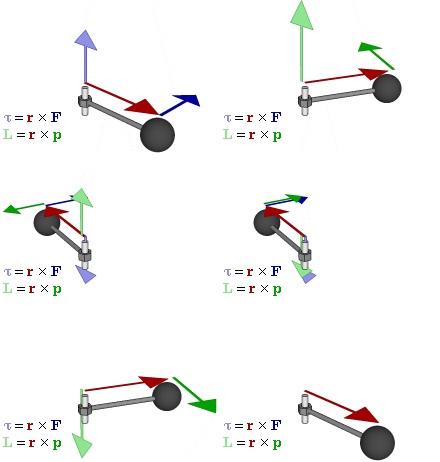
Read the \sin\theta carefully, because it contains the whole practical content:
- \theta = 90°, force perpendicular to the arm: \sin 90° = 1, maximum torque. This is why you push a door square-on.
- \theta = 0°, force along the arm: \sin 0 = 0, zero torque. Pulling a door handle straight towards the hinge does nothing at all, however hard you pull.
There is a second way to read the same formula that is often quicker. Group it as \tau = F(r\sin\theta), and r\sin\theta is the perpendicular distance from the axis to the line along which the force acts. That distance is called the moment arm, and it is what a mechanic is lengthening when they slip a pipe over a spanner handle.
Torque has units of newton-metres. Its dimension, \mathrm{M\,L^2\,T^{-2}}, is the same as energy's — and they are completely different quantities, which is exactly the warning Chapter 1.1 gave about dimensional analysis not being able to tell them apart. To keep them separate, torque is written in N·m and never in joules.
Sign convention: anticlockwise torque is positive, clockwise negative. This is a convention, not a fact, but it is the standard one and mixing conventions mid-problem is the usual source of error.
Moment of inertia: rotational mass
Newton's second law for rotation ought to look like \tau = (\text{something})\times\alpha. Deriving what that something is takes four lines.
Take a single particle of mass m at distance r from the axis. A tangential force F acts on it. Newton's second law gives F = ma_t = m r\alpha. Multiply both sides by r to turn the force into a torque:
\tau = rF = mr^2\alpha
So for one particle the "rotational mass" is mr^2. For a real body, add up every particle:
\boxed{I = \sum_i m_ir_i^2} \qquad\text{or, for a continuous body,}\qquad I = \int r^2\,dm
I is the moment of inertia, and:
\boxed{\tau_{\text{net}} = I\alpha}
Two things about I are worth stating plainly, because they are what make rotation different from linear motion.
It depends on where the axis is. Mass is a property of a body. Moment of inertia is a property of a body and a chosen axis. The same rod has three different values of I about three different axes, and quoting one without the other is meaningless.
It weights distance more heavily than mass, because r is squared. Moving a kilogram twice as far from the axis quadruples its contribution. This single fact explains the figure skater, the flywheel, the tightrope walker's pole and the design of every wheel.

Computing one from scratch: the thin rod
Take a uniform rod of mass M and length L, spinning about its centre. Its mass per unit length is \lambda = M/L, so a slice of thickness dx at distance x from the centre has mass dm = \lambda\,dx.
I = \int_{-L/2}^{L/2} x^2\,\lambda\,dx = \lambda\left[\frac{x^3}{3}\right]_{-L/2}^{L/2}
Evaluate at the limits. The upper gives \dfrac{(L/2)^3}{3} = \dfrac{L^3}{24}, and the lower gives \dfrac{(-L/2)^3}{3} = -\dfrac{L^3}{24}. Subtracting a negative adds, so:
I = \lambda\left(\frac{L^3}{24}+\frac{L^3}{24}\right) = \lambda\frac{L^3}{12} = \frac{M}{L}\cdot\frac{L^3}{12}
\boxed{I_{\text{rod, centre}} = \frac{ML^2}{12}}
The standard results
| Body | Axis | I |
|---|---|---|
| Point mass | Distance r | mr^2 |
| Thin rod, length L | Through centre, perpendicular | \tfrac{1}{12}ML^2 |
| Thin rod, length L | Through one end | \tfrac13 ML^2 |
| Hoop or thin ring, radius R | Through centre, perpendicular | MR^2 |
| Solid disc or cylinder, radius R | Through centre, perpendicular | \tfrac12MR^2 |
| Solid sphere, radius R | Through centre | \tfrac25MR^2 |
| Hollow sphere, radius R | Through centre | \tfrac23MR^2 |
The ordering in that table is the physics. A hoop has all its mass at the full radius R, so it gets the maximum possible MR^2. A disc has mass spread from the centre outwards, so its average r^2 is smaller and it gets \tfrac12MR^2. A solid sphere packs even more mass near the axis, so it drops to \tfrac25MR^2. Mass further out means a larger I, and that is the only thing to remember; the fractions follow from where the mass sits.
The parallel axis theorem
You will constantly need I about an axis that is not through the centre of mass. The theorem that gets you there is short:
\boxed{I = I_{\text{cm}} + Md^2}
where d is the distance between the new axis and a parallel one through the centre of mass.
Check it against the table. A rod about its end should be I_{\text{cm}} + M(L/2)^2 = \tfrac{1}{12}ML^2 + \tfrac14ML^2. Putting both over twelve: \tfrac{1}{12}ML^2 + \tfrac{3}{12}ML^2 = \tfrac{4}{12}ML^2 = \tfrac13ML^2. That is exactly the table's entry, so the theorem reproduces a result we derived independently.
Note that Md^2 is always positive, so the moment of inertia is smallest about an axis through the centre of mass. A body is always easiest to spin about its own centre, which is why a thrown hammer tumbles about its centre of mass and not about its head.
The perpendicular axis theorem
For a flat body lying in the xy plane only:
I_z = I_x + I_y
The moment about the axis sticking out of the plane equals the sum of the moments about two perpendicular axes lying in it. The proof is one line: for a point in the plane, r_z^2 = x^2+y^2, and x is its distance from the y-axis while y is its distance from the x-axis. Sum over all points and the theorem falls out.
Use it on a disc. By symmetry I_x = I_y, and we know I_z = \tfrac12MR^2, so 2I_x = \tfrac12MR^2, giving I_x = \tfrac14MR^2 for a disc spun about a diameter — a result that would take a genuinely unpleasant double integral to get directly.
Rotational energy and angular momentum
Every linear quantity has a rotational twin, and each one is derived the same way: write the linear form for one particle, substitute v = r\omega, and sum.
Kinetic energy. For one particle, \tfrac12mv^2 = \tfrac12m(r\omega)^2 = \tfrac12mr^2\omega^2. Sum over the body, and \omega is the same for every particle in a rigid body so it comes outside:
K_{\text{rot}} = \tfrac12\left(\sum m_ir_i^2\right)\omega^2 = \boxed{\tfrac12 I\omega^2}
Angular momentum. For one particle, L = rp = r(mv) = mr^2\omega. Sum:
\boxed{L = I\omega}
and in general, for a particle at position \vec{r} with momentum \vec{p}:
\vec{L} = \vec{r}\times\vec{p}
Work and power. W = \tau\theta and P = \tau\omega. The second is why an engine's power curve and torque curve are two views of the same data, related by the revolutions per minute.
The complete correspondence, which is worth learning as a table because it means you already know rotational mechanics:
| Linear | Rotational |
|---|---|
| Displacement s | Angle \theta |
| Velocity v | Angular velocity \omega |
| Acceleration a | Angular acceleration \alpha |
| Mass m | Moment of inertia I |
| Force F | Torque \tau |
| F = ma | \tau = I\alpha |
| Momentum p = mv | Angular momentum L = I\omega |
| F = dp/dt | \tau = dL/dt |
| Kinetic energy \tfrac12mv^2 | \tfrac12I\omega^2 |
| Work Fs | Work \tau\theta |
| Power Fv | Power \tau\omega |
Conservation of angular momentum
From \tau_{\text{net}} = dL/dt: if no external torque acts, dL/dt = 0, so:
\boxed{L = I\omega = \text{constant}}
This is a separate conservation law from linear momentum. A system can have zero net force and a large net torque, or the reverse — think of two equal and opposite forces applied at the two ends of a rod, which cancel as forces and add as torques.
The figure skater
A skater spinning with arms outstretched pulls them in and speeds up dramatically. No one pushes her; the ice is nearly frictionless, so there is no external torque, so I\omega is fixed. Pulling her arms in moves mass towards the axis, which cuts I — and because r is squared, moving her hands from 0.7 m to 0.1 m from the axis cuts their contribution by a factor of about fifty. With I perhaps a third of what it was, \omega must triple.
Now check the energy, because this is where it gets interesting:
K = \tfrac12I\omega^2 = \tfrac12\frac{(I\omega)^2}{I} = \frac{L^2}{2I}
With L fixed and I cut to a third, the kinetic energy triples. Energy is not conserved here, and it should not be: the skater does work pulling her arms inward against the centrifugal effect in her rotating frame. She is the energy source, and she can feel it.
Why a spinning top does not fall over
A stationary top falls immediately: gravity acts at its centre of mass, the pivot holds the tip, and the torque tips it over. A spinning top given the same torque does something else entirely — it stays up and its axis sweeps slowly around a cone.
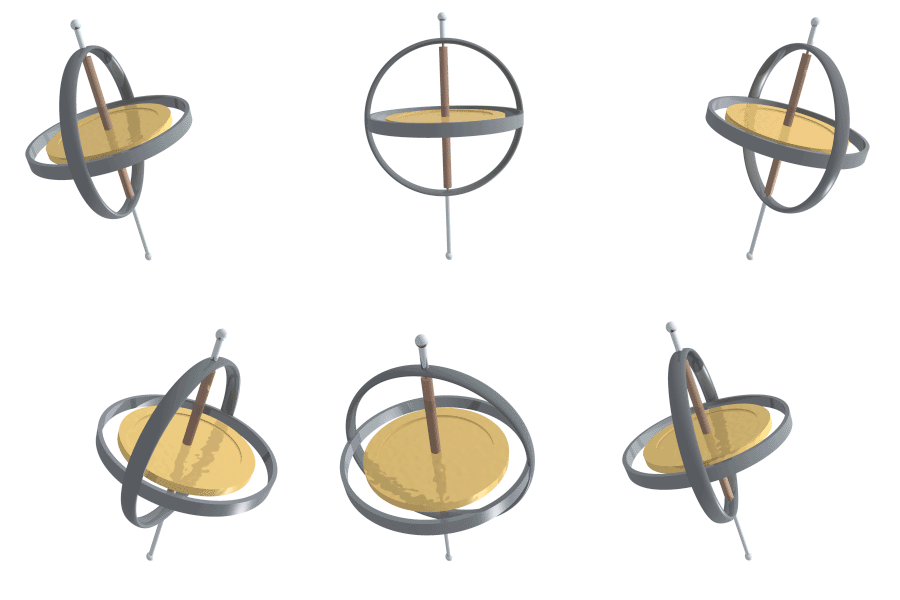
The explanation is one equation read carefully. \vec{\tau} = d\vec{L}/dt says torque changes angular momentum — and \vec{L} is a vector, so a torque can change its direction without changing its size, exactly as a centripetal force changes velocity's direction without changing speed.
For a spinning top, \vec{L} points along the spin axis, roughly horizontally. Gravity's torque \vec{r}\times\vec{F} is perpendicular to both the axis and to vertical — that is, horizontal and sideways. So d\vec{L} is sideways, and adding a sideways nudge to a horizontal vector rotates it rather than tipping it. The axis swings horizontally. That motion is called precession, and its rate is
\Omega = \frac{\tau}{L} = \frac{Mgr}{I\omega}
Read what that predicts: the faster the top spins (larger L), the slower it precesses. A top spinning down loses L, so its precession visibly accelerates until it wobbles and falls — which is exactly what you see.
The same effect keeps a moving bicycle upright, is how a gyrocompass finds true north with no magnetism at all, and is why the Earth's axis traces a circle in the sky every 25 772 years. That last one is precession caused by the Sun and Moon tugging on the Earth's equatorial bulge, and it is why the pole star changes over millennia: in 3000 BC the pole star was Thuban, not Polaris.
Why the day is getting longer
The Earth–Moon system has no external torque worth speaking of, so its total angular momentum is fixed. Tidal friction — the oceans dragging against the sea floor as the tidal bulge is pulled around — steadily slows the Earth's spin, removing angular momentum from the Earth's rotation. It has to go somewhere, and it goes into the Moon's orbit, which means the Moon must move further away.
The numbers are measured, not estimated: laser reflectors left on the Moon by Apollo astronauts show it receding at 3.8 cm per year, and the day is lengthening by about 1.7 milliseconds per century. Fossil coral growth bands from 400 million years ago record about 400 days in a year, which matches. This is why leap seconds exist.
Rolling without slipping
A wheel rolling along the ground is doing two things at once: its centre is translating, and the wheel is rotating about that centre. Rolling without slipping is the condition that links them.
If the wheel does not skid, the arc length that has unwound off the rim equals the distance the centre has travelled:
s = R\theta \quad\Longrightarrow\quad \boxed{v_{\text{cm}} = R\omega, \qquad a_{\text{cm}} = R\alpha}
This produces a result that sounds wrong and is not: the contact point of a rolling wheel is instantaneously stationary. Every point on the wheel has the translation velocity v_{\text{cm}} forwards plus the rotation velocity R\omega tangentially. At the bottom, the rotation velocity points backwards, so the two cancel exactly. At the top they add, so the top of a rolling wheel moves at 2v_{\text{cm}} — twice the speed of the car it belongs to.
That instantaneous stillness is why friction at the tyre contact patch is static friction, as Chapter 1.5 claimed, and it is also why rolling friction is so much smaller than sliding friction. Nothing is sliding.
The total kinetic energy splits into two terms:
K = \underbrace{\tfrac12Mv_{\text{cm}}^2}_{\text{translation}} + \underbrace{\tfrac12I\omega^2}_{\text{rotation}}
The race down the ramp
Release a solid sphere, a solid cylinder and a hoop from rest at the top of a ramp of height h. In what order do they finish?
Every object's I can be written I = cMR^2, where c is the fraction from the table: \tfrac25 for a solid sphere, \tfrac12 for a cylinder, 1 for a hoop.
Energy conservation, using \omega = v/R:
Mgh = \tfrac12Mv^2 + \tfrac12(cMR^2)\left(\frac{v}{R}\right)^2 = \tfrac12Mv^2 + \tfrac12cMv^2 = \tfrac12Mv^2(1+c)
The M cancels and the R cancels:
\boxed{v = \sqrt{\frac{2gh}{1+c}}}
Neither mass nor radius appears. Only the shape matters, through c:
| Body | c | v |
|---|---|---|
| Sliding block (frictionless) | 0 | \sqrt{2gh} |
| Solid sphere | 0.4 | 0.845\sqrt{2gh} |
| Solid cylinder | 0.5 | 0.816\sqrt{2gh} |
| Hoop | 1.0 | 0.707\sqrt{2gh} |
The sphere wins, the hoop loses, and a hollow ball loses to a solid one of identical mass and size. The reason is a clean statement about energy sharing: every rolling body arrives with the same total energy Mgh, but it has to split that total between going forwards and spinning. A hoop, with all its mass at the rim, must put half of it into spin, so only half is left for speed. A sphere puts only two-sevenths into spin.
A basketball and a marble, wildly different in size and mass, tie exactly — both are solid spheres, both have c = 0.4. That is a demonstration worth doing, because the result is genuinely counter-intuitive until you see the M and R cancel.
Where this shows up in your life
A flywheel stores energy as \tfrac12I\omega^2, and because \omega is squared, the fast-spinning ones win: modern flywheel energy storage runs carbon-fibre rotors at 50 000 rpm in a vacuum on magnetic bearings, and can absorb a train's entire braking energy in seconds.
A tightrope walker's long pole works by raising I about the wire. The walker's body tips at a rate \alpha = \tau/I, so tripling I cuts the rate of tipping to a third, buying time to correct. The pole often droops at the ends deliberately, which lowers the combined centre of mass below the wire and makes the whole system stable rather than merely slow.
A helicopter needs a tail rotor because of angular momentum. Spinning the main rotor one way must spin the body the other, and the tail rotor supplies the sideways thrust whose torque cancels it. Twin-rotor helicopters spin their two rotors in opposite directions and need no tail rotor at all.
And the reason a cat almost always lands on its feet, despite starting a fall with zero angular momentum and having nothing to push against, is that it changes its shape. By tucking the front half and extending the back half, then swapping, it rotates its front and rear sections through different angles while the total angular momentum stays exactly zero. Nothing is violated; the cat is exploiting the fact that I is not a constant when the body can deform.
What the next chapter fixes
Everything so far assumed gravity is a constant 9.81\ \text{m/s}^2 pointing down, which is a decent approximation within a few kilometres of the ground and useless anywhere else. Chapter 1.9 derives the real law — from Kepler's observations of the planets, step by step — proves the shell theorem that lets a whole planet be treated as a point, computes g from the Earth's mass, explains tides and escape velocity, and then does the thing this Part has been pointing at since Chapter 1.4: names the three places where Newton's gravity is measurably, unarguably wrong.