Appearance
8.5 — Neutrinos: The Particle That Barely Exists
About sixty-five billion neutrinos from the Sun pass through every square centimetre of your body every second. Right now. They pass through the Earth as though it were not there, and continue into space.
In your entire lifetime, roughly one of them will interact with an atom in your body.
This chapter is about the particle that was invented to save a conservation law, took twenty-six years to find, was thought massless for forty more, and turned out to be the only confirmed piece of physics beyond the Standard Model.
The crisis in beta decay
By the 1920s beta decay looked simple:
^{A}_{Z}\text{X} \to ^{A}_{Z+1}\text{Y} + e^-
Two bodies out means a fixed energy split. Conservation of energy and momentum in a two-body decay determines each product's energy exactly, the way an alpha decay does — and alpha particles do come out with sharp energies.
Beta electrons come out with a continuous spectrum, from zero up to a maximum. Most have less than the maximum, and the missing energy goes nowhere anybody could find.
Ellis and Wooster settled it experimentally in 1927. They put a beta source in a calorimeter and measured the total heat released. If the missing energy were being carried by undetected gamma rays, the calorimeter would catch it. It measured the mean electron energy, not the maximum. The energy was genuinely gone.
And angular momentum did not balance either. Nitrogen-14 has integer spin; its beta decay product carbon-14 also has integer spin; and an electron has spin ½. Integer cannot equal integer plus a half.
Bohr's proposal: abandon energy conservation in nuclear processes, at least statistically. He was serious about it, and given his record it was not a frivolous suggestion.
Pauli's desperate remedy
On 4 December 1930, Pauli wrote to a conference in Tübingen that he could not attend because he had a ball to go to in Zurich. The letter opens "Dear Radioactive Ladies and Gentlemen".
His proposal: a third particle is emitted, neutral, spin ½, very light, and interacting so weakly that nobody has seen it.
That fixes both problems at once. Three bodies share the energy, so the electron's share varies continuously. And a second spin-½ particle balances the angular momentum.
He wrote: "I have done a terrible thing. I have postulated a particle that cannot be detected."
Fermi named it in 1934 — neutrino, Italian for "little neutral one", to distinguish it from Chadwick's newly found neutron — and built the first quantitative theory of beta decay, which is the direct ancestor of the weak interaction in Chapter 8.3. Fermi's paper was rejected by Nature as "too remote from reality".
The corrected decay:
n \to p + e^- + \bar{\nu}_e
Finding it
The problem is the cross-section. A neutrino's chance of interacting with a nucleus is about 10^{-44} cm², which is the smallest number in experimental physics.
Compute the mean free path in lead, with n = 3.3\times10^{22} nuclei/cm³:
\lambda = \frac{1}{n\sigma} = \frac{1}{(3.3\times10^{22})(10^{-44})} = 3\times10^{21}\ \text{cm} = 3\times10^{19}\ \text{m}
About 3000 light years of lead to stop half of them. That is the number usually quoted as "a light year of lead", and it is the right order.
So you cannot stop them. You must have enough of them.
Reines and Cowan, 1956. They put a detector beside the Savannah River nuclear reactor, which produces about 10^{13} antineutrinos per square centimetre per second.
Their trick was a double signature. The reaction is inverse beta decay:
\bar{\nu}_e + p \to n + e^+
The positron annihilates immediately, giving two 0.511 MeV photons back to back (Chapter 7.10). The neutron wanders for a few microseconds and is then captured by cadmium dissolved in the tank, releasing a distinctive gamma cascade.
Two flashes, a few microseconds apart, of the right energies. No background process does that. They saw about three events per hour.
They sent Pauli a telegram. He replied: "Everything comes to him who knows how to wait." Reines received the Nobel Prize in 1995; Cowan had died in 1974.
Three flavours
The muon neutrino, 1962. Lederman, Schwartz and Steinberger at Brookhaven produced neutrinos from pion decay and found that they made muons and never electrons. So \nu_\mu \neq \nu_e. Nobel Prize 1988.
The tau neutrino, 2000. DONUT at Fermilab, four tracks in an emulsion.
And exactly three light ones. Chapter 8.6 explains how the Z boson's decay width settled this, and the answer is N_\nu = 2.984 \pm 0.008.
The solar neutrino problem
Ray Davis, from 1968, in the Homestake gold mine in South Dakota, 1500 m underground to shield from cosmic rays.
The detector: 380,000 litres of perchloroethylene — dry-cleaning fluid — in a tank. The reaction:
\nu_e + ^{37}\text{Cl} \to ^{37}\text{Ar} + e^-
Argon-37 is radioactive with a 35-day half-life. Every few weeks, Davis bubbled helium through the tank to sweep out the argon, and counted the atoms.
The expected rate was about one atom every two days, in a tank of 600 tonnes. He was counting individual atoms produced in a swimming pool of solvent, and separating them chemically from 10^{30} other atoms.
The result: about one third of the predicted rate.
This was checked for thirty years. Was Davis's chemistry wrong? Was John Bahcall's solar model wrong? Both were checked exhaustively and both held up. Gallium experiments (SAGE in Russia, GALLEX in Italy) with a lower energy threshold saw a deficit too. Kamiokande in Japan, using a completely different technique, saw about half.
Every experiment saw a deficit, and the size of the deficit depended on the energy.
Oscillation
Bruno Pontecorvo suggested the answer in 1957, long before the data demanded it: neutrinos change flavour in flight.
The mechanism
The key idea: the neutrinos produced in weak interactions — the flavour states \nu_e, \nu_\mu, \nu_\tau — are not the states with definite mass. Each flavour state is a superposition of mass states \nu_1, \nu_2, \nu_3.
Two-flavour version, which contains all the physics:
|\nu_e\rangle = \cos\theta|\nu_1\rangle + \sin\theta|\nu_2\rangle
|\nu_\mu\rangle = -\sin\theta|\nu_1\rangle + \cos\theta|\nu_2\rangle
with \theta the mixing angle.
Now propagate. Chapter 7.3 established that a state of definite energy evolves as e^{-iEt/\hbar}. The two mass states have different masses and therefore different energies for the same momentum:
E_i = \sqrt{p^2c^2+m_i^2c^4} \approx pc + \frac{m_i^2c^4}{2pc}
They accumulate phase at different rates. After a distance L:
|\nu(L)\rangle = \cos\theta\,e^{-iE_1L/\hbar c}|\nu_1\rangle + \sin\theta\,e^{-iE_2L/\hbar c}|\nu_2\rangle
The relative phase is what matters:
\Delta\phi = \frac{(E_2-E_1)L}{\hbar c} = \frac{\Delta m^2c^4L}{2\hbar c\,E}
where \Delta m^2 = m_2^2-m_1^2.
Project onto the muon flavour and square to get the probability of having changed:
\boxed{P(\nu_e\to\nu_\mu) = \sin^2(2\theta)\sin^2\left(\frac{1.27\,\Delta m^2[\text{eV}^2]\,L[\text{km}]}{E[\text{GeV}]}\right)}
The 1.27 packages all the constants, and it is the form used in every experimental paper.
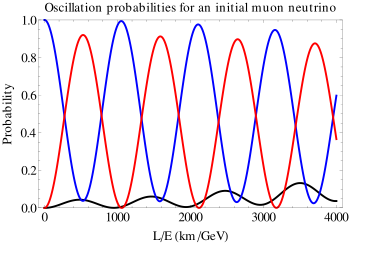
What the formula tells you
Oscillation requires mass. If \Delta m^2 = 0, the sine is zero and nothing happens. Observing oscillation proves at least two neutrinos have mass, and that the masses differ.
It also requires mixing. If \theta = 0, flavour and mass states coincide and nothing happens.
Only mass-squared differences are measurable, not the masses themselves. This is why the absolute mass scale remains unknown.
The oscillation length:
L_{\text{osc}} = \frac{2.48\,E[\text{GeV}]}{\Delta m^2[\text{eV}^2]}\ \text{km}
Design an experiment by matching L/E to the \Delta m^2 you want to probe. This is why some experiments are metres long and others thousands of kilometres.
The MSW effect
Solar neutrinos have an extra twist. Passing through the dense solar interior, electron neutrinos feel an extra potential from forward scattering off electrons — which muon and tau neutrinos do not, since the reaction requires an electron in the final state.
This changes the effective mixing in matter, and Mikheyev, Smirnov and Wolfenstein showed it can produce resonant conversion: at a particular density the conversion becomes essentially complete.
This is why the solar deficit depends on energy. Low-energy neutrinos oscillate in vacuum and are suppressed by about a half; high-energy ones undergo MSW conversion in the Sun and are suppressed to about a third. The energy dependence Davis and the gallium experiments saw is the fingerprint of matter effects, and it is one of the most convincing details in the whole story.
The experiments that settled it
Super-Kamiokande, 1998 — atmospheric neutrinos.
Cosmic rays hit the upper atmosphere and produce pions, which decay to muons and muon neutrinos, and the muons decay to electrons and more neutrinos. The ratio should be about 2 muon neutrinos per electron neutrino, and the flux should be the same from above and below since cosmic rays hit all sides of the Earth equally.
Super-K measured direction as well as flavour.
Neutrinos from above, travelling about 15 km: the expected number.
Neutrinos from below, having crossed 13,000 km of Earth: about half the expected muon neutrinos.
And the deficit depended on the zenith angle exactly as the oscillation formula predicts. Longer path, more oscillation. There is no other explanation.
Announced in June 1998 at Takayama. It is the discovery of neutrino mass, and it is the only confirmed departure from the Standard Model.
SNO, 2001–2002 — solving the solar problem outright.
The Sudbury Neutrino Observatory in a Canadian nickel mine used 1000 tonnes of heavy water, borrowed from Canada's reactor programme and worth about 300 million dollars.
Heavy water permits three different reactions, and that is the whole point:
Charged current: \nu_e + d \to p+p+e^-. Electron neutrinos only.
Neutral current: \nu_x + d \to p+n+\nu_x. All three flavours equally, because it proceeds via the Z boson which does not care about flavour.
Elastic scattering: \nu_x + e^- \to \nu_x+e^-. All flavours, with electron neutrinos weighted about six times more.
The result:
\text{Charged current (}\nu_e\text{ only)}: \quad 1.76\times10^{6}\ \text{cm}^{-2}\text{s}^{-1}
\text{Neutral current (all flavours)}: \quad 5.09\times10^{6}\ \text{cm}^{-2}\text{s}^{-1}
Predicted by the solar model: 5.05\times10^{6}.
The total flux matched the Sun's prediction exactly. Only a third were still electron neutrinos.
So the Sun was fine and the neutrinos had changed flavour. Thirty years of "the solar neutrino problem" ended in one measurement.
Takaaki Kajita (Super-K) and Arthur McDonald (SNO) shared the 2015 Nobel Prize. Davis and Koshiba had shared the 2002 prize for opening the field.
How Super-Kamiokande actually sees them

The detector. A stainless steel cylinder 39 m across and 42 m tall, holding 50,000 tonnes of ultrapure water, one kilometre underground in the Mozumi mine at Kamioka, Japan.
Why underground? Cosmic ray muons. At the surface about 100 per square metre per second arrive; at 1000 m of rock the rate falls by a factor of 10^{5}. The rock is the shield, and no artificial shield could be built that thick.
Why ultrapure water? Two reasons. Any dissolved radioactive impurity is a background, and the water must be transparent enough that light travels tens of metres. Super-K's water is filtered continuously and has an attenuation length of over 100 m — far clearer than any natural water, and clear enough that a technician in a boat on the surface during filling cannot see the bottom because there is nothing to scatter light.
11,129 photomultiplier tubes, each 50 cm in diameter, covering 40 % of the surface. A photomultiplier converts a single photon into a measurable electrical pulse by knocking out an electron and multiplying it through a cascade of dynodes, with a gain of about 10^{7}.
The detection mechanism: Cherenkov radiation
Chapter 2.5 introduced this as the optical version of a sonic boom.
A neutrino occasionally interacts, producing a charged lepton — an electron from \nu_e, a muon from \nu_\mu.
That lepton travels faster than light does in water. Light in water goes at c/1.33 = 0.75c, and the lepton can easily exceed that while remaining below c. Nothing is violated — the universal limit is c in vacuum.
It emits a cone of blue light, at the angle from Chapter 2.5:
\cos\theta = \frac{1}{n\beta} = \frac{1}{1.33} = 0.752 \quad\Longrightarrow\quad \theta = 41.2°
for a relativistic particle.
The cone projects onto the detector wall as a ring. From the ring the analysis extracts:
- Direction — from the ring's centre, giving the neutrino's arrival direction to a few degrees.
- Energy — from the total light collected.
- Flavour — from the ring's sharpness.

The flavour discrimination is the crucial detail, and it is elegantly simple.
An electron is light, so it scatters repeatedly and produces an electromagnetic shower — a cascade of pairs and photons all making their own overlapping cones. The ring is fuzzy.
A muon is 207 times heavier, so it barely scatters and travels almost dead straight until it stops. The ring is sharp.
Super-K distinguishes them with about 98 % accuracy, and that is what allowed the muon neutrino deficit to be measured against a stable electron neutrino background.
Rates. Super-K sees roughly 10 solar neutrino events per day, and about 8 atmospheric events per day, from 10^{20} neutrinos passing through.
SN 1987A
On 23 February 1987, three detectors — Kamiokande in Japan, IMB in Ohio, and Baksan in Russia — recorded a total of 24 neutrinos within 13 seconds.
Three hours later, a supernova appeared in the Large Magellanic Cloud.
Why the neutrinos arrived first. In a core collapse, 99 % of the energy comes out as neutrinos, and they escape immediately. The shock wave takes hours to reach the star's surface and produce visible light. Neutrinos are the early warning.
What those 24 events established:
- The core-collapse mechanism is right. The energy carried, 3\times10^{46} J, matched the gravitational binding energy of a neutron star.
- The neutrino mass is small. They arrived within seconds of each other across 168,000 light years, so their speeds are equal to about one part in 10^{9}, giving a mass limit of about 20 eV.
- The neutrino lifetime exceeds 10^{5} years in its own frame.
Twenty-four particles founded the field of neutrino astronomy. A supernova in our own galaxy would produce thousands of events, and a network called SNEWS now exists to alert astronomers within minutes.
What is still unknown
The absolute masses. Only differences of squares are measured:
\Delta m^2_{21} = 7.4\times10^{-5}\ \text{eV}^2, \qquad |\Delta m^2_{32}| = 2.5\times10^{-3}\ \text{eV}^2
So at least one neutrino weighs at least \sqrt{2.5\times10^{-3}} = 0.05 eV. Upper limits come from tritium beta decay (KATRIN, in Germany: <0.8 eV) and from cosmology (the sum of all three <0.12 eV).
Even the heaviest neutrino is at least a million times lighter than the electron. Nobody knows why.
The ordering. Is \nu_3 the heaviest (normal ordering) or the lightest (inverted)? The sign of \Delta m^2_{32} is not yet determined. DUNE and Hyper-Kamiokande are designed to settle it.
Dirac or Majorana? Is the neutrino its own antiparticle? Every other fermion is not. If the neutrino is Majorana — its own antiparticle — then lepton number is not conserved, and there is a natural explanation for why the masses are so small: the seesaw mechanism, in which a very heavy right-handed partner at around 10^{15} GeV pushes the observed mass down to:
m_\nu \sim \frac{m_D^2}{M_R}
With m_D at the electroweak scale and M_R at the grand unification scale, this gives exactly the observed sub-eV masses. It is the most attractive explanation available.
The test is neutrinoless double beta decay. Certain nuclei can decay by emitting two electrons and two antineutrinos. If the neutrino is Majorana, the two antineutrinos can annihilate each other internally, giving a decay with two electrons and nothing else — and a sharp peak at the full energy instead of a continuous spectrum.
Experiments running: GERDA and LEGEND (germanium, Italy), KamLAND-Zen (xenon, Japan), CUORE (tellurium, Italy), EXO, SNO+, and more. Current limits push the half-life beyond 10^{26} years. Nothing found yet.
CP violation in the lepton sector. If neutrinos violate CP, leptogenesis becomes possible: CP-violating decays of heavy right-handed neutrinos in the early universe produce a lepton asymmetry, which is converted into a baryon asymmetry by known electroweak processes. This is currently the leading explanation for why there is matter at all (Chapter 7.10).
T2K in Japan and NOvA in the United States have hints of CP violation at about 2–3 standard deviations. DUNE, sending a beam 1300 km from Fermilab to South Dakota, is designed to measure it decisively from about 2030.
Sterile neutrinos. Several short-baseline experiments (LSND, MiniBooNE) have seen anomalies suggesting a fourth, non-interacting neutrino. MicroBooNE found no support for it in 2021, and the situation is unresolved.
Neutrino astronomy
IceCube, at the South Pole, instruments one cubic kilometre of Antarctic ice with 5160 optical sensors on 86 strings frozen 1.5 to 2.5 km deep. The ice is the detector; Cherenkov light travels far in it.
It found astrophysical neutrinos in 2013, at energies up to a few PeV — millions of times the energy of solar neutrinos. Two early events were named Bert and Ernie.
In September 2017 it caught a 290 TeV neutrino and alerted telescopes within a minute. They found the blazar TXS 0506+056 flaring in gamma rays at the same position. The first identified source of high-energy cosmic neutrinos, and strong evidence that blazars accelerate cosmic rays.
Why neutrino astronomy matters. Light is absorbed and deflected; charged cosmic rays are bent by magnetic fields so their arrival direction says nothing about their origin. Neutrinos travel in straight lines and pass through everything, so they point back at their source and can escape from places nothing else can — the core of a collapsing star, the centre of an active galaxy, and in principle the first second of the universe.
Others running or planned: KM3NeT in the Mediterranean, Baikal-GVD in Siberia, and IceCube-Gen2.
Where this shows up in your life
Reactor monitoring. A nuclear reactor's antineutrino flux depends on its fuel composition, and detectors placed outside can verify what a reactor is doing without access to it. This is an active non-proliferation technology.
Geoneutrinos. Radioactive decay in the Earth's interior produces antineutrinos, and KamLAND and Borexino have measured them. This is the only direct measurement of how much heat the Earth generates radioactively — about 20 TW of the total 47 TW — which matters for models of plate tectonics and the geodynamo.
Solar physics. Borexino has measured neutrinos from every step of the proton–proton chain and, in 2020, from the CNO cycle. It is the only way to see the Sun's core directly, since photons from the centre take about 100,000 years to random-walk out.
Supernova early warning, through SNEWS.
And sixty-five billion of them are passing through each square centimetre of you every second, and always have been.
What the next chapter fixes
Detecting a particle that interacts once per lifetime per person requires machinery, and so does producing particles heavy enough to have vanished from the universe 10^{-10} seconds after the Big Bang. Chapter 8.6 covers how it is done: how accelerators reach 13 TeV, what a detector actually measures, what luminosity means and why it is the number that decides what can be found, and what "a 5 sigma discovery" means statistically — including why the threshold is set so high and what happens when it is not respected.