Appearance
1.2 — Motion in a Straight Line
Drop a stone off a bridge. It starts at rest, and one second later it is falling at about ten metres a second, and two seconds later at about twenty. It never jumps from one speed to the next; it passes through every speed in between. So the question "how fast is the stone going?" only has an answer if you say when, and answering it properly needs the one idea that separates physics from arm-waving: an instantaneous rate.
This chapter builds that idea from the ground up, then uses it to derive the four equations that describe every straight-line motion with constant acceleration — including the stone.
Position needs an origin and a sign, not just a distance
Before anything can move you have to say where it is, and "where" is always relative to something. Pick a point on the road and call it zero. Pick a direction and call it positive. Now every location on the road is one number: +40\ \text{m} is forty metres one way, -40\ \text{m} is forty metres the other. That number is the position, written x.
The choice of origin and of which way is positive is entirely yours. Nothing physical depends on it. But once you have chosen, you are stuck with it for the whole problem, and half of all sign errors in mechanics come from quietly changing your mind halfway through.
Displacement is the change in position:
\Delta x = x_{\text{final}} - x_{\text{initial}}
The symbol \Delta, a Greek capital delta, is read "change in" and always means final minus initial. Displacement carries a sign, and it does not care what route you took.
Distance is the total length of the path you actually walked, and it never carries a sign.
The difference is not a technicality, so here is the case that makes it bite. Walk 100 m east, then 100 m back west. Your distance travelled is 200 m — your legs know all about it. Your displacement is zero, because you finished where you started. Every quantity in this chapter is built on displacement, not distance, which is why a lap of a running track counts for nothing in the equations even though it counts for a great deal in your lungs.
Average velocity is a slope; instantaneous velocity is a limit
Average velocity over a stretch of time is displacement divided by the time it took:
v_{\text{avg}} = \frac{\Delta x}{\Delta t} = \frac{x_2 - x_1}{t_2 - t_1}
Read aloud: average velocity equals the change in position divided by the change in time. Its dimension is \mathrm{L\,T^{-1}}, as Chapter 1.1 established, and its SI unit is metres per second.
Average speed is the other one: total distance over total time. For the there-and-back walk, average velocity is zero and average speed is not, and again the difference is the sign.
Average velocity is a blunt instrument. It tells you that a car covered 60 km in one hour, and says nothing about the traffic light where it sat for four minutes. To get the speed at a moment, do the obvious thing: make the time interval smaller. Measure the displacement over one second, then over a tenth of a second, then a thousandth. As the window shrinks around a single instant, the average over that window stops changing and settles on a number. That number is the instantaneous velocity:
v = \lim_{\Delta t \to 0}\frac{\Delta x}{\Delta t} = \frac{dx}{dt}
Read aloud: v equals the limit, as delta t goes to zero, of delta x over delta t, which is written dee x by dee t and called the derivative of x with respect to t. This is exactly the derivative built in Volume II, Chapter 5.2, and it is worth noticing that Newton invented it for this problem. He needed a way to talk about the speed of a planet at an instant, no such mathematics existed, so he built it.
Geometrically, the picture is this. Plot position against time. The average velocity between two instants is the slope of the straight line joining those two points on the curve — the chord. As you slide the second point towards the first, the chord pivots, and in the limit it becomes the tangent at that point. Instantaneous velocity is the slope of the tangent to the position–time graph.

Two consequences you can read straight off a graph, without any algebra:
- A horizontal position–time graph means zero slope, so the object is stationary.
- A straight sloping graph means constant slope, so constant velocity, and the steeper the line the faster the motion. A downward slope means negative velocity — moving back towards the origin.
- A curved graph means the slope is changing, so the velocity is changing, and that is acceleration.
Acceleration is the rate at which velocity changes
Do the same operation once more. Average acceleration is the change in velocity over the time it took:
a_{\text{avg}} = \frac{\Delta v}{\Delta t}
and instantaneous acceleration is its limit:
a = \frac{dv}{dt} = \frac{d}{dt}\left(\frac{dx}{dt}\right) = \frac{d^2x}{dt^2}
Read the last piece aloud: the second derivative of x with respect to t. Acceleration is the rate of change of the rate of change of position. Dimension \mathrm{L\,T^{-2}}, unit metres per second squared, which is best read as "metres per second, per second" — how many metres per second of speed you gain each second.
Three things about acceleration trip almost everyone up at first, and they are all the same misconception wearing different hats.
Acceleration does not mean speeding up. It means changing velocity. Slowing down is an acceleration, pointing backwards. This is why physics avoids the word "deceleration" — it is just acceleration with a sign you already had.
You can be accelerating while momentarily at rest. Throw a ball straight up. At the very top it is not moving, so v = 0. But it is not staying there, so its velocity is changing, and in fact a = -9.8\ \text{m/s}^2 at that instant just as at every other. Zero velocity says nothing at all about acceleration; they are independent numbers.
You can be accelerating at constant speed. Not in this chapter — a straight line has no room for it — but a car going round a roundabout at a steady 30 km/h is accelerating the whole way, because velocity includes direction and the direction is changing. Chapter 1.5 does that case in full.
Deriving the four equations of motion
Now suppose the acceleration is constant. This is not a small special case: a dropped stone, a braking car, a ball rolling down a ramp, a sledge on ice all have very nearly constant acceleration, and the equations below run most of first-year mechanics.
Set up notation once and use it everywhere:
- u — the velocity at t = 0, the initial velocity
- v — the velocity at time t, the final velocity
- a — the constant acceleration
- t — the elapsed time
- s — the displacement during that time
The first equation: v = u + at
Start from the definition of acceleration, a = dv/dt, and rearrange so all the v's are on one side:
dv = a\,dt
Now integrate both sides. On the left, velocity runs from its starting value u to its value v at time t. On the right, time runs from 0 to t:
\int_u^v dv = \int_0^t a\,dt
Read aloud: the integral from u to v of dee v equals the integral from zero to t of a dee t. The left side is straightforward — integrating dv just gives v, evaluated between the limits, so it is v - u. On the right, a is constant, which is the entire reason this works, so it comes outside the integral:
v - u = a\int_0^t dt = a\,[\,t\,]_0^t = a(t - 0) = at
Rearranging:
\boxed{v = u + at}
In words: your speed now is the speed you started with, plus the amount you gained, which is the rate of gain times how long you have been gaining. Dimensionally, \mathrm{L\,T^{-1}} = \mathrm{L\,T^{-1}} + \mathrm{L\,T^{-2}}\cdot\mathrm{T}, and both terms are velocities. It checks out.
The second equation: s = ut + \tfrac12 at^2
Now start from the definition of velocity, v = dx/dt, and substitute what we just found for v:
\frac{dx}{dt} = u + at
Separate and integrate. Position runs from x_0 to x, time from 0 to t:
\int_{x_0}^{x} dx = \int_0^t (u + at)\,dt
The left side gives x - x_0, which is exactly the displacement s. The right side splits into two integrals, because the integral of a sum is the sum of the integrals:
s = \int_0^t u\,dt + \int_0^t at\,dt
In the first, u is a constant (it is the velocity at one specific instant, t=0, so it is a fixed number), giving ut. In the second, a is constant and comes out, leaving \int_0^t t\,dt = \left[\tfrac{t^2}{2}\right]_0^t = \tfrac{t^2}{2}. So:
\boxed{s = ut + \tfrac12 at^2}
There is a second way to see this that is worth having, because it explains where the \tfrac12 comes from. Draw the velocity–time graph: a straight line starting at height u and rising with slope a to height v at time t. The area under a velocity–time graph is the displacement — because area is height times width, which is velocity times time, which is distance. That area is a rectangle of height u and width t, sitting under a triangle of base t and height (v - u) = at. So
s = \underbrace{ut}_{\text{rectangle}} + \underbrace{\tfrac12 \cdot t \cdot at}_{\text{triangle}} = ut + \tfrac12at^2
The \tfrac12 is the \tfrac12 from the area of a triangle. That is all it ever was.
The third equation: v^2 = u^2 + 2as
This one is for when you do not know the time and do not want to find it. Take the first equation, v = u + at, and solve for t:
t = \frac{v - u}{a}
Substitute that into the second equation:
s = u\left(\frac{v-u}{a}\right) + \frac12 a\left(\frac{v-u}{a}\right)^2
Work the second term first. Squaring gives \dfrac{(v-u)^2}{a^2}, and the \tfrac12 a in front cancels one power of a:
\frac12 a \cdot \frac{(v-u)^2}{a^2} = \frac{(v-u)^2}{2a}
So
s = \frac{u(v-u)}{a} + \frac{(v-u)^2}{2a}
Multiply everything by 2a to clear the denominators:
2as = 2u(v-u) + (v-u)^2
Expand both terms on the right:
2as = 2uv - 2u^2 + v^2 - 2uv + u^2
The 2uv and -2uv cancel. The -2u^2 + u^2 collapses to -u^2:
2as = v^2 - u^2
\boxed{v^2 = u^2 + 2as}
Notice there is no t anywhere in it. That is its entire reason for existing: it connects speed to distance directly. Chapter 1.6 will show that this equation is really the work–energy theorem in disguise — multiply both sides by \tfrac12 m and you get kinetic energy on the left and work done on the right.
The fourth equation: s = \dfrac{u+v}{2}\,t
When acceleration is constant, velocity rises linearly, and the average of a quantity that rises linearly is just the average of its endpoints:
v_{\text{avg}} = \frac{u+v}{2}
Since average velocity times time is displacement,
\boxed{s = \frac{u+v}{2}\,t}
On the velocity–time graph this is the area of a trapezium computed the standard way: mean of the parallel sides times the width. It is the same area as before, sliced differently.
Important: the shortcut v_{\text{avg}} = (u+v)/2 works only for constant acceleration. If the acceleration changes, the velocity graph is not a straight line and its average is not the average of its ends. This is one of the most common wrong steps in problems where a body accelerates and then decelerates.
The four together
| Equation | What is missing | Use it when |
|---|---|---|
| v = u + at | s | You want a speed after a known time |
| s = ut + \tfrac12at^2 | v | You want a distance after a known time |
| v^2 = u^2 + 2as | t | Time is neither given nor wanted |
| s = \frac{u+v}{2}t | a | Acceleration is unknown or irrelevant |
Every constant-acceleration problem gives you three of the five quantities u, v, a, t, s and asks for a fourth. The middle column tells you which equation to reach for: pick the one that does not contain the quantity you neither know nor want.
Free fall, and Galileo's two ideas
Near the Earth's surface, every object dropped in the absence of air resistance falls with the same constant acceleration, about
g = 9.81\ \text{m/s}^2
pointing down. The letter g is universal and you will use it constantly. Chapter 1.9 will derive its value from Newton's law of gravitation and the mass and radius of the Earth; for now it is a measured fact.
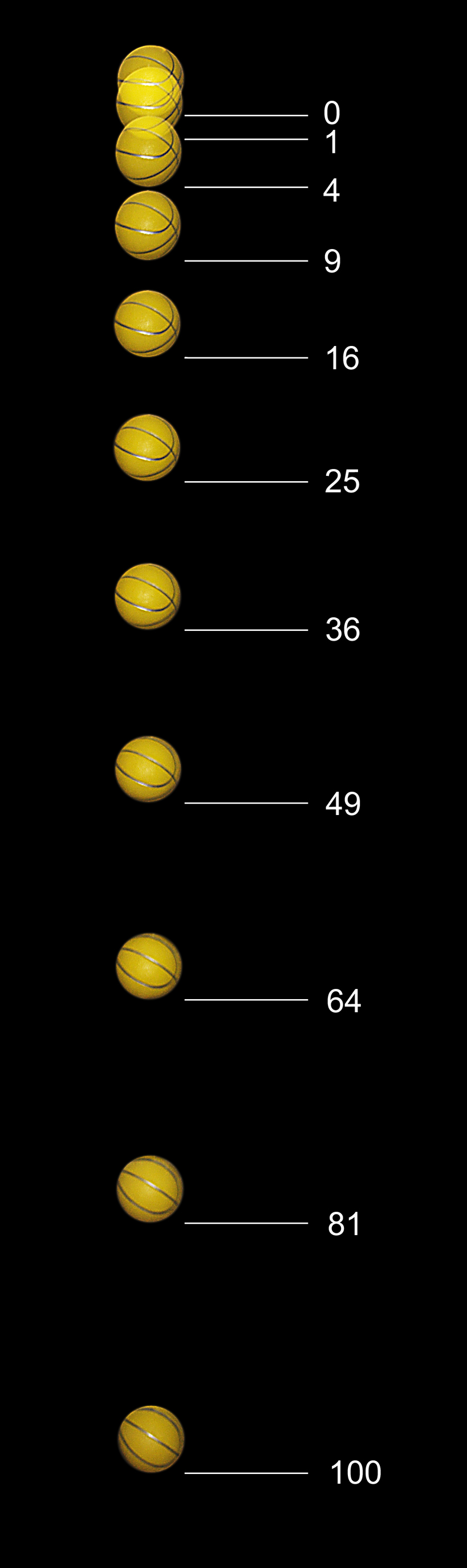
That "every object" is Galileo's contribution and it took two separate insights.
First, that heavy things do not fall faster. Aristotle had said they did, and for two thousand years that was accepted, partly because it looks true — a hammer does beat a feather. Galileo's argument against it, made around 1638, needed no experiment at all and is one of the cleverest pieces of reasoning in the history of science. Suppose heavy objects really do fall faster. Now tie a heavy stone to a light stone with a string. The light stone falls slower, so it drags on the heavy one and holds it back, and the pair should fall slower than the heavy stone alone. But the pair, tied together, is a single object heavier than either, so it should fall faster. The same assumption gives two opposite answers, so the assumption is broken. Weight cannot be what sets the rate of fall.
Second, that the rate could be measured despite falling being too fast to time. Galileo had no accurate clock. So he slowed gravity down by rolling balls down a gently inclined plane, where only a component of gravity acts along the slope, and timed them with a water clock — measuring the weight of water that ran out during the roll. He found that the distance covered went as the square of the time: in the second interval a ball covers three times what it covered in the first, then five, then seven. Those odd numbers are exactly what s \propto t^2 produces, since 1, 4, 9, 16 differ by 3, 5, 7. That is the second equation of motion, discovered experimentally, sixty years before calculus existed to derive it.
The hammer and feather objection is real, of course — air resistance is a genuine force and Chapter 1.11 handles it properly. But in 1971 the commander of Apollo 15, David Scott, stood on the Moon with no air at all, held out a geological hammer and a falcon feather, and let go. They hit the dust together, on live television, three hundred and thirty-three years after Galileo said they would.
Worked example: the stone off the bridge
A stone is dropped from rest off a bridge and hits the water 3.0 s later. How high is the bridge, and how fast is the stone moving when it lands?
Take downwards as positive, so a = +9.81\ \text{m/s}^2. Dropped from rest means u = 0. We know u, a and t, and we want s, so reach for the equation that has those four and not v:
s = ut + \tfrac12 at^2 = 0 \times 3.0 + \tfrac12 (9.81)(3.0)^2
s = \tfrac12 \times 9.81 \times 9.0 = 44.1\ \text{m}
So the bridge is about 44 m above the water. To two significant figures — which is all the "3.0 s" entitles us to — that is 44\ \text{m}.
For the landing speed we know u, a, t and now s, so either of two equations will do. Using the first:
v = u + at = 0 + 9.81 \times 3.0 = 29.4\ \text{m/s}
That is about 106 km/h. Check it with the third equation as a cross-test:
v^2 = u^2 + 2as = 0 + 2(9.81)(44.1) = 865.2 \quad\Rightarrow\quad v = \sqrt{865.2} = 29.4\ \text{m/s}
The two agree, which is what you want from a cross-check: they came through different algebra and landed on the same number.
Worked example: thrown upward, the sign trap
A ball is thrown straight up at 20\ \text{m/s}. How high does it go, and how long until it returns to your hand?
The trap here is the sign of g, and the fix is to choose a direction once and never waver. Take upwards as positive. Then the initial velocity is u = +20\ \text{m/s}, and gravity pulls downwards, so a = -9.81\ \text{m/s}^2. The negative sign is not a decoration; it is doing the work.
At the highest point the ball is instantaneously at rest, so v = 0. Time is not wanted, so use the third equation:
0 = (20)^2 + 2(-9.81)s \quad\Rightarrow\quad 19.62\,s = 400 \quad\Rightarrow\quad s = 20.4\ \text{m}
For the time to come back to your hand, the displacement is s = 0 — the ball returns to where it started, and displacement does not care that it went up 20 m in between. Use the second equation:
0 = 20t + \tfrac12(-9.81)t^2 = t\left(20 - 4.905\,t\right)
A product is zero when either factor is zero, so t = 0 or t = 20/4.905 = 4.08\ \text{s}. The root t = 0 is the moment of throwing, which is a true solution and not a useful one. The answer is 4.08\ \text{s}.
Notice the structure: the ball takes 20/9.81 = 2.04\ \text{s} to reach the top, and exactly the same again to come down. Free fall under constant acceleration is symmetric in time, and the ball returns to your hand at the same speed it left it, 20\ \text{m/s}, now pointing down. That symmetry is a special case of energy conservation, which Chapter 1.6 makes general.
When acceleration is not constant
The four boxed equations are not laws of nature. They are the solution to one particular case — a constant — and every step of the derivation used that. If the acceleration changes with time, they are simply wrong, and using them anyway is the most expensive mistake available in this chapter.
The definitions, however, never stop being true:
v = \frac{dx}{dt}, \qquad a = \frac{dv}{dt}
So the general method is always the same. Given a(t), integrate once to get v(t) and once more to get x(t), fixing the constant of integration each time from the conditions at t = 0. Given x(t), differentiate twice.
There is one more form worth having, for when acceleration depends on position rather than time — which is the situation for a spring, and for gravity far from the Earth. Use the chain rule:
a = \frac{dv}{dt} = \frac{dv}{dx}\cdot\frac{dx}{dt} = v\frac{dv}{dx}
Read aloud: acceleration equals v times dee v by dee x. The middle step multiplied and divided by dx, which is legitimate here because dx/dt is exactly v. This lets you write a\,dx = v\,dv and integrate with respect to position instead of time. Integrating both sides of that with constant a gives as = \tfrac12(v^2 - u^2), which is the third equation again — so the boxed equation was a special case of this all along, and Chapter 1.6 will recognise it as the work–energy theorem.
Where this shows up in your life
Every road-safety stopping-distance table is the third equation. A car braking at about 7\ \text{m/s}^2 on dry tarmac from 50\ \text{km/h} (13.9 m/s) needs s = v^2/2a = 193/14 = 13.8\ \text{m} of braking distance. Double the speed to 100\ \text{km/h} and the speed doubled but v^2 quadrupled, so the distance becomes 55 m. The braking distance goes as the square of the speed, and that single fact is why speed limits near schools are what they are.
Airbag timing is the same equations run backwards. The bag must be fully inflated before your head arrives, and your head is arriving at whatever the car was doing. At 50 km/h a head 30 cm from the wheel gets there in about 20 milliseconds, which is why the sensor-to-inflation budget for an airbag is measured in single-digit milliseconds.
What the next chapter fixes
Everything here happened on a line. Real motion happens in a plane and in space: a thrown ball goes up and forwards at once, a boat crosses a river while the river carries it downstream. Chapter 1.3 adds vectors, which let you handle two directions at the same time by handling each one separately, and uses them to derive the full trajectory of a projectile — including why 45° is the angle for maximum range, and why that stops being true the moment air resistance is real.