Appearance
3.2 — Kinetic Theory: Pressure from Molecules
A bicycle tyre holds up a rider because the air inside pushes outwards on every square millimetre of the inner wall. Nothing in that sentence explains why. There is no spring in there, nothing stretched, nothing compressed in the way a solid is compressed. There is only a gas, which is mostly empty space.
Kinetic theory says the push is molecules hitting the wall. Each collision is tiny and lasts almost no time, but there are so many of them, so often, that the drumming averages out into a perfectly steady force. This chapter turns that sentence into a formula, using nothing but Newton's second law from Chapter 1.4 and some careful counting. When the counting is done, temperature will have stopped being a reading on a dial and become something you can picture.
The assumptions, stated honestly
Every derivation rests on a model, and the model here is called an ideal gas. Its assumptions:
- The gas is a very large number of identical molecules in constant random motion.
- The molecules are so small compared to the gaps between them that their own volume is negligible.
- They do not attract or repel each other except during collisions.
- All collisions — with each other and with the walls — are perfectly elastic, so kinetic energy is conserved (Chapter 1.7).
- Between collisions they move in straight lines, obeying Newton's laws.
Assumptions 2 and 3 are the ones that eventually fail, and Chapter 3.6 shows exactly where: squeeze a gas hard enough or cool it enough and the molecules are no longer far apart, no longer indifferent to each other, and the gas condenses into a liquid — something an ideal gas can never do. For air at room temperature and pressure, though, molecules occupy about 0.1 % of the volume and the model is very good.
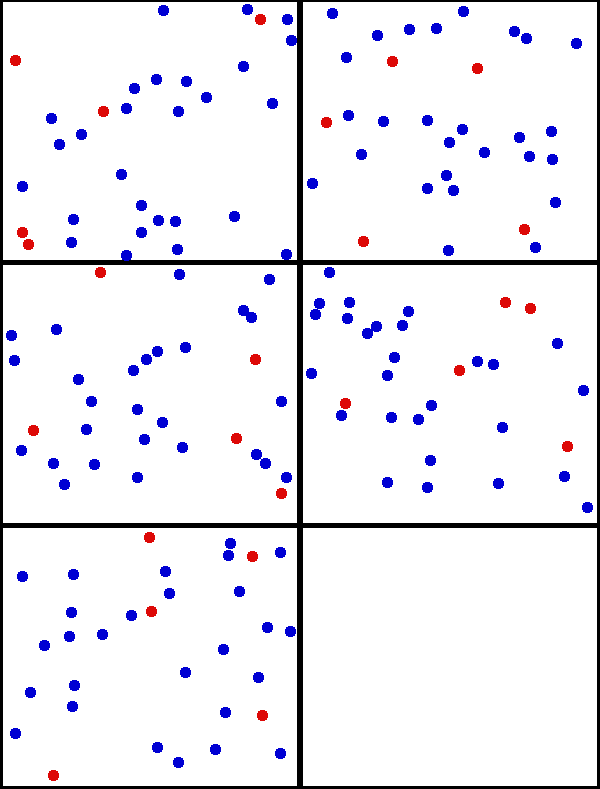
Watch a single particle in that animation and it is chaos. Watch the whole box and it is completely steady — the same number of hits per second on every wall, forever. That transition from chaos to steadiness is the single most important idea in this Part.
Deriving the pressure of a gas
Put N molecules, each of mass m, inside a cube of side L. Volume V = L^3. Aim at one wall — the one facing the x direction, of area A = L^2.
Step 1: what one collision does. Take one molecule with velocity components (v_x, v_y, v_z). It hits the wall and bounces back elastically, so v_x becomes -v_x and the other two components are untouched (the wall is flat and pushes only along x).
Its momentum along x went from mv_x to -mv_x, so the change is:
\Delta p = -mv_x - (mv_x) = -2mv_x
By Newton's third law (Chapter 1.4), whatever the wall did to the molecule, the molecule did the opposite to the wall. So the wall received +2mv_x of momentum from this one hit.
Step 2: how often that molecule hits. After bouncing, the molecule crosses to the far wall, a distance L, bounces, and comes back — a round trip of 2L at speed v_x along the x direction. So the time between successive hits on our wall is:
\Delta t = \frac{2L}{v_x}
The y and z motion does not matter here. It moves the molecule sideways along the wall but does not change how long the x round trip takes.
Step 3: the force from one molecule. Newton's second law in its momentum form says force is the rate of momentum transfer:
F_1 = \frac{\Delta p}{\Delta t} = \frac{2mv_x}{2L/v_x} = \frac{mv_x^2}{L}
That is an average over the round trip. The real force is a series of sharp spikes, but with 10^{22} molecules the spikes merge into a smooth push, in exactly the way individual raindrops merge into a steady patter.
Step 4: add up all the molecules.
F = \frac{m}{L}\left(v_{x1}^2 + v_{x2}^2 + \dots + v_{xN}^2\right) = \frac{m}{L}\,N\,\overline{v_x^2}
where \overline{v_x^2} (read: v-x-squared bar) is the average of v_x^2 over all the molecules. Writing it as N times the average is just what an average means, rearranged.
Step 5: get rid of the x. There is nothing special about the x direction. The motion is random, so on average the molecules are moving no more in one direction than another:
\overline{v_x^2} = \overline{v_y^2} = \overline{v_z^2}
And by Pythagoras in three dimensions, v^2 = v_x^2 + v_y^2 + v_z^2 for every molecule, so the same holds for the averages:
\overline{v^2} = \overline{v_x^2} + \overline{v_y^2} + \overline{v_z^2} = 3\overline{v_x^2} \quad\Longrightarrow\quad \overline{v_x^2} = \tfrac{1}{3}\overline{v^2}
Substituting:
F = \frac{mN\overline{v^2}}{3L}
Step 6: turn force into pressure. Pressure is force per unit area, and A = L^2:
P = \frac{F}{A} = \frac{mN\overline{v^2}}{3L\cdot L^2} = \frac{mN\overline{v^2}}{3V}
\boxed{PV = \tfrac{1}{3}Nm\overline{v^2}}
Read aloud: P V equals one third N m v-squared-bar. Pressure times volume equals a third of the total mass of gas times the mean square speed.
That is the whole derivation, and it is worth pausing on what just happened. We started with a bouncing ball and Newton's laws, did nothing but bookkeeping, and produced a relationship between two things you can measure with a gauge and a ruler — and molecules, which nobody could see when this was first done.
Where temperature comes from
Rewrite the boxed result to expose the kinetic energy. Multiply and divide by 2:
PV = \frac{2}{3}N\left(\tfrac{1}{2}m\overline{v^2}\right) = \frac{2}{3}N\overline{E_k}
where \overline{E_k} is the average kinetic energy of one molecule.
Now bring in what the laboratory says. Robert Boyle in 1662 found that PV is constant at fixed temperature. Jacques Charles and later Joseph Louis Gay-Lussac found volume rises in proportion to absolute temperature at fixed pressure. Amedeo Avogadro argued that equal volumes of any gas at the same P and T hold equal numbers of molecules. Put all three together and you get the ideal gas law, which was an experimental summary long before anyone derived it:
PV = Nk_BT
with k_B = 1.380649\times10^{-23} J/K, the Boltzmann constant, named for Ludwig Boltzmann. Chemists usually write the same law as PV = nRT, where n counts moles rather than molecules and R = N_A k_B = 8.314 J mol⁻¹ K⁻¹, with N_A = 6.022\times10^{23} molecules per mole. It is the same equation in different currency.
Set the theory equal to the experiment:
\frac{2}{3}N\overline{E_k} = Nk_BT
The N cancels, and:
\boxed{\overline{E_k} = \tfrac{1}{2}m\overline{v^2} = \tfrac{3}{2}k_BT}
This is what temperature is. Not "how hot something feels", not "what the mercury reads" — the average translational kinetic energy of a molecule, multiplied by 3k_B/2. The Boltzmann constant is nothing more than the exchange rate between the unit we invented for hotness and the unit we invented for energy. Had physics been done in a different order we might never have needed a separate unit for temperature at all.
Two consequences fall straight out.
Absolute zero is where the motion stops. Set T = 0 and \overline{E_k} = 0. You cannot have negative kinetic energy, so you cannot go below. (Quantum mechanics later modifies this — Chapter 7.9 shows that a small zero-point motion survives even at absolute zero — but the classical picture is right that there is a floor.)
At the same temperature, all gases have the same average molecular kinetic energy. A hydrogen molecule and a carbon dioxide molecule in the same room carry the same average E_k. Since CO₂ is 22 times heavier, it must be moving more slowly — by a factor of \sqrt{22} \approx 4.7.
Worked example: how fast is the air in this room?
Find the typical speed of a nitrogen molecule at 27 °C. Nitrogen is N₂, molar mass 28 g/mol.
First, the mass of one molecule:
m = \frac{0.028\ \text{kg/mol}}{6.022\times10^{23}\ \text{/mol}} = 4.65\times10^{-26}\ \text{kg}
Temperature in kelvin: T = 27 + 273 = 300 K.
From \frac{1}{2}m\overline{v^2} = \frac{3}{2}k_BT, solve for the square root of the mean square speed — called the root-mean-square speed, v_{\text{rms}}:
v_{\text{rms}} = \sqrt{\overline{v^2}} = \sqrt{\frac{3k_BT}{m}}
v_{\text{rms}} = \sqrt{\frac{3(1.381\times10^{-23})(300)}{4.65\times10^{-26}}} = \sqrt{\frac{1.243\times10^{-20}}{4.65\times10^{-26}}} = \sqrt{2.673\times10^{5}}
v_{\text{rms}} = 517\ \text{m/s}
Just over 1,860 km/h. The air sitting apparently still in front of you is a swarm moving faster than a rifle bullet, in every direction at once, and it looks still only because the average of all those velocities is zero.
Notice how close that is to the speed of sound in air, 343 m/s. That is not a coincidence — a sound wave is a disturbance passed along by molecules bumping into their neighbours, so it cannot travel much faster than the molecules themselves do. Chapter 2.3 derived v_{\text{sound}} = \sqrt{\gamma P/\rho}; put the kinetic theory result into it and the two differ only by the factor \sqrt{\gamma/3} \approx 0.68.
Equipartition: the energy-sharing rule
The derivation above counted only motion through space — three directions, three ways to hold energy. But a real molecule can do more. A dumbbell-shaped molecule like N₂ or O₂ can tumble end over end, and it can vibrate along its bond like two masses on a spring.
Each independent way a molecule can store energy is called a degree of freedom. The equipartition theorem — proved properly with statistical mechanics, but very believable from the symmetry of collisions — says:
Every degree of freedom that appears in the energy as a squared term gets an average of \frac{1}{2}k_BT.
"Squared term" covers both \frac{1}{2}mv_x^2 for motion and \frac{1}{2}I\omega^2 for rotation and \frac{1}{2}kx^2 for the spring energy of a vibration. Collisions shuffle energy around at random, and there is no reason for one storage channel to end up favoured over another, so they even out.
Count them:
- Monatomic gas (helium, argon — a single atom): 3 translational only. Total \frac{3}{2}k_BT.
- Diatomic gas (N₂, O₂): 3 translational + 2 rotational. Only two rotations, because spinning about the axis through both nuclei moves essentially nothing — the moment of inertia about that axis is nearly zero (Chapter 1.8). Total \frac{5}{2}k_BT.
- Diatomic with vibration active: add 2 more (kinetic and potential in the spring) for \frac{7}{2}k_BT.
This immediately predicts heat capacities. Internal energy of N molecules with f degrees of freedom is U = \frac{f}{2}Nk_BT, so the energy needed per kelvin at constant volume is:
C_V = \frac{f}{2}Nk_B \quad\text{or per mole}\quad C_{V,m} = \frac{f}{2}R
For helium, f = 3 gives C_{V,m} = 12.5 J mol⁻¹ K⁻¹. Measured: 12.5. For nitrogen at room temperature, f = 5 gives 20.8. Measured: 20.8. The theory is exactly right.
And then it fails, which is the interesting part
Nitrogen's vibrational degrees of freedom are there — the bond really can stretch — so why does room-temperature nitrogen behave as if f = 5 rather than 7?
Classically there is no answer, and this was a genuine crisis. Measure C_V for hydrogen across a wide temperature range and you find it sitting at \frac{3}{2}R at very low temperature, climbing to \frac{5}{2}R around room temperature, and reaching \frac{7}{2}R only above about 3000 K. Degrees of freedom appear to switch on as the gas warms, which makes no sense at all if energy is shared smoothly.
The resolution is quantum mechanics, and it is one of the first places quantisation was forced on physicists. Rotational and vibrational energies come in discrete steps, not a continuum (Chapter 7.4 derives this for the harmonic oscillator). If the step size for vibration is much larger than the typical energy exchanged in a collision, which is roughly k_BT, then a collision simply cannot excite a vibration — there is not enough energy in one hit to climb even the first rung. The channel is not shared in; it is frozen out. Warm the gas until k_BT is comparable to the step and the channel opens.
So a heat-capacity measurement on hydrogen gas, done with nineteenth-century equipment, was already telling anyone who looked that energy is quantised. Nobody read the message until Planck was forced into the same conclusion by a different experiment in 1900 (Chapter 7.1).
The Maxwell–Boltzmann distribution: not everyone moves at the average
Saying air molecules travel at 517 m/s is like saying the average adult is 1.7 m tall. True and useful, and it hides the spread. Some molecules are crawling; some are moving at three times the average, having just been struck favourably several times in a row.
James Clerk Maxwell worked out the shape of that spread in 1860, and Boltzmann later re-derived it from deeper principles. The result:
f(v) = 4\pi\left(\frac{m}{2\pi k_BT}\right)^{3/2} v^2 e^{-mv^2/2k_BT}
Read the pieces rather than the whole. The exponential e^{-mv^2/2k_BT} is the heart: it says the probability of a molecule having kinetic energy E falls off as e^{-E/k_BT}, so high energies are exponentially unlikely, and "high" means "large compared to k_BT". The v^2 in front is geometry: there are more ways to have a large speed than a small one, because in velocity space the surface area of a sphere of radius v grows as v^2. The messy constant in the middle is only there to make the total probability add to 1.
The product of a rising v^2 and a falling exponential is a curve that starts at zero, rises to a peak, and falls away with a long tail on the right.

Three different "typical speeds" can be read off this curve and they are not equal:
- v_p = \sqrt{2k_BT/m} — the most probable speed, the peak of the curve.
- \bar{v} = \sqrt{8k_BT/\pi m} — the mean speed, slightly right of the peak because the tail drags the average up.
- v_{\text{rms}} = \sqrt{3k_BT/m} — the root mean square, larger still because squaring weights fast molecules more heavily.
Their ratio is fixed: v_p : \bar{v} : v_{\text{rms}} = 1 : 1.128 : 1.225. Which one you want depends on the question. Energy questions want v_{\text{rms}} because energy goes as v^2. Collision-rate questions want \bar{v}.
The tail is where the interesting physics lives. Chemical reactions usually need a minimum energy to get going, called the activation energy (Chapter 10.6). Only molecules out in the tail have it. Since the tail is exponential, a modest rise in temperature multiplies the number of molecules above a threshold enormously — which is why reaction rates roughly double for every 10 °C, and why food spoils so much faster in a warm room than a cold one.
The tail also explains evaporation without boiling. A puddle at 20 °C is nowhere near 100 °C, yet it dries up. The molecules in the extreme right tail have enough energy to break free of the liquid's surface attractions, and they leave. That removes the most energetic molecules, so the average of what remains falls — the puddle cools itself. That is evaporative cooling, and it is precisely the mechanism of sweating from Chapter 3.1, now with a picture of which molecules actually leave.
And it explains why Earth still has an atmosphere but the Moon does not. Escape velocity from Earth is 11.2 km/s (Chapter 1.9), enormously larger than nitrogen's 0.5 km/s, so the fraction of nitrogen molecules in the tail beyond escape velocity is unimaginably small. But hydrogen and helium are light and fast, their tails reach further, and Earth has lost essentially all of its original supply of both. The Moon's escape velocity is only 2.4 km/s, close enough to molecular speeds that even nitrogen leaks away over geological time.
Mean free path: how far a molecule gets
If molecules move at 500 m/s, why does the smell of coffee take a minute to cross a room rather than arriving instantly? Because a molecule does not travel in a straight line. It travels a very short distance, hits something, and heads off in a new random direction.
The average distance between collisions is the mean free path, \lambda (lambda). Derive it by asking what volume a molecule sweeps out. Treat molecules as spheres of diameter d. Two of them collide when their centres pass within d of each other, so our molecule effectively sweeps a cylinder of radius d — cross-sectional area \sigma = \pi d^2, called the collision cross-section.
In travelling a distance \ell, it sweeps a volume \sigma\ell. If there are n = N/V molecules per unit volume, the number of centres in that swept volume is n\sigma\ell. Setting that to 1 gives the distance at which one collision is expected:
\lambda = \frac{1}{n\sigma} = \frac{1}{n\pi d^2}
A more careful treatment accounts for the fact that the other molecules are moving too, which raises the relative speed by a factor of \sqrt{2} and shortens the path:
\boxed{\lambda = \frac{1}{\sqrt{2}\,n\pi d^2}}
Numbers for air at room conditions. From PV = Nk_BT, the number density is:
n = \frac{P}{k_BT} = \frac{101325}{(1.381\times10^{-23})(300)} = 2.45\times10^{25}\ \text{molecules per m}^3
Taking d \approx 3.7\times10^{-10} m for a nitrogen molecule:
\lambda = \frac{1}{\sqrt{2}(2.45\times10^{25})\pi(3.7\times10^{-10})^2} = \frac{1}{1.489\times10^{7}} = 6.7\times10^{-8}\ \text{m}
About 67 nanometres, or roughly 180 molecular diameters. And the collision rate is \bar{v}/\lambda \approx 480/6.7\times10^{-8} \approx 7\times10^9 collisions per second. Seven billion collisions a second, each one sending the molecule off in a new direction.
That is why the coffee smell is slow. The molecule is doing a random walk, and a random walk of N steps of length \lambda covers a net distance of only \lambda\sqrt{N}, not \lambda N. To cover 3 m across a room takes (3/6.7\times10^{-8})^2 \approx 2\times10^{15} steps. At 7\times10^9 steps per second, that is around three days. In practice the smell arrives in seconds because the air is not still — convection currents carry it bodily. Pure diffusion really is that slow, and you can watch it: a drop of ink in a glass of perfectly undisturbed water takes hours to spread.
Mean free path also decides what "vacuum" means. Pump a chamber down to 10^{-6} atmospheres and \lambda grows by a factor of a million, to about 67 m — far larger than the chamber. At that point a molecule flies from wall to wall without meeting another molecule at all, and the gas stops behaving like a fluid. This is why a vacuum flask works: with few enough molecules in the gap, there is no chain of collisions to carry heat across it, and conduction through the gas essentially stops.
Where this shows up in your life
A pressure cooker works because PV = Nk_BT ties pressure to temperature. Sealing the pot lets the pressure rise to about 2 atmospheres, which raises water's boiling point to roughly 120 °C, and food cooks far faster at 120 °C than at 100 °C — again because reaction rates depend exponentially on the tail of the Maxwell–Boltzmann distribution. The same physics in reverse ruins cooking at altitude: lower pressure, water boils at 85 °C, and rice takes forever.
Tyre pressure warnings in winter are the gas law with V roughly fixed. Drop from 30 °C to 0 °C — that is 303 K to 273 K — and pressure falls by the ratio 273/303 = 0.90, so a tyre at 35 psi reads about 31.5 psi. Nothing leaked.
A hot air balloon is Charles's law: heat the air inside and it expands, some spills out of the open bottom, so what remains is less dense than the air outside, and Archimedes' principle from Chapter 1.11 lifts it.
Enriching uranium exploits the mass dependence of molecular speed. Uranium hexafluoride made with ²³⁵U is 1 % lighter than the ²³⁸U version, so it moves about 0.4 % faster and diffuses through a porous barrier slightly quicker. One pass separates almost nothing; thousands of stages in cascade separate enough. That 0.4 % is the whole reason enrichment is an industrial-scale undertaking rather than a bench experiment.
What the next chapter fixes
We now know what a gas is made of and what its temperature means, and we can compute its pressure. What we cannot yet do is account for energy properly when a gas is squeezed, expanded or heated in a controlled way — when a piston moves, work is done, and the bookkeeping between heat in, work out and internal energy stored has to balance exactly. Chapter 3.3 sets up that ledger, which is the first law of thermodynamics, and works out all four of the standard processes a gas can be taken through.