Appearance
7.8 — Entanglement, Bell's Theorem and What It All Means
In 1935 Einstein, Boris Podolsky and Nathan Rosen published a four-page paper arguing that quantum mechanics must be incomplete. The argument was careful, the logic was sound, and the conclusion was wrong — but nobody could show it was wrong for twenty-nine years, and nobody could test it for another seven after that.
The reason it took so long is that the disagreement looked purely philosophical. What John Bell found in 1964 was that it is not: the two positions make different numerical predictions, and the difference can be measured. The measurements have now been done, repeatedly, with every loophole closed, and the 2022 Nobel Prize went to three of the people who did them.
Entangled states
Take two electrons prepared with total spin zero — a singlet state:
|\psi\rangle = \frac{1}{\sqrt{2}}\left(|\uparrow\rangle_A|\downarrow\rangle_B - |\downarrow\rangle_A|\uparrow\rangle_B\right)
Reading the notation. The vertical-bar-and-angle-bracket is Dirac's, and |\uparrow\rangle_A means "particle A has spin up". The whole expression says the pair is in a superposition of two possibilities: A up and B down, or A down and B up.
What the state does not say. It does not say which. Neither particle has a definite spin on its own.
What it does say. Whatever they are, they are opposite. Measure A along any axis and B will give the opposite along that same axis, with certainty.
Why this is different from ordinary correlation. Put one glove from a pair in each of two boxes and post them to opposite ends of the Earth. Open one, see a left glove, and you know instantly the other is right. No physics happened. The gloves were always left and right; you merely learned which was which.
The entangled state is not like that, and Bell's theorem is exactly the proof that it is not.
Entanglement is not the exception. Any two systems that interact become entangled. It is generic. What is rare is keeping the entanglement, because interaction with the environment spreads it into uncountably many degrees of freedom and it becomes unusable — which is decoherence, later in this chapter.
The EPR argument
Einstein, Podolsky and Rosen set out three assumptions, all of which look obviously true.
Locality. No influence travels faster than light. Nothing done to A can affect B instantaneously.
Realism. If you can predict the value of a quantity with certainty without disturbing a system, then that quantity has a definite value. ("Element of reality" was their phrase.)
Completeness. A complete theory must contain an element for every element of reality.
Their argument:
- Measure A's spin along z and get up. Then B's spin along z is down, with certainty.
- B was not touched, and by locality nothing done at A could have changed it.
- So by realism, B's z-spin was definite all along.
- But you could equally have measured A along x, and by the same reasoning B's x-spin was definite all along.
- So B has definite z and x spins simultaneously.
- Quantum mechanics says it cannot — those operators do not commute (Chapter 7.5), so no state has both.
- Therefore quantum mechanics is incomplete. There must be extra variables the theory does not describe.
This is a good argument. Every step follows. Einstein's conclusion was that quantum mechanics is a correct statistical theory over some deeper deterministic layer, like thermodynamics over molecules — and that the deeper layer, with its hidden variables, remained to be found.
Bohr's reply was published within months and is famously hard to follow. Most physicists at the time concluded that Bohr had won, and it is not clear that many of them could say why.
Bell's theorem
John Bell was an Irish physicist working on accelerator design at CERN who thought about foundations in his spare time. In 1964 he asked a question nobody had asked: suppose EPR are right and hidden variables exist. What would that predict?
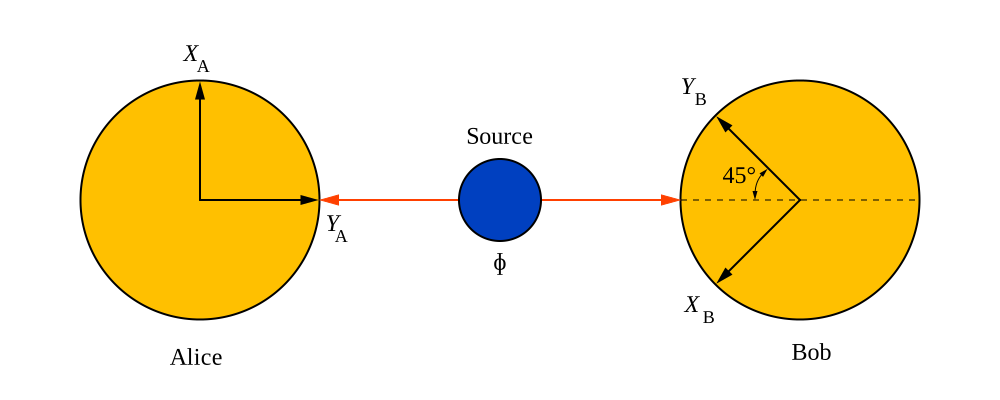
The key insight: local hidden variables and quantum mechanics agree on the perfectly-correlated case, where both measurements use the same axis. They disagree when the two detectors are set to different angles.
Setting up the inequality
Alice measures along one of two directions, a or a'. Bob measures along b or b'. Each measurement gives +1 or -1.
Define the correlation E(a,b) as the average of the product of the two results over many pairs. If they always agree, E = +1; if they always disagree, E = -1; if uncorrelated, E = 0.
Now assume local realism. Each particle carries some hidden variable \lambda, determined at the source, which fixes what result it will give for any possible measurement direction. Write A(a,\lambda) = \pm1 for Alice's outcome and B(b,\lambda) = \pm1 for Bob's.
"Local" enters here: A depends on Alice's setting and \lambda, and not on Bob's setting b. That is the whole content of the assumption.
Consider the combination:
A(a,\lambda)B(b,\lambda)+A(a,\lambda)B(b',\lambda)+A(a',\lambda)B(b,\lambda)-A(a',\lambda)B(b',\lambda)
Factor it:
= A(a,\lambda)\left[B(b,\lambda)+B(b',\lambda)\right]+A(a',\lambda)\left[B(b,\lambda)-B(b',\lambda)\right]
Now the decisive step. B(b,\lambda) and B(b',\lambda) are each \pm1. So either they are equal — in which case the first bracket is \pm2 and the second is 0 — or they differ, in which case the first is 0 and the second is \pm2.
Either way, exactly one bracket is \pm2 and the other is zero. Since the A values are \pm1, the whole expression is always exactly +2 or -2.
Average over \lambda and the average of something bounded by \pm2 is bounded by \pm2:
\boxed{|S| = |E(a,b)+E(a,b')+E(a',b)-E(a',b')| \leq 2}
The CHSH inequality, named after Clauser, Horne, Shimony and Holt, who gave Bell's argument this experimentally convenient form in 1969.
Notice what went into it. Nothing about quantum mechanics. Nothing about what the hidden variables are. Only that outcomes are predetermined and that each side's outcome does not depend on the other side's setting. Any theory with those two properties must obey it.
What quantum mechanics predicts
For the singlet state, quantum mechanics gives:
E(a,b) = -\cos\theta_{ab}
where \theta_{ab} is the angle between the two measurement directions.
Choose the angles to maximise S: a = 0°, a' = 45°, b = 22.5°, b' = 67.5°.
E(a,b) = -\cos(22.5°) = -0.9239
E(a,b') = -\cos(67.5°) = -0.3827
E(a',b) = -\cos(22.5°) = -0.9239
E(a',b') = -\cos(22.5°) = -0.9239
S = -0.9239-0.3827-0.9239+0.9239 = -1.3066
Using the standard sign arrangement, the magnitude is:
|S| = 2\sqrt{2} = 2.828
Quantum mechanics predicts 2.828. Local realism forbids anything above 2.
A 41 % violation. Not a subtle discrepancy — an enormous, unmissable gap.
And 2\sqrt{2} is not arbitrary. It is the Tsirelson bound, the maximum any quantum theory permits. Quantum mechanics violates local realism, and does not violate it as much as it logically could — a fact nobody has a satisfying explanation for.
The experiments
Freedman and Clauser, 1972. The first test, using calcium atoms emitting correlated photon pairs. Violation observed, though with loopholes.
Aspect, Grangier and Roger, 1981–82. Better source, and crucially, in the 1982 version, the detector settings were changed while the photons were in flight, using acousto-optic switches operating faster than light could travel between the stations. This closed the possibility that the detectors somehow "knew" each other's settings in advance. Violation confirmed to many standard deviations.
Zeilinger and others, 1998 onwards. Entangled photons separated by 400 m with genuinely random and relativistically separated setting choices.
The loophole-free experiments, 2015. Three groups — Delft, NIST and Vienna — independently closed all major loopholes in one experiment.
The loopholes that had to be closed:
The locality loophole. Could a signal have travelled between the stations? Closed by separating them far enough that the setting choice, measurement and result recording at each station are outside the other's light cone. Delft used stations 1.3 km apart.
The detection loophole. Real detectors miss most photons, and if the detected sample were biased, a local theory could fake a violation. Closed by using detectors with high enough efficiency — the Delft experiment used entangled electron spins in diamond, detected with essentially 100 % efficiency.
The freedom-of-choice loophole. Could the setting choices have been correlated with the hidden variables? Closed by generating settings from independent quantum random number generators, and in the 2018 "Cosmic Bell" experiment, from the colours of photons emitted by quasars billions of years ago — pushing any conspiracy back to before the Earth existed.
The result, every time: local realism is ruled out.
The 2022 Nobel Prize went to John Clauser, Alain Aspect and Anton Zeilinger for this work.
What has to go
The theorem forces a choice. At least one of the following is false:
Locality. Distant events can influence each other faster than light.
Realism. Properties do not have definite values before measurement.
Freedom of choice. The experimenters' settings were determined in advance along with everything else — superdeterminism. Almost nobody takes this seriously, because it undermines the possibility of doing science at all, though 't Hooft has defended it.
Most physicists give up realism. Properties genuinely do not exist until measured. The particle does not have a spin along x that we fail to know; it has no spin along x.
And it must be said clearly: no signal is sent.
Why entanglement cannot send a message
This is the most common misunderstanding, and the answer is precise.
Alice's results are random. She sees up and down with 50 % probability each, no matter what Bob does, no matter what setting he uses, no matter whether he measures at all. Her local statistics are completely unaffected by anything Bob does.
The correlation only appears when the two records are compared, and comparing them requires sending the data by ordinary means at or below c.
This is the no-communication theorem, and it is provable from the structure of quantum mechanics: the reduced density matrix describing Alice's system is unchanged by any operation Bob performs.
Entanglement is a correlation that no local mechanism can explain, and it is not a channel. Relativity's causal structure from Chapter 6.5 is safe.
What it does allow is more subtle and genuinely useful:
Quantum key distribution. Alice and Bob use entangled pairs to generate a shared random key. Any eavesdropper must measure, measurement disturbs the state, and the disturbance shows up as a reduced Bell violation. The security rests on physics rather than on computational difficulty, and it has been demonstrated over 1200 km by China's Micius satellite.
Quantum teleportation. Transfer an unknown quantum state from A to B, using a shared entangled pair plus two classical bits sent at or below c. The state is destroyed at A. It is not matter transport and it is not faster than light, and the classical channel is essential — without those two bits, B has nothing.
Quantum computing. Entanglement across many qubits is what makes quantum algorithms able to explore a space that grows exponentially with qubit count.
Decoherence
Why is the everyday world not full of superpositions?
Not because of size, and not because anybody looks. Because of decoherence.
A quantum system is never isolated. Air molecules hit it, photons scatter off it, its own internal degrees of freedom couple to each other. Every one of those interactions entangles the system with its environment.
Once entangled, the environment holds which-path information — and Chapter 7.2 established that interference vanishes exactly when that information exists anywhere.
The timescales are the striking part.
| System | Decoherence time |
|---|---|
| Electron in vacuum | \sim1 s |
| Large molecule in air | \sim10^{-30} s |
| Dust grain, 10 μm, in air | \sim10^{-31} s |
| Dust grain in vacuum, sunlight only | \sim10^{-21} s |
| Dust grain in intergalactic space, CMB only | \sim10^{-6} s |
A dust grain in air decoheres in 10^{-31} seconds. Even in deep space, lit by nothing but the cosmic microwave background, it lasts a microsecond.
So Schrödinger's cat is never in a superposition of alive and dead in any observable sense. Not because measuring it collapses it, but because the cat is continuously and violently entangled with 10^{27} air molecules and photons. The superposition is real for a duration no clock could resolve.
What decoherence explains: why classical physics emerges, why interference is fragile, why quantum computers must be isolated and cooled to millikelvin, and why the "measurement problem" is far less mysterious than it was in 1935.
What it does not explain: why one specific outcome occurs rather than another. Decoherence turns a superposition into a mixture — a situation where the different outcomes no longer interfere — but it does not select one. That remains open, and it is where the interpretations differ.
The interpretations
All of these make identical experimental predictions. Choosing between them is not currently an empirical question.
Copenhagen. The wavefunction is a tool for calculating probabilities. Measurement collapses it. Do not ask what happens in between. Strength: it works, and it is what everybody uses in practice. Weakness: "measurement" is never defined, so the theory has a vague boundary in its own axioms.
Many-worlds (Everett, 1957). There is no collapse. The wavefunction always evolves by the Schrödinger equation, and measurement entangles the observer with the system, so all outcomes occur in different branches. Strength: the simplest possible axioms — one equation, no collapse postulate. Weakness: an extravagant ontology, and it struggles to explain why the Born rule probabilities are what they are.
Pilot wave (de Broglie–Bohm). Particles have definite positions at all times, guided by a real wave. Fully deterministic. Strength: realist, no measurement problem, reproduces all predictions. Weakness: explicitly non-local — the guiding equation depends instantaneously on all particle positions — and it does not extend gracefully to quantum field theory.
Objective collapse (GRW, Penrose). Collapse is a real physical process, spontaneous and rare for single particles but overwhelmingly fast for large ones. Strength: it is the only class that makes different predictions, so it is testable. Weakness: experiments have been steadily narrowing the parameter space and finding nothing.
QBism and relational views. The wavefunction describes an agent's information, not the world. Strength: dissolves the paradoxes. Weakness: many find it evasive about what is actually out there.
Where the community stands. Informal polls at foundations conferences give roughly 40 % Copenhagen or "shut up and calculate", 20 % many-worlds, and the rest spread across the others. There is no consensus, and after a century that is itself worth noting.
The honest summary: quantum mechanics is the most precisely tested theory ever constructed, and physicists do not agree on what it says about the world. The formalism is not in doubt. Its meaning is.
Where this shows up in your life
Quantum key distribution is commercially deployed by banks and governments, and China operates a satellite-based network.
Quantum computers from IBM, Google and others manipulate entangled qubits; the whole engineering challenge is fighting decoherence.
Quantum random number generators are in some phones and security modules, producing randomness that is fundamental rather than algorithmic.
Quantum sensing uses entangled states to beat the standard noise limit, in magnetometers, gravimeters and — in LIGO's squeezed light — gravitational wave detectors.
And every time you use classical logic about the everyday world, you are relying on decoherence having already done its work, 10^{-31} seconds ago.
What the next chapter fixes
Chapter 7.4 found that a confined particle cannot be still, and Chapter 7.5 showed why. That result has a consequence that sounds like mysticism and is measured routinely: empty space is not empty, and it is not still either. Chapter 7.9 works through zero-point motion, what the quantum vacuum contains, the force between two uncharged plates in a vacuum that has been measured to a few percent, and where the energy inside an atom actually comes from.