Appearance
8.2 — The Standard Model, Read Completely

Seventeen fundamental fields. Everything you have ever seen, touched, eaten or measured is made of the first column plus the photon and the gluon. The rest exist for microseconds in accelerators, in cosmic rays, and in the first instants of the universe.
This chapter reads the table completely: what each entry is, what the numbers mean, which are predicted and which are put in by hand, and what the whole thing does not contain.
Reading the table
Six quarks (purple), in three generations of two. They carry colour charge and feel all four forces.
Six leptons (green), in three generations of two. They carry no colour and do not feel the strong force.
Four gauge bosons (red): the photon, the gluon, the W and the Z. These are the force carriers, and Chapter 8.3 explains what they do.
One scalar boson (yellow): the Higgs, found in 2012. Chapter 8.4.
The graviton is not in the table because it has never been observed, and no consistent quantum theory of gravity exists to put it in.
The quarks
| Quark | Symbol | Charge | Mass | Discovered |
|---|---|---|---|---|
| Up | u | +\frac{2}{3} | 2.16 MeV | 1968 (SLAC) |
| Down | d | -\frac{1}{3} | 4.67 MeV | 1968 (SLAC) |
| Charm | c | +\frac{2}{3} | 1.27 GeV | 1974 |
| Strange | s | -\frac{1}{3} | 93 MeV | 1968 |
| Top | t | +\frac{2}{3} | 172.7 GeV | 1995 |
| Bottom | b | -\frac{1}{3} | 4.18 GeV | 1977 |
All spin ½. All carry colour charge in three varieties.
A caution about the masses. Quark masses are not directly measurable, because a free quark cannot exist (Chapter 8.3). The values above are "current quark masses" defined within a particular theoretical scheme. They are also not what makes up the proton's mass — the proton weighs 938 MeV and its three quarks total about 9 MeV. Chapter 6.4 explained where the other 98 % comes from: gluon field energy and quark confinement energy.
The top quark's mass, 172.7 GeV, is the strangest number in the table. It is 79,000 times the up quark's, and it is close to the electroweak energy scale, which many physicists suspect is not a coincidence. Nobody has an explanation.
Isospin and the up–down near-degeneracy. The up and down quarks differ in mass by only 2.5 MeV, which is tiny compared with everything else in nuclear physics. That near-equality is why protons and neutrons have almost the same mass, and it is what makes nuclear physics work — a nucleus can substitute one for the other at little energy cost. The neutron is heavier by 1.29 MeV, and it is worth appreciating how much hangs on that number: if the proton were heavier instead, hydrogen atoms would decay and there would be no chemistry.
The leptons
| Lepton | Symbol | Charge | Mass | Lifetime |
|---|---|---|---|---|
| Electron | e^- | -1 | 0.511 MeV | Stable |
| Muon | \mu^- | -1 | 105.7 MeV | 2.2 μs |
| Tau | \tau^- | -1 | 1777 MeV | 2.9\times10^{-13} s |
| Electron neutrino | \nu_e | 0 | <0.8 eV | Stable |
| Muon neutrino | \nu_\mu | 0 | <0.19 MeV | Stable |
| Tau neutrino | \nu_\tau | 0 | <18.2 MeV | Stable |
All spin ½. No colour charge.
The electron is stable because it is the lightest charged particle and charge conservation gives it nothing to decay into.
The muon decays to an electron and two neutrinos in 2.2 μs, which is a long time by particle standards — long enough for cosmic-ray muons to reach the ground (Chapter 6.3).
The tau is heavy enough to decay into hadrons, which no other lepton can do, and about 65 % of its decays produce quarks.
Neutrino masses are quoted as upper limits because they are extraordinarily small and have never been directly measured. What is measured is the difference of squared masses, from oscillation, and Chapter 8.5 explains what that means. The Standard Model as originally written has massless neutrinos, and the 1998 discovery that they oscillate proved that wrong — which makes neutrino mass the one confirmed piece of physics beyond the Standard Model.
Lepton number is conserved: each generation has its own count, and the totals are preserved in every observed interaction. Neutrino oscillation violates the flavour counts while preserving the total, which is itself a hint that something deeper is going on.
The gauge bosons
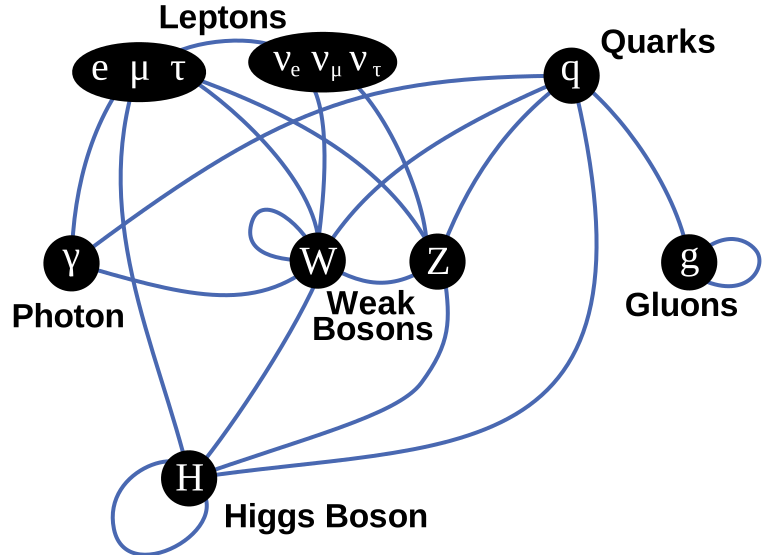
| Boson | Force | Mass | Charge | Range |
|---|---|---|---|---|
| Photon \gamma | Electromagnetic | 0 | 0 | Infinite |
| Gluon g | Strong | 0 | 0 (carries colour) | \sim10^{-15} m |
| W$^\pm$ | Weak | 80.4 GeV | \pm1 | \sim10^{-18} m |
| Z$^0$ | Weak | 91.2 GeV | 0 | \sim10^{-18} m |
All spin 1 — vector bosons.
The photon is exactly massless, which is why electromagnetism has infinite range and obeys 1/r^2 exactly (Chapter 4.2). Experimental limits put its mass below 10^{-27} eV.
The gluon is massless and yet the strong force has short range, which contradicts the rule from Chapter 7.10 that massless carriers give infinite range. The resolution is confinement: gluons carry colour charge themselves, so they interact with each other, and the force does not fall off with distance the way electromagnetism does. Chapter 8.3 works this through.
There are eight gluons, not one. A gluon carries a colour and an anticolour, giving 3\times3 = 9 combinations, of which one is a colourless singlet that does not participate, leaving eight.
The W and Z are enormously heavy, which is why the weak force is weak. Their range, from R = \hbar/mc, is about 2\times10^{-18} m — a thousandth of a proton's radius.
They were predicted before they were found. Glashow, Weinberg and Salam's electroweak theory of the 1960s predicted their existence and, once the weak mixing angle was measured, their masses. CERN found them in 1983 at almost exactly the predicted values, and Rubbia and van der Meer had the Nobel Prize within a year.
The Higgs boson
Mass 125.25 GeV. Charge 0. Spin 0 — the only fundamental scalar particle known.
Predicted in 1964 by Higgs, Englert, Brout and three others. Found at CERN on 4 July 2012. Higgs and Englert received the Nobel Prize in 2013; Brout had died in 2011.
It is not "the particle that gives mass to everything". The field gives mass to the elementary particles that couple to it; the boson is an excitation of that field, and detecting it is how the field's existence was confirmed. Chapter 8.4 does this properly.
And it does not account for most of your mass — that is gluon field energy, as above.
What the Standard Model predicts
Every particle in the table was predicted before it was found, except the muon and the tau:
| Particle | Predicted | Found | Gap |
|---|---|---|---|
| Positron | 1928 | 1932 | 4 years |
| Neutrino | 1930 | 1956 | 26 years |
| Charm quark | 1970 | 1974 | 4 years |
| Bottom quark | 1973 | 1977 | 4 years |
| W and Z | 1968 | 1983 | 15 years |
| Top quark | 1973 | 1995 | 22 years |
| Higgs boson | 1964 | 2012 | 48 years |
No prediction of the Standard Model has ever failed a test, and some of its predictions have been confirmed to twelve decimal places (Chapter 7.7).
Precision at the LHC: cross-sections for producing W bosons, Z bosons, top quarks and Higgs bosons have been measured across many orders of magnitude and agree with calculation throughout.
What is put in by hand
Here is the honest accounting, and it is why nobody thinks the Standard Model is final.
Nineteen free parameters must be measured and inserted; the theory does not predict them:
- 9 fermion masses (6 quarks, 3 charged leptons)
- 3 quark mixing angles + 1 CP-violating phase (the CKM matrix)
- 3 gauge couplings (strong, weak, electromagnetic)
- 2 Higgs parameters (its mass and its vacuum expectation value)
- 1 QCD vacuum angle (measured to be essentially zero, which is itself a puzzle)
Add neutrino masses and mixings and it becomes about 26.
Twenty-six numbers, none explained. Compare with general relativity, which has one (G, or two if you count \Lambda). A theory with twenty-six adjustable dials is describing a pattern rather than explaining it.
And the pattern of the numbers is bizarre. The electron and the top quark differ in mass by a factor of 340,000. The neutrino and the top quark by a factor of at least 10^{11}. There is no organising principle.
The CKM matrix
Quarks change flavour in weak interactions, and the probabilities are governed by a 3\times3 matrix — the Cabibbo–Kobayashi–Maskawa matrix:
V_{\text{CKM}} \approx \begin{pmatrix} 0.974 & 0.225 & 0.004\\ 0.225 & 0.973 & 0.041\\ 0.009 & 0.040 & 0.999\end{pmatrix}
Read the structure. The diagonal is close to 1, meaning quarks usually stay in their own generation. The off-diagonal elements are small, and they get smaller the further from the diagonal. Transitions within a generation are common, between adjacent generations less so, and between the first and third are rare.
Why this matters enormously: the matrix has a complex phase that cannot be removed by any redefinition, and that phase is the only source of CP violation in the Standard Model. It is the entire reason the theory treats matter and antimatter differently at all.
And it is not enough. Chapter 7.10 noted the observed matter–antimatter asymmetry is about 10^{10} times larger than the CKM phase can produce. This is a confirmed failure of the Standard Model to explain something we can see — namely, that there is anything to see.
Kobayashi and Maskawa's argument in 1973 was remarkable. They observed that CP violation had been seen in kaons in 1964, showed that a two-generation matrix cannot produce a complex phase, and concluded that there must be a third generation — at a time when three of its four members were undiscovered. All three were subsequently found.
The neutrino equivalent is the PMNS matrix, and its mixing angles are all large rather than small, which is another unexplained difference.
The forces, compared
| Force | Relative strength | Range | Carrier | Acts on |
|---|---|---|---|---|
| Strong | 1 | 10^{-15} m | Gluon | Colour charge |
| Electromagnetic | 10^{-2} | Infinite | Photon | Electric charge |
| Weak | 10^{-6} | 10^{-18} m | W, Z | Weak isospin |
| Gravity | 10^{-38} | Infinite | (Graviton) | Mass–energy |
The "relative strength" numbers are rough and depend on the energy and distance at which you compare, because the couplings run (Chapter 8.3). At the electroweak scale the weak force is not much weaker than electromagnetism; it appears weak at low energy purely because of the W and Z masses.
Gravity's 10^{-38} is the hierarchy problem, and it is the largest unexplained number in physics.
What the Standard Model does not contain
Gravity. Not included, and not includable by the existing methods (Chapter 7.10's renormalisation discussion).
Dark matter. Chapter 12.7 shows it makes up 27 % of the universe's energy and 85 % of its matter. No Standard Model particle can be it — it must be electrically neutral, stable over the age of the universe, non-baryonic, and cold. Neutrinos were the obvious candidate and are ruled out by being far too light and therefore too fast.
Dark energy. 68 % of the universe, and the Standard Model's estimate of vacuum energy is wrong by 10^{122} (Chapter 7.9).
Matter–antimatter asymmetry. Off by ten orders of magnitude.
Neutrino masses. The original theory has none; they exist; the mechanism is unknown.
The strong CP problem. QCD permits a term that would violate CP, with a coefficient \theta that could be anything from 0 to 2\pi. The neutron's electric dipole moment constrains it to |\theta| < 10^{-10}. Why is it zero to ten decimal places? The leading proposal introduces a new particle, the axion, which is also a dark matter candidate. Searches are running.
The hierarchy problem. Quantum corrections should drive the Higgs mass up to the Planck scale, 10^{19} GeV, unless something cancels them to one part in 10^{34}. Nothing in the theory does.
Why three generations? No answer.
Why these masses? No answer.
The Lagrangian
Everything above is encoded in one expression:
\mathcal{L} = -\frac{1}{4}F_{\mu\nu}F^{\mu\nu}+i\bar{\psi}\gamma^\mu D_\mu\psi+\left|D_\mu\phi\right|^2-V(\phi)+\left(y\bar{\psi}\phi\psi+\text{h.c.}\right)
Read it term by term — this is the whole theory in five pieces.
Term 1, -\frac{1}{4}F_{\mu\nu}F^{\mu\nu}: the force fields. F_{\mu\nu} is the field strength tensor, and for electromagnetism it contains exactly the \vec{E} and \vec{B} of Chapter 4.7. This term is Maxwell's equations, generalised to the strong and weak forces.
Term 2, i\bar{\psi}\gamma^\mu D_\mu\psi: the matter fields and how they interact with the forces. \psi is a quark or lepton field, \gamma^\mu are Dirac's matrices from Chapter 7.10, and D_\mu is the covariant derivative — an ordinary derivative plus a term coupling to the gauge fields. All the interactions live in that one symbol.
Term 3, |D_\mu\phi|^2: the Higgs field's kinetic energy, and the term that gives the W and Z their masses when the field takes its vacuum value.
Term 4, V(\phi): the Higgs potential, whose shape is what makes the vacuum non-zero. Chapter 8.4.
Term 5, y\bar{\psi}\phi\psi: the Yukawa couplings, which give the fermions their masses. The nine fermion masses are nine separate y values, each measured, none explained.
It fits on a coffee mug, and CERN sells one. And it describes every experiment ever performed, except those involving gravity, dark matter or dark energy.
The gauge structure
The Standard Model's symmetry is written:
SU(3)_C \times SU(2)_L \times U(1)_Y
SU(3)_C — colour, the strong force, with 8 gluons.
SU(2)_L — weak isospin, with 3 gauge fields. The subscript L is one of the strangest facts in physics: the weak force acts only on left-handed particles. Chapter 8.3 explains what that means and why it was such a shock.
U(1)_Y — hypercharge, with 1 gauge field.
The last two mix. The photon and the Z are combinations of the SU(2) and U(1) fields, mixed by an angle \theta_W with \sin^2\theta_W \approx 0.231. This is why electromagnetism and the weak force are one force at high energy, and it predicts a relation between the W and Z masses:
\frac{m_W}{m_Z} = \cos\theta_W
\frac{80.4}{91.2} = 0.882, \qquad \cos\theta_W = \sqrt{1-0.231} = 0.877
Agreement to half a percent, and the small difference is accounted for by known quantum corrections. This is a genuine prediction relating three independently measured quantities, and it works.
Where this shows up in your life
Nuclear power and nuclear medicine depend on weak-interaction decay rates computed from this framework.
Carbon dating is a weak decay: carbon-14 beta-decays with a 5730-year half-life.
The Sun shines through a weak interaction — the first step of the proton–proton chain converts a proton to a neutron, which requires the W boson (Chapter 12.1).
PET, MRI and radiotherapy all descend from this physics and its detector technology.
Smoke detectors, food irradiation, industrial radiography and semiconductor doping by ion implantation all use particle beams.
And the World Wide Web was written by Tim Berners-Lee at CERN in 1989 to let particle physicists share data.
What the next chapter fixes
The table lists the forces without explaining what a force is in this framework. Chapter 8.3 answers that: forces arise from gauge symmetry — the requirement that the theory not care about a certain kind of arbitrary local choice — and demanding that symmetry forces the existence of exactly the right carrier particles. It also teaches Feynman diagrams as a working tool, explains why the strong coupling gets weaker at high energy while the electromagnetic one gets stronger, and shows why a quark can never be pulled out of a proton no matter how hard you pull.