Appearance
8.4 — The Higgs Field and What Mass Is
Chapter 8.3 ended with a contradiction. Gauge symmetry forbids mass terms for gauge bosons — a term m^2A_\mu A^\mu in the Lagrangian is not gauge invariant, so the theory breaks if you write one.
And the W and Z weigh 80 and 91 GeV, which is about as far from massless as a particle in the Standard Model gets.
Either gauge theory is wrong, or something makes the bosons heavy without a mass term being written down. The resolution, worked out in 1964 by six people in three independent papers, was that the symmetry is exact in the equations and broken by the vacuum.
Symmetry that the ground state does not share
The idea has ordinary examples, and they are worth having before the field theory.
A pencil balanced on its point. The situation is perfectly symmetric — every horizontal direction is equivalent. But the pencil cannot stay balanced. It falls, and once it has fallen it points in one direction. The laws are symmetric; the outcome is not.
A ferromagnet. Above the Curie temperature (Chapter 4.8) the spins point randomly and there is no preferred direction. Cool it and the spins align, choosing a direction that the physics did not specify. The equations have rotational symmetry; the ground state does not.
A round dinner table. Everyone has a bread roll on their left and right, perfectly symmetric. The first person to choose breaks the symmetry, and everyone else must follow.
This is spontaneous symmetry breaking, and it is not a violation of the symmetry. The symmetry is still there in the equations; it is simply not visible in the particular state the system has settled into.
The Higgs potential
Introduce a new field \phi — the Higgs field — with a potential:
V(\phi) = -\mu^2|\phi|^2+\lambda|\phi|^4
Read the two terms. The second, \lambda|\phi|^4 with \lambda > 0, grows at large |\phi| and keeps the potential bounded below. The first has a negative coefficient, which is the unusual choice — an ordinary field would have +\mu^2|\phi|^2, giving a simple bowl with its minimum at zero.
With the minus sign, zero is a maximum.
\frac{dV}{d|\phi|} = -2\mu^2|\phi|+4\lambda|\phi|^3 = 0
|\phi|^2 = \frac{\mu^2}{2\lambda} \quad\Longrightarrow\quad \boxed{|\phi| = \frac{\mu}{\sqrt{2\lambda}} \equiv \frac{v}{\sqrt{2}}}
The minimum is at a non-zero value.
The shape is often called a Mexican hat or a wine bottle bottom: a hump in the middle and a circular trough around it. In the complex plane of \phi, every point in the trough has the same energy, so the choice of which one is arbitrary.
The field picks one. That choice breaks the symmetry.
v = 246\ \text{GeV}
The vacuum expectation value. This number is measured, and it sets the entire scale of the weak interaction.
So empty space is not empty. The Higgs field has a value of 246 GeV everywhere, including in the deepest vacuum. It is not a substance and it is not an ether — it has no rest frame, does not slow anything down, and is perfectly Lorentz invariant. It is a scalar field with a non-zero background value.
How the W and Z get mass
Chapter 8.2 listed the Higgs kinetic term:
\left|D_\mu\phi\right|^2
where D_\mu = \partial_\mu - igW_\mu - ig'B_\mu is the covariant derivative from Chapter 8.3.
Substitute \phi = v/\sqrt{2} and expand. The cross terms produce:
\frac{1}{2}\left(\frac{gv}{2}\right)^2W_\mu W^\mu + \dots
That has exactly the form of a mass term, \frac{1}{2}m^2A_\mu A^\mu, and reading off:
\boxed{m_W = \frac{gv}{2}, \qquad m_Z = \frac{v\sqrt{g^2+g'^2}}{2}}
The gauge bosons acquired masses without any mass term ever being written. The symmetry of the Lagrangian is intact; the vacuum broke it, and the mass appeared from the interaction with the background field.
Check the numbers. With g = 0.653 and v = 246 GeV:
m_W = \frac{(0.653)(246)}{2} = 80.3\ \text{GeV}
Measured: 80.377 GeV.
And the ratio:
\frac{m_W}{m_Z} = \frac{g}{\sqrt{g^2+g'^2}} = \cos\theta_W
\frac{80.4}{91.2} = 0.882 \quad\text{against}\quad \cos\theta_W = 0.877
This is the relation quoted in Chapter 8.2, now derived. It connects three independently measured quantities and it works.
The photon stays massless. The particular combination of fields that is the photon does not couple to the Higgs vacuum value, so it picks up no mass term. This is why electromagnetism has infinite range and the weak force does not — a single mechanism producing two completely different-looking forces.
Where the extra degrees of freedom come from
A massless spin-1 boson has two polarisation states (the two transverse ones of light, Chapter 5.5). A massive one has three — the extra longitudinal mode.
Where does the third come from? From the Higgs field.
The complex Higgs doublet has four real components. Three of them are "eaten" by the W$^+, W^-$ and Z, becoming their longitudinal polarisations. The fourth is left over, and it is the Higgs boson.
The eaten components would otherwise have been massless Goldstone bosons — a general theorem says spontaneously breaking a continuous symmetry produces one massless boson per broken generator. In a gauge theory they are absorbed instead, which is the Higgs mechanism, and this is why nobody sees the Goldstone bosons that Nambu's theorem predicts.
How fermions get mass
Gauge bosons are done. Fermions need a separate mechanism, and it is far less elegant.
Chapter 8.3 established that the weak force acts only on left-handed particles. So left-handed and right-handed electrons transform differently under SU(2), and a mass term m\bar{\psi}_L\psi_R is not gauge invariant either.
Fermion masses are also forbidden by the symmetry.
The fix is a Yukawa coupling:
\mathcal{L}_Y = -y_e\bar{\psi}_L\phi\psi_R + \text{h.c.}
This is gauge invariant, because the Higgs field carries exactly the right quantum numbers to compensate. When \phi takes its vacuum value:
\boxed{m_f = \frac{y_f v}{\sqrt{2}}}
The mass is proportional to how strongly the particle couples to the Higgs field.
Compute the couplings:
| Particle | Mass | y_f |
|---|---|---|
| Electron | 0.511 MeV | 2.9\times10^{-6} |
| Muon | 105.7 MeV | 6.1\times10^{-4} |
| Tau | 1.777 GeV | 1.0\times10^{-2} |
| Bottom quark | 4.18 GeV | 0.024 |
| Top quark | 172.7 GeV | 0.993 |
The top quark's Yukawa coupling is essentially exactly 1.
Nobody knows whether that is a coincidence or a clue, and it is one of the most-discussed numbers in the field. A coupling of exactly 1 looks like it means something.
And the electron's is 3\times10^{-6}. The theory says nothing about why. Every fermion mass in the Standard Model is a free parameter dressed up as a coupling constant. The Higgs mechanism explains how fermions can have mass in a gauge theory; it explains nothing about why the values are what they are.
A useful test that has been passed. If mass comes from the Higgs coupling, then the Higgs boson should decay into heavy particles far more often than light ones, with rates proportional to m_f^2. Measured branching ratios:
| Decay | Predicted | Observed |
|---|---|---|
| b\bar{b} | 58 % | Confirmed 2018 |
| WW | 21 % | Confirmed |
| \tau\tau | 6.3 % | Confirmed 2017 |
| ZZ | 2.6 % | Confirmed (discovery channel) |
| \gamma\gamma | 0.23 % | Confirmed (discovery channel) |
| \mu\mu | 0.02 % | Evidence 2020 |
The rates scale with mass squared, as predicted, across three generations. That is a strong confirmation that the Higgs mechanism is what gives fermions their masses.
Finding it
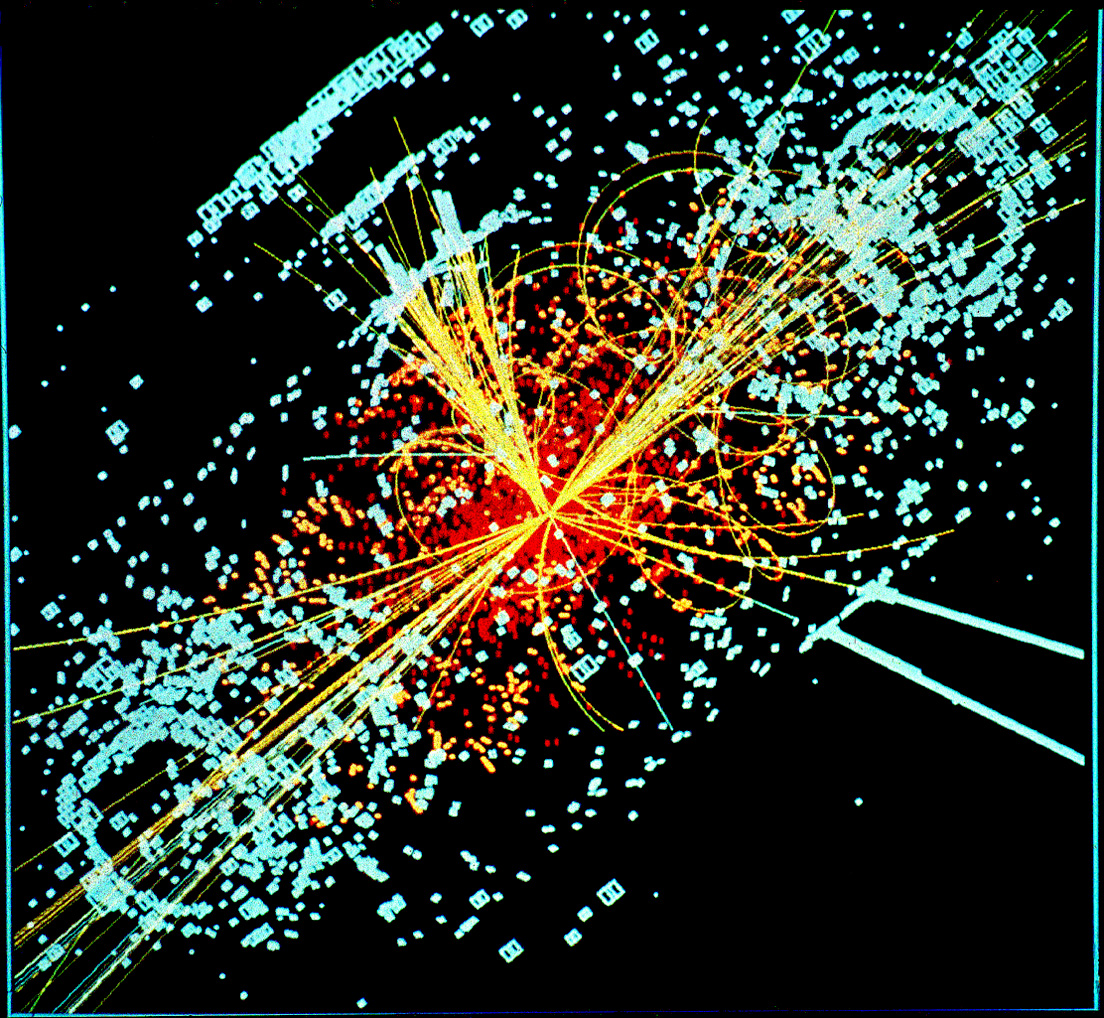
The problem. The Standard Model predicted everything about the Higgs boson except its mass, which depends on \lambda and was unknown. So the search had to cover a wide range, and the production rate and decay pattern change across it.
Production at the LHC is dominated by gluon fusion: two gluons from the colliding protons interact through a loop of top quarks to make a Higgs. It is rare — about one collision in ten billion.
The Higgs lives 1.6\times10^{-22} s and decays before travelling any measurable distance, so it is never seen directly. You reconstruct it from its decay products' invariant mass (Chapter 6.5).
The two golden channels:
H \to \gamma\gamma. Only 0.23 % of decays, and it requires a loop since the photon is massless and does not couple to the Higgs directly. But two photons are measured extremely precisely, giving a sharp peak.
H \to ZZ \to 4\ell. Even rarer, about 0.012 %, and four charged leptons is an exceptionally clean signature with almost no background.
The discovery, 4 July 2012. ATLAS and CMS independently reported an excess at 125 GeV. Both reached 5 standard deviations, the conventional threshold. Two experiments, different detector technologies, different analysis teams, same answer.
What "5 sigma" means: the probability of the background fluctuating to produce that excess is about 1 in 3.5 million. Chapter 8.6 discusses why particle physics uses such a demanding threshold.
Peter Higgs was in the audience at CERN and wept. He had published the prediction in 1964, aged 35. He was 83.
Higgs and Englert received the 2013 Nobel Prize. Robert Brout, Englert's collaborator, had died in 2011. Guralnik, Hagen and Kibble, who published the third of the three 1964 papers, were not included — the prize is limited to three living people, and this is a standing complaint about it.
Measured properties
| Property | Value | Status |
|---|---|---|
| Mass | 125.25 GeV | Measured to 0.1 % |
| Spin | 0 | Confirmed (spin-2 excluded) |
| Parity | Even | Confirmed |
| Charge | 0 | Confirmed |
| Width | 3.2 MeV | Consistent with prediction |
| Lifetime | 1.6\times10^{-22} s | Inferred |
| Self-coupling | — | Not yet measured |
The spin-0 measurement matters. It was determined from the angular distribution of the decay products, and it makes the Higgs the only fundamental scalar ever found. Every other particle in the table has spin ½ or 1.
The self-coupling is the big remaining test. The Higgs potential predicts that Higgs bosons should interact with each other, with a strength fixed by \lambda. Measuring it requires producing two Higgs bosons at once, which is about a thousand times rarer than one. The High-Luminosity LHC, running through the 2030s, should get a first measurement. If the self-coupling does not match, the potential is not the simple one written above, and that would be the first crack in the Standard Model at the LHC.
Is the vacuum stable?
The measured masses of the Higgs and the top quark sit in a peculiar place.
The Higgs quartic coupling \lambda runs with energy, like the gauge couplings of Chapter 8.3. The top quark's large Yukawa coupling drives \lambda downwards as the energy rises.
Extrapolating with the measured values, \lambda crosses zero at around 10^{10} to 10^{12} GeV.
Negative \lambda means the potential turns over and there is a deeper minimum somewhere else. Our vacuum would then be metastable — stable against small perturbations, but able to decay by quantum tunnelling into a lower-energy state.
If that happened, a bubble of true vacuum would expand at nearly the speed of light, and inside it the particle masses and couplings would be completely different. Atoms would not exist. You would get no warning, because the bubble wall travels at essentially c.
The calculated lifetime is around 10^{100} years or more — enormously longer than the current age of the universe at 1.4\times10^{10} years. This is not something to worry about, and the calculation is sensitive to the top mass at the level of a fraction of a percent, so the conclusion is not firm.
What it does indicate is that the Standard Model's parameters sit remarkably close to the boundary between stable and unstable, which many physicists regard as another hint that something is missing.
What mass actually is
Now the question this book has been circling since Chapter 1.4 can be answered properly, and the answer has three separate parts.
1. Elementary particle mass comes from the Higgs coupling. Electrons, quarks, W and Z bosons are massive because they interact with the Higgs field's vacuum value. This accounts for the masses in the Standard Model table.
2. Most of your mass does not come from the Higgs. Chapter 6.4 established this: a proton weighs 938 MeV and its three quarks total about 9 MeV. Over 98 % of the proton's mass is the energy of the gluon field and the confinement energy, converted to mass by E = mc^2.
So if the Higgs field switched off, you would lose under 2 % of your mass — and every atom would instantly disintegrate, because electrons would be massless and travel at c, and no bound states would exist.
3. "Resistance to acceleration" is a consequence, not a definition. The inertia you feel pushing an object is the result of these energies, and general relativity (Chapter 6.6) says it is exactly equal to the gravitational mass to fifteen decimal places.
The popular "molasses" picture is misleading and worth correcting. The Higgs field is often described as a syrup that particles wade through. That suggests a drag force, which would slow things down and would define a preferred rest frame — both flatly wrong. The Higgs field is perfectly Lorentz invariant, exerts no drag, and a particle moving through it at constant velocity continues at constant velocity forever. What the coupling does is give the field equation a term that makes the particle's dispersion relation E^2 = p^2c^2+m^2c^4 rather than E = pc. That is what mass is in field theory.
Why the mass is a problem
The hierarchy problem, mentioned in Chapter 8.2, is sharpest here.
Quantum corrections to the Higgs mass come from loops of every particle it couples to, and they scale with the largest energy at which the theory still applies. If the Standard Model holds up to the Planck scale, 10^{19} GeV, then:
m_H^2 = m_{H,\text{bare}}^2 + \Delta m^2, \qquad \Delta m^2 \sim (10^{19}\ \text{GeV})^2
To end up at 125 GeV, the bare mass and the correction must cancel to about 34 decimal places.
Nothing in the theory arranges that. It is possible, and it looks absurd.
Why does this affect only the Higgs? Because fermion masses are protected by chiral symmetry and gauge boson masses by gauge symmetry — both mean the correction is proportional to the mass itself, so a small mass stays small. A scalar has no such protection, and this is a special disease of the only scalar in the theory.
Proposed solutions:
Supersymmetry pairs every particle with a superpartner of opposite statistics, whose loop contributions cancel the ordinary ones. The LHC has looked hard and found nothing up to about 2 TeV, which does not exclude supersymmetry but removes much of its motivation, since a superpartner far above the Higgs mass reintroduces fine tuning.
Compositeness. If the Higgs is not fundamental but a bound state of something smaller, the problem dissolves the same way it does for the proton. No evidence.
Extra dimensions, lowering the true Planck scale so there is no large gap to cancel. No evidence.
Anthropic selection. In a multiverse with many vacua, only those with a small Higgs mass produce atoms and observers. Chapter 12.9 discusses whether this counts as an explanation.
Or the universe is simply fine-tuned, with no deeper reason.
The honest position: this is unsolved, and the LHC's failure to find anything new has made it harder rather than easier.
Where this shows up in your life
Atoms exist because the electron has mass, which comes from the Higgs coupling. A massless electron would travel at c and could not be bound.
The Sun burns slowly because the weak force is weak, which is because the W is heavy, which is because of the Higgs vacuum value. A lighter W would make the Sun burn out in millions of years rather than billions.
Neutron stars and the periodic table depend on the up–down quark mass difference, which is a difference of two Yukawa couplings.
And superconducting magnet technology developed for the LHC is used in MRI scanners worldwide.
What the next chapter fixes
One family of particles in the Standard Model has been mentioned repeatedly and never explained. Neutrinos were postulated to save a conservation law, took twenty-six years to detect, pass through a light year of lead without stopping, and were found in 1998 to do something the Standard Model says is impossible — which makes them the only confirmed crack in the theory. Chapter 8.5 tells that story, works through the oscillation mathematics, and explains in detail how Super-Kamiokande sees a particle that barely interacts with anything.