Appearance
6.7 — The Mathematics of Curved Space, Built From Scratch
Chapter 6.6 ended needing a language: a way to describe a space whose geometry changes from place to place, to say what a straight line means in it, and to measure how curved it is.
This chapter builds that language from a two-dimensional surface you can hold in your hand. Nothing is assumed. Every symbol is introduced in words before it is used, every index is explained, and by the end you will be able to read the Einstein field equations of Chapter 6.8 term by term.
The hardest thing here is not any single idea. It is the notation, which is compressed to a degree that makes a page of tensor calculus look like a wall. Take it slowly and it unpacks.
Intrinsic versus extrinsic
Start with the question that makes all this possible.
An ant lives on the surface of a sphere. It cannot leave the surface, cannot see the sphere from outside, and has no idea there is a third dimension. Can it discover that its world is curved?
Yes, and here is how.
Draw a triangle. Start at the north pole, walk south to the equator, turn 90° left, walk a quarter of the way round, turn 90° left again, and walk back to the pole. You have traced a triangle whose three angles are each 90°, summing to 270°.
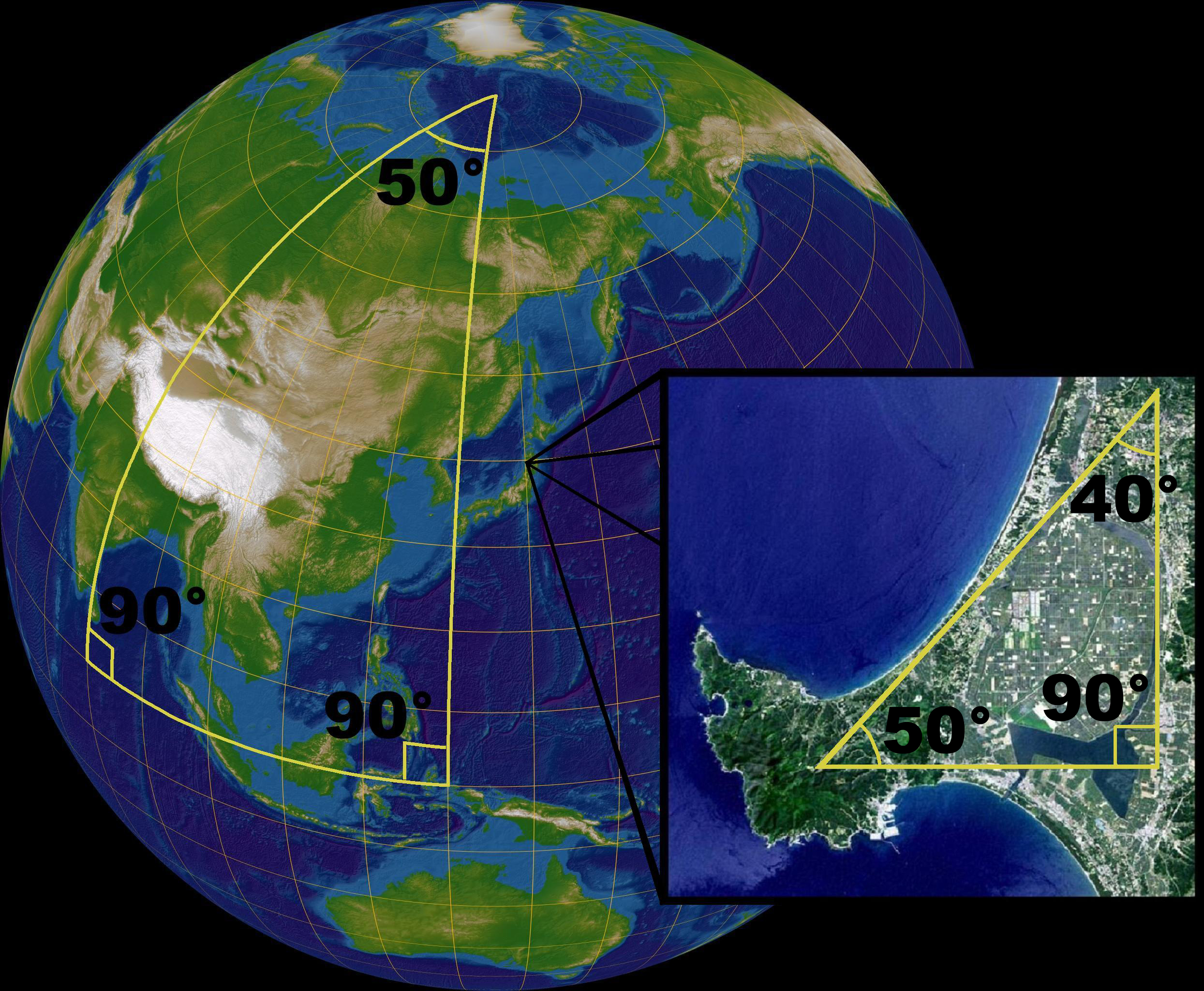
On a flat surface the angles of any triangle sum to exactly 180°. The ant has measured 270° without ever leaving the surface.
Measure a circle. Draw a circle of radius r, measured along the surface, and measure its circumference. On a plane it is 2\pi r. On a sphere it is less. On a saddle it is more.
These are intrinsic measurements — made entirely from inside, using only distances and angles within the surface. Gauss proved in 1827 that curvature is intrinsic, a result he was pleased enough with to call the Theorema Egregium, the remarkable theorem.
This is what makes general relativity possible. We cannot step outside spacetime to see it curve. We can only make measurements from within, and Gauss's theorem says that is enough.
Contrast with extrinsic curvature. Roll a sheet of paper into a cylinder. From outside it looks curved. But triangles on it still have 180°, circles still have circumference 2\pi r, and you can unroll it without stretching. A cylinder has zero intrinsic curvature. A sphere has positive; a saddle has negative; and no amount of bending turns one into another without stretching — which is why every flat map of the Earth distorts something, and why an orange peel cannot be flattened.
Manifolds
A manifold is a space that looks flat if you zoom in far enough, even though it may be curved overall.
The Earth's surface is the standard example. Any small patch looks like a flat plane, which is why a local map works and why people thought the Earth was flat for a long time. Zoom out and the curvature appears.
Two features matter for what follows.
A manifold needs coordinates, and no single coordinate system need cover it. Latitude and longitude cover the Earth except at the poles, where longitude becomes meaningless — every longitude meets there. That is a failure of the coordinates, not of the sphere. Nothing physical happens at the pole. Chapter 6.9 uses exactly this distinction to show that the "singularity" at a black hole's event horizon is a coordinate artefact while the one at the centre is not.
Coordinates are labels, not measurements. One degree of longitude is 111 km at the equator and 2 km near the poles. The coordinate difference is the same; the distance is not. So we need a separate object that converts coordinate differences into real distances, and that object is the metric.
The metric
In flat two-dimensional space with Cartesian coordinates, Pythagoras gives the distance between two nearby points:
ds^2 = dx^2 + dy^2
Read aloud: dee-s squared equals dee-x squared plus dee-y squared. The d means an infinitesimally small step, and ds is the actual distance corresponding to steps dx and dy.
Switch to polar coordinates, x = r\cos\theta, y = r\sin\theta, and the same distance is:
ds^2 = dr^2 + r^2d\theta^2
Look at the r^2. A step of d\theta in angle corresponds to a distance r\,d\theta, which depends on where you are. The space is still perfectly flat; the coordinates are curved, and the metric knows it.
On a sphere of radius R, using latitude-like \theta (measured from the north pole) and longitude \phi:
ds^2 = R^2d\theta^2 + R^2\sin^2\theta\,d\phi^2
The \sin^2\theta is the geometry of the sphere. At the equator, \theta = 90° and \sin\theta = 1, so a degree of longitude is full size. At \theta = 0, the pole, \sin\theta = 0 and longitude lines have shrunk to nothing. The metric contains the entire shape of the surface.
Writing it with indices
The general form is:
ds^2 = \sum_{\mu}\sum_{\nu} g_{\mu\nu}\,dx^\mu dx^\nu
and this is where the notation needs unpacking, because it is compressed in three separate ways at once.
First: x^\mu means "the \mu-th coordinate". The Greek letter \mu (mu) is an index — a label that runs over the available coordinates. In four-dimensional spacetime, \mu runs over 0, 1, 2, 3, with x^0 = ct, x^1 = x, x^2 = y, x^3 = z. The raised position is not a power. x^2 means the second coordinate, not x squared. This clash is genuinely unfortunate and universal.
Second: g_{\mu\nu} is the metric tensor. It is a table of numbers, one for each pair (\mu,\nu) — in four dimensions, a 4\times4 table. Its job is to say how much real distance you get from a step in each pair of coordinate directions. It is a function of position: the table has different entries at different points, and that variation is what curvature means.
Third: the Einstein summation convention. Writing \sum signs everywhere is exhausting, so Einstein introduced the rule that a repeated index is automatically summed over. The formula becomes:
ds^2 = g_{\mu\nu}dx^\mu dx^\nu
with the sum over both \mu and \nu understood — sixteen terms in four dimensions, written in five symbols. Einstein reportedly joked that this was his greatest discovery.
Reading some metrics
Flat 2D space, with x^1 = x and x^2 = y:
g_{\mu\nu} = \begin{pmatrix}1 & 0\\ 0 & 1\end{pmatrix}
The diagonal entries are 1, meaning a unit step in each coordinate is a unit of distance. The off-diagonal entries are zero, meaning the coordinates are perpendicular.
Flat spacetime (Minkowski), with x^0 = ct:
\eta_{\mu\nu} = \begin{pmatrix}1&0&0&0\\0&-1&0&0\\0&0&-1&0\\0&0&0&-1\end{pmatrix}
The symbol \eta (eta) is reserved for this one. Multiplying out gives:
ds^2 = c^2dt^2 - dx^2 - dy^2 - dz^2
which is exactly the invariant interval of Chapter 6.5. The minus signs on the space terms are the whole of special relativity, written as a geometry.
A sphere:
g_{\mu\nu} = \begin{pmatrix}R^2 & 0\\0 & R^2\sin^2\theta\end{pmatrix}
Position-dependent, because of the \sin^2\theta. That is the signature of a metric that might describe curvature — though not proof of it, since polar coordinates on a flat plane also give a position-dependent metric.
Upstairs and downstairs indices
There are two kinds of index position and the distinction has to be made once, clearly.
An index upstairs (contravariant) labels the components of a displacement or a velocity — things that scale like coordinates. dx^\mu, v^\mu.
An index downstairs (covariant) labels the components of a gradient — things that scale inversely to coordinates. \partial_\mu f.
The reason for two kinds: if you change from metres to centimetres, a displacement's components multiply by 100 while a gradient's components divide by 100. The two behave oppositely, so they need different bookkeeping.
The metric converts between them:
v_\mu = g_{\mu\nu}v^\nu, \qquad v^\mu = g^{\mu\nu}v_\nu
where g^{\mu\nu} is the matrix inverse of g_{\mu\nu}. This is called raising and lowering indices, and it is done constantly.
Why bother? Because a quantity with one upstairs index and one matching downstairs index, summed, is a scalar — a single number that every observer agrees on, independent of coordinates. That is what physics wants. The whole point of the index machinery is to build coordinate-independent statements out of coordinate-dependent pieces.
Geodesics: what "straight" means
In flat space a straight line is the shortest path between two points, and it is the path a free particle follows.
On a curved surface, "straight" needs redefining, and the definition that generalises is: a geodesic is the straightest possible path — one that does not turn left or right as far as the surface allows.
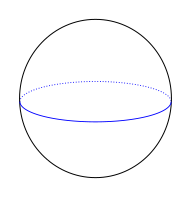
On a sphere, geodesics are great circles, which is why flights from London to Tokyo go over the Arctic. On a flat map that route looks like a wild detour; on the globe it is the straight line.
The geodesic equation:
\boxed{\frac{d^2x^\mu}{d\tau^2} + \Gamma^\mu_{\alpha\beta}\frac{dx^\alpha}{d\tau}\frac{dx^\beta}{d\tau} = 0}
Read it in pieces.
The first term is the acceleration in coordinates — the second derivative of position with respect to proper time. In flat space with Cartesian coordinates this is the only term, and setting it to zero gives x = x_0 + vt: a straight line at constant speed, which is Newton's first law.
The second term contains \Gamma^\mu_{\alpha\beta}, the Christoffel symbols, and they are the correction that says how the coordinate grid itself twists and stretches from point to point.
Christoffel symbols
The name sounds forbidding and the meaning is simple: the Christoffel symbols say how much a vector's components change purely because the coordinate system changed, when the vector itself did not.
An example with no curvature at all. Take polar coordinates on a flat plane. Move a vector from one place to another without rotating it. Its x and y components do not change — but its r and \theta components do, because the directions "radially outward" and "tangentially" point differently at different places. That change is entirely an artefact of the coordinates, and the Christoffel symbols track it so it can be subtracted off.
They are computed from the metric alone:
\Gamma^\mu_{\alpha\beta} = \frac{1}{2}g^{\mu\nu}\left(\frac{\partial g_{\nu\alpha}}{\partial x^\beta} + \frac{\partial g_{\nu\beta}}{\partial x^\alpha} - \frac{\partial g_{\alpha\beta}}{\partial x^\nu}\right)
Read it in words: take the derivatives of the metric in every direction, combine three of them in this particular pattern, and multiply by the inverse metric. The pattern of pluses and minus is exactly what makes the result transform correctly under a change of coordinates.
The key fact about Christoffel symbols:
They can be nonzero even in perfectly flat space (polar coordinates), and they can be made to vanish at any single point by choosing suitable coordinates.
That second half is the equivalence principle in mathematics. At any point you can find coordinates where the Christoffels are zero — a freely falling frame, in which gravity locally disappears. What you cannot do is make them vanish over a whole region if the space is genuinely curved. Curvature is what remains.
Worked example: geodesics on a sphere
Take the sphere metric, g_{\theta\theta} = R^2 and g_{\phi\phi} = R^2\sin^2\theta, and compute one Christoffel symbol.
\Gamma^\theta_{\phi\phi} = \frac{1}{2}g^{\theta\theta}\left(-\frac{\partial g_{\phi\phi}}{\partial\theta}\right) = \frac{1}{2}\cdot\frac{1}{R^2}\cdot\left(-\frac{\partial(R^2\sin^2\theta)}{\partial\theta}\right)
= -\frac{1}{2R^2}\cdot R^2\cdot 2\sin\theta\cos\theta = -\sin\theta\cos\theta
Now put it into the geodesic equation for the \theta component:
\frac{d^2\theta}{ds^2} - \sin\theta\cos\theta\left(\frac{d\phi}{ds}\right)^2 = 0
Check it on the equator. There \theta = \pi/2, so \cos\theta = 0 and the second term vanishes, leaving d^2\theta/ds^2 = 0. A path with constant \theta = \pi/2 satisfies this: the equator is a geodesic. ✓
Check it on a line of latitude at \theta = 60°. Now \sin\theta\cos\theta = (0.866)(0.5) = 0.433 \neq 0, so a path with constant \theta does not satisfy the equation. Lines of latitude other than the equator are not geodesics — which is why an aircraft flying "due east" along a latitude line is continuously turning, and why the great-circle route is shorter.
The Riemann curvature tensor
Christoffel symbols are coordinate-dependent, so they cannot be the measure of curvature. What is?
Parallel transport. Take a vector and carry it around a closed loop, keeping it "as parallel as possible" at each step — never deliberately rotating it. Return to the start. In flat space, the vector comes back pointing the same way. In curved space, it does not.

Do it concretely. Stand at the north pole holding an arrow pointing south along the Greenwich meridian. Walk to the equator, keeping the arrow parallel — it still points south. Walk a quarter of the way round the equator, still keeping it parallel — it still points south, which is now sideways relative to your motion. Walk back to the pole along that meridian. Your arrow has rotated by 90°.
You never turned it. The surface did.
The rotation angle is proportional to the area enclosed, and the constant of proportionality is the curvature. That is Gauss's intrinsic curvature, made operational.
In n dimensions this is encoded in the Riemann curvature tensor:
R^\rho_{\ \sigma\mu\nu} = \partial_\mu\Gamma^\rho_{\nu\sigma} - \partial_\nu\Gamma^\rho_{\mu\sigma} + \Gamma^\rho_{\mu\lambda}\Gamma^\lambda_{\nu\sigma} - \Gamma^\rho_{\nu\lambda}\Gamma^\lambda_{\mu\sigma}
Four indices. Do not try to hold the whole formula in your head; read what each part does.
- \rho says which component of the vector got changed.
- \sigma says which component it started as.
- \mu and \nu define the little loop you carried it around — one for each of the two directions spanning the loop.
The derivative terms (\partial_\mu\Gamma) compare how the coordinate twisting differs between the two directions. The product terms (\Gamma\Gamma) account for the twisting compounding on itself, which is what makes gravity nonlinear.
The one thing to remember:
R^\rho_{\ \sigma\mu\nu} = 0 everywhere if and only if the space is flat.
This is a genuine test. It does not care what coordinates you used. Polar coordinates on a plane give nonzero Christoffel symbols and a zero Riemann tensor, correctly reporting that the plane is flat.
How many components? In four dimensions, 4^4 = 256 — but symmetries reduce the independent ones to 20. Still a lot, and it is why exact solutions of Einstein's equations are rare and precious.
Ricci tensor and scalar
Twenty components is more than the field equations need, so two contractions are used.
The Ricci tensor sums over the first and third indices:
R_{\mu\nu} = R^\alpha_{\ \mu\alpha\nu}
Ten independent components in four dimensions. Its physical meaning is volume change: it measures how fast a small ball of freely falling test particles changes volume. Positive Ricci curvature makes the ball shrink.
The Ricci scalar contracts once more:
R = g^{\mu\nu}R_{\mu\nu}
A single number at each point — the average curvature there. On a sphere of radius a in two dimensions, R = 2/a^2: smaller spheres are more curved, as they should be.
What was thrown away in going from Riemann to Ricci is called the Weyl tensor, and it describes shape change without volume change — the stretching-and-squeezing that tidal forces produce, and the part that propagates as gravitational waves through empty space (Chapter 6.10). Empty space can have zero Ricci curvature and nonzero Weyl curvature, which is exactly what a gravitational wave is, and it is why waves can travel where there is no matter.
Geodesic deviation: curvature is tidal force
Chapter 6.6 ended with two balls in a falling lift drifting relative to each other. Here is that statement in the new language.
Two nearby geodesics with separation vector \xi^\mu (xi) obey:
\frac{D^2\xi^\mu}{d\tau^2} = -R^\mu_{\ \alpha\beta\nu}u^\alpha u^\beta\xi^\nu
Read it: the relative acceleration of two freely falling objects is the Riemann tensor acting on their separation. The left side is what the observer in the lift measures — the balls drifting together or apart. The right side says the entire cause is curvature.
So tidal force is curvature. They are the same thing with two names, and the ocean tides of Chapter 1.9 are a direct measurement of the curvature of spacetime near the Earth.
This also settles the question of what is real and what is coordinates. The part of gravity you can transform away by falling is coordinates. The part you cannot — the tidal part, which stretches you head to foot and squeezes you side to side — is curvature, and it is present in every frame.
The vocabulary, in one table
| Object | Indices | What it means |
|---|---|---|
| g_{\mu\nu} | 2 down | Converts coordinates to distances |
| \Gamma^\mu_{\alpha\beta} | 1 up, 2 down | How the coordinate grid twists |
| R^\rho_{\ \sigma\mu\nu} | 1 up, 3 down | Full curvature; zero means flat |
| R_{\mu\nu} | 2 down | Volume change of falling matter |
| R | none | Average curvature at a point |
| T_{\mu\nu} | 2 down | Energy, momentum and stress present |
The last one has not appeared yet, and it is the subject of Chapter 6.8.
Where this shows up in your life
Every map you have ever used. A Mercator projection preserves angles and wrecks areas — Greenland looks the size of Africa and is a fourteenth of it. That is the Theorema Egregium in action: a sphere cannot be flattened without distortion, so every projection must sacrifice something, and choosing what to sacrifice is the whole art of cartography.
Flight paths. Great-circle routes are geodesics, and the reason a London–Los Angeles flight goes over Greenland is that the geodesic does.
GPS. The receiver solves for its position in a curved spacetime, and Chapter 6.9 shows the correction is not optional.
Peeling an orange. The peel will not lie flat, and no amount of pressing helps, because its intrinsic curvature is nonzero and flattening would require stretching.
Pizza. Fold a slice along its length and the tip stops drooping. Folding introduces extrinsic curvature in one direction, and since the intrinsic curvature must stay zero — the dough does not stretch — the surface is forced to stay flat in the perpendicular direction. The floppy tip is held up by Gauss's theorem.
What the next chapter fixes
The geometry is built. What is missing is the connection to physics: an equation saying how much curvature a given amount of matter produces. Chapter 6.8 writes down the Einstein field equations, reads each side term by term, explains why the particular combination on the left is the only one that could work, derives the Newtonian limit so that \nabla^2\phi = 4\pi G\rho falls out as a special case, and explains the cosmological constant — the term Einstein added, removed, and which turned out to be needed after all.