Appearance
5.6 — Lasers, Holography and Optical Fibre
Light from a candle, a bulb or the Sun comes from atoms emitting independently. Each one lights up when it happens to, in a random direction, with a random phase, at whatever wavelength its energy levels allow. The result spreads in all directions, contains every colour, and scrambles its phase a hundred million times a second.
A laser produces light in which every photon is in step with every other one, travelling the same way, at the same wavelength. That difference is not a matter of degree. It requires a mechanism that has no classical analogue at all, and Einstein found it in 1917 while thinking about something else entirely.
Three ways an atom interacts with light
An atom has discrete energy levels — Chapter 7.6 derives them; for now take it that an electron can sit at E_1 or at a higher E_2, and nowhere between. The gap corresponds to a photon of frequency:
hf = E_2 - E_1
where h = 6.626\times10^{-34} J·s is Planck's constant, introduced properly in Chapter 7.1.
Absorption. A photon of exactly that energy arrives, the atom takes it, and the electron jumps from E_1 to E_2. The photon is gone.
Spontaneous emission. An excited atom drops back to E_1 on its own, after a random delay of typically 10^{-8} s, emitting a photon in a random direction with a random phase. This is where ordinary light comes from. Because the direction and phase are random for each atom, the light is incoherent and spreads everywhere.
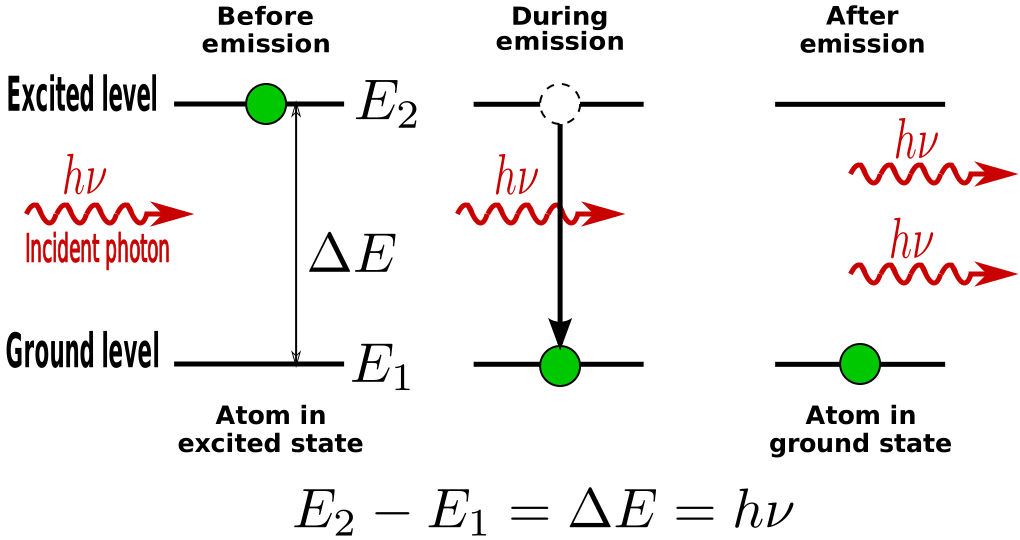
Stimulated emission. This is the one Einstein had to invent. A photon of exactly the right energy passes an atom that is already excited. Instead of being absorbed — the atom is already up there — it triggers the atom to drop now, and the emitted photon is identical to the trigger in every respect: same frequency, same direction, same phase, same polarisation.
One photon goes in; two identical photons come out. Amplification, with perfect copying.
Why Einstein needed it
He was not trying to invent lasers. He was trying to derive Planck's black-body formula (Chapter 3.7) from a simple model of atoms in equilibrium with radiation.
Set it up. Let N_1 and N_2 be the numbers of atoms in the two levels, and \rho the energy density of radiation at the transition frequency. The rate of upward transitions is proportional to N_1\rho. The rate of downward transitions, with only spontaneous emission available, would be proportional to N_2 alone. In equilibrium these balance:
B N_1\rho = A N_2 \quad\Longrightarrow\quad \rho = \frac{A}{B}\cdot\frac{N_2}{N_1}
And statistical mechanics (Chapter 3.2) says the level populations follow the Boltzmann factor:
\frac{N_2}{N_1} = e^{-(E_2-E_1)/k_BT} = e^{-hf/k_BT}
So this model predicts \rho \propto e^{-hf/k_BT}, which is Wien's approximation — correct at high frequency and wrong at low frequency, where the measured curve behaves quite differently.
Einstein found that adding a third process, stimulated emission at a rate proportional to N_2\rho, fixes it exactly:
BN_1\rho = AN_2 + BN_2\rho
Solve for \rho:
\rho(B N_1 - BN_2) = AN_2 \quad\Longrightarrow\quad \rho = \frac{A}{B}\cdot\frac{1}{(N_1/N_2) - 1} = \frac{A/B}{e^{hf/k_BT}-1}
That is Planck's law, with its characteristic e^x - 1 in the denominator. The term that had to be added to make thermodynamics come out right is the term that lasers run on.
Population inversion: the hard part
Stimulated emission competes with absorption. In a normal material at thermal equilibrium, the Boltzmann factor guarantees N_2 < N_1 — there are always more atoms in the lower state — so absorption wins and a beam is attenuated rather than amplified.
To amplify, you need N_2 > N_1. More atoms excited than not. This is called population inversion, and it cannot happen at any temperature: putting N_2 > N_1 into the Boltzmann factor gives a negative absolute temperature. It is a genuinely non-equilibrium state, and it has to be forced.
Why two levels can never work
Suppose you try. Shine light at the transition frequency to pump atoms up. But that same light stimulates emission back down, at exactly the same rate coefficient B. The best you can ever reach is N_2 = N_1, where the two rates balance — the medium becomes transparent and no more.
So a two-level system cannot be inverted, by anything. This is why the laser took forty-three years after Einstein's paper: the problem is not making stimulated emission happen, it is arranging for there to be something to stimulate.
Three-level and four-level schemes
Three-level (the original ruby laser, 1960). Pump atoms from the ground state E_1 to a short-lived high state E_3. From there they decay very fast, without emitting light, to a metastable state E_2 — one with an unusually long lifetime, milliseconds rather than nanoseconds, because the direct transition to the ground state is quantum-mechanically suppressed. Atoms pile up at E_2, and the lasing transition is E_2 \to E_1.
The weakness is that E_1 is the ground state, where most atoms live. You must pump more than half of all the atoms up before inversion begins, which takes enormous power. Theodore Maiman's first ruby laser used a photographic flash lamp wrapped around the rod and worked only in pulses.
Four-level (nearly everything since). Add a fourth level. Pump from ground E_0 to E_3; fast decay to metastable E_2; lase from E_2 to E_1; then fast decay from E_1 back to E_0.
The trick is that E_1 is not the ground state and empties almost instantly, so it is essentially always empty. Inversion between E_2 and E_1 therefore needs only a handful of excited atoms, not half of them. Threshold power drops by orders of magnitude and continuous operation becomes easy. Every laser pointer, fibre amplifier and industrial cutting laser is four-level.
The cavity
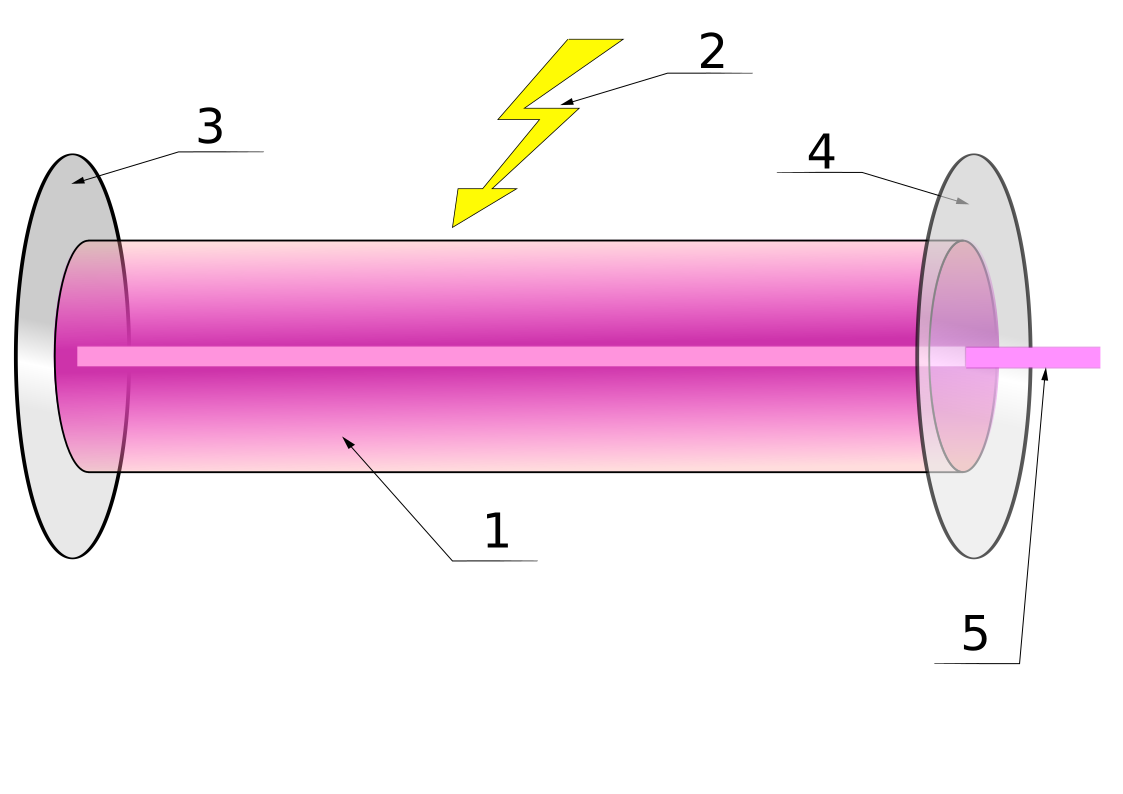
An inverted medium amplifies, but one pass gains only a few percent. Put mirrors at both ends and light bounces back and forth, being amplified on every pass.
One mirror is fully reflecting; the other transmits a little — typically 1 % to 5 %. That leak is the beam.
The cavity does three jobs at once, and each accounts for one property of laser light.
1. It selects direction. Only light travelling almost exactly along the axis survives many round trips; anything at an angle walks off the mirrors and is lost. This is why a laser beam is a beam.
2. It selects wavelength. The light must form a standing wave between the mirrors, so a whole number of half-wavelengths must fit in the cavity length L:
L = m\frac{\lambda}{2} \quad\Longrightarrow\quad \lambda = \frac{2L}{m}
Only these longitudinal modes are allowed. For L = 30 cm, adjacent modes are separated by c/2L = 500 MHz, which is tiny compared with an optical frequency of 5\times10^{14} Hz. This is why laser light is one colour to a precision no other source approaches.
3. It builds coherence. Every photon in the cavity was stimulated by another photon there, so they inherit each other's phase. The whole beam is one wave.
Threshold is the condition that round-trip gain exceeds round-trip loss. Below it, nothing; above it, the output rises steeply. Watch a laser diode's output against current and you see a sharp knee at threshold, which is why they must be driven with current control rather than voltage — a small voltage change past the knee can produce a destructive current surge.
The word is an acronym: Light Amplification by Stimulated Emission of Radiation. Charles Townes built the microwave version, the maser, in 1954; Maiman built the first optical laser in May 1960. It was famously described at the time as "a solution looking for a problem".
What makes laser light different
Monochromatic. A helium–neon laser has a linewidth of about 10^{-6} nm around 632.8 nm. A "red" LED spans 20 nm. That is a factor of twenty million.
Coherent. The coherence length — the distance over which the phase stays predictable — is millimetres for a laser pointer, metres for a good gas laser, and kilometres for a stabilised one. For sunlight it is under a micrometre. Chapter 5.3's interference experiments become trivially easy with a laser and are delicate with anything else.
Collimated. The beam barely spreads. It cannot avoid spreading entirely, because diffraction (Chapter 5.4) applies to a laser like everything else. For a beam of initial width w:
\theta \approx \frac{\lambda}{\pi w}
Worked number. A laser pointer with \lambda = 650 nm and w = 1 mm:
\theta = \frac{650\times10^{-9}}{\pi\times10^{-3}} = 2.1\times10^{-4}\ \text{rad}
Over the 384,000 km to the Moon that gives a spot 2\times2.1\times10^{-4}\times3.84\times10^8 = 161 km across. Apollo's retroreflectors are still detectable because the returning light is similarly spread and only a few photons come back per pulse — but they do come back, and that is how the Earth–Moon distance is measured to millimetres.
Bright, in the sense that matters. A 1 mW laser pointer puts its milliwatt into a 1 mm² spot with a tiny angular spread. Focus it to the diffraction limit and the intensity exceeds the Sun's surface. This is what makes even low-power lasers an eye hazard: your own lens focuses the parallel beam to a spot a few micrometres across on the retina, concentrating the power by a factor of about a million.
Kinds of laser
| Type | Wavelength | Typical use |
|---|---|---|
| Helium–neon | 632.8 nm | Alignment, teaching, holography |
| Semiconductor diode | 405–1550 nm | Everything consumer, fibre optics |
| Nd:YAG | 1064 nm | Cutting, marking, surgery |
| CO₂ | 10.6 μm | Industrial cutting, engraving |
| Excimer | 193 nm | Eye surgery, chip lithography |
| Fibre | 1030–1080 nm | Welding, high-power industry |
Semiconductor diode lasers dominate by number — billions are made every year. They are millimetres across, run off a few volts, and convert electricity to light at over 50 % efficiency. Volume III, Chapter 2 covers the semiconductor physics; the optical principle is identical to everything above, with the cavity formed by the cleaved crystal faces themselves, whose reflectivity comes free from the refractive index step.
CO₂ lasers at 10.6 μm are absorbed strongly by organic materials and water, which is why they cut wood, acrylic and fabric so well and why they are invisible — 10.6 μm is deep infrared, and a CO₂ laser's beam path is genuinely dangerous precisely because you cannot see it.
Excimer lasers at 193 nm are absorbed in the top fraction of a micrometre of tissue and break molecular bonds directly rather than heating, so they remove material without cooking the surroundings. That is why laser eye surgery uses them, and Chapter 5.2 explains what the reshaping achieves.
Holography
An ordinary photograph records only the intensity of light arriving at each point. All the phase information — which encodes where the light came from — is thrown away, which is why a photograph is flat.
A hologram records the phase too, and it does it by interference.
Recording. Split a laser beam. Send one half to illuminate the object; let the light it scatters fall on a photographic plate. Send the other half — the reference beam — straight to the plate.
The two beams interfere on the plate. Where they arrive in phase the plate is exposed; where they arrive out of phase it is not. The developed plate holds a fine pattern of fringes — typically thousands of lines per millimetre — that encodes the phase of the object wave relative to the reference at every point.
The plate looks like grey noise. There is no picture on it.
Reconstruction. Illuminate the plate with the reference beam alone. The fringe pattern acts as a complicated diffraction grating (Chapter 5.4) and diffracts the reference beam into exactly the wavefront the object originally produced. Your eye receives light identical to what the object sent, so you see the object in three dimensions, and you can look around its edges by moving your head.
Two consequences make holography strange in a way photography is not.
Cut a hologram in half and each half still shows the whole scene, from a more restricted viewpoint. Every part of the plate received light from every part of the object, so every part encodes the whole. Cut a photograph in half and you have half a picture.
It requires a laser. The reference and object beams must stay coherent over the difference in their path lengths, which is centimetres. With sunlight's coherence length under a micrometre there is no interference pattern to record. Dennis Gabor invented holography in 1947 and could not demonstrate it properly, because the laser did not exist for another thirteen years. He received the Nobel Prize in 1971, after lasers made his idea work.
The holograms on banknotes and credit cards are mass-produced embossed versions — surface relief patterns stamped into foil — viewable in white light because they are designed to reconstruct at a particular angle. They are hard to counterfeit because copying one requires the original optical setup, not just a scanner.
Optical fibre
Chapter 5.1 established the mechanism: total internal reflection in a glass core surrounded by lower-index cladding. What makes it a global technology rather than a curiosity is a combination of three things, and it is worth seeing why each was necessary.

1. Transparency. Ordinary window glass loses about 90 % of light per metre. Fibre needs losses measured per kilometre. Charles Kao argued in 1966 that the loss was due to impurities — particularly iron and water — rather than to glass itself, and that ultra-pure silica should reach 20 dB/km. Everybody thought it impossible. Corning achieved 17 dB/km in 1970, and modern fibre reaches 0.15 dB/km at 1550 nm, which means light travels 20 km before losing half its power. Kao received the Nobel Prize in 2009.
2. A source small and coherent enough. A single-mode fibre core is about 9 μm across. Nothing but a laser can be coupled into it efficiently, and a semiconductor laser is the only laser cheap and small enough to put on the end of every fibre in a network.
3. Dispersion control. Two different effects smear a pulse as it travels, and both had to be solved.
Modal dispersion afflicts wide-core fibre, where light can take many different zig-zag paths. A ray bouncing steeply travels further than one going straight, so a sharp pulse arrives spread out. Two fixes exist: grade the refractive index so it falls smoothly towards the edge, which makes the outer parts of the ray travel faster and equalises the times; or shrink the core until only one path fits, which is single-mode fibre and is what all long-haul links use.
Chromatic dispersion is the effect from Chapter 5.1: n depends on wavelength, so different colours travel at different speeds. Even a laser has a finite linewidth, and over 100 km a small spread becomes a significant time smear. It is managed by operating near 1310 nm, where silica's dispersion happens to pass through zero, or by periodically inserting fibre with the opposite dispersion to unwind it.
The result. A single fibre carries over 100 terabits per second using wavelength division multiplexing — dozens of laser wavelengths sharing one strand, each carrying its own data, separated at the far end by a grating. Roughly 1.4 million kilometres of submarine cable carry essentially all intercontinental internet traffic. Satellites carry a rounding error by comparison, because a fibre has vastly more bandwidth and a quarter of the latency.
Erbium-doped fibre amplifiers are the piece that made very long links practical, and they are lasers without mirrors. A length of fibre doped with erbium is pumped by a 980 nm diode laser, creating population inversion in the erbium ions. A signal at 1550 nm passing through is amplified by stimulated emission directly, in the fibre, without ever being converted to electricity. Before these arrived in 1987, every 40 km needed a repeater that detected the light, regenerated the signal electronically and re-transmitted it — expensive, slow, and locked to one data rate. An optical amplifier does not care what the data is.
Where this shows up in your life
Barcode scanners, laser printers, optical drives, laser levels, rangefinders, and the sensor in an optical mouse are all diode lasers.
Fibre to your home, and the entire internet backbone.
Laser eye surgery, retinal photocoagulation, laser lithotripsy for kidney stones, and laser scalpels that cut and cauterise simultaneously.
Industrial cutting and welding. A 10 kW fibre laser cuts 25 mm steel, and does it with a focused spot a fraction of a millimetre across.
LiDAR — pulses of laser light, timed for their return — maps the world for autonomous vehicles, surveys archaeological sites through forest canopy, and measures atmospheric aerosols.
Atomic clocks and GPS. Laser cooling holds atoms nearly still so their transition frequency can be measured with extreme precision, and Volume III, Chapter 8.2 covers what that buys you.
Gravitational wave detection. LIGO's interferometer (Chapter 5.3) needs a laser of extraordinary stability, and its 200 kW of circulating power is what makes measuring 10^{-18} m possible.
What Part 5 established
Part 5 took light as given and asked what it does.
Ray optics came out of a single principle about travel time. Fermat's least-time path gave the equal-angle law of reflection and Snell's law of refraction, and from those two came total internal reflection, the diamond's sparkle, fibre optics, the rainbow's 42°, and the fact that the Sun has already set when you watch it setting.
Curved surfaces turned those laws into images, and the same equation 1/u + 1/v = 1/f described every mirror, lens, eye, camera and telescope, with the lens-maker's formula explaining where f comes from.
Then the ray picture failed, in the one way that mattered: it cannot produce darkness by adding light. Interference explained the double slit, the colours of soap films and beetles, and the anti-reflective coating that makes modern lenses possible.
Diffraction turned the same wave physics into a hard limit. Every optical instrument, from your eye to the Event Horizon Telescope, is bounded by 1.22\lambda/D, and the entire semiconductor industry's progress for forty years has been a fight against that inequality.
Polarisation used the one remaining property of a transverse wave, and explained sunglasses, LCD screens, the blue sky and how a bee navigates.
And lasers required something that no wave theory of light contains: a quantum mechanical process in which one photon triggers the emission of an identical twin.
That last point is the thread out of this Part. Chapters 5.1 through 5.5 treat light as a wave and every result is correct. Chapter 5.6 needed discrete energy levels, photons, and Planck's constant, and none of that fits into Maxwell's equations. Something is missing.
What the next Part fixes
Two things are now unexplained and they lead in opposite directions.
Maxwell's equations say light travels at 1/\sqrt{\mu_0\varepsilon_0}, and they do not say relative to what. Every other wave has a medium that answers that question. Light does not, and the experiment designed to find the medium found nothing at all. Part 6 follows that thread, and it ends with gravity being the shape of spacetime.
And the atoms in this chapter had discrete energy levels for no stated reason, emitted in packets of hf for no stated reason, and the black-body curve of Chapter 3.7 came out infinite without them. Part 7 follows that thread. Both start from a failure that classical physics could not paper over, and between them they replace everything in Parts 1 through 5 with something stranger and more accurate.