Appearance
1.4 — Newton's Three Laws
Slide a book across a table and it stops. For two thousand years the obvious conclusion was drawn: motion needs a cause, and when the cause is removed, motion ceases. Aristotle wrote it down, everyone could see it was true, and physics stayed stuck there.
The book stops because of friction. Remove the friction — put the book on an air-hockey table, or on ice, or in space — and it does not stop. What the ancient world took for the natural behaviour of matter was a local detail of living on a rough planet with an atmosphere. Getting past that required someone to describe a world nobody had ever seen: one with no friction at all, where a moving thing simply keeps moving.
That is Newton's first law, and it is the hardest of the three, because it asks you to trust a reasoned abstraction over the direct evidence of your eyes.

The first law: what happens when nothing happens
A body remains at rest, or continues to move in a straight line at constant speed, unless acted on by a net external force.
Take that phrase by phrase, because every word is carrying weight.
"At rest, or moving in a straight line at constant speed." These two are grouped together deliberately, and the grouping is the whole insight. Rest is not a special state. A book on a table and a spacecraft coasting at 30 000 km/h are, as far as physics is concerned, doing the same thing: not accelerating. Whether you call one of them "at rest" depends only on where you are standing.
"Net." Forces add as vectors, so several forces can act and still cancel. The book on the table has gravity pulling it down and the table pushing it up, and it sits still not because nothing acts on it but because the two cancel exactly. Net force is the vector sum, and only that sum matters.
"External." Forces the body exerts on itself cannot move it. You cannot lift yourself by pulling on your own belt, however hard you pull, and the third law will explain exactly why.
What the first law is really claiming
At first reading, the first law looks like a special case of the second — set F = 0 in F = ma and you get a = 0. If that were all it said, it would be redundant, and Newton would not have listed it separately.
What it actually does is define the arena in which the second law is allowed to be used.
Sit in a car with a ball on the dashboard. The car accelerates forward. The ball rolls backwards. In your frame — the car's frame — the ball just accelerated with nothing touching it, so the first law appears to have been violated. Seen from the road, nothing strange happened: the ball kept doing what it was doing while the car moved forward underneath it.
A frame of reference where the first law holds is called an inertial frame. The road is one. The accelerating car is not. And \vec{F} = m\vec{a} is only true in inertial frames — that is the real content of the first law. It tells you when you are allowed to use the second. Chapter 1.5 shows how to work inside an accelerating frame anyway, by inventing a bookkeeping force to patch the discrepancy.
Strictly, the surface of the Earth is not inertial either: it spins, so it is accelerating. But the acceleration is about 0.03\ \text{m/s}^2 at the equator, roughly a third of a percent of g, which is why we ignore it for a falling ball and cannot ignore it for a hurricane, whose spiral is caused by exactly this effect.
Inertia, and the thing that measures it
The tendency of a body to keep doing what it is doing is called inertia, and the quantity that measures how much of it a body has is its mass. A shopping trolley full of bricks is harder to get moving and harder to stop than an empty one, in the same proportion. That is what mass is: resistance to having your velocity changed.
This is worth separating carefully from weight, because everyday language runs them together.
- Mass is how much stuff there is and how strongly it resists acceleration. It is a scalar, measured in kilograms, and it is the same everywhere in the universe.
- Weight is the gravitational force acting on that mass, W = mg. It is a vector, measured in newtons, and it changes with location.
An astronaut on the Moon has the same mass as on Earth and one sixth the weight. Which means that on the Moon they could hold a heavy toolbox effortlessly, and would still be knocked flat if that toolbox swung into them at speed — because the impact depends on inertia, and the inertia did not change. Astronauts in orbit are not weightless because gravity has vanished; at the altitude of the International Space Station gravity is still about 90% of its surface value. They are weightless because they are in free fall, which Chapter 1.9 explains properly.
The second law: how force and motion connect
The net force on a body equals the rate of change of its momentum. For constant mass, this reduces to force equals mass times acceleration.
Newton wrote it in terms of momentum, and that form is both more general and more nearly what he meant:
\vec{F}_{\text{net}} = \frac{d\vec{p}}{dt}, \qquad \text{where } \vec{p} = m\vec{v}
Momentum \vec{p} is mass times velocity, and Chapter 1.7 develops it properly. For now, expand the derivative using the product rule:
\vec{F}_{\text{net}} = \frac{d(m\vec{v})}{dt} = m\frac{d\vec{v}}{dt} + \vec{v}\frac{dm}{dt}
If the mass is constant, the second term is zero because dm/dt = 0, and we are left with the famous form:
\boxed{\vec{F}_{\text{net}} = m\vec{a}}
The second term is not a curiosity. For a rocket, mass is decreasing fast as fuel burns, so dm/dt is large and negative, and that term is the thrust. Chapter 1.7 derives the rocket equation from it. Anything where mass changes — a rocket, a conveyor belt being loaded, a raindrop growing as it falls — needs the momentum form.
What the second law actually tells you
It is three equations, not one. \vec{F} = m\vec{a} is a vector equation, so it separates into components exactly as Chapter 1.3 described:
F_x = ma_x, \qquad F_y = ma_y, \qquad F_z = ma_z
Each direction is handled on its own. Every problem in this Part is solved by writing these out.
Force causes acceleration, not velocity. This is the single most persistent misconception in mechanics. A constant force does not produce a constant speed; it produces a steadily increasing speed. When you push a sofa across a carpet at a steady walk, you are not applying a force to keep it moving — you are applying a force to cancel friction, and the net force is zero, which is why the speed is constant. Remove friction and the same push would accelerate the sofa forever.
The direction of the acceleration is the direction of the net force, not of the velocity. A ball thrown upward has velocity up and acceleration down. A car turning left has velocity forward and acceleration left. Velocity says where you are going; acceleration says where the force is.
It defines what a force is. There is a circularity people notice and worry about: force is defined by F = ma, and mass is defined by how much force it takes to accelerate something. The escape is that the law is testable in bulk. Take one standard mass, define the newton by it, and then every other force you measure has to be consistent across every experiment — the same spring stretched by the same amount must accelerate a 2 kg block half as fast as a 1 kg block, always, everywhere. It is that web of consistency that makes the law content rather than definition.
The newton, sized properly
One newton is the force that accelerates one kilogram at one metre per second squared. To get a feel for it: a medium apple weighs about one newton. Your own weight, if you are 70 kg, is 70 \times 9.81 \approx 690\ \text{N}. A car engine produces a few thousand newtons of driving force. A Falcon 9 first stage produces about 7 600 000 N at sea level.
The third law: forces come in pairs
If body A exerts a force on body B, then body B exerts a force on body A that is equal in magnitude and opposite in direction.
\vec{F}_{AB} = -\vec{F}_{BA}
Push a wall and the wall pushes you. Fire a rifle and the rifle kicks. Jump off a boat and the boat slides backwards. The Earth pulls the apple down with some force, and the apple pulls the Earth up with exactly the same force — the Earth's acceleration is just 10^{25} times smaller because its mass is 10^{25} times larger.
The law is easy to state and easy to misuse. Three things fix that.
The two forces act on different bodies. Always. This is where every third-law confusion comes from. The pair is "A on B" and "B on A". They can never cancel each other, because cancelling requires both forces to act on the same body, and by construction these do not. When you push a box and it accelerates, the box's acceleration is decided entirely by the forces acting on the box — your push, friction, gravity, the floor. The box's reaction on your hand is real, but it appears in your equation, not the box's.
"Equal and opposite" says nothing about the effects being equal. A truck hits a mosquito. The forces are exactly equal — the mosquito hits the truck as hard as the truck hits the mosquito. The accelerations are not, because a = F/m and the masses differ by ten orders of magnitude. Same force, wildly different consequence.
The pair always has the same type. If the action is gravitational, the reaction is gravitational. If it is a contact push, the reaction is a contact push. A common wrong answer says the reaction to your weight (Earth pulling you down) is the ground pushing you up. It is not — those act on the same body, you, and are two different kinds of force. The reaction to Earth pulling you down is you pulling the Earth up. The ground pushing you up is one half of a separate pair, whose other half is you pushing down on the ground.

How anything moves at all, given that forces cancel in pairs
If every force has an equal opposite, why does anything ever accelerate? Because the two halves act on different things.
When you walk, your foot pushes backwards on the ground. The ground pushes forwards on your foot. The force on you is the ground's forward push, and there is nothing on you cancelling it, so you accelerate forwards. The backwards force acts on the Earth, which duly accelerates backwards by an utterly unmeasurable amount. Walking is possible because friction lets your foot push backwards, which is why walking on ice is hard: no backward push is available, so no forward reaction comes.

A rocket is the cleanest demonstration, because it works in a vacuum. There is nothing to push against, and there does not need to be. The engine throws mass backwards at high speed; by the third law, that mass throws the rocket forwards. Chapter 1.7 turns this into the Tsiolkovsky equation and Part 11 uses it to reach orbit.
The four forces you will actually meet in mechanics
Before solving anything, you need a short catalogue of the forces that appear in ordinary problems.
Weight, \vec{W} = m\vec{g}. The Earth's gravitational pull, always straight down towards the Earth's centre, acting effectively at the body's centre of mass. It acts whether or not the body is touching anything.
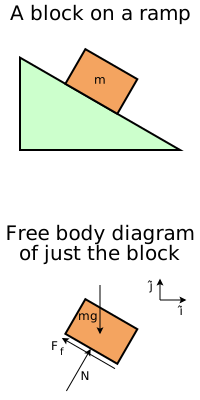
Normal force, \vec{N}. The push a surface gives perpendicular to itself. The word "normal" here means perpendicular, not usual. A surface is not a passive thing: when you rest a book on a table the table's surface deforms microscopically like a very stiff spring, and pushes back exactly hard enough to stop the book sinking further. The normal force is not always equal to the weight. On a horizontal table with nothing else acting, it is. On a slope it is mg\cos\theta. In a lift accelerating upwards it is more than mg, which is the heaviness you feel. If you press down on the book, it grows to match. Its value is always found by applying the second law, never by assuming.
Tension, \vec{T}. The pull transmitted along a taut string, rope or cable, always directed along the string and always pulling away from the body. A string can pull, never push. For an ideal string — massless and inextensible — the tension is the same all the way along, and a frictionless massless pulley changes the direction of the tension without changing its size. Both idealisations are good enough for almost every problem you will meet, and both fail for a heavy hanging chain, which Chapter 1.10 handles.
Friction, \vec{f}. The force a surface exerts parallel to itself, opposing relative sliding. Chapter 1.5 treats it in full.
Two more appear later: the spring force F = -kx from Chapter 2.1, and drag from Chapter 1.11.
Free-body diagrams — the discipline that makes problems solvable
Almost every mechanics mistake is a bookkeeping mistake: a force left out, a force put in that is not there, or two forces acting on different bodies written into the same equation. The free-body diagram is the procedure that prevents all three, and it should be drawn every single time, including when the problem looks too easy to need it.
The recipe:
- Choose one body. Exactly one. Draw it as a dot or a simple box, stripped of all its surroundings.
- Draw every force acting on that body, as an arrow starting at the body and pointing the way the force pushes or pulls. Nothing else goes on the diagram.
- Leave out every force the body exerts on something else. Those belong to a different diagram.
- Choose axes. Usually one axis along the expected acceleration, because that makes the algebra shortest.
- Write \sum F_x = ma_x and \sum F_y = ma_y, with signs read straight off your chosen axes.
Worked example: the lift, and why you feel heavy
You stand on a bathroom scale in a lift. Your mass is 70 kg. What does the scale read when the lift accelerates upwards at 2.0\ \text{m/s}^2?
Free-body diagram for you. Two forces: weight mg downwards, normal force N upwards from the scale. Nothing else — the lift's motor and cable act on the lift, not on you.
Take upwards as positive. The second law in the vertical direction:
N - mg = ma
N = m(g+a) = 70(9.81 + 2.0) = 70 \times 11.81 = 827\ \text{N}
The scale reads whatever it pushes with, so it reads 827 N, or about 84 kg in the units scales usually display. You have not gained mass. The scale is measuring the force needed to accelerate you upwards as well as hold you against gravity, and reporting it as if only gravity were involved.
Run the variations, because they are the interesting part:
- Lift accelerating downwards at 2.0\ \text{m/s}^2: a = -2.0, so N = 70(9.81-2.0) = 547\ \text{N}. You feel lighter.
- Lift moving at constant speed, up or down: a = 0, so N = mg = 687\ \text{N}. Normal reading. You cannot feel steady motion, only changes in it — the first law again.
- Cable snaps, lift in free fall: a = -g, so N = 70(9.81-9.81) = 0. The scale reads zero. You are weightless, not because gravity stopped but because nothing is stopping you from falling. This is exactly the situation of an astronaut in orbit.
Worked example: two blocks and a string
A 3.0 kg block sits on a frictionless table, connected by a light string over a frictionless pulley to a 2.0 kg block hanging off the edge. Find the acceleration and the tension.
Before any algebra, draw the arrangement and then draw each block on its own. The left panel below is the situation; the two right panels are the free-body diagrams, one per block. Every problem in this Part is set up exactly this way, and the drawing is not optional — it is where the physics is decided.
The temptation is to write one equation for the whole thing. Resist it until you have seen why the two-diagram version works, because the two-diagram version is what generalises.
Free-body diagram for the hanging block (call it m_2 = 2.0 kg). Forces: weight m_2g down, tension T up. It accelerates downwards, so take down as positive for this block:
m_2 g - T = m_2 a \tag{1}
Free-body diagram for the table block (m_1 = 3.0 kg). Forces: weight m_1g down, normal N up, tension T horizontally towards the pulley. Vertically it does not accelerate, so N = m_1g and that direction is finished. Horizontally, take the direction of motion as positive:
T = m_1 a \tag{2}
The string is inextensible, so both blocks have the same magnitude of acceleration a — that is the physical fact that links the two diagrams, and it is why the sign conventions were chosen separately for each block.
Substitute (2) into (1):
m_2 g - m_1 a = m_2 a
m_2 g = (m_1 + m_2)a
a = \frac{m_2 g}{m_1+m_2} = \frac{2.0 \times 9.81}{5.0} = 3.92\ \text{m/s}^2
And then from (2):
T = m_1 a = 3.0 \times 3.92 = 11.8\ \text{N}
Two checks worth doing. First, the tension is less than the hanging block's weight (2.0 \times 9.81 = 19.6\ \text{N}) — it has to be, otherwise the hanging block would not accelerate downwards at all. Second, the acceleration formula reads sensibly: the driving force is the hanging weight m_2g, and it has to accelerate the total mass m_1 + m_2, because both blocks move. That is the shortcut version, and now you can see it is a consequence rather than a rule.
The Atwood machine, and why it was built
Hang both blocks over the pulley instead, one on each side, with m_1 > m_2. This is the Atwood machine, built by George Atwood in 1784, and its purpose is worth knowing because it explains the shape of the answer.
The one physical fact linking the two diagrams is the string: it cannot stretch, so if m_1 falls one centimetre, m_2 rises exactly one centimetre. Both blocks have the same magnitude of acceleration. That is why we may write one symbol a in both equations, and choosing "positive" separately for each block is what lets that single symbol be positive in both.
m_1g - T = m_1a \tag{1}
T - m_2g = m_2a \tag{2}
Add the two equations. The tension appears as -T in one and +T in the other, so it cancels — and this is the trick worth remembering, because it works for every connected system:
m_1g - m_2g = m_1a + m_2a
\boxed{a = \frac{(m_1-m_2)g}{m_1+m_2}}
Read it as a sentence: the unbalanced weight, (m_1-m_2)g, has to accelerate the total mass. Now substitute back into (2) to get the tension:
T = m_2(g+a) = m_2g + m_2\frac{(m_1-m_2)g}{m_1+m_2} = \frac{m_2g(m_1+m_2) + m_2g(m_1-m_2)}{m_1+m_2}
The numerator is m_2g\left[(m_1+m_2)+(m_1-m_2)\right] = m_2g(2m_1) = 2m_1m_2g:
\boxed{T = \frac{2m_1m_2g}{m_1+m_2}}
Numbers. Take m_1 = 5.0 kg and m_2 = 3.0 kg:
a = \frac{(5.0-3.0)\times9.81}{8.0} = \frac{19.62}{8.0} = 2.45\ \text{m/s}^2
T = \frac{2\times5.0\times3.0\times9.81}{8.0} = \frac{294.3}{8.0} = 36.8\ \text{N}
Three checks, each of which teaches something.
Equal masses. Put m_1 = m_2 = m. Then a = 0 and T = 2m^2g/2m = mg. The system hangs balanced and each string segment carries one weight, which is obviously right.
One mass zero. Put m_2 = 0. Then a = g and T = 0. The remaining block is in free fall with a slack string. Also obviously right.
Is the tension between the two weights? m_2g = 29.4 N and m_1g = 49.1 N, and T = 36.8 N sits between them. It must: the light block is being accelerated upwards, so the string must pull harder than its weight; the heavy block is accelerating downwards, so the string must pull less than its weight.
Why Atwood built it. In 1784 there was no way to time a free fall accurately — a metre of drop is over in 0.45 s, and clocks of the period could not resolve that. The formula above shows how to fix it: make m_1 and m_2 nearly equal and the acceleration becomes as small as you like. With m_1 = 51 g and m_2 = 49 g, a = 2g/100 = 0.196\ \text{m/s}^2, and a one-metre drop now takes 3.2 s, which an eighteenth-century pendulum clock could time comfortably. Atwood slowed gravity down by a factor of fifty on purpose, which is the same trick Galileo used with his inclined plane in Chapter 1.2, and the machine is still in every teaching laboratory for the same reason.
The pulley that actually reduces force
A single fixed pulley, as above, changes only the direction of the tension — you pull down and the load goes up, and you pull with the load's full weight. It buys convenience, not advantage.
A movable pulley is different, and the reason is a counting argument you can do by eye.
Here is the whole argument. The rope is a single rope running over and under the pulleys, and an ideal rope carries the same tension everywhere along its length. In the right-hand picture, two segments of rope run upwards from the movable pulley, and between them they must support the load:
2T = W \quad\Longrightarrow\quad T = \frac{W}{2}
You pull with half the weight. Count the segments supporting the moving block and that count is your mechanical advantage — four segments means a quarter of the force, which is how a block-and-tackle lets one person raise an engine.
And nothing is free, exactly as with the hydraulic press in Chapter 1.11. To raise the load by 1 m, both supporting segments must shorten by 1 m, so you must pull 2 m of rope through your hands. Half the force, twice the distance, identical work — which Chapter 1.6 will name as conservation of energy.
What Newton got wrong, and where the laws stop
These three laws ran physics unchallenged for 218 years, and they are still what every bridge, engine, aircraft and satellite is designed with. But they are not the final word, and it is worth knowing the boundary now rather than being surprised in Part 6.
At speeds near light, the second law fails. Momentum is not m\vec{v}; it is \gamma m\vec{v} where \gamma grows without limit as speed approaches c. A constant force applied forever does not produce unbounded speed — it produces speed approaching c and never reaching it. At everyday speeds \gamma differs from 1 by parts per trillion, which is why nobody noticed for two centuries. Chapter 6.4 derives this.
At atomic scales, the whole framework fails. An electron does not have a definite position and a definite momentum to put into these equations. Chapter 7.5 shows the uncertainty principle that forbids it, and Chapter 7.3 gives the replacement.
For gravity, the third law is not quite right. Newton's gravity acts instantly across any distance, so if the Sun vanished the Earth would swerve immediately. Relativity forbids that — nothing travels faster than light, gravitational influence included. Chapter 6.8 replaces the force picture with curved spacetime, and Chapter 6.10 shows that the changes propagate as waves at exactly the speed of light.
And there is a philosophical scar Newton himself felt. He gave a law for how gravity behaves and no account whatsoever of what it is or how it reaches across empty space. He said so plainly — hypotheses non fingo, "I frame no hypotheses" — and it bothered him for the rest of his life. It stayed unanswered until 1915.
Where this shows up in your life
Every seatbelt is the first law. In a crash the car stops; you do not, because no force has yet acted on you. The belt is the thing that applies that force, spread over your chest and hips rather than concentrated on your skull and the windscreen. The reason it must be worn low across the pelvis is that the pelvis can take the force and the abdomen cannot.
Every headrest is the third law running backwards. In a rear-end collision your seat accelerates your torso forwards while your head, unforced, stays put — which relative to your body means it snaps backwards. The headrest supplies the missing force to the head at the same time as the seat supplies it to the back.
And every time a heavy door swings shut faster than you expected, you have measured inertia directly: the same push you use on a light door produces less acceleration on a heavy one, in exact proportion to the masses.
What the next chapter fixes
We have the laws, but almost no forces to put in them. Real problems involve friction that sometimes lets things slide and sometimes does not, ropes at angles, and objects going in circles where the acceleration points somewhere the object is not moving. Chapter 1.5 supplies all of that: friction with its two distinct regimes, circular motion and the centripetal acceleration derived from scratch, banked roads, and an honest account of what centrifugal force is and is not.