Appearance
10.6 — Energy and Speed of Reactions
A diamond is thermodynamically unstable. Graphite is the favoured form of carbon at room temperature and pressure, and every diamond on Earth is in the process of turning into graphite.
The process takes longer than the age of the universe.
That gap — between what a reaction wants to do and what it does — is the difference between thermodynamics and kinetics, and this chapter covers both and the relationship between them.
Enthalpy
Chapter 3.3 established the first law, \Delta U = Q-W. Most chemistry happens in open vessels at constant atmospheric pressure, where the system can expand and do work on the atmosphere.
Enthalpy accounts for that automatically:
H = U+PV
\Delta H = \Delta U + P\Delta V = Q_p
At constant pressure, the enthalpy change is simply the heat exchanged. That is why it is the quantity chemists tabulate.
Sign convention: \Delta H < 0 is exothermic (heat out, flask gets warm); \Delta H > 0 is endothermic.
Hess's law
Enthalpy is a state function (Chapter 3.3), so the total change depends only on the start and end points.
The enthalpy change is the same whatever route the reaction takes.
This is enormously useful, because it lets you compute the enthalpy of a reaction that cannot be measured directly.
Worked example: the enthalpy of forming carbon monoxide.
\text{C}(s)+\tfrac{1}{2}\text{O}_2 \to \text{CO}(g)
Cannot be measured directly — burning carbon in limited oxygen always gives a mixture of CO and CO₂.
But these two can:
\text{C}(s)+\text{O}_2 \to \text{CO}_2, \qquad \Delta H = -393.5\ \text{kJ/mol}
\text{CO}+\tfrac{1}{2}\text{O}_2 \to \text{CO}_2, \qquad \Delta H = -283.0\ \text{kJ/mol}
Subtract the second from the first:
\Delta H = -393.5-(-283.0) = -110.5\ \text{kJ/mol}
A number obtained without ever running the reaction.
From formation enthalpies:
\Delta H^\circ_{\text{rxn}} = \sum\Delta H^\circ_f(\text{products})-\sum\Delta H^\circ_f(\text{reactants})
with elements in their standard states defined as zero.
Worked example: burning methane.
\text{CH}_4+2\text{O}_2 \to \text{CO}_2+2\text{H}_2\text{O}(l)
Using \Delta H^\circ_f: CH₄ -74.8, CO₂ -393.5, H₂O(l) -285.8 kJ/mol.
\Delta H = \left[-393.5+2(-285.8)\right]-\left[-74.8+0\right] = -965.1+74.8 = -890.3\ \text{kJ/mol}
Natural gas releases 890 kJ per mole, or 55.5 MJ/kg — the highest of any hydrocarbon, because methane has the highest hydrogen-to-carbon ratio and H–O bonds are strong.
From bond energies, as a rough alternative:
\Delta H \approx \sum(\text{bonds broken})-\sum(\text{bonds formed})
Less accurate, because tabulated bond energies are averages over many compounds, and it is useful when formation data are unavailable.
Entropy again
Chapter 3.5 built entropy twice. In chemistry the counting version is the useful one:
S = k_B\ln W
More ways to arrange means higher entropy.
Predicting the sign of \Delta S:
| Change | \Delta S |
|---|---|
| Solid → liquid → gas | Positive, large |
| Fewer gas moles → more | Positive |
| Dissolving a solid | Usually positive |
| Temperature rise | Positive |
The gas mole count usually dominates, because the gas phase has vastly more available arrangements.
Worked example. For 2\text{H}_2+\text{O}_2 \to 2\text{H}_2\text{O}(l), three moles of gas become zero. \Delta S is strongly negative, and the tabulated value is -327 J/mol/K.
And yet the reaction happens explosively. That is the puzzle Gibbs solved.
Gibbs free energy
The second law says the entropy of the universe increases (Chapter 3.5). But chemists want a criterion involving only the system, since measuring the surroundings is impractical.
Derive it. The surroundings receive -\Delta H of heat at temperature T:
\Delta S_{\text{surr}} = \frac{-\Delta H}{T}
\Delta S_{\text{universe}} = \Delta S_{\text{sys}}-\frac{\Delta H}{T} > 0
Multiply by -T, which flips the inequality:
\Delta H - T\Delta S_{\text{sys}} < 0
Define the Gibbs free energy:
\boxed{G = H-TS, \qquad \Delta G = \Delta H - T\Delta S}
\boxed{\Delta G < 0 \iff \text{spontaneous}}
This is one of the most useful results in physical chemistry, and it is worth appreciating what just happened: a statement about the entire universe was converted into a statement about the flask alone. All the information about the surroundings is contained in \Delta H/T.
Reading the four cases
| \Delta H | \Delta S | Spontaneous? |
|---|---|---|
| - | + | Always |
| - | - | At low T |
| + | + | At high T |
| + | - | Never |
Worked example: hydrogen burning. \Delta H = -572 kJ/mol, \Delta S = -327 J/mol/K, at 298 K:
\Delta G = -572-(298)(-0.327) = -572+97.4 = -474.6\ \text{kJ/mol}
Strongly spontaneous, and the entropy term opposes it and is far too small to matter.
At what temperature would it stop?
T = \frac{\Delta H}{\Delta S} = \frac{-572}{-0.327} = 1749\ \text{K}
Above about 1750 K the reaction reverses and water decomposes — which is exactly what thermal water splitting exploits, and why it requires such extreme temperatures.
Worked example: ice melting. \Delta H = +6.01 kJ/mol, \Delta S = +22.0 J/mol/K.
At 263 K (-10 °C):
\Delta G = 6010-(263)(22.0) = 6010-5786 = +224\ \text{J/mol}
Positive — ice does not melt.
At 283 K (+10 °C):
\Delta G = 6010-(283)(22.0) = 6010-6226 = -216\ \text{J/mol}
Negative — ice melts.
At the melting point, \Delta G = 0:
T = \frac{6010}{22.0} = 273.2\ \text{K}
The melting point of water, derived from an enthalpy and an entropy.
The link to equilibrium
Chapter 10.4 quoted the relationship; here is where it comes from.
For a reaction not at standard conditions:
\Delta G = \Delta G^\circ + RT\ln Q
At equilibrium, \Delta G = 0 and Q = K:
\boxed{\Delta G^\circ = -RT\ln K}
A thermodynamic quantity and an equilibrium constant are the same information in different units.
Worked example: how sensitive is K to \Delta G^\circ?
| \Delta G^\circ (kJ/mol) | K at 298 K |
|---|---|
| +20 | 3.1\times10^{-4} |
| +10 | 1.8\times10^{-2} |
| 0 | 1 |
| -10 | 57 |
| -20 | 3.2\times10^{3} |
| -40 | 1.0\times10^{7} |
Every 5.7 kJ/mol multiplies K by ten. That is a small energy — a fifth of a hydrogen bond — and it changes the outcome by an order of magnitude. This is why biological systems can be exquisitely selective: a small difference in binding energy produces an enormous difference in occupancy.
Coupling reactions
A non-spontaneous reaction can be driven by a spontaneous one, if they share an intermediate.
This is how all of biology works.
ATP hydrolysis:
\text{ATP}+\text{H}_2\text{O} \to \text{ADP}+\text{P}_i, \qquad \Delta G^\circ = -30.5\ \text{kJ/mol}
Making glutamine from glutamate has \Delta G^\circ = +14.2 kJ/mol and will not happen on its own.
Couple them:
-30.5+14.2 = -16.3\ \text{kJ/mol}
Spontaneous. And K shifts from 3\times10^{-3} to about 7\times10^{2} — five orders of magnitude.
Every unfavourable process in a cell — building proteins, pumping ions uphill, contracting muscle — is coupled to ATP hydrolysis. A human turns over roughly their own body weight in ATP every day, recycling each molecule hundreds of times.
Kinetics
Thermodynamics says where. Kinetics says how fast, and they are independent.
The rate law must be determined experimentally and cannot be read off the balanced equation:
\text{rate} = k[\text{A}]^m[\text{B}]^n
m and n are the orders, and they are whatever the mechanism makes them — often not the stoichiometric coefficients, sometimes fractional, occasionally negative.
Integrated rate laws:
| Order | Rate law | Integrated | Linear plot | Half-life |
|---|---|---|---|---|
| 0 | k | [\text{A}] = [\text{A}]_0-kt | [\text{A}] vs t | [\text{A}]_0/2k |
| 1 | k[\text{A}] | \ln[\text{A}] = \ln[\text{A}]_0-kt | \ln[\text{A}] vs t | 0.693/k |
| 2 | k[\text{A}]^2 | 1/[\text{A}] = 1/[\text{A}]_0+kt | 1/[\text{A}] vs t | 1/k[\text{A}]_0 |
First order is the one where the half-life is independent of concentration, which is why radioactive decay (Chapter 9.2) and most drug elimination follow it.
And alcohol does not. Ethanol elimination is zero order above about 0.02 % blood concentration, because the enzyme alcohol dehydrogenase is saturated — it works at full capacity regardless of how much substrate is present. So you eliminate a fixed amount per hour, roughly one unit, however much you drank. Drinking twice as much takes twice as long to clear, not the same time.
Activation energy
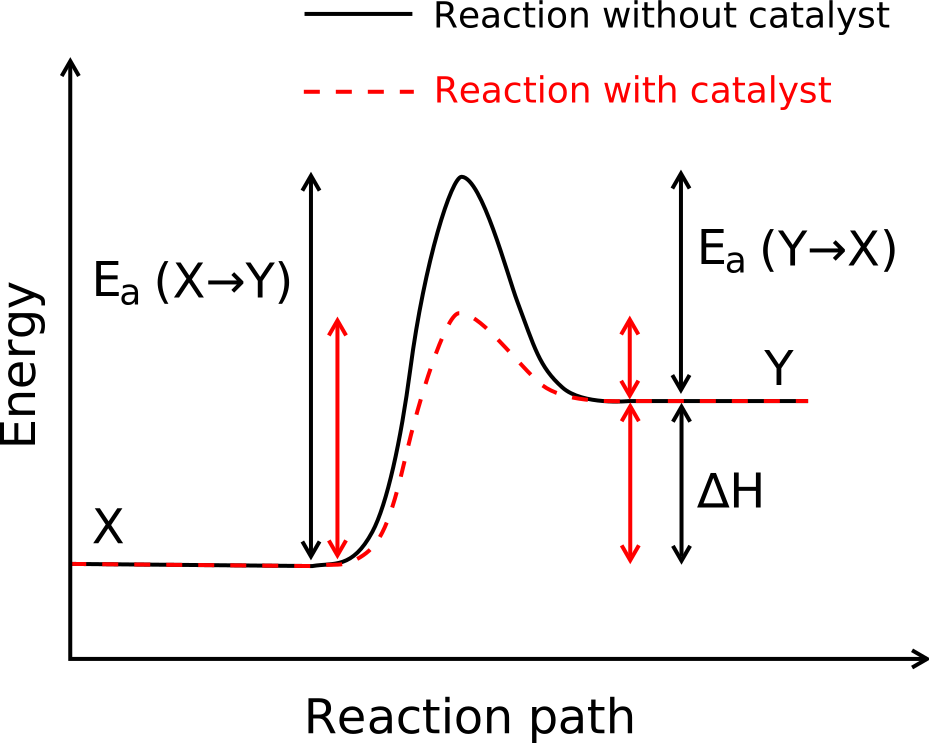
Even a downhill reaction needs a push. Bonds must break before new ones form, and the arrangement at the top of the barrier is the transition state — a configuration lasting about 10^{-13} s that cannot be isolated.
Two quantities, and they are independent:
\Delta H is the difference between the two ends. It fixes the thermodynamics.
E_a is the height of the barrier. It fixes the kinetics.
\boxed{\text{Diamond}\to\text{graphite}: \ \Delta G = -2.9\ \text{kJ/mol}, \quad E_a \approx 540\ \text{kJ/mol}}
Favourable and utterly blocked. Every carbon atom would have to break four covalent bonds simultaneously.
The Arrhenius equation
\boxed{k = Ae^{-E_a/RT}}
A is the pre-exponential factor — how often molecules collide with the right orientation.
e^{-E_a/RT} is the fraction of collisions with enough energy.
And that exponential comes straight from the Maxwell–Boltzmann distribution of Chapter 3.2. The fraction of molecules with energy above E_a in a thermal distribution is e^{-E_a/RT}, and that is the entire origin of the temperature dependence.
Linear form, for extracting E_a from data:
\ln k = \ln A - \frac{E_a}{R}\cdot\frac{1}{T}
Plot \ln k against 1/T and the slope is -E_a/R.
Worked example: the rule of thumb
Why does a reaction roughly double for every 10 °C?
Take E_a = 50 kJ/mol, from 298 K to 308 K:
\frac{k_2}{k_1} = e^{-\frac{E_a}{R}\left(\frac{1}{T_2}-\frac{1}{T_1}\right)} = e^{-\frac{50000}{8.314}\left(\frac{1}{308}-\frac{1}{298}\right)}
= e^{-6014\times(3.2468\times10^{-3}-3.3557\times10^{-3})} = e^{-6014\times(-1.089\times10^{-4})} = e^{0.655} = 1.93
Almost exactly double. The rule of thumb works because typical activation energies are around 50 kJ/mol.
With E_a = 100 kJ/mol it quadruples, and with E_a = 25 it rises only 40 %. The rule is not universal; it reflects a typical barrier height.
Worked example: why food spoils in a warm room
Bacterial growth has E_a \approx 60 kJ/mol. Compare a refrigerator at 4 °C (277 K) with a kitchen at 25 °C (298 K):
\frac{k_{298}}{k_{277}} = e^{-\frac{60000}{8.314}\left(\frac{1}{298}-\frac{1}{277}\right)} = e^{-7217\times(3.3557-3.6101)\times10^{-3}}
= e^{-7217\times(-2.544\times10^{-4})} = e^{1.836} = 6.3
Six times faster. Milk that keeps a week in the fridge lasts a day on the counter. That is the whole reason refrigeration exists, and it is one exponential.
And it is why a pressure cooker works (Chapter 3.2): raising the temperature from 100 °C to 120 °C speeds cooking reactions by about a factor of three.
Catalysis
A catalyst provides a different route with a lower barrier, and is not consumed.
What it does:
Lowers E_a, sometimes enormously.
Speeds forward and reverse equally, because both directions go over the same lowered barrier.
Worked example: hydrogen peroxide decomposition.
| Condition | E_a (kJ/mol) | Relative rate at 298 K |
|---|---|---|
| Uncatalysed | 75 | 1 |
| Iodide ion | 56 | 2\times10^{3} |
| Catalase enzyme | 8 | \sim10^{12} |
\frac{k_{\text{catalase}}}{k_{\text{uncat}}} = e^{(75000-8000)/(8.314\times298)} = e^{27.0} = 5\times10^{11}
Five hundred billion times faster. Catalase converts about 40 million H₂O₂ molecules per second per enzyme molecule, which is close to the diffusion limit — it works as fast as substrate can arrive.
And this is why pouring peroxide on a wound foams. Catalase in your tissue and in blood is destroying it at that rate.
What a catalyst cannot do:
Change \Delta G, \Delta H, \Delta S or K. It cannot make an unfavourable reaction favourable.
The reason is thermodynamic, not technical. If a catalyst shifted the equilibrium, you could build a cycle — catalyse forward, remove the catalyst, let it relax, repeat — and extract work from a system at constant temperature with no other change, violating the second law (Chapter 3.4).
Types:
Homogeneous — same phase as reactants, like acid catalysis in solution.
Heterogeneous — different phase, usually a solid surface. Reactants adsorb, bonds weaken, they react and desorb. This is the Haber process's iron and the catalytic converter's platinum.
Enzymes — biological catalysts, and the most impressive by a wide margin. Orotidine decarboxylase accelerates its reaction by a factor of 10^{17}, turning a process with a half-life of 78 million years into one taking 18 milliseconds.
How enzymes achieve it. Not by brute force but by binding the transition state more tightly than the reactants. An enzyme's active site is shaped to fit the strained, distorted transition-state geometry rather than the comfortable ground state, so it stabilises the top of the barrier and lowers it.
The proof is transition-state analogues — molecules designed to mimic the transition state's shape. They bind enzymes up to a million times more tightly than the natural substrate, and several are important drugs. The antiviral oseltamivir is one.
Catalytic converters run three reactions at once:
2\text{CO}+\text{O}_2 \to 2\text{CO}_2
2\text{NO}_x \to \text{N}_2+x\text{O}_2
\text{hydrocarbons}+\text{O}_2 \to \text{CO}_2+\text{H}_2\text{O}
Platinum, palladium and rhodium, chosen because their partly filled d orbitals bind the reactants just strongly enough to weaken their bonds without holding them permanently — the Sabatier principle, which says the best catalyst binds intermediates with intermediate strength.
And they need to warm up. Most of a car's lifetime emissions occur in the first two minutes after a cold start, before the converter reaches its operating temperature of about 300 °C. The Arrhenius equation, in your exhaust pipe.
Reaction mechanisms
A balanced equation is a summary, not a description. The actual sequence of elementary steps is the mechanism.
The rate-determining step is the slowest one, and the overall rate law reflects it and everything before it.
Worked example.
2\text{NO}_2+\text{F}_2 \to 2\text{NO}_2\text{F}
The observed rate law is k[\text{NO}_2][\text{F}_2] — first order in each, not second order in NO₂ as the equation suggests.
Proposed mechanism:
\text{Step 1 (slow)}: \quad \text{NO}_2+\text{F}_2 \to \text{NO}_2\text{F}+\text{F}
\text{Step 2 (fast)}: \quad \text{NO}_2+\text{F} \to \text{NO}_2\text{F}
The slow step involves one NO₂ and one F₂, giving exactly the observed rate law. The stoichiometry says two NO₂ are consumed overall; the kinetics says only one is involved in the bottleneck.
A mechanism can never be proved, only disproved. It must be consistent with the rate law, and consistency is not proof — several mechanisms often fit the same data, and distinguishing them requires isotope labelling, intermediate detection, or stereochemical evidence.
Where this shows up in your life
Refrigeration — Arrhenius applied to bacteria.
Cooking — Arrhenius applied to the Maillard reaction, which has a high enough activation energy that it essentially does not run below about 140 °C. This is why boiled food does not brown and roasted food does.
Enzymes run every process in you, and a fever of 40 °C speeds them by about 30 % — which is part of why fever helps fight infection and why higher fevers are dangerous.
Catalytic converters, at about a gram of platinum each.
Industrial catalysis is involved in over 90 % of all chemical manufacturing.
Drug design targets enzyme active sites, and most drugs are enzyme inhibitors.
And diamonds are still turning into graphite, on a timescale of about 10^{80} years.
What the next chapter fixes
Carbon has been mentioned repeatedly as the element that makes more compounds than all the others combined. Chapter 10.7 covers what those compounds are: the functional groups that organise ten million molecules into a manageable number of families, the mechanisms that explain how they react rather than asking anyone to memorise the outcomes, and why the shape and handedness of a carbon compound decides whether it is a medicine or a poison.