Appearance
6.5 — Spacetime, Intervals and Causality
Two observers disagree about how far apart two events are. They disagree about how long apart. They disagree about which came first. Everything measurable seems to depend on who is asking.
But not everything. There is one combination of the disagreed-upon numbers that comes out the same for everybody, and finding it turns relativity from a list of strange effects into geometry.
Hermann Minkowski, who had taught Einstein mathematics in Zurich and had thought him a lazy student, saw this in 1908 and announced it with unusual force:
"Henceforth space by itself, and time by itself, are doomed to fade away into mere shadows, and only a kind of union of the two will preserve an independent reality."
The invariant interval
In ordinary space, two observers using rotated coordinate systems disagree about \Delta x and \Delta y for the same pair of points. They agree completely about the distance:
\Delta s^2 = \Delta x^2 + \Delta y^2
Rotation shuffles the coordinates and preserves the length. The Lorentz transformation is the spacetime analogue of a rotation, and the quantity it preserves is:
\boxed{\Delta s^2 = c^2\Delta t^2 - \Delta x^2 - \Delta y^2 - \Delta z^2}
Note the minus signs. This is not Pythagoras; time enters with the opposite sign from space. That single sign difference is the entire geometric content of relativity, and it is why spacetime is not just four-dimensional space.
Proving it is invariant
Take one dimension of space for clarity and apply the transformation from Chapter 6.2:
c^2t'^2 - x'^2 = c^2\gamma^2\left(t-\frac{vx}{c^2}\right)^2 - \gamma^2(x-vt)^2
Expand both squares:
= \gamma^2\left[c^2t^2 - 2vxt + \frac{v^2x^2}{c^2}\right] - \gamma^2\left[x^2 - 2vxt + v^2t^2\right]
The cross terms -2vxt appear in both brackets with opposite overall signs, so they cancel:
= \gamma^2\left[c^2t^2 + \frac{v^2x^2}{c^2} - x^2 - v^2t^2\right]
Group the t^2 and x^2 terms:
= \gamma^2\left[c^2t^2\left(1-\frac{v^2}{c^2}\right) - x^2\left(1-\frac{v^2}{c^2}\right)\right] = \gamma^2\left(1-\frac{v^2}{c^2}\right)\left[c^2t^2-x^2\right]
And \gamma^2(1-v^2/c^2) = 1 by definition:
\boxed{c^2t'^2 - x'^2 = c^2t^2 - x^2}
Every observer computes the same interval. They disagree about the separate pieces and agree on this combination, exactly as observers using rotated axes disagree about x and y and agree about the distance.
Three kinds of separation
The sign of \Delta s^2 splits every pair of events into one of three categories, and the categories have completely different physical meanings.
Timelike, \Delta s^2 > 0
Time dominates. The events are close enough in space, and far enough apart in time, that something travelling slower than light can be present at both.
A single object can attend both events. In the frame where it is at rest, the two events happen at the same place, and:
\Delta s^2 = c^2\Delta\tau^2 \quad\Longrightarrow\quad \Delta\tau = \frac{\Delta s}{c}
So the interval measures proper time — the time on a clock carried between the two events.
The order is absolute. No Lorentz transformation can flip which came first, so cause and effect are safe: one event can be the cause of the other, and everybody agrees which is which.
Spacelike, \Delta s^2 < 0
Space dominates. The events are too far apart for anything, even light, to get from one to the other.
No object can attend both. There exists a frame in which they are simultaneous, and in that frame:
\Delta s^2 = -\Delta x^2 \quad\Longrightarrow\quad \text{proper distance} = \sqrt{-\Delta s^2}
The order is not absolute. Different observers put them in different orders, and Chapter 6.3 showed exactly how. This is harmless precisely because they cannot influence each other — there is no causal relationship whose direction could be scrambled.
Lightlike (null), \Delta s^2 = 0
Exactly on the boundary. Only light connects them.
c^2\Delta t^2 = \Delta x^2 \quad\Longrightarrow\quad \frac{\Delta x}{\Delta t} = c
Every observer agrees a light signal connects them, which is postulate 2 written geometrically. And the proper time along a light path is zero: a photon experiences no time at all between emission and absorption. A photon that left a galaxy 13 billion years ago and lands in a telescope tonight has, by its own reckoning, made the trip instantaneously.
Spacetime diagrams
The conventions:
- Time upward, space across. This is the opposite of most graphs and it is universal in relativity.
- Plot ct rather than t, so both axes are in metres and light travels at 45°.
- A worldline is an object's complete history — the path it traces through the diagram.
- A stationary object has a vertical worldline: it moves in time and not in space.
- A faster object's worldline is more tilted, and 45° is the limit.
Nothing physical has a worldline shallower than 45°. That is the speed limit, drawn.
The light cone

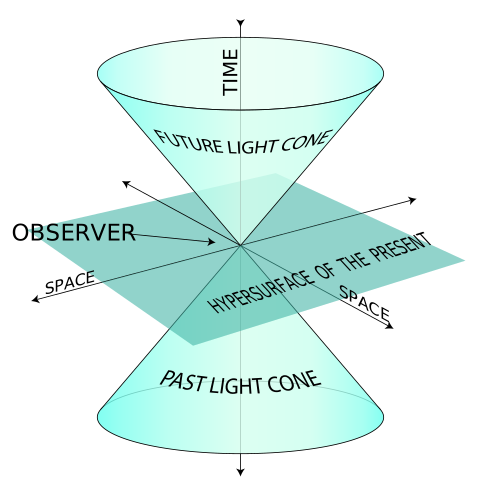
Pick an event — here, now. Draw all the light rays leaving it and all the light rays arriving at it. In two space dimensions plus time these form a double cone, and the picture divides the whole of spacetime into three regions.
The future light cone (up): everything you can possibly influence. Every event in there is timelike or lightlike separated from you and lies in your future for every observer.
The past light cone (down): everything that could possibly have influenced you. Everything you can know about.
Elsewhere (outside both): spacelike separated. You cannot affect it, it cannot affect you, and its time-ordering relative to you is a matter of who is asking.
"Elsewhere" is the part with no Newtonian counterpart. In Newtonian physics, all of space at this instant is "now" for everybody. In relativity, everything outside your light cone is neither past nor future — it is causally disconnected, and calling it "now" is a frame-dependent convention rather than a fact.
Worked example. The nearest star, Proxima Centauri, is 4.2 light years away. Everything happening there right now is in your "elsewhere". You cannot know about it, and nothing you do can affect it, for 4.2 years. The current state of Proxima Centauri is not part of your present in any observer-independent sense.
The tilted axes

Draw a second frame's axes on the same diagram and the geometry of relativity becomes visible.
The ct' axis is the set of points with x' = 0 — the moving observer's own worldline. It tilts towards the light line by angle \theta where \tan\theta = v/c.
The x' axis is the set of points with t' = 0 — the moving observer's "now". From the transformation, t' = 0 means t = vx/c^2, so this axis tilts up by the same angle.
Both axes tilt towards the 45° light line, from opposite sides. That symmetry is why light stays at 45° for both — which is postulate 2, made geometric.
And now the earlier puzzles become obvious rather than paradoxical:
Simultaneity. Two events on a horizontal line are simultaneous in the unprimed frame. That line is not parallel to the x' axis, so they are not simultaneous in the primed frame. There is nothing more to it.
Length contraction. Measuring a rod means slicing its worldsheet along a line of constant time. Two frames slice at different angles, so they cut different lengths from the same sheet.
The twins. Alice's worldline is straight; Bob's is bent. The proper time along a worldline is \int d\tau, and — because of the minus signs in the interval — the straight path has the longest proper time, not the shortest. This is the reverse of ordinary geometry, where a straight line is the shortest distance, and it is the direct consequence of the sign flip on the time term. The twin who took the straight route through spacetime aged most.
Four-vectors
The tidiest way to handle all this is to put time and space in one object, and energy and momentum in another.
The position four-vector:
x^\mu = (ct, x, y, z)
The energy–momentum four-vector:
p^\mu = \left(\frac{E}{c}, p_x, p_y, p_z\right)
A four-vector is anything that transforms under the Lorentz transformation the same way (ct, x, y, z) does. The point of identifying them is that every four-vector has an invariant length, computed with the same minus signs.
For position, the invariant length is the interval. For energy–momentum:
\left(\frac{E}{c}\right)^2 - p^2 = \text{invariant}
Chapter 6.4 already found what that invariant is:
\frac{E^2}{c^2} - p^2 = m^2c^2 \quad\Longrightarrow\quad E^2 = (pc)^2 + (mc^2)^2
So mass is the invariant length of the energy–momentum four-vector, which is a much better definition than "amount of stuff". It explains at a stroke why mass is the same in every frame while energy and momentum are not, and why a massless particle's four-vector has zero length while being nonzero — the same thing that happens to a light path in spacetime.
The parallel is exact:
| Spacetime | Energy–momentum |
|---|---|
| t and x mix under boosts | E and p mix under boosts |
| Interval c^2t^2 - x^2 invariant | E^2 - p^2c^2 invariant |
| Invariant = proper time | Invariant = mass |
That is why E = mc^2 had to exist. Energy is the time component of a four-vector whose invariant length is the mass, so a particle at rest — with no momentum — must still have an energy, and it must be mc^2.
Invariant mass of a system
The four-vector formalism earns its keep here. For a system of particles, add the four-vectors component by component and take the invariant length:
M_{\text{system}}^2c^4 = \left(\sum E_i\right)^2 - \left(\sum \vec{p}_i c\right)^2
Two photons flying in opposite directions have zero mass each and a nonzero mass together, because their momenta cancel while their energies add. Two 511 keV photons back to back have an invariant mass of 1.022 MeV/c² — exactly the mass of the electron–positron pair that made them.
This is how particles are discovered. Measure the energies and momenta of the decay products, compute the invariant mass, and plot it for millions of collisions. A particle that existed briefly shows up as a bump at its own mass. The Higgs boson was found in 2012 as a bump at 125 GeV in exactly such a plot, in the invariant mass of pairs of photons.
Why faster than light breaks causality
The speed limit is usually stated as a fact about energy — you would need infinite energy to accelerate a mass to c. That argument does not forbid something that was always faster than light, and it does not forbid sending information faster than light by some means that is not a moving object.
The real argument is causality, and it is worth doing properly.
Setup. Suppose you can send a signal at speed u > c. Send it from event A (at the origin) to event B, at x = d, arriving at time t = d/u.
Now look from a frame moving at v:
t'_B = \gamma\left(t_B - \frac{vx_B}{c^2}\right) = \gamma\left(\frac{d}{u} - \frac{vd}{c^2}\right) = \gamma d\left(\frac{1}{u}-\frac{v}{c^2}\right)
This is negative — B happens before A — whenever:
\frac{1}{u} < \frac{v}{c^2} \quad\Longrightarrow\quad v > \frac{c^2}{u}
Since u > c, the required v is less than c, so such a frame is perfectly ordinary and physically reachable. In it, the signal arrives before it was sent.
Now close the loop. In that frame, have the recipient immediately send a reply, also at speed u, back to A. By the same argument, the reply can arrive at A before the original message was sent.
You have sent a message to your own past. And then you can send "do not send the message", which is a genuine logical contradiction rather than merely a strange one.
So faster-than-light signalling and causality cannot both hold. Physics keeps causality.
What is allowed to exceed c
Several things move faster than c and none of them carries information, which is the loophole that matters:
A spot of light swept across the Moon by rotating a laser on Earth moves along the surface far faster than c. But the spot is not an object — each photon travelled at c — and nothing at one point of the Moon influences the next.
Phase velocity in a medium can exceed c where the refractive index is below 1, which happens for X-rays in glass. Signals travel at the group velocity, which does not.
Scissors. Close a very long pair of blades and the intersection point races along faster than c. The intersection is a geometric construction, not a thing.
Cosmic expansion. Galaxies beyond the Hubble distance recede faster than c (Chapter 12.5), because space between them is expanding rather than them moving through space. No local speed exceeds c and no signal can be sent this way — quite the reverse, since those galaxies become permanently unreachable.
Quantum entanglement, which correlates measurements on distant particles instantaneously. Chapter 7.8 shows in detail why this cannot transmit information: each individual measurement result is random, and the correlation only becomes visible when the two sets of results are compared, which requires an ordinary signal.
And tachyons, hypothetical particles that always move faster than c, have never been observed and would allow exactly the causal loop above.
Where this shows up in your life
Every GPS fix is a solution of a spacetime geometry problem. The receiver has four unknowns — three position coordinates and its own clock offset — and solves them from four satellite signals, using intervals rather than distances. Chapter 6.9 adds the general-relativistic correction.
Particle physics uses invariant mass constantly. Every published discovery of a new particle is a bump in an invariant-mass histogram.
The night sky is a picture of your past light cone. The Sun as it was 8 minutes ago, Proxima as it was 4.2 years ago, Andromeda as it was 2.5 million years ago. You never see anything as it is now, and "now" for a distant object is not a well-defined idea in the first place.
Every science fiction story with faster-than-light travel is, whether it says so or not, a time travel story, because the argument above applies to starships as much as to signals. Chapter 12.9 checks the loopholes people propose.
What the next chapter fixes
Everything so far has assumed inertial frames — no acceleration, no gravity. That is a severe restriction, and Einstein knew it from the start: a theory that cannot handle a falling apple is not a theory of the world. The problem is that Newton's gravity acts instantaneously across any distance, which the last section just showed is impossible. Chapter 6.6 begins the repair with a single observation Einstein called the happiest thought of his life — that a person in free fall feels no gravity — and shows that it immediately predicts gravitational time dilation, gravitational redshift, and the bending of starlight, before any of the machinery of curved spacetime is built.