Appearance
1.6 — Work, Energy and Power
A rollercoaster car is released from a 40 m hill, dives through a valley, climbs a 25 m hump, corkscrews through a helix and arrives at a station. How fast is it going at the bottom of the first dive?
You could do it with forces. Write down the track's shape, find the component of gravity along the track at every point, integrate the acceleration along the curve. It would take an afternoon, and you would need the exact geometry of a track that was designed by a computer.
Or you could say: it dropped 40 m, so its speed at the bottom is \sqrt{2 \times 9.81 \times 40} = 28\ \text{m/s}, and be right, in one line, without knowing the shape of the track at all.
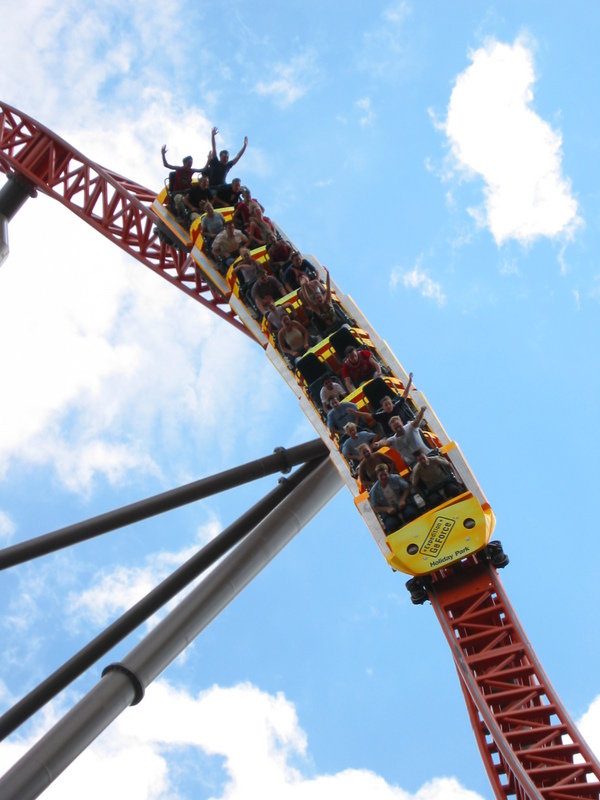
That shortcut is the energy method, and it is not merely a labour-saver. Energy turns out to be more fundamental than force: it survives into relativity, into quantum mechanics, and into thermodynamics, in places where "force" stops making sense at all.
Work: force times distance, but only the useful part
Push a crate 10 m with a steady horizontal force of 50 N. You have done work, and the amount is
W = Fd = 50 \times 10 = 500\ \text{J}
The unit is the joule: one joule is one newton acting through one metre. In base units, \mathrm{M\,L^2\,T^{-2}}.
Now push at an angle — dragging a suitcase by a handle tilted 40° above horizontal. Only the horizontal part of your pull moves the suitcase forwards; the vertical part tries to lift it and contributes nothing to its horizontal travel. So only the component of force along the displacement counts:
\boxed{W = Fd\cos\theta}
where \theta is the angle between the force and the displacement. This is the dot product of two vectors from Volume II, Chapter 4.1, and it is worth writing that way because the notation carries the meaning:
W = \vec{F}\cdot\vec{d}
Read the cosine carefully, because it produces three cases and all three matter.
\theta < 90°: positive work. The force has a component along the motion, and it is speeding the object up or helping it along.
\theta = 90°: zero work. The force is perpendicular to the motion and does nothing energetically, however large it is. Carry a heavy suitcase across a level floor and you do no work on the suitcase: your upward force is perpendicular to your horizontal walk. Your muscles get tired because holding a static contraction burns chemical energy, but none of that energy goes into the suitcase. This is also why the tension in a string does no work on a ball whirled in a circle, and why the Moon's orbital speed does not change — gravity is always perpendicular to the motion, so it does no work, so the speed is constant. The centripetal force from Chapter 1.5 is always a zero-work force.
\theta > 90°: negative work. The force opposes the motion and is taking energy out. Friction always does negative work on a sliding body. Lower a box gently to the floor and your hand does negative work on it, while gravity does positive work.
When the force changes along the way
W = Fd\cos\theta assumes a constant force. If the force varies — a spring being stretched, gravity far from the Earth — chop the path into pieces so small that the force is effectively constant across each, add up the work on each, and take the limit:
W = \int_{x_1}^{x_2} F(x)\,dx
Read aloud: work equals the integral from x-one to x-two of F of x, dee x. Geometrically, work is the area under the force–displacement graph, in exactly the sense that displacement was the area under the velocity–time graph in Chapter 1.2.
Do the spring immediately, because it is the case you will use most. A spring obeys Hooke's law: to stretch it a distance x from its natural length you must pull with force F = kx, where k is the spring constant in newtons per metre. The force is not constant — it grows as you stretch — so:
W = \int_0^x kx'\,dx' = k\left[\frac{x'^2}{2}\right]_0^x = \tfrac12 kx^2
The factor of one half is again the area of a triangle: the force rises linearly from 0 to kx over a distance x, and the area of that triangle is \tfrac12 \times x \times kx.
Kinetic energy, and the theorem that connects it to work
Take a body of mass m acted on by a net force, moving along a line. Compute the work that force does:
W = \int F\,dx
Substitute Newton's second law, F = ma:
W = \int ma\,dx
Now use the trick from the end of Chapter 1.2: a = v\,dv/dx. This came from the chain rule, a = dv/dt = (dv/dx)(dx/dt) = v\,dv/dx, and it is exactly what lets us swap an integral over distance for one over speed:
W = \int m\,v\frac{dv}{dx}\,dx = \int_{u}^{v} mv\,dv
The dx cancels and the limits change from positions to the speeds at those positions. Now integrate:
W = m\left[\frac{v^2}{2}\right]_{u}^{v} = \tfrac12 mv^2 - \tfrac12 mu^2
Define the kinetic energy of a body as
\boxed{K = \tfrac12 mv^2}
and the result becomes the work–energy theorem:
\boxed{W_{\text{net}} = \Delta K = K_f - K_i}
In words: the net work done on a body equals the change in its kinetic energy. Do positive work and it speeds up; do negative work and it slows down; do zero net work and its speed is unchanged whatever else happens to it.
This is not a new law. It is Newton's second law integrated over distance rather than time, and every step above shows exactly that. Its value is that it eliminates time and acceleration from the problem, leaving only speeds and distances — which are usually what you were given and what you wanted.
You have also just proved the third kinematic equation properly. For constant force on a straight line, W = Fd = mad, so mad = \tfrac12mv^2 - \tfrac12mu^2, and cancelling m and multiplying by 2 gives v^2 = u^2 + 2ad. That equation from Chapter 1.2 was the work–energy theorem in disguise the whole time.
Two features of kinetic energy that catch people out:
It is a scalar and it is never negative. v^2 is positive whichever way the object is moving. A ball moving left at 5 m/s and one moving right at 5 m/s have identical kinetic energy. This makes energy easier to add than momentum — no vector bookkeeping — and also means energy alone can never tell you which way something is going.
It goes as the square of the speed. Double the speed and the kinetic energy quadruples. This is why a crash at 100 km/h is four times as violent as one at 50 km/h, not twice, and why the braking distances in Chapter 1.2 scaled the way they did.
Potential energy, and which forces are allowed to have it
Lift a book 1 m and you do work mgh against gravity. Let it go and gravity gives that work back as kinetic energy. The work was stored somewhere in between, and we call the store potential energy.
But not every force allows this. Slide the book 1 m across a table against friction and you do work too — and letting go gives you nothing back. The energy went into heat and it is not coming home.
The distinction has a name.
A force is conservative if the work it does on a body moving between two points does not depend on the path taken. Equivalently, the work it does round any closed loop is zero. Gravity, spring forces and electrostatic forces are conservative. Friction, drag and any push you supply with your own muscles are not.
Only conservative forces can have a potential energy. The reason is straightforward once you see it: potential energy is supposed to be a function of position alone, U(x), so that the work done between two points is -\Delta U. If the work depended on which route you took, then U would have to have several different values at the same point, and it would not be a function of position at all.
For a conservative force the defining relationship is:
\Delta U = -W_{\text{cons}}
The minus sign says: when the conservative force does positive work on the body, the store goes down. Gravity does positive work on a falling book, and the book's gravitational potential energy decreases.
Gravitational potential energy near the surface
Lift a mass m through a height h. Gravity acts downwards while the displacement is upwards, so gravity's work is negative: W_{\text{grav}} = -mgh. Therefore
\Delta U = -(-mgh) = mgh
\boxed{U_{\text{grav}} = mgh}
Only the change in U ever matters, so you may set the zero anywhere convenient — the floor, the table, sea level. A book on a table has 20 J of potential energy relative to the floor and 0 J relative to the table, and every physical prediction is identical either way, because every equation contains \Delta U and the choice of zero cancels.
This formula assumes g is constant, which is only true near the surface. Chapter 1.9 derives the general form U = -GMm/r and shows this one is its low-altitude approximation.
Elastic potential energy
We computed the work to stretch a spring by x: it was \tfrac12kx^2. So
\boxed{U_{\text{spring}} = \tfrac12 kx^2}
Note that x is the displacement from the spring's natural length, and the x^2 means compression stores exactly as much as extension.
Conservation of energy
Suppose only conservative forces act. Then all the work done is -\Delta U, and the work–energy theorem says that work equals \Delta K:
\Delta K = -\Delta U \quad\Longrightarrow\quad \Delta K + \Delta U = 0 \quad\Longrightarrow\quad \boxed{K + U = \text{constant}}
The sum E = K + U is the mechanical energy, and it does not change. This is the rollercoaster shortcut, and now you can see exactly what it rests on and when it is allowed.
If non-conservative forces are also present — friction, air resistance, an engine — the statement generalises:
\Delta K + \Delta U = W_{\text{non-cons}}
Friction makes W_{\text{non-cons}} negative, so mechanical energy drops. It has not been destroyed; it has become thermal energy in the two rubbing surfaces, which is still energy, just no longer available for doing mechanical work. Chapter 3.5 makes that "no longer available" precise, and it turns out to be the deepest idea in thermodynamics.
Worked example: the rollercoaster, properly
The car starts at rest at the top of a 40 m hill. Ignore friction. Find its speed at the bottom, and at the top of a later 25 m hump.
Take the bottom of the track as U = 0.
At the start: K_1 = 0 (at rest), U_1 = mg(40). At the bottom: K_2 = \tfrac12mv^2, U_2 = 0.
Energy is conserved:
0 + mg(40) = \tfrac12mv^2 + 0
The mass cancels — as it must, since Chapter 1.2 already showed that fall speed does not depend on mass:
v = \sqrt{2g(40)} = \sqrt{2 \times 9.81 \times 40} = \sqrt{784.8} = 28.0\ \text{m/s}
At the 25 m hump: now U_3 = mg(25), so
mg(40) = \tfrac12mv_3^2 + mg(25)
\tfrac12 v_3^2 = g(40-25) = 9.81 \times 15
v_3 = \sqrt{2 \times 9.81 \times 15} = \sqrt{294.3} = 17.2\ \text{m/s}
Only the height difference entered. Not the length of track, not its steepness, not the corkscrew. That is the power of the method, and it also explains a design rule you can verify at any theme park: no hill after the first can be taller than the first. There is no energy source on the track, so the car can never rise above the height it started from. Real coasters lose some energy to friction, so every hill is comfortably lower than the last.
Worked example: the spring launcher
A 0.20 kg ball is pressed against a spring of stiffness k = 800\ \text{N/m}, compressing it 0.15 m, then released horizontally on a frictionless surface. How fast does the ball leave?
Stored elastic energy converts entirely to kinetic energy:
\tfrac12 k x^2 = \tfrac12 m v^2
\tfrac12 (800)(0.15)^2 = \tfrac12 (0.20) v^2
400 \times 0.0225 = 0.10\,v^2
9.0 = 0.10\,v^2 \quad\Longrightarrow\quad v^2 = 90 \quad\Longrightarrow\quad v = 9.5\ \text{m/s}
Now add friction: the ball slides 2.0 m along a surface with \mu_k = 0.30 after launch. Friction does negative work -\mu_k mg d:
\tfrac12 mv_f^2 = 9.0 - (0.30)(0.20)(9.81)(2.0) = 9.0 - 1.18 = 7.82\ \text{J}
v_f = \sqrt{\frac{2 \times 7.82}{0.20}} = \sqrt{78.2} = 8.8\ \text{m/s}
The 1.18 J that vanished from the mechanical books is now heat in the surface and the ball. Nothing was lost; it changed form.
Energy diagrams: reading motion off a graph of U
Plot U(x) against position and you can read off the entire behaviour of a system without solving anything.
The total energy E is a horizontal line on this plot, because it does not change. At any position, the vertical gap between that line and the U curve is the kinetic energy, since K = E - U.
That single observation gives you everything:
Where the line meets the curve, K = 0 and the body stops. These are the turning points. The body cannot go past them, because beyond them U > E would force K < 0, and kinetic energy cannot be negative. The body is trapped between turning points, oscillating.
At a minimum of U, the body is in stable equilibrium. Nudge it either way and U rises, so the force pushes it back. A ball in a valley.
At a maximum of U, the equilibrium is unstable. Nudge it and U falls in that direction, so the force pushes it further away. A ball balanced on a hilltop.
The link between the curve and the force is exact:
F = -\frac{dU}{dx}
The force is minus the slope of the potential energy curve. Read aloud: F equals minus dee U by dee x. The minus sign says that things are pushed downhill in potential energy. This follows straight from \Delta U = -W = -\int F\,dx; differentiate both sides and you have it.
This is why "a system seeks its lowest energy state" is not mysticism. It is a restatement of the fact that force points down the potential gradient. A ball rolls into a valley because the slope of the valley is the force, with a minus sign.
The picture generalises far beyond mechanics. A chemical bond is a minimum in a potential energy curve (Chapter 10.1). A nucleus is a minimum in a different one (Chapter 9.2). The reason a proton and electron form a hydrogen atom is the same reason a ball settles in a valley, and Chapter 7.6 solves that valley exactly.
Power: how fast the energy moves
Two cranes both lift a tonne of bricks to the tenth floor. One takes a minute, the other an hour. They do identical work. They are not identical machines.
Power is the rate of doing work:
P = \frac{dW}{dt}, \qquad P_{\text{avg}} = \frac{W}{t}
The unit is the watt: one joule per second. Dimension \mathrm{M\,L^2\,T^{-3}}.
There is a second form that is often more useful. If a force F acts on something moving at velocity v, then in time dt it moves v\,dt and does work Fv\,dt, so:
\boxed{P = Fv}
or \vec{F}\cdot\vec{v} in general.
This one equation explains why a car has gears. An engine delivers roughly constant power over its useful range. Since P = Fv, force and speed trade against each other: at low speed you can have a large force, at high speed only a small one. First gear gives you the force to accelerate away from rest; top gear gives you speed at the cost of having almost no force left over, which is why you cannot accelerate hard in top gear and why a car has a top speed at all — that speed is where the available force has fallen to exactly match air drag.
Worked example: what it takes to climb a hill
A 1200 kg car climbs a 5° incline at a steady 20 m/s. Rolling and air resistance total 600 N. What power must the engine deliver?
At steady speed there is no acceleration, so the driving force exactly balances everything opposing it. Opposing forces: resistance (600 N) and the component of weight along the slope (mg\sin 5°).
mg\sin 5° = 1200 \times 9.81 \times 0.0872 = 1026\ \text{N}
F_{\text{drive}} = 600 + 1026 = 1626\ \text{N}
P = Fv = 1626 \times 20 = 32\,520\ \text{W} \approx 33\ \text{kW}
About 44 horsepower, which is a modest fraction of what a family car has available — most of a car's engine exists for acceleration and for high-speed cruising, where drag rises as v^2 and the power needed to overcome it rises as v^3.
That cube is worth pausing on. Drag force goes as v^2 (Chapter 1.11), and power is force times velocity, so power against drag goes as v^3. Doubling your cruising speed needs eight times the power. It is the single biggest reason aircraft fly at high altitude where the air is thin, and why the fuel cost of driving at 130 km/h instead of 100 km/h is far worse than the 30% the speeds suggest.
Sizing power against things you know
- A person walking upstairs: about 200 W
- A racing cyclist, sustained: about 400 W
- A kettle: 2000–3000 W
- A family car engine: 80 000–150 000 W
- A Falcon 9 first stage at liftoff: about 9\times10^9 W
The human body at rest runs on roughly 100 W, which is genuinely the same as an old-fashioned incandescent light bulb. A room with twenty people in it is being heated by two kilowatts of people, and that is why lecture theatres need air conditioning in winter.
Where energy actually goes
"Energy is conserved" is a strange claim the first time you meet it, because energy so obviously disappears all the time. A bouncing ball stops bouncing. A car coasting to a halt loses everything it had.
It never disappears. It changes into forms we do not usually count. The bouncing ball's energy becomes heat in the rubber and the floor, and sound in the air. The coasting car's becomes heat in the brakes, in the tyres, and in the churned-up air behind it. Track it carefully enough and the books always balance — this was established experimentally by James Joule in the 1840s, who measured the temperature rise of water stirred by a falling weight and found that a fixed amount of mechanical work always produced exactly the same amount of heat.
The chain from a meal to a step is worth writing out, because every link is a form of the same quantity:
Sunlight (electromagnetic) → sugar in a plant (chemical) → your food (chemical) → ATP in your cells (chemical) → muscle contraction (mechanical) → your body rising a stair (gravitational potential) → and when you sit back down, heat.
Every arrow is lossy, which Chapter 3.4 shows is not an engineering failure but a law. And Chapter 6.4 adds the final twist: mass is itself a form of energy, E = mc^2, so the true conservation law is of mass-energy together. The Sun is losing four million tonnes of mass every second, and that mass is the sunlight.
Where this shows up in your life
Your electricity bill is measured in kilowatt-hours, which is a power multiplied by a time, and therefore an energy. A 2 kW heater run for 3 hours uses 6 kWh, or 6000 \times 3600 = 2.16 \times 10^7 joules. The bill charges you for energy and the appliance label quotes power, and the two are connected by exactly the equation in this chapter.
Regenerative braking in an electric car is the potential-to-kinetic conversion run backwards deliberately. Instead of turning the car's kinetic energy into brake heat and throwing it away, the motor runs as a generator and puts perhaps 70% of it back in the battery. On a long descent an electric car can arrive at the bottom with more range than it had at the top, which sounds impossible until you notice it simply cashed in the mgh it earned on the way up.
And the reason a fall from four metres is far more than twice as dangerous as a fall from two is that the energy delivered to your body is mgh, linear in height — but the stopping distance stays the same (the compression of your legs and the floor), so the force goes up linearly too, while the speed of arrival goes as \sqrt{h}. Doubling the height doubles the force your bones must absorb, and bones have a definite breaking point.
What the next chapter fixes
Energy is a scalar, and that is both its strength and its limit. It tells you how fast things are moving and never which way. For collisions — two cars, two billiard balls, a rocket and its exhaust — direction is the whole question, and energy alone cannot answer it. Worse, energy is often not conserved in a collision, because the bodies deform and heat up. Chapter 1.7 introduces momentum, which is a vector, which is always conserved in a collision whatever the bodies do to each other, and which turns out to be the quantity Newton was really talking about all along.