Appearance
9.4 — The Periodic Table and Why It Has That Shape
The periodic table is the most recognisable diagram in science and its shape looks arbitrary. Two elements in the first row, eight in the next two, eighteen in the next two, thirty-two after that, with a block of fourteen chopped out and parked underneath.
Every one of those numbers comes from Chapter 7.6's orbital counting, and this chapter derives them.
It also tells the story of how Mendeleev built the table in 1869 knowing nothing about electrons, nothing about atomic number, and nothing about quantum mechanics — and used the gaps in it to predict three elements that were then found.
Mendeleev
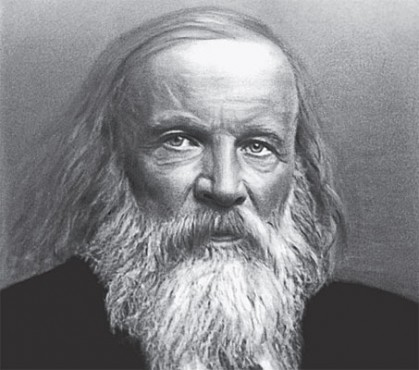
The situation in 1869. Sixty-three elements were known, with atomic weights measured to varying accuracy and no organising principle. Several people had noticed partial patterns — Döbereiner's triads, Newlands's "law of octaves", which was mocked at a Chemical Society meeting where someone asked whether he had tried arranging them alphabetically.
Mendeleev's method. He wrote each element on a card with its weight and properties and arranged them by weight, starting a new row whenever the properties began to repeat.
Three decisions made his table work, and each took nerve.
1. He left gaps. Where no known element fitted the pattern, he left an empty space rather than forcing a neighbour into it.
2. He reordered elements when properties demanded it. Tellurium (127.6) sits before iodine (126.9) despite being heavier, because tellurium behaves like selenium and iodine like bromine. Mendeleev asserted the weights must be wrong. They were not — the explanation is isotopes, and the correct ordering principle is atomic number, which nobody knew existed. He was right for a reason he could not have known.
3. He predicted the missing elements in quantitative detail.
The predictions
Eka-aluminium (below aluminium in the table). Mendeleev, 1871:
| Property | Predicted | Gallium (found 1875) |
|---|---|---|
| Atomic weight | 68 | 69.7 |
| Density | 5.9 g/cm³ | 5.91 |
| Melting point | Low | 29.8 °C |
| Oxide formula | Ea₂O₃ | Ga₂O₃ |
| Oxide density | 5.5 g/cm³ | 5.88 |
Lecoq de Boisbaudran discovered gallium and reported a density of 4.7. Mendeleev wrote to him saying the measurement must be wrong. De Boisbaudran repurified his sample and remeasured: 5.9. A theorist in Saint Petersburg correcting an experimentalist in Paris about an element the theorist had never seen.
Eka-silicon, predicted 1871, found 1886 as germanium:
| Property | Predicted | Germanium |
|---|---|---|
| Atomic weight | 72 | 72.6 |
| Density | 5.5 g/cm³ | 5.35 |
| Colour | Dark grey | Greyish white |
| Oxide density | 4.7 g/cm³ | 4.70 |
| Chloride boiling point | Below 100 °C | 86 °C |
| Chloride density | 1.9 g/cm³ | 1.88 |
Eka-boron was found in 1879 as scandium.
This is what converted the table from a filing system into a law of nature. Predicting an unknown substance's density to two significant figures is not something a mnemonic can do.
What Mendeleev did not predict: the noble gases. An entire column was missing and there was no gap for it, because they are chemically inert and therefore invisible to the methods of the time. Ramsay found argon in 1894 and the rest followed, and Mendeleev's initial reaction was to doubt they were elements at all. The table absorbed them without disruption, which was itself a strong endorsement.
Moseley and atomic number
The remaining problem was the ordering anomalies — tellurium before iodine, cobalt before nickel, argon before potassium. Weight was clearly not quite the right variable.
Henry Moseley, in 1913, fired electrons at different metal targets and measured the X-ray wavelengths emitted when an inner-shell vacancy was filled.
He found:
\sqrt{\frac{1}{\lambda}} \propto (Z-1)
A perfectly straight line against an integer, with no exceptions.
That integer is the number of protons. Moseley had found a way to measure it directly, and it settled every ordering dispute at once.
Three immediate results:
The correct ordering is by Z, not by weight. Tellurium is Z = 52 and iodine Z = 53, so Mendeleev's insistence was right and the weights were fine.
The number of remaining gaps was fixed. Moseley showed exactly which atomic numbers were unaccounted for — 43, 61, 72, 75 — and all four were subsequently found or made (technetium, promethium, hafnium, rhenium). No more surprises were possible.
The rare earths were counted. Their number had been genuinely unclear, and Moseley settled it.
Moseley was killed at Gallipoli in 1915, aged 27. Rutherford and others campaigned afterwards for scientists to be kept out of combat. Isaac Asimov wrote that his death may have been the most costly single death of the war to mankind generally.
The shape, derived
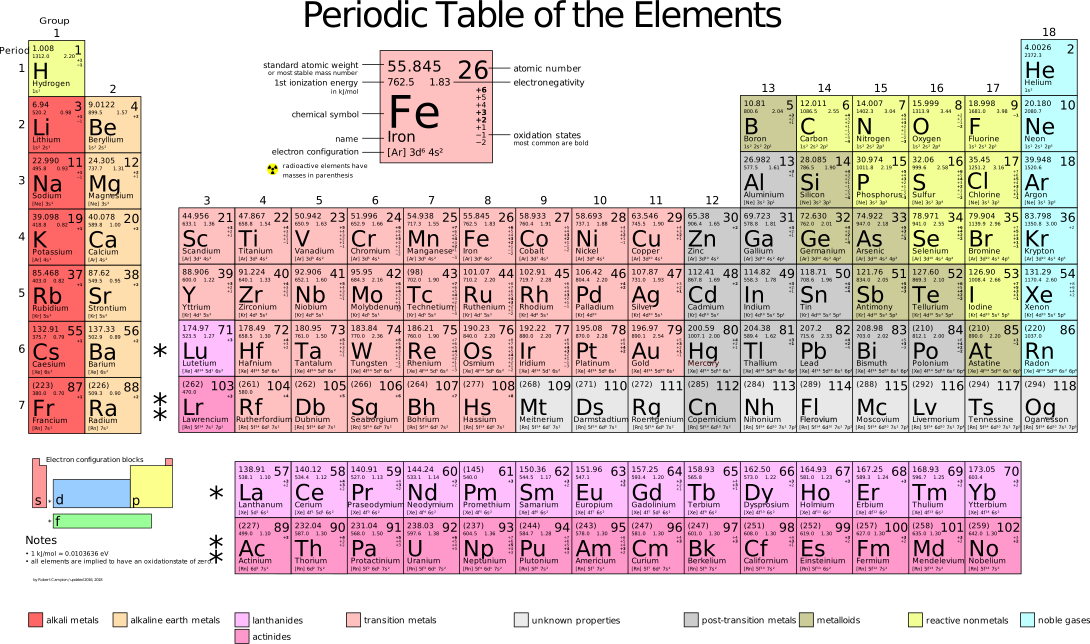
Here is the whole derivation.
Chapter 7.6 established: for a given \ell there are 2\ell+1 values of m_\ell, and Chapter 7.7 added a factor of 2 for spin.
\text{Capacity} = 2(2\ell+1)
| Subshell | \ell | Orbitals | Electrons |
|---|---|---|---|
| s | 0 | 1 | 2 |
| p | 1 | 3 | 6 |
| d | 2 | 5 | 10 |
| f | 3 | 7 | 14 |
Chapter 9.3 established the filling order:
1s\ |\ 2s\,2p\ |\ 3s\,3p\ |\ 4s\,3d\,4p\ |\ 5s\,4d\,5p\ |\ 6s\,4f\,5d\,6p\ |\ 7s\,5f\,6d\,7p
Now count each period:
| Period | Subshells filled | Electrons | Elements |
|---|---|---|---|
| 1 | 1s | 2 | 2 |
| 2 | 2s 2p | 2+6 | 8 |
| 3 | 3s 3p | 2+6 | 8 |
| 4 | 4s 3d 4p | 2+10+6 | 18 |
| 5 | 5s 4d 5p | 2+10+6 | 18 |
| 6 | 6s 4f 5d 6p | 2+14+10+6 | 32 |
| 7 | 7s 5f 6d 7p | 2+14+10+6 | 32 |
\boxed{2,\ 8,\ 8,\ 18,\ 18,\ 32,\ 32}
That is the shape of the periodic table, and it is arithmetic.
Every structural feature now has a reason:
Why is the first row only 2 elements? Because n = 1 has only \ell = 0, so only 1s exists.
Why are rows 2 and 3 both 8, not 8 and 18? Because 3d does not fill until after 4s, so period 3 gets only 3s and 3p.
Why do the transition metals appear only from row 4? Because that is where 3d first fills. They are the d block.
Why are the lanthanides and actinides drawn separately? Because the f block is 14 wide and putting it inline would make the table 32 columns across. It is a printing convenience, not a chemical statement, and the 32-column form is arguably more honest.
Why are the noble gases inert? Filled ns^2np^6, with a large gap to the next subshell. Nothing to give, nothing to take.
Why do elements in a column behave alike? Same outer configuration. Lithium, sodium, potassium and the rest are all ns^1, so they all lose one electron easily and form +1 ions.
The blocks
s block (groups 1–2). Outer electron in an s orbital. Soft, reactive metals.
p block (groups 13–18). Outer electrons in p orbitals. Metals, metalloids and all the non-metals, with the sharpest property changes across it.
d block (groups 3–12). Filling d orbitals. The transition metals, and their distinctive properties all trace to partly filled d shells:
- Variable oxidation states, because d and s electrons are close in energy so several combinations can be removed.
- Coloured compounds, because d–d transitions have energies in the visible range.
- Magnetic behaviour, from unpaired d electrons (Chapter 4.8).
- Catalytic activity, from the ability to bind and release molecules through partly occupied orbitals.
f block. Lanthanides and actinides. Filling f orbitals, which are buried beneath filled outer shells, so all lanthanides behave almost identically chemically — which is precisely why separating them is so difficult and why rare earth processing is an industrial specialty.
Groups worth knowing
Group 1, the alkali metals (ns^1). Lithium, sodium, potassium, rubidium, caesium, francium.
Reactivity increases down the group. Lithium fizzes in water; sodium darts about; potassium ignites; caesium explodes violently. The reason is the ionisation energy, which falls as the outer electron moves further from the nucleus and is better screened: Li 5.39 eV, Na 5.14, K 4.34, Rb 4.18, Cs 3.89.
Group 2, the alkaline earths (ns^2). Beryllium, magnesium, calcium, strontium, barium, radium. Less reactive than group 1, because removing two electrons costs more than removing one.
Group 17, the halogens (ns^2np^5). Fluorine, chlorine, bromine, iodine, astatine.
One electron short of a filled shell, so they grab electrons ferociously. Reactivity decreases down the group, the opposite of group 1, because the incoming electron goes further out and is less attracted. Fluorine is the most reactive element there is and will burn asbestos, water and glass.
Group 18, the noble gases (ns^2np^6). Chemically almost inert — but not entirely. Neil Bartlett made the first xenon compound in 1962, XePtF₆, after noticing that xenon's ionisation energy (12.1 eV) is close to oxygen's (12.2 eV) and that O₂PtF₆ existed. Krypton and radon compounds followed. Helium, neon and argon still form no stable compounds.
Periodic trends

Two factors explain every trend, and Chapter 9.5 develops them quantitatively.
Across a period, Z_{\text{eff}} increases. Each step adds a proton and an electron, but the added electron goes into the same shell and screens poorly — Slater's rules give only 0.35 per same-shell electron. So the net pull on the outer electrons grows.
Down a group, n increases. The outer electrons are in a larger shell, further out, and the added inner shells screen almost completely (Slater's 0.85 and 1.00).
Everything follows:
| Trend | Across (→) | Down (↓) |
|---|---|---|
| Atomic radius | Decreases | Increases |
| Ionisation energy | Increases | Decreases |
| Electron affinity | Increases | Decreases |
| Electronegativity | Increases | Decreases |
| Metallic character | Decreases | Increases |
So the most metallic element is bottom left (francium) and the most non-metallic is top right (fluorine), ignoring the noble gases which have no electronegativity in the usual sense.
Where the table stops
Element 118, oganesson, completes period 7. Beyond it, period 8 would be 50 elements wide, because 5g orbitals (\ell = 4, capacity 18) would start filling.
Making them is very hard. Superheavy elements are made by firing one nucleus at another and hoping they fuse. Element 117, tennessine, was made by bombarding berkelium-249 with calcium-48 for 150 days and produced six atoms, each surviving about 50 milliseconds.
Is there a limit? Two arguments say something changes around Z = 137 or so.
The Bohr model gives the innermost electron a speed of Z\alpha c, which reaches c at Z = 137. That is a failure of the model rather than of physics, but the relativistic Dirac equation also becomes problematic — for Z > 137 the ground state energy becomes complex, which signals that the vacuum itself becomes unstable and spontaneously produces electron–positron pairs.
And nuclear stability runs out. Half-lives fall off steeply with Z, though there is a predicted island of stability around Z = 114 or 126 with N = 184, where closed nuclear shells might give half-lives of years rather than milliseconds. Nobody has reached it, because the required neutron-rich projectiles do not exist.
The heaviest naturally occurring element is uranium (Z = 92). Everything beyond is synthetic, though trace plutonium and neptunium occur naturally from neutron capture in uranium ores.
Where this shows up in your life
Every material choice ever made. Copper for wires because it is in the d block with loosely held electrons; silicon for chips because it is a group 14 metalloid with exactly the right band gap; lithium for batteries because it is the lightest metal and gives up its electron easily.
Rare earth magnets in every hard drive, wind turbine and electric motor use neodymium, whose f electrons give it a large magnetic moment.
Catalytic converters use platinum-group metals for their partly filled d orbitals.
Fluoride in toothpaste works because fluorine's extreme electronegativity lets it replace hydroxide in tooth enamel, making a more acid-resistant mineral.
Sodium and potassium ions run every nerve impulse in your body, and the fact that a cell can distinguish them despite their chemical similarity depends on the size difference that comes from being in different periods.
And helium's inertness and low mass — a consequence of 1s^2 being a filled shell — is why it is used for lifting, for breathing mixtures, and for cooling superconducting magnets.
What the next chapter fixes
The trends have been stated with hand-waving reasons. Chapter 9.5 makes them quantitative: computes Z_{\text{eff}} with Slater's rules across a whole period, explains the specific irregularities in ionisation energy that a smooth trend cannot account for, sets out the three competing electronegativity scales and what each one actually measures, and explains why the ionic radius of a cation is so much smaller than its parent atom.