Appearance
8.1 — From the Atom to the Quark
In 1932 the picture of matter was as simple as it has ever been. Everything was made of three particles: protons, neutrons and electrons. Add the photon for light and the list was complete.
Within twenty-five years there were over a hundred "elementary" particles, arriving faster than anyone could name them, with no pattern and no explanation. Enrico Fermi told a student that if he could remember the names of all the particles he would have become a botanist. Willis Lamb suggested in his 1955 Nobel lecture that the discoverer of a new particle used to be rewarded with a Nobel Prize and should now be fined ten thousand dollars.
This chapter is the story of how that mess was reduced to seventeen fields — and how the reduction was achieved by finding a pattern, predicting a gap in it, and going out and finding what was missing.
The road to the nucleus
1897 — the electron. J. J. Thomson showed cathode rays are deflected by both electric and magnetic fields, measured their charge-to-mass ratio, and found it 1800 times larger than hydrogen's. A particle smaller than an atom, and the same one whatever the cathode was made of. The atom was not atomic.
1909–11 — the nucleus. Geiger and Marsden fired alpha particles at gold foil, and a tiny fraction bounced straight back. Rutherford's reaction is the most quoted line in nuclear physics: "It was almost as incredible as if you fired a fifteen-inch shell at a piece of tissue paper and it came back and hit you." Chapter 9.1 works the scattering argument through properly. The atom is almost all empty space with a tiny dense nucleus.
1919 — the proton. Rutherford knocked hydrogen nuclei out of nitrogen, showing the hydrogen nucleus is a constituent of other nuclei.
1932 — the neutron. James Chadwick identified a neutral particle of roughly proton mass, which explained isotopes and made nuclear structure make sense.
1932 — the positron. Anderson found it in cosmic rays, confirming Dirac's prediction (Chapter 7.10).
At this point the world was made of four particles, and it looked finished.
The particle zoo
Then cosmic rays and the first accelerators started producing things nobody had asked for.
1936 — the muon. Anderson and Neddermeyer found a particle 207 times the electron's mass, otherwise apparently identical. It was briefly mistaken for Yukawa's predicted pion (Chapter 7.10) and turned out to be something else entirely: a heavy copy of the electron with no obvious purpose. Rabi's response — "Who ordered that?" — is still the honest summary.
1947 — the pion. Powell found it in photographic emulsions flown on mountain tops. This was Yukawa's particle, at 139.6 MeV, and it mediates the nuclear force between nucleons.
1947 onwards — the strange particles. The kaon, the lambda, the sigma, the xi. They were called strange because they behaved oddly: they were produced copiously, which meant a strong interaction, and then decayed slowly, taking 10^{-10} s instead of the 10^{-23} s a strong decay should take.

How the pictures were read. A bubble chamber holds liquid hydrogen just below boiling. A charged particle passing through leaves a trail of ions, which nucleate bubbles, and a photograph catches them. From the curvature in a magnetic field you get p = qBr (Chapter 4.5); from the bubble density you get the ionisation rate and hence the speed; and from the two together you get the mass. Every particle discovered between 1950 and 1970 was found by people with magnifying glasses measuring curves on photographs.
By 1960 there were over a hundred, and the word "elementary" had become embarrassing.
Strangeness
The slow decays needed an explanation. Murray Gell-Mann and Kazuhiko Nishijima independently proposed a new conserved quantity, strangeness S, in 1953:
- The strong interaction conserves S.
- The weak interaction does not, and can change it by one unit.
So strange particles are produced in pairs, one with S = +1 and one with S = -1, by the strong force — which is fast. To decay into ordinary particles requires changing S, which only the weak force can do, and the weak force is slow.
This explained the puzzle exactly, and it introduced the technique that dominated the next decade: find a conserved quantum number, use it to organise the mess.
The Eightfold Way
In 1961 Gell-Mann and, independently, Yuval Ne'eman noticed that if you plot the particles on axes of strangeness against charge, they fall into geometric patterns — hexagons and triangles, with definite numbers of members.
Eight spin-½ baryons in a hexagon with two particles at the centre. Eight spin-0 mesons in the same pattern.

Gell-Mann called it the Eightfold Way, a joke on the Buddhist path, and the mathematics behind it is the group SU(3) — the symmetries of a three-component object.
The prediction that settled it
The spin-3/2 baryons formed a triangle with ten places and only nine were occupied.
Gell-Mann predicted the tenth in 1962, and the pattern told him everything about it: strangeness -3, charge -1, spin 3/2, and — from the even spacing of masses in the triangle — a mass of about 1680 MeV. He named it the omega-minus.

Brookhaven found it in February 1964, in a single bubble chamber photograph out of 100,000 examined. Mass: 1672 MeV. Strangeness -3. Exactly as predicted.
This is the same kind of event as Mendeleev predicting germanium from a gap in the periodic table (Chapter 9.4), and it meant the same thing: the pattern is real, and it is telling you about underlying structure.
Quarks
In 1964 Gell-Mann and, independently, George Zweig proposed what the pattern meant: the "elementary" particles are not elementary. They are made of three smaller things.
Gell-Mann took the name quark from a line in Finnegans Wake: "Three quarks for Muster Mark." Zweig called them aces and his paper was not accepted for publication.
The three original quarks:
| Quark | Symbol | Charge | Strangeness |
|---|---|---|---|
| Up | u | +\frac{2}{3} | 0 |
| Down | d | -\frac{1}{3} | 0 |
| Strange | s | -\frac{1}{3} | -1 |
Fractional charge, which nobody had ever seen and which almost everyone found absurd. Gell-Mann himself initially described quarks as a mathematical bookkeeping device rather than real objects, partly to avoid ridicule.
Two rules build everything:
- Baryons = three quarks (qqq)
- Mesons = quark + antiquark (q$\bar{\text{q}}$)
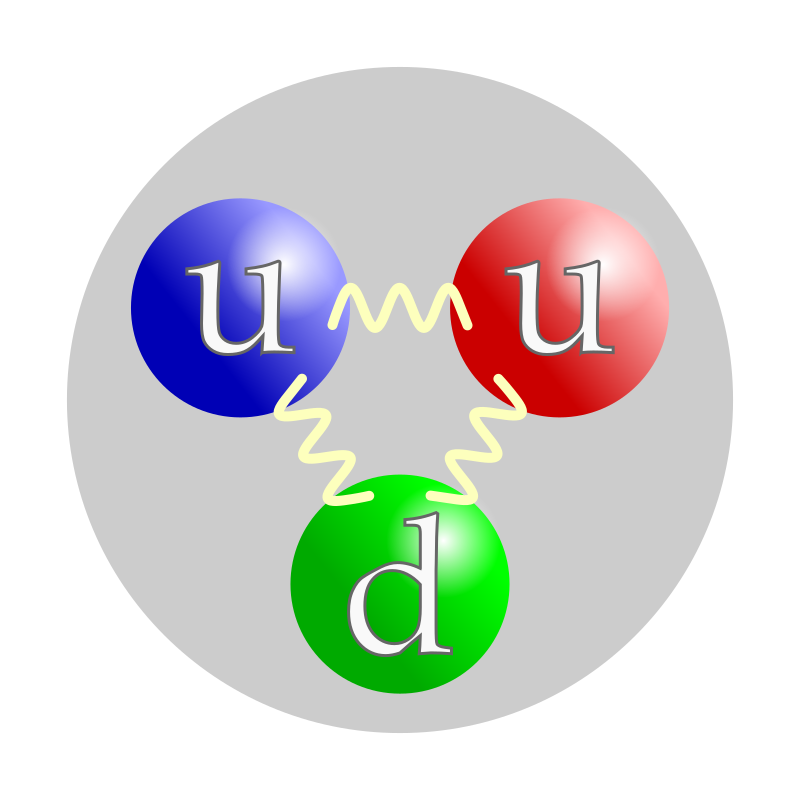
Check the arithmetic.
Proton = uud:
\frac{2}{3}+\frac{2}{3}-\frac{1}{3} = +1$$ ✔ **Neutron = udd:**
Pion \pi^+ = u$\bar{\text{d}}$:
\frac{2}{3}+\frac{1}{3} = +1$$ ✔ **Omega-minus = sss:**
Every one of the hundred particles is a combination of three quarks and their antiquarks. The hexagons and triangles of the Eightfold Way are simply the ways of arranging three objects, and the pattern was the shadow of the structure.
Colour
The quark model had an immediate and serious problem.
The omega-minus is sss with spin 3/2, meaning all three strange quarks have parallel spins and are otherwise in identical states. Three identical fermions in the same state violates the Pauli exclusion principle (Chapter 7.7).
The fix, proposed by Greenberg in 1964 and developed by Han and Nambu: quarks carry an additional quantum number with three values. Gell-Mann named them colours — red, green, blue — with no connection to visible colour whatsoever.
With colour, the three s quarks are distinguishable and exclusion is satisfied.
And a rule comes with it: all observable particles must be colourless — either all three colours together (a baryon) or a colour and its anticolour (a meson). This is why quarks are never seen alone, and Chapter 8.3 explains the mechanism.
Was colour invented just to fix one problem? It looked that way in 1964, which is why it was not immediately accepted. Two independent measurements settled it:
The ratio R. In electron–positron collisions, the rate of producing hadrons relative to muons is proportional to the sum of squared quark charges times the number of colours. Without colour, theory gives R = 2/3 at low energy; with three colours, R = 2. Measured: 2. Direct evidence for exactly three colours.
The neutral pion's decay rate. The \pi^0 \to 2\gamma rate is proportional to the number of colours squared, and it comes out right for N_c = 3 and wrong by a factor of nine for N_c = 1.
Deep inelastic scattering
The decisive experiment was at SLAC in 1968, and it was Rutherford's gold foil experiment repeated with a much bigger hammer.
The setup. Fire 20 GeV electrons at protons and measure how they scatter.
If the proton were a soft uniform ball of charge, large-angle scattering would be rare — the same reasoning Rutherford used.
Result: large-angle scattering was common. The electrons were bouncing off something small and hard inside.
And the pattern of scattering showed "scaling" — the cross-section depended only on a single dimensionless combination of variables rather than on the energy separately. Bjorken predicted this, and Feynman interpreted it: the electron is scattering off point-like constituents, which he called partons to avoid committing to the quark model.
Measuring their properties:
- Spin ½ — from the angular distribution.
- Fractional charges of +\frac{2}{3} and -\frac{1}{3} — from comparing electron and neutrino scattering.
- Three of them carrying the quantum numbers — from the sum rules.
They were quarks. Friedman, Kendall and Taylor received the 1990 Nobel Prize.
And one number did not add up. The quarks accounted for only about half the proton's momentum. The other half is carried by electrically neutral constituents that the electrons pass straight through — the gluons, the carriers of the strong force (Chapter 8.3).
Three more quarks
Charm. In 1970 Glashow, Iliopoulos and Maiani showed that a fourth quark was needed to suppress certain kaon decays that should have been common and were not — the GIM mechanism. In November 1974 two groups found it simultaneously: Ting at Brookhaven called it J, Richter at SLAC called it psi, and the particle is still officially the J/psi. It is a charm–anticharm bound state, and the event is known as the November Revolution because it converted the remaining sceptics to the quark model overnight. Both shared the 1976 Nobel Prize.
Bottom. Predicted by Kobayashi and Maskawa in 1973, who showed that CP violation — the matter–antimatter asymmetry of Chapter 7.10 — requires at least three generations of quarks. Found at Fermilab in 1977 in the upsilon meson. Kobayashi and Maskawa received the Nobel Prize in 2008.
Top. The partner of bottom, and it took eighteen years to find because it is enormously heavy: 173 GeV, about the mass of a whole gold atom concentrated in one quark. Found at Fermilab in 1995.
The top quark is so heavy it decays before it can form a bound state. Its lifetime is 5\times10^{-25} s, shorter than the 3\times10^{-24} s it takes the strong force to bind it to anything. It is the only quark ever observed as a bare quark rather than inside a hadron.
Leptons
Alongside the quarks runs a second family that does not feel the strong force.
Electron (1897), muon (1936), tau (1975, at SLAC, 3477 times the electron's mass).
And a neutrino for each. Chapter 8.5 tells their story in full; here is the outline.
Pauli proposed the neutrino in 1930 to save energy conservation in beta decay. The electrons emitted had a continuous spectrum of energies, not a fixed value, which meant energy was disappearing. Pauli suggested an undetected neutral particle carried it off, and wrote in his letter, "I have done a terrible thing, I have postulated a particle that cannot be detected."
Found in 1956 by Cowan and Reines beside a nuclear reactor at Savannah River, twenty-six years later.
Three flavours, matching the three charged leptons, and Chapter 8.6 explains how the Z boson's decay width proved there are exactly three light ones.
Three generations
Everything sorts into three copies of the same structure:
| Generation | Quarks | Leptons |
|---|---|---|
| 1 | up, down | electron, electron neutrino |
| 2 | charm, strange | muon, muon neutrino |
| 3 | top, bottom | tau, tau neutrino |
Everything you are made of is in generation 1. Protons and neutrons are up and down quarks; the electrons are electrons. The other eight particles exist for a few microseconds at most before decaying into generation 1.
The masses span eleven orders of magnitude:
| Particle | Mass |
|---|---|
| Electron neutrino | < 0.8 eV |
| Electron | 0.511 MeV |
| Up quark | 2.2 MeV |
| Down quark | 4.7 MeV |
| Strange quark | 93 MeV |
| Muon | 105.7 MeV |
| Charm quark | 1.27 GeV |
| Tau | 1.777 GeV |
| Bottom quark | 4.18 GeV |
| Top quark | 172.7 GeV |
Nobody knows why there are three generations, why the masses are what they are, or why they span such a range. These are among the deepest unanswered questions in physics, and Chapter 8.7 covers the attempts.
Rabi's question about the muon has never been answered.
Where the story stands
In 1932: four particles, no theory.
In 1960: over a hundred particles, no theory.
By 1975: six quarks, six leptons, and force carriers, organised by a theory that predicted every one of them before it was found.
The reduction is genuine. Everything in the zoo of the 1950s is a combination of quarks. The hundred particles were like the hundred elements of chemistry before atomic structure — real, distinct, and composite.
Where this shows up in your life
Every atom in your body is up and down quarks and electrons, and nothing else.
PET scanners use positron annihilation, and radiotherapy uses beams whose behaviour is computed from this framework.
Muons from cosmic rays are used to image the interiors of volcanoes, nuclear reactors and pyramids, since they penetrate hundreds of metres of rock and their absorption maps density. A previously unknown void in the Great Pyramid was found this way in 2017.
Carbon dating works because of a weak-interaction decay.
And the technologies invented to detect these particles have propagated widely: the World Wide Web was written at CERN to share particle physics data, and PET, MRI and medical accelerators all descend from detector and beam technology.
What the next chapter fixes
The list is now complete but it is only a list. Chapter 8.2 reads the Standard Model properly — every particle with its mass, charge, spin and colour, arranged in the pattern that has become the most famous table in physics — and explains what each column means, why the generations exist as a structure even though nobody knows why there are three, and exactly which numbers in it are predicted and which are measured and put in by hand.