Appearance
1.1 — What "Alive" Actually Means
Put four things on a table: a candle flame, a dried seed, a crystal growing in a jar of salt water, and a virus.
The flame consumes fuel, gives off heat, grows when you feed it, shrinks when you starve it, moves toward oxygen, and if you touch it to a second wick it makes another flame. The seed does nothing at all — no heat, no movement, no chemistry you can measure — and can sit in a museum drawer for a thousand years, yet drop it in wet soil and a tree comes out. The crystal grows in an orderly, repeating pattern that looks designed. The virus is a package of genetic instructions in a protein shell; on the table it is as inert as the crystal, but inside a human throat it will make ten thousand copies of itself in a day.
Only one of those four is alive by every test biology uses. Working out which one, and why the other three fail, is not word games. It is how you find out what a body is actually doing every second, and therefore what it means when it stops.
The seven things a living thing does
Biology does not define life with a single sentence, because every single sentence anyone has tried has let something in that should not be in or kept something out that should be in. What it uses instead is a list of properties. Something is alive when it does all of them at once.
1. It is organised, and the organisation goes all the way down. A living thing is not a lump. It is built in layers, each layer made of the layer below it, and each layer doing something the layer below cannot do alone.
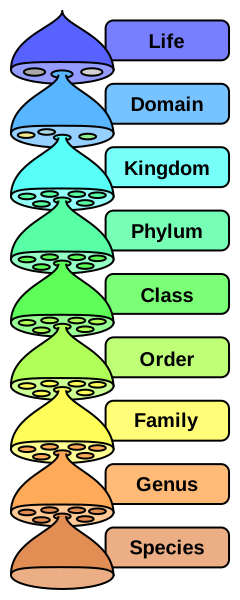
Walk up that ladder with your own heart. Carbon, hydrogen, oxygen and nitrogen atoms join into amino acids. Amino acids link into a protein called myosin. Myosin bundles with another protein called actin into a machine that shortens when it is given energy. Millions of those machines line up into a muscle cell. Muscle cells connect end to end into heart muscle tissue. That tissue is folded into four chambers, which is the organ. The organ plus the blood vessels leaving it is the cardiovascular system. And that is one of the eleven systems that add up to you.
The important word in that paragraph is emerges. A single myosin molecule cannot pump blood. Neither can one cell. Pumping is something that only appears once you have the whole arrangement, and it disappears the moment the arrangement is broken — which is exactly why a heart that has been cut into pieces cannot beat even though every molecule in it is still there and still perfectly good.
2. It runs a chemistry that costs energy — metabolism. Metabolism is the whole set of chemical reactions happening inside a living thing, and the word is worth taking apart because it will come back on nearly every page of this volume. It has two halves. Catabolism is breaking big molecules into small ones and collecting the energy released — this is what happens to the food you ate this morning. Anabolism is spending that energy to build big molecules out of small ones — this is what happens when your body turns the amino acids from that food into new muscle.
The scale of it is genuinely hard to believe. Your body holds only about 250 grams of ATP at any moment — ATP being the small molecule that carries usable energy from wherever it was released to wherever it is needed, covered properly in Chapter 1.6. But you spend and remake that 250 grams so many times a day that the total mass of ATP passing through you in twenty-four hours is roughly your own body weight. A sixty-kilogram person makes and destroys something close to sixty kilograms of ATP a day, and does it silently, without ever noticing.
3. It holds its inside steady while the outside moves — homeostasis. Homeostasis comes from Greek: homoios, similar, and stasis, standing. Standing similar. It means keeping the conditions inside the body inside a narrow band no matter what the world does.
You are doing it right now on a dozen channels at once. Your core temperature is being held near 37 °C whether the room is 5 °C or 40 °C. The acidity of your blood is being held between pH 7.35 and 7.45, a band so narrow that falling outside it in either direction is a medical emergency with its own name — acidosis below, alkalosis above. Your blood sugar is being held near 90 milligrams per decilitre whether you have just eaten a plate of rice or not eaten for two days. Your blood's sodium concentration is held between 135 and 145 millimoles per litre whether you drank four litres of water or none.
None of this is free, and none of it is automatic in the sense of not needing machinery. Each one is a control loop: a sensor that measures the quantity, a controller that compares it against a set point, and an effector that pushes it back. Chapter 4.7 builds those loops properly. What matters here is that holding steady is work, and a large fraction of the energy you spend at rest goes into it.
4. It grows and develops. Growth is getting bigger. Development is getting different. Both are needed, and they are not the same thing.
A crystal grows: sodium and chloride ions stick onto the outside of the existing lattice and the cube gets larger while staying exactly the same arrangement all the way through. A person grows in a completely different way — from the inside, by cells dividing, and while getting bigger they also become things they were not before. The single cell you started as had no heart. Twenty-two days later there was a tube beating in your chest. That is development, and no crystal has ever done it.
5. It responds to what happens to it. Touch something hot and your hand is already moving before you feel the pain, because a reflex arc in your spinal cord acted without consulting your brain (Chapter 11.3). A bacterium swims up a gradient of sugar. A plant turns its leaves toward light. A pupil narrows in a fraction of a second when a torch is shone at it.
The general term for this is irritability in older textbooks and responsiveness in newer ones, and the point is that the response is not just physics happening to the organism. A rock also responds to a hammer. The difference is that a living thing's response is directed — it tends to move the organism toward something good for it or away from something bad, using a mechanism built for that purpose.
6. It reproduces. It makes more of itself, and the copies carry instructions that came from it. This is the property that fire fails on in a way that is worth being precise about, because at first glance fire clearly reproduces.
7. Its populations evolve. Over generations, the descendants change, because the copies are not perfect and some versions leave more descendants than others. This is Part 3 of this volume in its entirety. It is the property that turns the previous six from a list of chemistry into an explanation of why any of it exists.
Why the flame is not alive
Go back to the candle. It scores well on the list. It has organised structure — a blue inner cone of unburnt vapour and a yellow outer cone of burning carbon, in a stable arrangement. It has metabolism of a kind: it takes in fuel and oxygen and releases energy. It grows. It responds to a draught. Touch a wick to it and you have a second flame with the same properties, which certainly looks like reproduction.
It fails on homeostasis and it fails on heredity.
A flame does not regulate itself. It has no set point and no sensor. Turn up the oxygen and it just burns hotter until the fuel is gone; there is nothing in it trying to bring it back to a target. Every condition inside a flame is a straight consequence of the conditions outside it. That is the exact opposite of what your body does when a room gets hot.
And the second flame carries nothing from the first. There are no instructions passed on, so there is no variation to inherit and nothing for selection to work on. A million generations of candle flames give you the same flame. This is why property 7 matters so much: without heredity there is no evolution, and without evolution the whole list is just a description of a chemical process rather than an account of a lineage that has been running for nearly four billion years.
The crystal fails harder and in the same places. It grows by addition from outside rather than division from inside, it has no metabolism, no homeostasis, no development and no heredity.
The cell: the smallest thing that is alive
Everything that passes all seven tests is made of cells, and this is not a coincidence but the central fact of biology.

Cell theory is three statements, and they took two hundred years to assemble.
All living things are made of one or more cells. Robert Hooke got the first half of this in 1665 by accident. He was pointing an early microscope at a slice of cork bark, saw a honeycomb of empty boxes, and named them cells after the small bare rooms monks slept in — cellula in Latin, little room. What Hooke actually saw were the dead cell walls of a plant with the contents long gone, so he named the container rather than the thing. Within a decade Antonie van Leeuwenhoek in Delft, grinding far better lenses than anyone else alive, was looking at pond water, rainwater, and the scrapings from his own teeth, and reporting that all of them were crawling with tiny things that swam. He called them animalcules, little animals. Nobody believed him for years.
The cell is the basic unit of structure and function in life. Matthias Schleiden said it for plants in 1838, Theodor Schwann for animals in 1839, and it is a bigger claim than it looks. It says that whatever a living thing does — digesting, moving, thinking, defending itself — is being done by cells, and that if you want to understand a disease you eventually have to find out which cells are doing what.
Every cell comes from a pre-existing cell. Rudolf Virchow put this in print in 1855 as omnis cellula e cellula, every cell from a cell. This is the statement that killed a two-thousand-year-old idea.
The idea that had to die first: spontaneous generation
For most of recorded history it was obvious that living things arose from non-living matter. Leave meat out and maggots appear in it. Leave grain in a damp corner and mice show up. Aristotle taught it, and everyone from Roman farmers to seventeenth-century physicians agreed, because the evidence of the eyes was right there.
Francesco Redi cracked the first piece in 1668 with an experiment a child can follow. He put meat in several jars. Some he left open. Some he sealed. Some he covered with fine gauze, which lets air through but not flies. Maggots appeared only in the open jars. On the gauze-covered jars, flies landed on the gauze and laid eggs on the gauze, and maggots appeared there — on the outside, where the flies had been, not in the sealed meat. The maggots were not being generated by the meat. They were the children of flies.
That settled maggots but not microbes, and the argument dragged on for another two hundred years, because when you boil a broth and leave it exposed it clouds with bacteria within days, and it was not obvious where they came from. Louis Pasteur ended it in 1859–61 with the swan-neck flask. He boiled broth in a flask whose neck he had drawn out into a long S-shaped bend, open to the air at the end. Air could get in — that was the whole point, since defenders of spontaneous generation argued that sealing the flask excluded some vital principle in the air. But dust, and the microbes riding on it, settled in the bend of the neck and never reached the broth. The broth stayed clear for months. Then Pasteur tilted the flask so the liquid ran into the bend and back, and within a day it was cloudy.
The reason this experiment is still taught is that it does not merely show the result — it removes the opponent's explanation. The air was let in. The vital principle, if there was one, was let in. Only the dust was stopped, and stopping the dust was enough.
The consequence for you personally is antisepsis. If microbes come from other microbes rather than arising in a wound, then keeping them out of a wound prevents infection. Joseph Lister worked out the surgical implications in the 1860s, and the death rate after amputations in his ward fell from about 45 percent to about 15 percent. This is the origin of every sterile procedure in every hospital you will ever walk into.
Two kinds of cell, and you are made of the more complicated one

Prokaryotes — bacteria and archaea — are cells with no nucleus. Their DNA sits loose in the middle of the cell in a region called the nucleoid, usually as a single circular loop, with no membrane around it. The name says exactly this: Greek pro, before, and karyon, kernel or nut. Before the kernel. They are small, typically 0.5 to 5 micrometres across — a micrometre being a thousandth of a millimetre, written µm — and they have almost no internal compartments.
Eukaryotes — every animal, plant, fungus and protist, including every cell in your body — keep their DNA inside a membrane-walled nucleus. Eu, true; karyon, kernel. True kernel. They are typically 10 to 100 µm across, which sounds like a modest difference until you remember that volume goes as the cube of length: a 20 µm human cell has roughly a thousand times the volume of a 2 µm bacterium. And they are full of separate membrane-walled compartments, each running a different chemistry.
That last point is the one that matters. A prokaryote runs all its chemistry in one room. A eukaryote has rooms. The stomach acid of the cell is sealed inside lysosomes so it does not digest everything. Energy production is sealed inside mitochondria. Protein manufacture and packaging happen along a dedicated production line. Compartments let a cell run reactions that would poison each other if they met, and that is the structural reason eukaryotes could get complicated enough to build a body.
The numbers on your own body
A typical human cell is about 10 to 30 µm across. Some are far from typical. A red blood cell is a flattened disc about 7 to 8 µm wide, and the width matters: the narrowest capillaries are about 5 µm across, so a red cell has to bend to get through, which is why anything that makes red cells stiff — sickle cell disease being the clearest example, covered in Chapter 2.8 — blocks small vessels and kills tissue downstream. A single motor neuron running from the base of your spine to the muscles of your foot is one cell with an extension close to a metre long. And the largest single cell any animal makes is an ostrich egg, the yolk being one cell, about 15 centimetres across.
How many cells are in you? The best-supported estimate, published by Sender, Fuchs and Milo in 2016 after a careful organ-by-organ count, is about 30 trillion human cells — that is 3 × 10¹³, a 3 followed by thirteen zeros. Nearly 90 percent of them by number are red blood cells, which are small and numerous; by mass, muscle and fat cells dominate.
The same paper produced a second number worth carrying around. You also contain about 38 trillion bacterial cells, almost all of them in the large intestine. By count they outnumber your own cells slightly. By mass they add up to only around 200 grams, because they are so much smaller. The older claim that bacteria outnumber human cells ten to one came from a 1972 back-of-the-envelope estimate that was never intended to be precise, and it is wrong; the honest ratio is close to one to one. Chapter 9.6 covers what those bacteria are doing for you, which turns out to be a great deal.
Viruses: the hard case
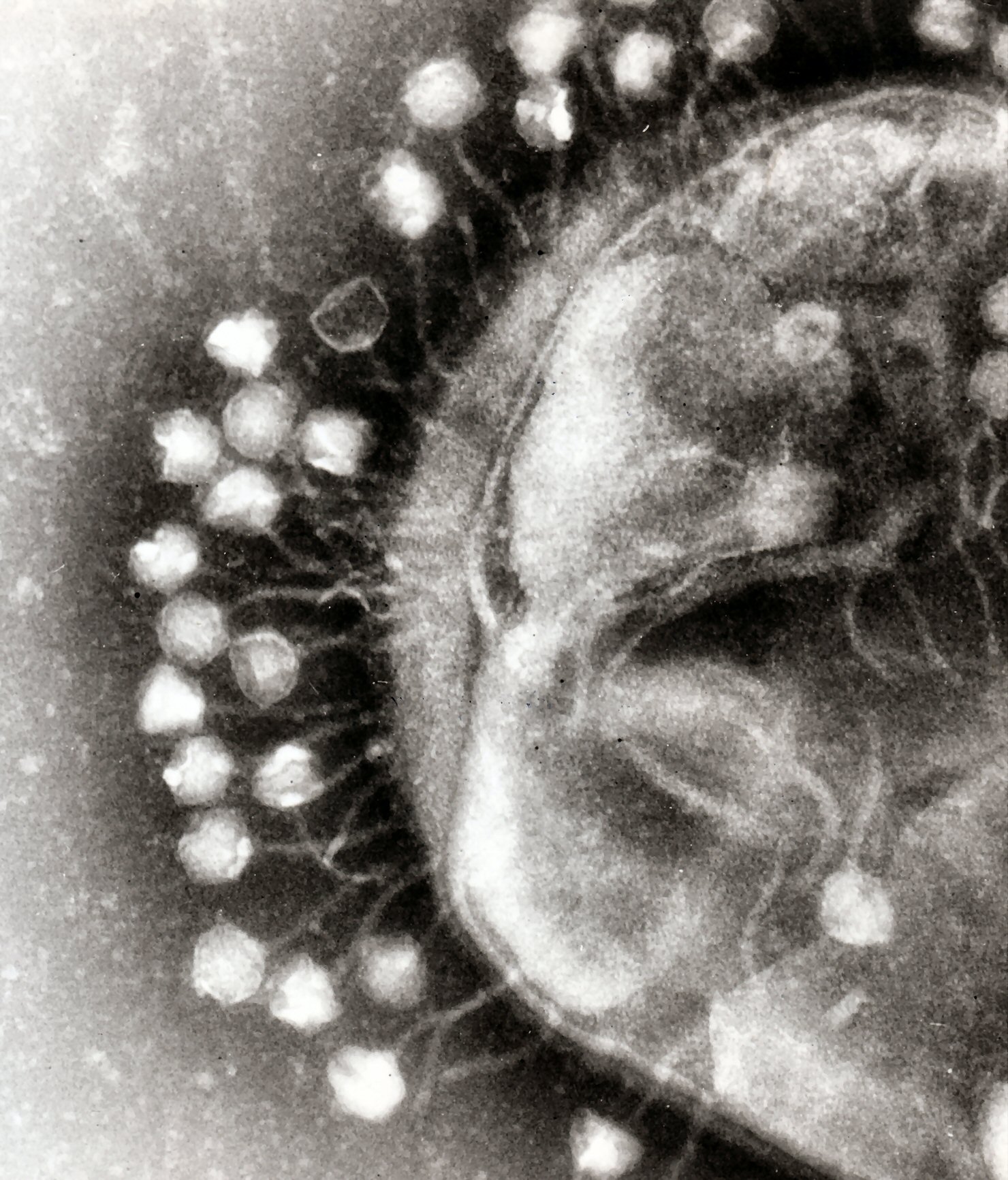
A virus is a set of genetic instructions — DNA or RNA — inside a protein coat called a capsid, sometimes with a stolen scrap of cell membrane wrapped around the outside. That is the whole organism. Sizes run from about 20 nanometres for the smallest to about 750 nanometres for the giant mimivirus, a nanometre being a millionth of a millimetre. Influenza is around 100 nm. For scale: you could line up about 100 influenza particles across a single red blood cell.
Run a virus through the seven properties.
Organised: yes, and beautifully so — many capsids are geometrically perfect icosahedra, twenty-sided solids assembled automatically from identical protein subunits. Reproduces: yes, prolifically. Evolves: emphatically yes, and that is why you need a new flu vaccine every year. Responds to its environment: in a limited chemical sense, yes — a capsid springs open when it meets the right receptor.
Metabolism: no. A virus has no machinery for extracting energy from anything. It carries no ribosomes, so it cannot build a single protein by itself. Homeostasis: no — there is nothing inside to regulate. Growth and development: no — a virus does not get bigger, it is assembled at full size.
So a virus outside a cell is a chemical, not an organism. It has no more metabolism than a grain of sand. What it has is the ability to get inside a cell that does have all that machinery, and hijack it. The formal term is obligate intracellular parasite: obligate because it has no alternative, intracellular because the only place it can operate is inside another cell.
Most biologists therefore say viruses are not alive, and the answer is not entirely satisfying. The dissatisfaction is honest and worth sitting with, because it teaches something about definitions in science. Our categories were built by looking at cells; a virus was not part of the training data. It sits on a boundary that nature never had any reason to make sharp. The right response is not to argue about the word but to say precisely what a virus can and cannot do — which is what the paragraphs above did, and which is all a doctor treating an infection actually needs.
The practical payoff is immediate. Antibiotics do not work on viruses, and this is why. Every antibiotic attacks a piece of machinery that bacteria have and you do not: a bacterial cell wall, a bacterial ribosome, a bacterial enzyme for copying DNA. A virus has none of those things — it is using your machinery. There is nothing bacterial for the drug to attack. Taking an antibiotic for a cold does nothing to the cold and does real harm, by killing off useful bacteria and by selecting for resistant strains, both covered in Chapter 17.12.
Prions: it gets worse
A prion is smaller and stranger still. It is a protein, with no genetic material of any kind, that causes disease by touching a normal protein of the same type and forcing it to fold into the wrong shape. The misfolded version then does the same to the next one. The damage spreads through the brain as a chain reaction of shape changes, leaving it full of microscopic holes — which is why these are called spongiform encephalopathies, sponge-like brain diseases. Creutzfeldt–Jakob disease in humans and BSE in cattle are prion diseases.
Stanley Prusiner proposed this in 1982 and was widely disbelieved, because an infectious agent with no genes contradicted everything. He received the Nobel Prize for it in 1997. Nobody calls a prion alive. It reproduces, in the sense that the misfolded form increases, and it does so without a single one of the other six properties.
What death is, exactly
If life is those seven properties running, death is them stopping — but they do not stop at the same moment, and the gap between them is the whole of emergency medicine.
Clinical death is the moment the heart stops pumping and breathing stops. It is not the end of anything at the cellular level. Almost every cell in the body is still alive, still holding its internal chemistry, still full of intact machinery. What has stopped is delivery: no circulation means no oxygen and no glucose arriving, and no waste leaving.
Biological death is when cells begin to die irreversibly, and the clock on it is different for every tissue, because it depends on how fast that tissue burns energy and how much it can improvise without oxygen.
The brain is at the front of the queue and by a long way. It is about 2 percent of your body weight and takes about 20 percent of your oxygen, and unlike muscle it has almost no capacity to work without oxygen and almost no stored fuel. So the timings are brutal and specific: consciousness is lost in about 10 seconds after blood flow to the brain stops, because that is roughly how long the oxygen already dissolved in the brain lasts. Irreversible damage to the most vulnerable neurons begins at around 4 to 6 minutes. After about 10 minutes without circulation, survival with intact brain function becomes very unlikely.
Meanwhile, other tissue is fine. Skin cells survive for hours. A cornea can be recovered and transplanted many hours after death. This staggering is exactly why organ donation is possible at all, and it is exactly why the number that matters in a collapse is four minutes.
And that is the connection to the thing on the table at the start. Chest compressions work because they are not medicine — they are plumbing. A person doing compressions on a stopped heart is manually replacing the pump so that the still-living cells keep receiving oxygen from the still-oxygenated blood, holding biological death off until something can restart the rhythm. Every minute without compressions costs roughly 7 to 10 percent of the chance of survival. Chapter 23.2 is the full procedure, and it is one of the chapters in this book worth reading before you need it rather than during.
What the next page fixes
This page said a cell is the smallest thing that is alive, and used words like protein, membrane and ATP as if they were already understood. They are not, yet. Chapter 1.2 goes down one level and builds the four families of molecule every living thing is made from — carbohydrates, lipids, proteins and nucleic acids — starting from water, which is the substance that makes all four of them behave the way they do.