Appearance
14.3 — Hair and Nails
You have about 5 million hair follicles, of which around 100,000 are on your scalp. You never make new ones after birth — the number is fixed before you are born, and follicles that are lost are not replaced.
You lose 50 to 100 scalp hairs a day, which is entirely normal and is the reason a hairbrush is never empty.
Hair structure
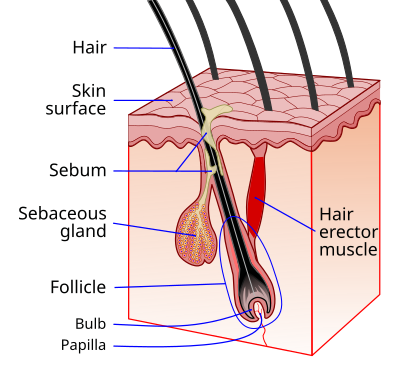
The shaft is dead. Only the bulb at the base contains living dividing cells.
Which is why cutting hair does not affect its growth, and why the belief that shaving makes hair grow back thicker is wrong.
The reason it appears thicker is straightforward. An uncut hair tapers to a fine point; a cut one has a blunt end of full diameter. The blunt stubble feels coarser and looks darker against the skin. Nothing about the follicle has changed.
Three layers of the shaft. The cuticle — overlapping scales, like roof tiles, protecting the inside. The cortex — the bulk, containing keratin and pigment. The medulla — a hollow core, present in thick hairs and absent in fine ones.
Damaged cuticle is what "damaged hair" means. Heat, bleach and friction lift and break the scales, so light scatters instead of reflecting — hence dullness — and the cortex is exposed, so the hair breaks. Split ends are the cortex fraying once the cuticle has gone.
And this is why no product "repairs" hair. Conditioners smooth and coat the cuticle temporarily, which genuinely improves appearance and manageability, and the hair itself is dead and cannot heal. The only permanent solution is cutting off the damaged length.
Hair shape is determined by follicle shape. A round follicle produces straight hair; an oval one produces wavy; a flat, curved follicle produces tightly curled hair, because the shaft grows in a helix and the disulfide bonds set the curve.
And permanent waving is chemistry on those bonds (Chapter 1.3): breaking the disulfide bridges, shaping the hair, and re-forming them in the new position.
The growth cycle
Three phases, and each follicle cycles independently — which is why humans do not moult.
Anagen (growing) — 2 to 7 years on the scalp, and about 85 to 90 percent of follicles are in this phase at any time. Growth rate is about 1 centimetre a month.
And the length of anagen determines maximum hair length. Someone whose anagen lasts two years cannot grow hair past about 25 centimetres, however long they wait. Scalp anagen is far longer than that of eyebrows, which is why eyebrows do not require trimming.
Catagen (transition) — 2 to 3 weeks. The follicle shrinks.
Telogen (resting) — about 3 months, and 10 to 15 percent of follicles. The hair is held loosely and eventually sheds.
Telogen effluvium is the diffuse hair loss that follows a physiological shock — childbirth, severe illness, major surgery, rapid weight loss, high fever, severe stress, or starting or stopping certain drugs.
The stressor pushes a large proportion of follicles into telogen simultaneously, and they all shed together about three months later.
That delay is the single most useful fact about it. A person losing handfuls of hair is looking for a cause now, and the cause was three months ago. Asking what happened around then usually produces the answer immediately.
And it recovers completely, over 6 to 12 months, provided the trigger has passed. Reassurance with an explanation is the treatment, and the explanation matters because the fear of permanent baldness causes more distress than the shedding.
Hair loss
Androgenetic alopecia — male and female pattern hair loss.
Affects around 50 percent of men by 50 and up to 40 percent of women by 70.
The mechanism: dihydrotestosterone, produced from testosterone by 5-alpha-reductase (Chapter 12.6), acts on genetically susceptible follicles.
And it does not kill them. It miniaturises them. Each cycle produces a shorter anagen phase and a finer, shorter, less pigmented hair, until the follicle produces only invisible vellus hair.
Which is why early treatment matters far more than late treatment: a miniaturised follicle can be recovered, and a follicle that has been dormant for years usually cannot.
And the pattern is determined by follicle sensitivity, not by hormone levels. Men with pattern baldness have normal testosterone. The follicles on the top of the scalp are sensitive; those at the back and sides are not.
Which is exactly why hair transplantation works. Follicles taken from the back retain their insensitivity when moved to the top — "donor dominance" — so the transplanted hair persists while the surrounding native hair continues to thin. It is the follicle's own genetics that travel with it.
Treatment, with honest expectations:
Minoxidil (topical) — prolongs anagen and increases follicle size. Works for both sexes, requires continuous use, and stopping reverses the gains within months. There is an initial increase in shedding in the first weeks, which is follicles being pushed into a new cycle, and people frequently stop at exactly that point.
Finasteride (oral, men) — blocks 5-alpha-reductase. More effective than minoxidil, and its side effects should be stated honestly: reduced libido or erectile difficulty in a small percentage, mostly reversible on stopping, with continuing debate about persistent symptoms in a minority.
Transplantation — for suitable patterns and adequate donor supply.
And the encouraging framing is worth stating. Male pattern hair loss is not a disease and carries no health consequence. Treating it is entirely a personal choice, and choosing not to is not a failure to act. The distress it causes is real and is worth taking seriously; so is the option of not treating it at all.
Alopecia areata — autoimmune, with T cells attacking the follicle.
Sudden well-defined round patches of complete hair loss, with smooth skin and no scarring. It can progress to loss of all scalp hair or all body hair.
It is unpredictable, and many patches regrow spontaneously within a year.
And treatment has changed substantially and recently. JAK inhibitors — oral drugs blocking the signalling pathway the attacking T cells use — produce substantial regrowth in a majority of patients with severe disease, and were approved for it from 2022. This is a genuine transformation for a condition that had almost nothing effective before it.
Scarring alopecias destroy the follicle permanently. These are the ones where speed matters — lichen planopilaris, discoid lupus, frontal fibrosing alopecia — because hair that has been lost cannot return, and the aim is to stop the process before more is lost.
Any hair loss with scalp redness, scaling, itching, pain or visible loss of follicle openings needs prompt dermatological assessment rather than watchful waiting.
Other causes worth checking: iron deficiency, thyroid disease, protein or calorie deficiency, and drugs — chemotherapy, and also anticoagulants, some antidepressants, retinoids, and beta-blockers.
Chemotherapy hair loss occurs because follicles are among the fastest-dividing tissues (Chapter 1.7). It is almost always temporary, and scalp cooling during infusion reduces it substantially by constricting the vessels supplying the follicles.
Hirsutism and hypertrichosis
Two different things, frequently conflated.
Hirsutism — coarse terminal hair in a male pattern in a woman: face, chest, back, abdomen. Androgen-driven.
The commonest cause is polycystic ovary syndrome (Chapter 12.6). Others: congenital adrenal hyperplasia, androgen-secreting tumours, and drugs.
Rapid onset with deepening voice, clitoral enlargement or muscle bulk suggests a tumour and requires urgent investigation.
Hypertrichosis — excess hair anywhere, in any pattern, not androgen-driven. Usually drug-induced.
And a practical point about treating hirsutism: it takes six months to judge, because that is the follicle cycle. Hormonal treatment prevents new hair developing and does nothing to existing terminal hair, which must be removed physically. Setting that expectation prevents people abandoning effective treatment at three months.
Hair colour and greying
Melanocytes in the follicle bulb transfer pigment to the growing shaft (Chapter 14.1).
Greying happens when those melanocytes are exhausted or lost.
And an individual hair does not turn grey. It grows out grey from the root because the follicle stopped making pigment for that cycle. The proportion of grey hairs increases; the hairs themselves do not change.
Which is also why the belief that plucking a grey hair makes several grow is wrong — one follicle produces one hair, and plucking it damages that follicle without affecting any other.
Timing is strongly genetic. The "50-50-50 rule" — 50 percent of people have 50 percent grey hair by 50 — is a rough approximation and varies substantially by population, occurring later on average in people of African and Asian descent.
Can stress cause greying? The evidence has moved from folklore toward mechanism. A 2020 study demonstrated in mice that acute stress depletes melanocyte stem cells through sympathetic nerve activation, and human hair analysis has shown greying that correlates with periods of stress — and, strikingly, some reversal when stress resolved. The effect is real, modest, and not the overnight transformation of legend.
Premature greying can indicate vitamin B12 deficiency, thyroid disease, or vitiligo affecting the follicles, and is worth a check if it is markedly early.
Nails
Made of keratin, like hair, and produced by the nail matrix under the base of the nail.
Only the matrix is living. The visible nail plate is dead, which is why nail treatments do not affect growth and why damage to the matrix — not to the plate — causes permanent deformity.
The lunula — the pale crescent at the base — is the visible part of the matrix. It is pale because the matrix cells are dense and opaque.
Growth: fingernails about 3 millimetres a month, so a full nail takes 4 to 6 months to replace. Toenails grow about half as fast — 12 to 18 months for a full replacement.
And that slow growth explains why nail conditions take so long to treat. Fungal toenail infection requires months of treatment not because the fungus is hard to kill but because the visible nail must grow out.
Growth is faster in summer, in the dominant hand, and in youth, and slows with age and poor circulation.
White spots are almost never a calcium or zinc deficiency, despite the persistent belief. They are minor trauma to the matrix weeks earlier, and they grow out.
What nails reveal
Nails are a slow-motion record of the previous months, which makes them genuinely useful.
Clubbing — loss of the normal angle at the nail base, with the nail bed becoming spongy and the fingertip bulbous.
One of the most useful physical signs in medicine, because its causes are a specific list: lung cancer, bronchiectasis, cystic fibrosis, lung fibrosis, cyanotic congenital heart disease, infective endocarditis, inflammatory bowel disease, and cirrhosis.
The mechanism is not fully established, and the leading explanation involves megakaryocytes bypassing the lung and releasing growth factors in the fingertips.
Beau's lines — transverse grooves across the nail.
They mark a period when the matrix stopped growing — severe illness, high fever, chemotherapy, or major surgery.
And they can be dated. Measuring the distance from the cuticle and dividing by 3 millimetres per month gives the number of months since the event, which is a genuinely satisfying piece of clinical arithmetic.
Koilonychia — spoon-shaped, concave nails. Classically iron deficiency.
Splinter haemorrhages — thin red-brown lines running lengthwise. Usually trauma; classically associated with infective endocarditis (Chapter 7.2), where they are one of several peripheral signs.
Nail pitting — small depressions. Psoriasis, and alopecia areata.
Onycholysis — the nail lifting from its bed. Trauma, psoriasis, fungal infection, thyroid disease.
Terry's nails — the nail white with a narrow pink band at the tip. Cirrhosis, heart failure, diabetes.
Blue nails — cyanosis, or certain drugs.
And one that matters more than all of the above.
A new pigmented streak running lengthwise in a single nail, in a light-skinned person, must be assessed for subungual melanoma.
Particularly if it is widening, is darker at the base, is a single nail, or if the pigment extends onto the skin of the nail fold — a finding called Hutchinson's sign.
Longitudinal pigmented bands are common and normal in people with darker skin, usually in multiple nails, and that context is essential in interpreting them.
Subungual melanoma is frequently diagnosed late, because it is mistaken for a bruise and because a bruise under a nail should grow out over months. A pigmented area that does not move with nail growth is not a bruise.
Fungal nail infection (onychomycosis) — thickened, discoloured, crumbling nails, commoner with age and in diabetes.
It should be confirmed by sampling before treatment, because psoriasis and trauma look similar and oral antifungals require months of treatment with liver monitoring. Treating the wrong diagnosis for six months is a common and avoidable error.
Ingrowing toenails — the nail edge penetrating the surrounding skin.
And the prevention is specific and widely got wrong: cut toenails straight across rather than curved, and not too short. Rounding the corners encourages the edge to grow into the fold. Well-fitting shoes matter too.
What the next page fixes
The skin's ability to repair itself is what makes it a viable barrier at all. Chapter 14.4 covers wound healing and scars — the four phases, what makes healing fail, and why some wounds should be closed and others should not.