Appearance
3.7 — The Rest of Life, Compactly
Everything you can see with your unaided eye is a small twig on the eukaryote branch. By number of individuals, by total mass of living material, by metabolic diversity, and by length of time on Earth, life is overwhelmingly microbial, and the animals and plants that fill every nature documentary are a late and unrepresentative sample.
This chapter covers the rest of the tree at the level that actually matters to you: what each group is, what it does to you or for you, and where it turns up in medicine. Plants get a full section rather than a course, because the parts of botany that matter for a life are photosynthesis, food, and drugs.
Bacteria

Prokaryotes with no nucleus (Chapter 1.1), typically 0.5 to 5 micrometres, with a circular chromosome, often carrying small extra loops called plasmids — which is where antibiotic resistance genes usually live, and which bacteria trade between each other, including across species.
The wall is the key to both classification and treatment. The Gram stain, devised by Hans Christian Gram in 1884, separates bacteria into two groups by how their walls hold a dye.
Gram-positive bacteria have a thick outer layer of peptidoglycan that retains the purple stain. Staphylococcus, Streptococcus, Clostridium, Bacillus.
Gram-negative bacteria have a thin peptidoglycan layer sandwiched under an extra outer membrane, which does not retain the stain, so they appear pink with the counterstain. E. coli, Salmonella, Pseudomonas, Neisseria.
That extra outer membrane is why Gram-negative infections are harder to treat. It excludes many antibiotics, and it contains lipopolysaccharide (endotoxin), which the immune system reacts to violently — it is the main driver of the catastrophic inflammatory cascade in Gram-negative sepsis (Chapter 17.11). A doctor seeing a Gram stain result knows within an hour which antibiotics are plausible and how worried to be.
Most bacteria are harmless or useful. Your gut microbiome (Chapter 9.6) synthesises vitamin K and several B vitamins, breaks down fibre your enzymes cannot touch, and occupies space that would otherwise be available to pathogens. Roughly 38 trillion of them live in you (Chapter 1.1). Fewer than a hundred bacterial species cause most human disease, out of an estimated millions.
Archaea are the third domain (Chapter 3.4) — superficially like bacteria, genetically closer to us. Many live in extreme conditions: boiling springs, saturated brine, strongly acidic water. Remarkably, no archaeon is known to cause human disease, which is one of the genuine open questions in microbiology. Methanogenic archaea live in the human gut and produce methane.
Protists
A catch-all for eukaryotes that are not animals, plants or fungi. It is not a natural group — it is what is left over — and it contains organisms as different from each other as you are from a mushroom.
They cause several of the world's most serious diseases.
Plasmodium causes malaria, transmitted by Anopheles mosquitoes. It kills over 500,000 people a year, mostly African children under five, and it has shaped the human genome more than any other pathogen (Chapters 3.3, 17.7).
Entamoeba histolytica causes amoebic dysentery and liver abscess. Giardia causes prolonged watery diarrhoea. Trypanosoma causes sleeping sickness in Africa and Chagas disease in South America. Leishmania, transmitted by sandflies, causes disfiguring skin ulcers or a fatal visceral form.
And some are the base of the food chain. Diatoms and other photosynthetic plankton produce a large share of the world's oxygen — estimates for marine phytoplankton's contribution run from about a third to half of annual global oxygen production.
Fungi
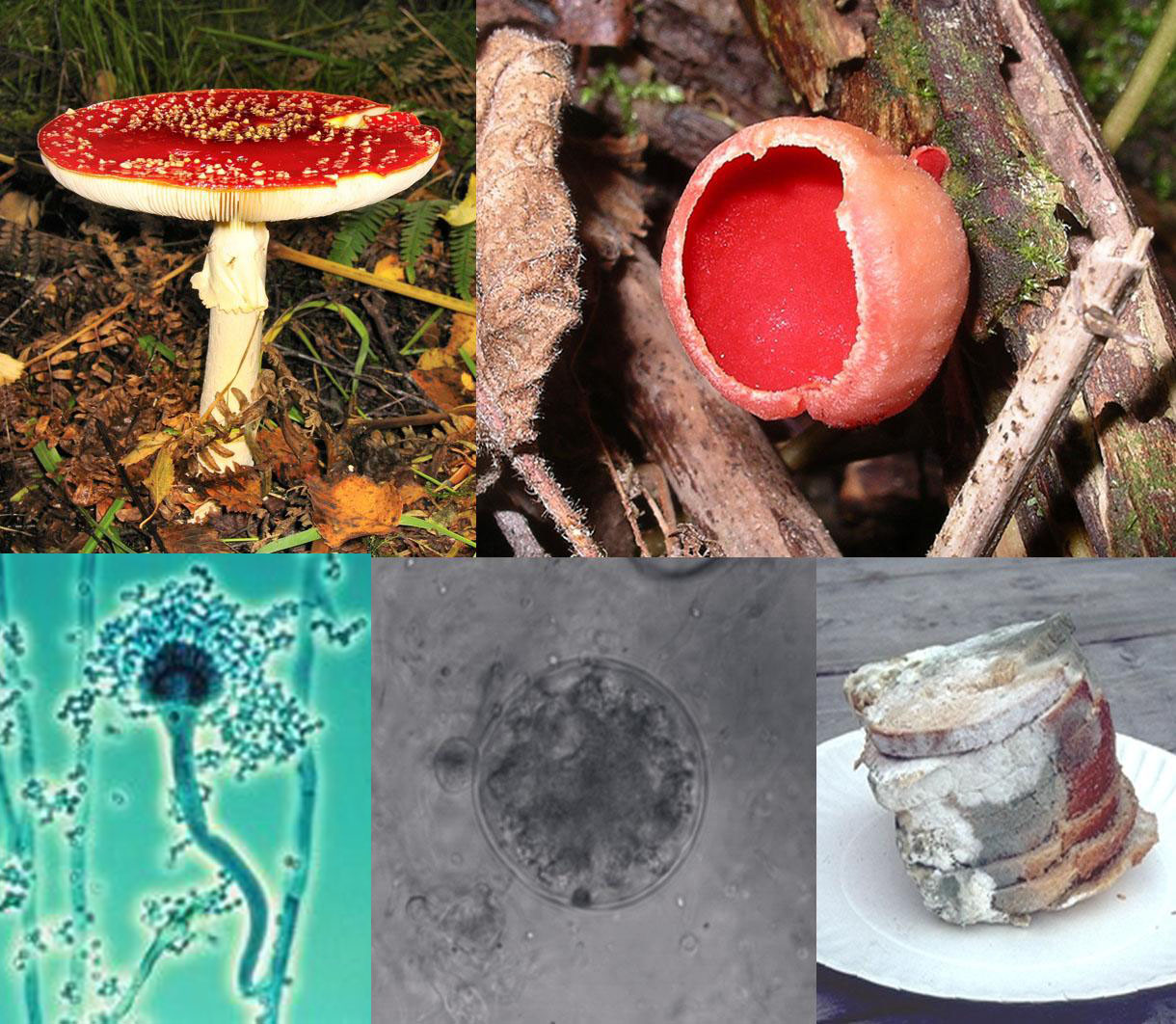
Eukaryotes with cell walls made of chitin — the same material as insect shells, not the cellulose of plants. They cannot photosynthesise, so they feed by secreting enzymes onto their surroundings and absorbing the products. Most exist as hyphae, thin threads forming a network called a mycelium; the mushroom is only the reproductive structure.
Fungi are more closely related to animals than to plants, and this single fact governs antifungal treatment. A drug that attacks a fungal cell has fewer safe targets than one attacking a bacterium, because fungal biochemistry is much closer to ours. This is why antifungal drugs are more toxic, slower to work, and fewer in number. The main exploitable difference is that fungal membranes use ergosterol where ours use cholesterol, and most antifungals target that: amphotericin B binds ergosterol and punches holes; the azoles block its synthesis. Chapter 22.6.
Human fungal disease ranges from trivial to lethal. Athlete's foot, ringworm and thrush are common and mild. Invasive aspergillosis and cryptococcal meningitis kill people whose immunity is suppressed, and cryptococcal meningitis remains a leading cause of death in advanced HIV. Candida auris, which emerged in the 2010s, is resistant to multiple antifungal classes and is a growing hospital problem.
And fungi gave medicine two of its foundations. Penicillin came from Penicillium mould, noticed by Alexander Fleming in 1928 when a contaminated plate showed a bacteria-free zone around the mould. Cyclosporine, from a soil fungus, made organ transplantation possible by suppressing rejection. Statins were first isolated from fungi. The great majority of antibiotics come from soil microorganisms — bacteria and fungi have been fighting each other chemically for billions of years, and we mostly took their weapons.
Fungi also make bread rise and beer ferment (Chapter 1.6), and they are the main decomposers of wood on land. Without them, dead trees would not rot.
Plants
Plants get one chapter here because the reader is not training to be a botanist. What matters is the chemistry that feeds everything and the molecules medicine took from them.

Three features distinguish a plant cell: a cellulose wall, chloroplasts, and a large vacuole. The vacuole explains wilting — when water is short, its pressure falls, the cell no longer pushes against its wall, and the plant droops. Watering restores the pressure and the plant stands up again within hours.
Photosynthesis
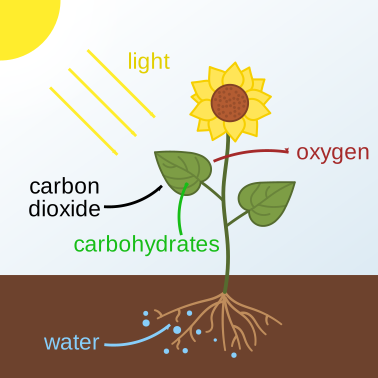
6\,\mathrm{CO_2} + 6\,\mathrm{H_2O} + \text{light} \;\longrightarrow\; \mathrm{C_6H_{12}O_6} + 6\,\mathrm{O_2}
Six carbon dioxide plus six water, driven by light, give one glucose and six oxygen. Compare it with the respiration equation in Chapter 1.6 and you will see it is exactly the same equation run backwards. Photosynthesis stores solar energy in a chemical bond; respiration spends it. That is the entire energy economy of the biosphere in two lines.
Two stages, and they mirror respiration closely.
The light reactions, in the thylakoid membranes inside chloroplasts. Chlorophyll absorbs light and loses an electron. The lost electron is replaced by splitting a water molecule — and the oxygen you breathe is the by-product of that split. It does not come from the carbon dioxide, which is a common and understandable misconception. The energised electrons then run down an electron transport chain, pumping protons across a membrane, and the protons return through an ATP synthase.
That should sound familiar, because it is the same machine. ATP synthase, proton gradients, electron transport — the chloroplast is doing chemiosmosis exactly as your mitochondria do, for the same reason: both descend from bacteria, and both inherited the mechanism from a common ancestor (Chapter 1.9).
The Calvin cycle, in the chloroplast's fluid interior, uses that ATP to attach carbon dioxide to a sugar and build glucose. The enzyme that grabs the CO₂ is called RuBisCO, and it is almost certainly the most abundant protein on Earth — roughly a kilogram for every person alive. It is also remarkably inefficient, and sometimes grabs oxygen instead of carbon dioxide by mistake, wasting energy. A billion years of selection has not fixed it, which is a useful illustration of Chapter 3.2's constraint.
Chlorophyll is green because it absorbs red and blue light and reflects green. Autumn colour appears when chlorophyll is broken down and reabsorbed before leaf fall, revealing the yellow and orange carotenoid pigments that were there all along.
What plants give you
Food. Directly as grains, fruits, vegetables and pulses, and indirectly through every animal you eat, since livestock eat plants.
Fibre, from cellulose (Chapter 1.2).
Oxygen — though as noted, marine phytoplankton contribute at least as much as land plants.
And medicines. The list is longer than most people realise, and every one of these is a plant chemical that a plant made to poison something else.
| Drug | Plant | Used for |
|---|---|---|
| Aspirin | Willow bark | Pain, fever, clot prevention |
| Morphine | Opium poppy | Severe pain |
| Digoxin | Foxglove | Heart failure, atrial fibrillation |
| Quinine | Cinchona bark | Malaria |
| Artemisinin | Sweet wormwood | Malaria |
| Atropine | Deadly nightshade | Slow heart, eye dilation |
| Paclitaxel | Pacific yew | Cancer chemotherapy |
| Vincristine | Madagascar periwinkle | Leukaemia, lymphoma |
| Colchicine | Autumn crocus | Gout |
| Metformin's origin | French lilac | Type 2 diabetes |
Two of these are worth a sentence more. Artemisinin was found by Tu Youyou in the 1970s, working through classical Chinese medical texts as part of a Chinese military programme to find a malaria treatment. A fourth-century text described soaking wormwood in cold water rather than boiling it, which led her to extract at low temperature — the active compound is destroyed by heat. It is now the backbone of malaria treatment worldwide, and she received the 2015 Nobel Prize in Medicine.
Willow bark for pain was recorded in Egyptian papyri and by Hippocrates. The active principle, salicin, causes severe stomach irritation, and Felix Hoffmann at Bayer modified it in 1897 to make acetylsalicylic acid — aspirin — which is gentler and more potent. Traditional use identified the plant; chemistry made it a usable drug. That is the honest relationship between traditional medicine and pharmacology, and Chapter 22.15 develops it.
And the caution that belongs here: "natural" and "safe" are unrelated. Digitalis, atropine and colchicine are all lethal at doses only somewhat above their therapeutic ones, and all are plant extracts. Deadly nightshade, hemlock, oleander and castor bean are all plants. A herbal preparation of unknown concentration is a drug at an unknown dose.
Animals
Multicellular eukaryotes that eat other organisms and, with few exceptions, move. Over a million described species, with insects making up the majority and beetles alone accounting for around 400,000.
The clinically relevant point is that animals are the main vectors of human disease, and the list is short enough to hold.
Mosquitoes transmit malaria, dengue, chikungunya, Zika, yellow fever, Japanese encephalitis and filariasis, and kill more humans than any other animal by a wide margin. Ticks transmit Lyme disease and several rickettsial infections. Fleas transmitted plague, which killed a substantial fraction of medieval Europe. Sandflies transmit leishmaniasis. Tsetse flies transmit sleeping sickness. Freshwater snails host the schistosomiasis parasite. Dogs and bats transmit rabies, which is essentially 100 percent fatal once symptoms begin and 100 percent preventable if the vaccine is given promptly after exposure. Chapter 23.9.
Parasitic worms deserve their own line because they infect over a billion people. Roundworms, hookworms, whipworms and tapeworms in the gut; schistosomes in blood vessels; filarial worms in lymphatics causing elephantiasis. Mass deworming programmes are among the cheapest public health interventions available. Chapter 17.3.
The scale, honestly stated
By biomass, plants dominate overwhelmingly — roughly 80 percent of all carbon in living things is plant, most of it wood. Bacteria are the next largest group. All animals together are around 0.4 percent of biomass, and humans about 0.01 percent — though human livestock now outweigh all wild mammals by a factor of roughly fifteen, which is a fact about the present century rather than about biology.
By number of species, insects dominate the described list, but the estimated number of bacterial and fungal species dwarfs everything and most have never been catalogued.
By time, bacteria have existed for about 3.5 billion years and animals for about 600 million. We are a very recent phenomenon on a planet that has been microbial for almost its entire history.
What Part 4 does next
Parts 1 to 3 built the cell, the code, and the history. From here the book turns to the body, and stays there for twelve Parts.
Part 4 is the bridge. It covers the vocabulary anatomy uses, the four tissue types every organ is built from, and then the sequence by which one fertilised cell becomes an entire human being — fertilisation, the three germ layers, and how each organ physically forms. Knowing that sequence is what makes the rest of the volume make sense, because it explains why organs are where they are, why certain birth defects cluster together, and why the nerve supply of your diaphragm comes from your neck.