Appearance
10.6 — Kidney Failure, Dialysis and Transplantation
A kidney does five separate jobs: it excretes waste, balances water and electrolytes, regulates acid–base, controls long-term blood pressure, and makes two hormones. Dialysis replaces roughly the first three, partially. That gap is why dialysis keeps people alive rather than making them well, and why a transplant is so much better than a machine.
And the encouraging half of this chapter is that kidney disease is one of the areas where the last decade has produced genuinely large gains — drugs that slow progression substantially, and transplant outcomes that would have seemed impossible a generation ago.
Acute kidney injury
A sudden fall in kidney function over hours to days, defined by a rise in creatinine or a fall in urine output.
It affects around 10 to 20 percent of hospital admissions, and a large share is preventable.
The causes group into three, and the grouping is genuinely how it is worked out at the bedside.
Pre-renal (about 60 to 70 percent) — the kidney is fine, the blood supply is not.
Dehydration, bleeding, heart failure, sepsis, and drugs that interfere with the kidney's autoregulation — NSAIDs, which constrict the afferent arteriole, and ACE inhibitors or ARBs, which dilate the efferent one (Chapter 10.1).
That drug combination has a name in clinical practice — the "triple whammy": an ACE inhibitor or ARB, plus a diuretic, plus an NSAID. Each alone is usually tolerated. Together, in a person who then becomes dehydrated from a diarrhoeal illness, they reliably cause acute kidney injury. This is one of the commonest avoidable causes, and it is why patients on these drugs are given "sick day rules" — stop them temporarily during any illness with vomiting or diarrhoea.
Pre-renal injury is fully reversible if the perfusion is restored quickly. Left long enough it becomes acute tubular necrosis, which is not.
Renal (intrinsic) — the kidney tissue itself is damaged.
Acute tubular necrosis is the commonest, from prolonged low perfusion or from toxins — aminoglycoside antibiotics, contrast dye, myoglobin from rhabdomyolysis (Chapter 6.7).
Also glomerulonephritis, and interstitial nephritis, which is usually an allergic reaction to a drug.
Post-renal — obstruction.
Prostate enlargement, stones, tumours, or a blocked catheter. This is the one that is instantly reversible, and it is the one that must be excluded first, because relieving an obstruction restores function completely and delay causes permanent damage.
A bladder scan takes two minutes and should be done in every case.
Consequences of acute kidney injury: rising potassium (the most immediately dangerous, Chapter 10.3), acidosis, fluid overload, and accumulating waste products.
Treatment is largely about the cause plus supportive care. Restore perfusion, stop the offending drugs, relieve any obstruction, treat hyperkalaemia, and dialyse if necessary.
The indications for urgent dialysis form a memorable list — AEIOU: Acidosis that is severe and unresponsive, Electrolytes (refractory hyperkalaemia), Intoxication with a dialysable poison, Overload with fluid unresponsive to diuretics, and Uraemia with its complications.
Most acute kidney injury recovers, and that is the important message. But it is not a benign event even when it does — having had an episode raises the long-term risk of chronic kidney disease and of death, which is why prevention and follow-up both matter.
Chronic kidney disease
Irreversible loss of function over months to years, staged by estimated GFR.
| Stage | GFR (ml/min/1.73m²) | Meaning |
|---|---|---|
| 1 | over 90 | Normal GFR with other evidence of damage |
| 2 | 60–89 | Mildly reduced |
| 3a | 45–59 | Mild to moderate |
| 3b | 30–44 | Moderate to severe |
| 4 | 15–29 | Severe |
| 5 | under 15 | Kidney failure |
Staging also includes the degree of albuminuria, because albumin in the urine predicts progression and cardiovascular risk independently of GFR — a person at stage 3 with heavy proteinuria is at far higher risk than one at stage 3 without.
The two leading causes worldwide are diabetes and hypertension, together accounting for about two thirds. Then glomerulonephritis, polycystic kidney disease, and obstruction.
It is largely silent until stage 4 or 5, which is why it is found on blood tests rather than through symptoms — and why the tests are done in anyone with diabetes or hypertension.
When symptoms do come, they reflect the five lost functions.
Waste accumulation — fatigue, nausea, loss of appetite, itching, and a metallic taste. Fluid overload — swelling and breathlessness. Anaemia — from lost erythropoietin (Chapter 7.1). Bone disease — from lost vitamin D activation plus phosphate retention (Chapter 5.1). Hypertension — which then accelerates the kidney damage further.
And the leading cause of death in chronic kidney disease is not kidney failure — it is cardiovascular disease. People with moderate kidney disease are far more likely to die of a heart attack than to reach dialysis. This is why cardiovascular risk management is central to kidney care, and it is a point frequently missed by patients who assume the kidney is the only concern.
Slowing progression — where the good news is
This is the part of the chapter that has changed most, and it has changed a great deal.
Blood pressure control — the single most important measure, targeting below about 130/80.
ACE inhibitors or ARBs — they reduce proteinuria and slow progression by more than their blood pressure effect alone would predict, by lowering the pressure inside the glomerulus (Chapter 10.1).
SGLT2 inhibitors — and this is the genuinely new development. Developed as diabetes drugs (Chapter 1.4), they were found in large trials to substantially slow the progression of chronic kidney disease, in people with and without diabetes. Reductions of around 30 to 40 percent in the risk of progression to kidney failure. This is the largest advance in the field in decades, and it took an unexpected finding in a cardiovascular safety trial to reveal it.
Glucose control in diabetes.
Avoiding nephrotoxic drugs — particularly regular NSAIDs.
Not smoking, which accelerates progression measurably.
Dietary measures — moderate protein restriction, salt restriction, and phosphate restriction at later stages.
Oral bicarbonate for acidosis, which slows progression (Chapter 10.4).
Taken together, these can change the trajectory substantially. A patient identified at stage 3 and treated well may never reach dialysis in their lifetime, and that outcome is now common where it once was not.
Dialysis
When function falls below about 10 to 15 percent, waste and fluid accumulate faster than the kidney can clear them.
Dialysis works by diffusion across a semipermeable membrane — the same physics as any membrane in Chapter 1.4. Blood on one side, dialysis fluid on the other, and solutes move down their concentration gradients.
The dialysis fluid is designed by choosing what to put in it. It contains no urea or creatinine, so those diffuse out. It contains normal concentrations of sodium, calcium and glucose, so those do not move. It contains a lower potassium than the patient's blood, so potassium comes out — and the concentration is adjusted to the individual.
Water is removed separately, by pressure across the membrane — ultrafiltration — rather than by diffusion.
Haemodialysis
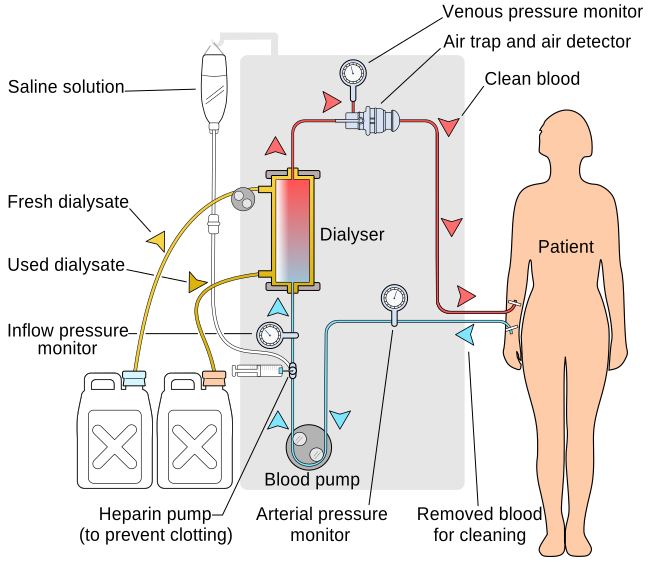
Typically 4 hours, three times a week, in a unit or at home.
Access is the practical problem. An arteriovenous fistula — surgically joining an artery to a vein in the arm — is the best option. The vein is exposed to arterial pressure, thickens and dilates over 6 to 12 weeks, and can then be needled repeatedly.
Fistulas last longer and have far fewer infections than catheters, which is why they are created well before dialysis is needed. A dialysis catheter in a large vein is the fallback and carries a substantial infection risk.
And a practical courtesy that is genuinely important: never take blood pressure or blood samples from an arm with a fistula. It can thrombose the access, which is a serious event for that person.
Between sessions, fluid and waste accumulate, so the person's chemistry swings over the week rather than staying steady. This is a fundamental limitation: a kidney works continuously and dialysis works intermittently.
Peritoneal dialysis
Uses the peritoneum — the abdominal lining — as the membrane. Fluid is run into the abdominal cavity through a permanent catheter, left to equilibrate, and drained.
Done at home, either as four exchanges a day or overnight by machine.
It gives more independence, more dietary freedom, and gentler continuous clearance. Its main complication is peritonitis, and the membrane's function declines over years.
Neither method replaces the hormonal functions. So dialysis patients still need erythropoietin injections, activated vitamin D, and phosphate binders.
And dialysis provides only about 10 to 15 percent of normal kidney clearance. This is the honest number and it explains everything about how dialysis patients feel — the fatigue, the dietary restrictions, the fluid limits of around a litre a day, and the fact that life expectancy on dialysis is substantially reduced.
It is a remarkable technology that keeps hundreds of thousands of people alive, and it is not a kidney.
Transplantation
The best treatment for end-stage kidney disease, and this is not a close comparison.
Outcomes: one-year graft survival around 95 percent for a living donor and 90 percent for a deceased donor. Median graft survival is around 12 to 20 years for a living donor kidney.
And life expectancy is roughly doubled compared with remaining on dialysis, alongside a very large improvement in quality of life.
The surgery is elegant and not what most people imagine. The new kidney is placed in the pelvis, not where the old ones are, connected to the iliac vessels and the bladder. The failed kidneys are usually left in place, because removing them adds risk for no benefit. So a transplant recipient typically has three kidneys.
Living donation is possible because one kidney is enough (Chapter 10.1). Donors have essentially normal life expectancy, with a small absolute increase in the long-term risk of kidney disease — a risk that is carefully explained and independently assessed.
Rejection is prevented by lifelong immunosuppression, usually a combination of a calcineurin inhibitor, an antiproliferative drug and a steroid.
And the cost of that is real and worth stating: increased infection risk, and a substantially increased risk of skin cancer and some other cancers, because immune surveillance is reduced (Chapter 19.7). Transplant recipients are advised on rigorous sun protection and have regular skin checks, and this is one of the more important pieces of long-term advice they receive.
Matching is by blood group and tissue type. Better matching gives better outcomes, and paired exchange schemes — where incompatible donor–recipient pairs are matched with other pairs — have substantially increased the number of living donor transplants possible.
The limiting factor everywhere is donor availability. Countries with opt-out consent systems have higher donation rates, though the effect depends heavily on how the system is implemented and on family involvement in practice rather than on the legal default alone.
What this Part adds up to
The kidney is the body's regulator. It does not merely excrete waste — it sets the volume, the concentration, the electrolyte composition, the acidity and the long-term blood pressure of everything inside you, and it does so continuously and without any conscious involvement.
Its failure therefore produces problems in every system, which is why chronic kidney disease is so much more than a urinary problem.
And the practical summary is short and mostly within a person's control.
Control blood pressure and blood sugar, which prevents the two leading causes. Stay hydrated, which prevents stones and protects against acute injury. Do not take regular NSAIDs without a reason, and stop them during any dehydrating illness. Ask what your kidney function is if you have diabetes, hypertension or a family history — it is on almost every blood test already taken and is frequently not discussed. And know the sick day rules if you are on an ACE inhibitor, ARB, diuretic or SGLT2 inhibitor: stop them temporarily during vomiting, diarrhoea or fever, and restart when eating and drinking normally.
Early kidney disease is silent, common, and now genuinely modifiable. The tests that find it are already being done; the drugs that slow it are cheap and available; and the difference between finding it at stage 2 and finding it at stage 5 is measured in decades.
What Part 11 does next
Every system so far has been coordinated by something. Part 11 covers the coordinator: the nervous system, from a single neuron's electrical behaviour through the spinal cord, the brainstem, the cerebral cortex, all twelve cranial nerves and the autonomic system, to the five senses — the largest Part in this volume, and the one that gets closest to explaining what it is to be you.