Appearance
12.7 — The Pineal, the Thymus, and the Hormones Nobody Names
Descartes called the pineal gland the seat of the soul, on the grounds that it was the only structure in the brain that was not paired. He was wrong about the soul and right that it is unusual, and its actual function — running the body's clock from a light signal — turned out to be stranger than anything he proposed.
This chapter finishes the endocrine system with the two remaining classic glands and with the growing list of organs that turned out to be endocrine organs without anyone noticing.
The pineal gland
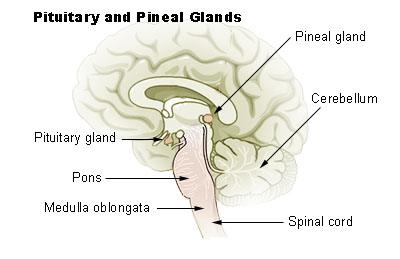
A pine-cone-shaped structure about 5 to 8 millimetres long, weighing around 0.1 grams, deep in the centre of the brain.
It produces melatonin, and only in darkness.
The pathway is genuinely peculiar and worth following, because it is the longest route between two structures a few centimetres apart in the whole body.
Light hits specialised retinal cells — not the rods and cones, but a small population containing a pigment called melanopsin, most sensitive to blue light around 460 to 480 nanometres.
They signal the suprachiasmatic nucleus of the hypothalamus — the master clock (Chapter 11.4).
That signal then travels down the spinal cord to the upper thoracic level, out to a sympathetic ganglion in the neck, and back up along the blood vessels into the skull to reach the pineal.
A signal from the eye to a gland a few centimetres behind it goes down to the chest and back. It is a legacy of the pineal's evolutionary history — in some reptiles it is a genuine light-sensing "third eye" on top of the head — and it is another example of the constraint in Chapter 3.6.
Melatonin rises about two hours before habitual sleep, peaks in the middle of the night, and falls before waking.
Its job is timing, not sedation. Melatonin is a signal that it is night, not a sleeping drug. This distinction matters practically: melatonin is effective for shifting the body clock — jet lag, delayed sleep phase, shift work — and only modestly effective as a sleep aid in ordinary insomnia.
And timing matters enormously. Taken in the evening it advances the clock; taken in the morning it delays it. Taken at the wrong time it makes jet lag worse. A small dose — 0.5 to 3 mg — is as effective as a large one for phase shifting, and the large doses commonly sold have no additional benefit.
Blue light suppresses melatonin, which is the physiological basis of advice about screens before bed. The effect on melatonin is real and measurable. The effect of screen filters and "night modes" on actual sleep quality is more modest than the marketing implies, and the more important factors are probably the content being engaging and the timing of use.
Melatonin production falls with age, which is one of several contributors to fragmented sleep in older people.
The pineal calcifies from adolescence onward, accumulating "brain sand". It is visible on skull X-rays and CT scans and is a useful midline landmark — a shifted pineal indicates a mass pushing the brain to one side. The calcification does not appear to impair function.
Circadian rhythm
The pineal is one output of a system that runs essentially every tissue.
The suprachiasmatic nucleus contains about 20,000 neurons and keeps time using a molecular feedback loop: a set of clock genes whose proteins accumulate, then switch off their own transcription, then degrade, allowing the cycle to restart. The loop takes about 24 hours.
Jeffrey Hall, Michael Rosbash and Michael Young received the 2017 Nobel Prize for working this out, largely in fruit flies.
The free-running period is about 24.2 hours, so it must be reset daily. Light is the main resetting signal, and food timing, exercise and temperature contribute.
And essentially every tissue has its own clock, synchronised by the central one. Liver, heart, kidney, gut and fat all show rhythmic gene expression, which is why so many physiological variables have a daily pattern.
Which has real clinical consequences:
Heart attacks peak in the morning hours, when blood pressure rises, platelets are stickier and cortisol is highest.
Asthma is worst in the early hours, when airway calibre is lowest.
Body temperature is lowest around 4 to 6 a.m., which is when a fever most often breaks and when alertness is at its minimum.
And drug effectiveness varies with timing. Chronotherapy — timing medication to the body clock — has good evidence in a few areas, including taking blood pressure medication and statins in the evening.
Shift work disrupts all of this, and the health consequences are well documented: increased cardiovascular disease, type 2 diabetes, obesity, and — the World Health Organization's cancer agency classifies shift work involving circadian disruption as a probable carcinogen. This is not a lifestyle inconvenience; it is a genuine occupational health issue affecting around 20 percent of workers in industrialised economies.
Seasonal affective disorder appears related to the same system — reduced light exposure in winter shifting the clock and affecting mood. Bright light therapy, 10,000 lux for 30 minutes in the morning, has reasonable evidence, and it works better in the morning than the evening, which fits the phase-shifting explanation.
The thymus
A soft, flat, two-lobed organ in the upper chest behind the sternum, and it is the only endocrine organ that is largest in childhood and essentially gone in adulthood.
About 15 to 20 grams at birth, peaking at 30 to 40 grams at puberty, and then progressively replaced by fat — down to a few grams of functional tissue by 60.
Its job is training T cells, which is Chapter 13.2 in full. The endocrine part is that it produces hormones — thymosin and others — that support that process.
Why it shrinks is a genuine question without a settled answer. The most-cited explanation is that the T cell repertoire is essentially established by early adulthood, so the enormous metabolic cost of maintaining the organ is no longer worth paying. Sex hormones accelerate the involution, which is consistent with that timing.
And its shrinkage has real consequences. Thymic output falls dramatically with age, so an older person's immune system relies on an established repertoire rather than on new cells. This contributes to reduced vaccine responses in the elderly and to increased susceptibility to genuinely new pathogens — which was visible in the age gradient of COVID-19 mortality.
Two clinical points.
A large thymus on a child's chest X-ray is normal and was historically mistaken for a mass, leading — in a genuinely dark episode of medical history — to thymic irradiation of children in the mid-twentieth century, which caused thyroid cancers decades later.
And thymoma — a thymic tumour — is strongly associated with myasthenia gravis (Chapter 6.2), which is why chest imaging is done in every newly diagnosed case.
The organs that turned out to be endocrine
This section is short and it changes how you think about the whole system.
Fat tissue. Adipose tissue is one of the largest endocrine organs in the body, and this was not recognised until leptin was discovered in 1994.
Leptin is produced in proportion to fat mass and signals the hypothalamus. It was greeted as the answer to obesity, and it was not.
The reason is instructive. Leptin's evolved function is to signal starvation, not surfeit. Low leptin is a powerful signal to eat and to conserve energy; high leptin is a weak signal to stop. The asymmetry makes sense: for most of history, the dangerous error was starving.
So obese people have high leptin and are resistant to it, and giving more does nothing.
Leptin treatment works spectacularly in the very rare children born unable to make it — who are relentlessly hungry from infancy and become severely obese, and who normalise on replacement. It does nothing for ordinary obesity.
Adiponectin is the other major one, and it is inversely related to fat mass — low in obesity, and it improves insulin sensitivity, which is part of why more fat means more insulin resistance.
Fat also produces inflammatory signals and converts androgens to oestrogen (Chapter 12.6).
The gut. More than twenty hormones, and one class has changed medicine recently.
GLP-1 is released by the gut in response to food. It increases insulin release, but only when glucose is high — which is why GLP-1-based drugs do not cause hypoglycaemia the way sulfonylureas do. It also slows stomach emptying and acts on the hypothalamus to reduce appetite.
GLP-1 receptor agonists — semaglutide and its relatives — have produced weight loss of 15 to 20 percent in trials, which is a magnitude previously achievable only with surgery, alongside reductions in cardiovascular events.
And their existence is a direct product of understanding a gut hormone, which is a good argument for basic endocrine research.
Ghrelin is the counterpart — the only known hormone that increases appetite, released by the stomach when empty and rising before meals. Its levels fall after bariatric surgery, which is part of why that operation works better than the mechanical restriction alone would explain.
The heart. Natriuretic peptides, released when the chambers are stretched, causing the kidney to excrete salt and water. Measuring BNP is now a standard test for heart failure — a hormone assay diagnosing a mechanical problem.
The kidney. Erythropoietin, renin, and the final activation of vitamin D (Chapter 10.1).
Bone. Osteocalcin, from osteoblasts, appears to affect insulin sensitivity and possibly muscle and cognition — a genuinely surprising finding suggesting the skeleton signals back to the metabolism that maintains it. The human evidence is less developed than the animal evidence, and it should be presented as promising rather than established.
Muscle. Myokines, released during contraction. They are a leading candidate for how exercise produces benefits in organs it does not mechanically load — including the brain, where exercise-induced signals appear to increase the growth factors that support neuron survival and hippocampal function (Chapter 11.6).
Skin. Vitamin D synthesis (Chapter 5.1).
The placenta. In pregnancy it becomes a large endocrine organ, producing hCG, oestrogen, progesterone, and hormones that deliberately induce insulin resistance in the mother — diverting glucose to the fetus, and causing gestational diabetes where the mother's reserve is inadequate (Chapter 15.6).
What this Part adds up to
The endocrine system is a broadcast network with private receivers. Hormones reach everything; only cells with the matching receptor respond.
Its architecture is almost entirely negative feedback in three levels, which is what makes endocrine diagnosis possible: measure the hormone and its controller together, and the pattern tells you which level has failed.
Its diseases come in four forms — too much, too little, resistance, and ectopic production — and recognising the form organises a large and otherwise scattered subject.
And the encouraging summary is substantial. Hypothyroidism, type 1 diabetes and adrenal insufficiency were all fatal or profoundly disabling within living memory and are now managed with daily replacement. Congenital hypothyroidism, the leading preventable cause of intellectual disability, is caught by a heel-prick test in the first week of life. Iodine deficiency, once the largest preventable cause of brain damage worldwide, has been enormously reduced by putting iodine in salt.
And type 2 diabetes — the largest endocrine disease in the world — can be pushed into remission by weight loss in a substantial proportion of people (Chapter 12.5), which is the single most hopeful fact in this Part and one of the least widely known.
The practical summary for a reader's own endocrine health is short. Maintain a reasonable weight and stay active, because visceral fat drives insulin resistance and is itself an endocrine organ. Protect your sleep and your light exposure, because the clock runs everything else. Get iodine from your diet. And if you have unexplained fatigue, weight change, temperature intolerance or mood change, ask for thyroid and glucose tests — they are cheap, they are on almost every routine panel already, and they explain a substantial proportion of symptoms that get attributed to stress or ageing.
What Part 13 does next
One system remains that touches every other. Part 13 covers the immune system — the barriers, the two arms of the response, how antibodies achieve near-infinite variety from a finite genome, why vaccines work, and what happens when the system attacks you instead.