Appearance
13.1 — Barriers and Innate Immunity
You are covered, inside and out, in bacteria. Around 38 trillion of them (Chapter 1.1), plus fungi and viruses, on every surface that touches the outside world — and your skin, gut, airways and urinary tract are all outside world in the sense that matters.
And you are almost never infected. The barriers hold, and behind them sits a defence system that is ready before any infection begins and does not need to learn anything first.
Two systems
Innate immunity — present from birth, immediate, non-specific, and with no memory. It responds identically to the thousandth encounter as to the first.
Adaptive immunity — learned, slow to start, extraordinarily specific, and with memory. It responds faster and harder every time.
They are not separate departments. The innate system decides whether the adaptive system is called, and what kind of response it mounts — which makes it the more consequential of the two in a way its "primitive" reputation obscures.
And the innate system handles the overwhelming majority of encounters without the adaptive system ever being involved.
The barriers
The first and best defence is not letting anything in, and it works better than anything downstream.
Skin — several layers of dead keratinised cells, continuously shed, taking attached organisms with them. Dry, which most bacteria dislike. Slightly acidic, at pH 4 to 6 — the "acid mantle" — which inhibits many pathogens. And already colonised by harmless bacteria that occupy the space.
Which is why any break in the skin matters so much. Burns are the extreme case: extensive burns remove the barrier over a large area, and infection, not the burn itself, is the leading cause of death after the first day.
Mucous membranes — wet surfaces, and they use different tactics.
Mucus traps. Cilia sweep — the mucociliary escalator of Chapter 4.2, moving a centimetre a minute.
Flushing — tears, saliva and urine all wash surfaces continuously. This is why urinary infections are commoner when flow is obstructed or infrequent (Chapter 10.5), and why a dry eye becomes infected.
Chemical defences. Lysozyme, in tears, saliva and mucus, digests bacterial cell walls. Stomach acid at pH 1.5 to 2 kills most swallowed organisms (Chapter 9.2) — which is why acid-suppressing drugs modestly increase the risk of gut infections. Lactoferrin binds iron, which bacteria need to grow — an underappreciated defence, and the reason the body also lowers blood iron during infection.
Antimicrobial peptides — defensins and cathelicidins — punch holes in microbial membranes, and are produced by skin, gut and airway lining cells.
The normal flora — colonisation resistance. A dense established community occupies the niches, consumes the nutrients and produces inhibitory substances.
And the clearest demonstration is what happens when it is removed. Clostridioides difficile colitis after antibiotics (Chapter 9.6), and thrush after antibiotics — the bacteria that normally keep Candida in check are killed, and the fungus expands.
Recognising an invader
The innate system faces a genuine problem: how do you recognise something you have never seen, without attacking yourself?
The answer, worked out largely in the 1990s, is that it recognises patterns that microbes have and human cells do not.
Pattern recognition receptors — of which the Toll-like receptors are the best known — detect conserved molecular patterns shared across whole classes of microbe.
Examples: lipopolysaccharide, in the outer membrane of every Gram-negative bacterium (Chapter 3.7). Peptidoglycan, in bacterial cell walls. Flagellin, in bacterial tails. Double-stranded RNA, which is produced by many viruses and essentially never by human cells. And unmethylated CpG DNA, which is a bacterial pattern.
These are structures that are essential to the microbe and therefore cannot easily be changed to evade detection. That is the whole design principle: target what the enemy cannot afford to lose.
Bruce Beutler and Jules Hoffmann shared the 2011 Nobel Prize for identifying these receptors, alongside Ralph Steinman for dendritic cells.
The system also detects damage rather than infection. Molecules that should be inside cells — DNA, ATP, uric acid — signal that cells have died violently, and trigger inflammation whether or not any microbe is present.
This is why a crush injury or a heart attack produces a systemic inflammatory response identical in appearance to sepsis. The body cannot tell, at that level, whether the tissue was destroyed by bacteria or by a blocked artery.
The cells
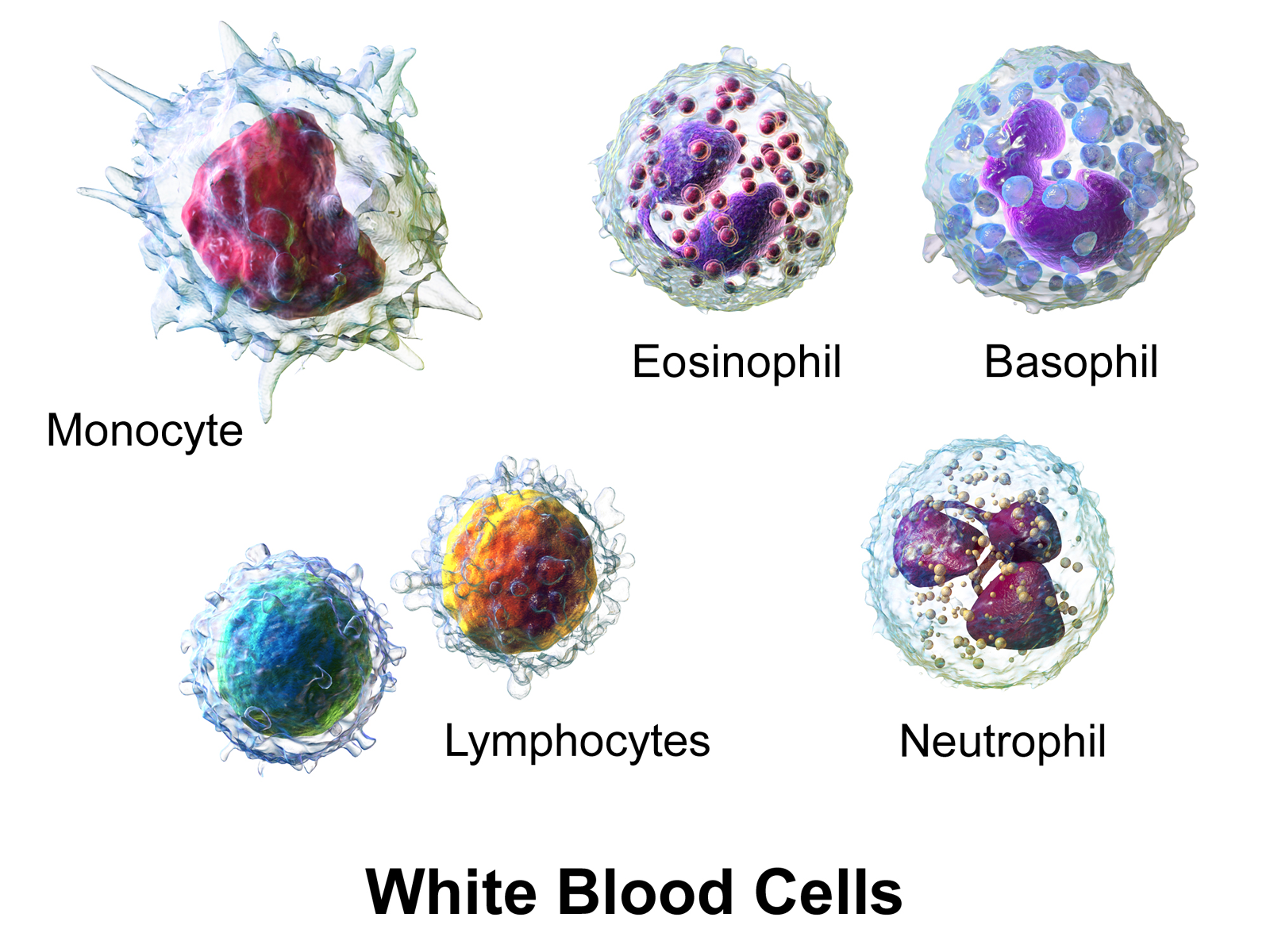
Neutrophils — 40 to 70 percent of white cells, and the first responders.
Made at around 100 billion a day, circulating for only 6 to 12 hours before entering tissue. They are disposable by design.
They arrive at an infection within minutes to hours, engulf bacteria, and die doing it. Pus is dead neutrophils, dead bacteria and tissue debris.
And they have a third weapon, discovered relatively recently, that is genuinely strange. Neutrophil extracellular traps: the cell expels its own DNA as a sticky mesh studded with antimicrobial proteins, trapping bacteria outside the cell. The neutrophil dies in the process. It is a suicide net, and it appears to contribute to both defence and, when excessive, to the clotting problems of severe sepsis and COVID-19.
Macrophages — from monocytes, and long-lived, unlike neutrophils. They are resident in every tissue, with local names: Kupffer cells in the liver (Chapter 9.4), microglia in the brain, alveolar macrophages in the lung.
They do three jobs. Phagocytosis. Antigen presentation — showing fragments of what they have eaten to T cells, which is how the adaptive system is briefed. And tissue repair, clearing debris and orchestrating healing.
Dendritic cells — the key link between the two systems. They sit in tissues, sample everything, and then migrate through the lymphatics to a lymph node to present what they have found to T cells (Chapter 7.8).
They are the messenger that starts the adaptive response, and without them it does not begin.
Natural killer cells — and their targeting logic is unusual and elegant.
Most cells display fragments of their own internal proteins on surface molecules called MHC class I, essentially advertising what is inside them. Killer T cells inspect that display and destroy any cell showing something foreign (Chapter 13.2).
So viruses and tumours evolved a countermeasure: stop displaying anything. A cell with no MHC class I cannot be inspected.
Natural killer cells close that loophole. They kill cells that are missing their identity display — "missing self" recognition. So a virus that hides is killed by one system and a virus that shows itself is killed by the other, and there is no configuration that escapes both.
Mast cells — in tissues, packed with histamine granules. They release them on contact with allergens or damage, causing the immediate local response of redness, swelling and itching. Central to allergy (Chapter 13.6).
Eosinophils — against parasites too large to swallow, and involved in allergy. Raised eosinophils suggest parasites or allergy, which is a genuinely useful pairing.
Phagocytosis

The steps: recognition and attachment, engulfment into a vesicle, fusion with a lysosome, and destruction.
Destruction uses two mechanisms.
Oxygen-dependent — the "respiratory burst": an enzyme generates reactive oxygen species, including hydrogen peroxide and, remarkably, hypochlorite — the active ingredient of household bleach, manufactured inside the cell.
Oxygen-independent — lysosomal enzymes, antimicrobial peptides, and lactoferrin.
And when the oxygen-dependent route fails, you get a specific disease. Chronic granulomatous disease is an inherited deficiency of the enzyme generating the burst. The cells engulf bacteria perfectly well and cannot kill them, so organisms survive inside the phagocyte — which becomes a protected transport system rather than a defence. Recurrent severe infections with specific organisms, and clumps of frustrated macrophages called granulomas.
Opsonisation makes phagocytosis far more efficient. Coating a microbe with antibody or complement gives the phagocyte something specific to grip. The word comes from Greek for "to prepare food for eating", which is exactly right.
The complement system
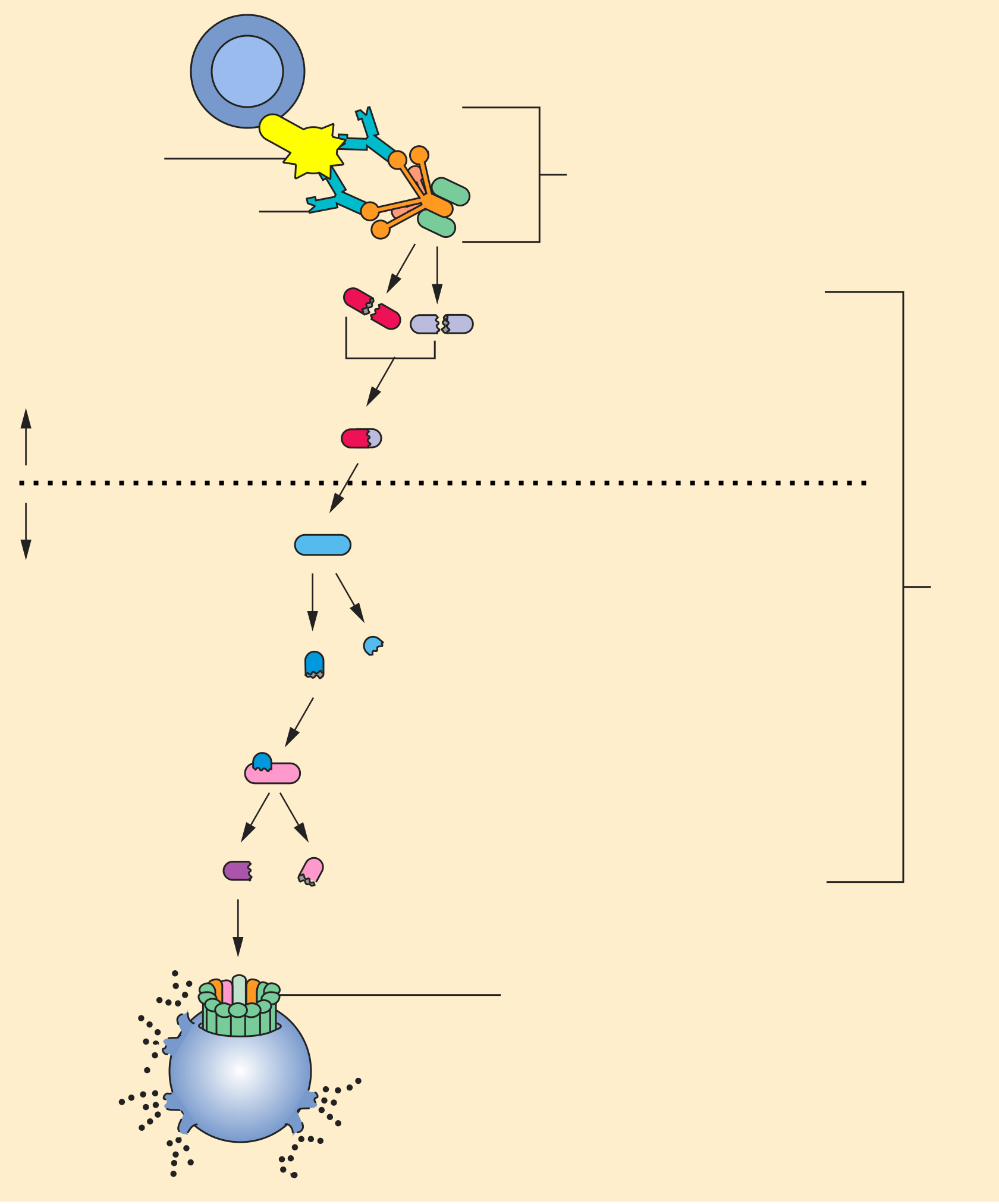
About 30 plasma proteins, made by the liver, circulating inactive, and activating in a cascade — the same amplification principle as clotting (Chapter 7.1).
Three activation routes:
Classical — triggered by antibody bound to a surface. This one requires the adaptive system, which is why it is the "classical" pathway despite being evolutionarily the newest.
Lectin — triggered by a protein binding mannose sugars found on microbial surfaces and not on human ones.
Alternative — complement spontaneously activates at a low rate on any surface, all the time. Human cells carry regulatory proteins that shut it down instantly; microbial surfaces do not.
So the alternative pathway works by the absence of protection rather than by the presence of a target, which is a genuinely clever design: it does not need to recognise the enemy at all, only to fail to recognise a friend.
Three outputs:
Opsonisation — coating the microbe for phagocytosis. Quantitatively the most important.
Inflammation — fragments released during the cascade attract neutrophils and trigger mast cells.
The membrane attack complex — proteins assembling into a pore that punches through the microbial membrane, causing it to burst.
And the membrane attack complex has a specific and limited importance. It is essential against one group of organisms: Neisseria — the bacteria causing meningococcal disease and gonorrhoea. People with a deficiency in the late complement components have recurrent meningococcal infections and are otherwise largely well, which is a remarkably narrow deficit and tells you exactly what that part of the system is for.
Failure of complement regulation causes disease too. Hereditary angioedema results from deficiency of a regulator, causing episodes of severe swelling of the face, airway and gut. It does not respond to adrenaline, antihistamines or steroids, because it is not an allergic reaction — which is exactly why recognising it matters, since treating it as anaphylaxis wastes the time in which the specific treatment could work.
And eculizumab, an antibody blocking a complement protein, treats two rare diseases caused by uncontrolled complement activation — a treatment designed directly from the mechanism.
Interferons
The antiviral arm of innate immunity, and the name describes the discovery: they interfere with viral replication.
A virus-infected cell releases interferon, which acts on neighbouring cells — not on the infected cell itself.
Those neighbours then switch on antiviral genes that degrade viral RNA, block viral protein synthesis, and prepare the cell to kill itself if infected.
So interferon is a warning to the neighbours. The infected cell is already lost; the signal protects the ones around it.
Interferons also activate natural killer cells and macrophages.
And they cause the systemic symptoms of a viral illness. The fever, aching muscles, headache and profound fatigue of influenza are largely interferon effects rather than damage caused by the virus itself.
Which is why interferon given as a drug produces exactly those side effects — a flu-like illness — and why it was so poorly tolerated when it was the main treatment for hepatitis C. Its replacement by direct-acting antivirals, with cure rates over 95 percent and few side effects, is one of the great therapeutic improvements of the last decade (Chapter 17.10).
The interface with the adaptive system
The innate system does not simply hold the line until the adaptive system arrives. It instructs it.
Dendritic cells present antigen to T cells and, at the same time, provide co-stimulatory signals and cytokines that determine what kind of response is mounted — antibody-dominant, cell-killing, or anti-parasite.
And the T cell requires both signals. Antigen alone, without co-stimulation, does not activate a T cell — it inactivates it.
That two-signal requirement is a major safety mechanism. It means a T cell encountering a harmless self-antigen on an ordinary cell, with no sign of danger, is switched off rather than switched on.
Which is exactly why adjuvants exist in vaccines. A purified protein alone is a poor vaccine, because it provides antigen without any danger signal. An adjuvant supplies the innate stimulus that tells the system this is worth responding to. Chapter 13.5.
And it is the basis of an entire class of cancer drugs. Checkpoint inhibitors block the "off" signals that tumours exploit to switch T cells off, releasing a response that was already present but suppressed (Chapter 19.7).
What the next page fixes
The innate system recognises categories. Chapter 13.2 covers the system that recognises individuals — how B and T cells generate enough different receptors to recognise essentially any molecule that could exist, including ones that have never existed, and how they are prevented from recognising you.