Appearance
1.9 — Where Life Came From
The Earth formed about 4.54 billion years ago. For the first few hundred million years it was being hit hard and often by leftover debris, and the surface was repeatedly melted. The oldest rocks that clearly contain the chemical fingerprint of living things are about 3.8 billion years old, and the oldest structures most researchers accept as fossils — layered mats built by microbes, from Western Australia — are about 3.48 billion years old.
So life appeared within a few hundred million years of the planet becoming habitable at all. That is fast, and it is the single most important clue in the subject, because it suggests that whatever happened was not a freak accident requiring impossible luck. It happened about as soon as it could.
This page covers what is actually known about how, what has been demonstrated in a laboratory, and — just as importantly — what is not known. The honest version is more interesting than the confident one, in both directions.
What has to be explained
Life did not need to appear all at once. It needed a sequence, and each step in the sequence has to be possible with ordinary chemistry and no help.
- Small molecules. Amino acids, sugars, the bases of nucleic acids.
- Chains. Those small molecules joined into polymers — proteins and nucleic acids.
- Copying. Some molecule able to make copies of itself, imperfectly.
- A compartment. A boundary, so that a useful molecule stays with the copies it makes rather than diffusing away.
- Energy. A steady source, coupled to the chemistry.
- The code. The link between a nucleic acid sequence and a protein sequence.
Steps 1, 2 and 4 are largely solved. Step 3 is partly solved. Steps 5 and 6 are where the real arguments are.
Step 1: the small molecules make themselves
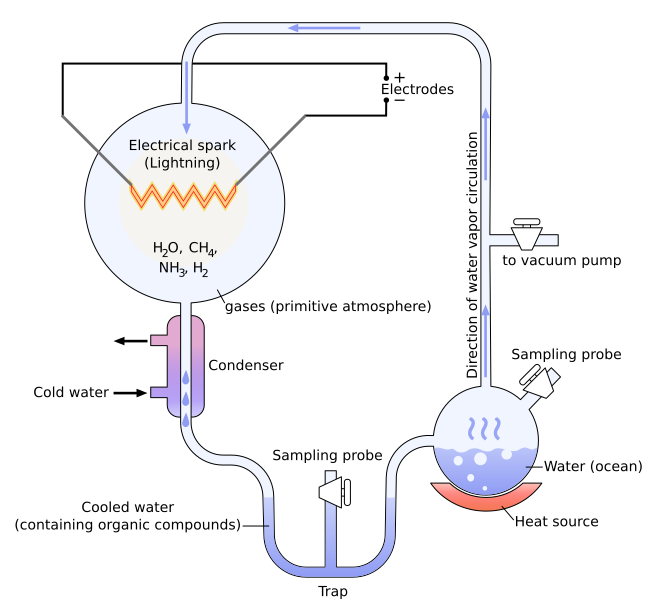
Stanley Miller was a 23-year-old graduate student working under Harold Urey in Chicago when he built the apparatus in the figure in 1952. He filled it with water, methane, ammonia and hydrogen — Urey's best guess at the early atmosphere — sealed it, boiled the water, and ran electric sparks through the gas to imitate lightning. Then he left it running for a week.
The water turned pink, then deep brown. When Miller analysed it he found amino acids — glycine and alanine among them — formed from nothing but gas, water and electricity. The paper appeared in Science in 1953 and it changed the subject from philosophy into an experimental science.
What the experiment showed and what it did not. It showed that the building blocks of life form spontaneously under plausible conditions, without any biological machinery. It did not show how life began, and Miller never claimed it did. Amino acids are not alive; they are only ingredients.
Two later developments are worth knowing, because they cut in opposite directions.
The criticism: geologists now think the early atmosphere was probably not as hydrogen-rich as Urey assumed, and was more likely dominated by carbon dioxide and nitrogen. Repeating the experiment with such a mixture gives far fewer amino acids.
The support, which is stronger: the molecules turn up everywhere anyway. In 2008 Jeffrey Bada reanalysed Miller's original sealed sample vials, which had been kept for over fifty years, using modern instruments, and found more than twenty amino acids rather than the handful Miller could detect in 1953. More decisively, the Murchison meteorite, which fell in Australia in 1969, has yielded over eighty amino acids, along with sugars and the bases found in nucleic acids. Nobody made those in a flask; they formed in space and arrived by post. Comets and interstellar clouds show the same chemistry.
So the ingredients are not the problem. The universe produces them readily, and the early Earth would have received them from above as well as making them below.
Step 2: joining them up, which water fights
Chapter 1.2 established that building a polymer is a condensation reaction — it releases a water molecule at each link. That creates an immediate difficulty, and it is a real one: a reaction that releases water does not want to happen in water. In a dilute ocean, chains break down faster than they build up. The early Earth's oceans are exactly where you would expect polymers not to form.
Three answers are on the table, and they are not exclusive.
Wet–dry cycling. A puddle at the edge of a hot spring evaporates, concentrating everything in it and removing the water that was opposing the reaction. Chains form on drying. Rain refills the puddle, and the cycle repeats. Laboratory versions of this do produce chains of amino acids and of nucleotides. Charles Darwin guessed something very close to this in a letter to Joseph Hooker in 1871, imagining "some warm little pond" with the right chemicals, and he added the sharp observation that any such compound formed today would be "instantly devoured or absorbed" — which is why it could only have happened before there was life to eat it.
Mineral surfaces. Clay minerals such as montmorillonite have charged layered surfaces that concentrate organic molecules out of dilute solution and hold them in alignment. In the laboratory, montmorillonite catalyses the assembly of RNA chains up to about fifty units long. The mineral acts as both a workbench and a crude catalyst.
Hydrothermal systems, covered below, provide mineral surfaces, temperature gradients and a continuous chemical flow all at once.
Step 3: something that copies itself
This is the hard one, and it contains a genuine paradox.
DNA stores information but cannot do anything with it — it needs proteins to be copied and read. Proteins do the work but carry no information about how to build themselves — they need DNA. Each requires the other, so neither can plausibly have come first.
The way out is a molecule that does both, and RNA turns out to be exactly that.
For decades RNA was thought to be a passive messenger. Then, in the early 1980s, Thomas Cech and Sidney Altman independently found RNA molecules that catalyse chemical reactions — ribozymes. They shared the 1989 Nobel Prize in Chemistry for it. That discovery made a self-sufficient RNA system conceivable: RNA can hold a sequence like DNA, and RNA can catalyse reactions like a protein.
This is the RNA world hypothesis, and it has one piece of evidence that is difficult to argue with. The ribosome — the machine that builds every protein in every living thing — is itself a ribozyme. When the ribosome's structure was finally solved in 2000, the site where peptide bonds are actually made turned out to contain no protein at all. It is pure RNA. The proteins in a ribosome are scaffolding around an RNA core. Venkatraman Ramakrishnan, Thomas Steitz and Ada Yonath received the 2009 Nobel Prize in Chemistry for that work.
And the fingerprints are all over your metabolism. Look again at the energy carriers from Chapter 1.6: ATP is a nucleotide. NAD is a nucleotide. FAD is a nucleotide. Coenzyme A contains one. There is no chemical reason a protein-based metabolism would have chosen nucleotides for these jobs. They look like leftovers from a time when RNA ran everything, kept because too much depended on them to change. Francis Crick called such things molecular fossils.
The remaining problem is that RNA is difficult to make from scratch. For a long time nobody could produce ribonucleotides under plausible early-Earth conditions — attempts to attach a base to a sugar simply did not work. In 2009 John Sutherland's group found a route that sidesteps the problem entirely: instead of making the sugar and the base separately and joining them, their reaction builds the finished nucleotide in stages from simpler starting molecules that plausibly existed, and the sugar and base are never separate intermediates. That result removed the single biggest chemical objection.
It has not been finished. Nobody has yet built an RNA molecule that copies itself from free nucleotides without help. Laboratory ribozymes can copy quite long stretches of other RNA, which is close, but the full self-copying replicator has not been demonstrated. This is an open problem, and it should be described as one.
Step 4: the compartment, which is the easy part
Chapter 1.4 already gave the answer. Drop fatty molecules into water and they assemble into closed spheres by themselves, driven by nothing more than water's preference for its own company. No machinery is required and no information is needed.
Jack Szostak's laboratory has shown that such vesicles will grow when more lipid is available, will incorporate RNA, and will divide into daughter vesicles when agitated — for example by wave action or by flow through porous rock. A vesicle containing RNA that grows and splits is not alive, but it has the outline of a cell, and every step has been done in a beaker.
Why the compartment matters so much: without one, a molecule that catalyses its own copying gives its benefit to the whole ocean. Inside a boundary, a better replicator makes more copies inside its vesicle, that vesicle grows and divides faster, and there is now something for selection to act on. The compartment is what turns chemistry into heredity.
Step 5: where the energy came from
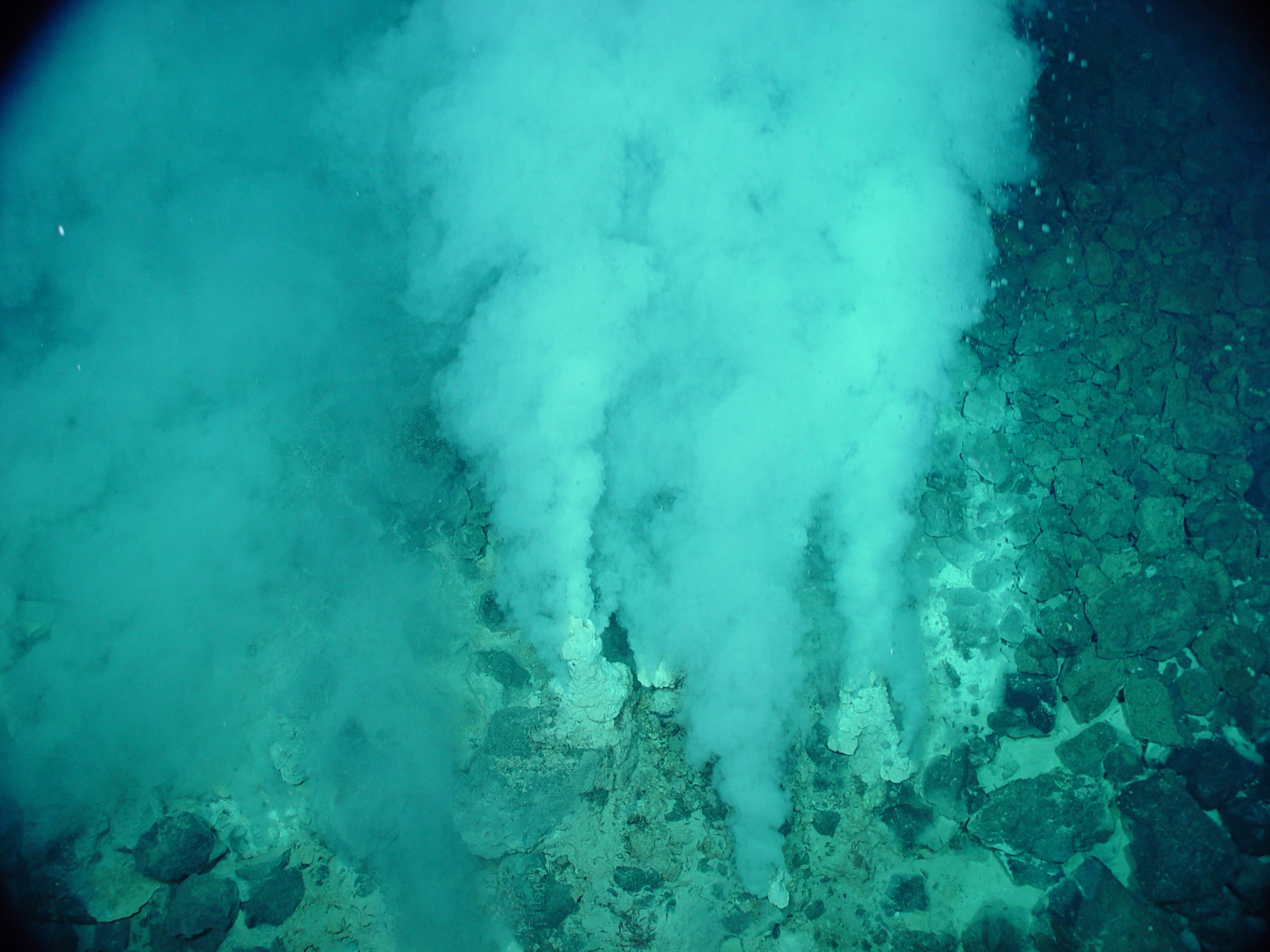
Two rival venues, and the argument between them is the most active part of the field.
The warm little pond. Shallow water at the surface, driven by sunlight, lightning and evaporation cycles. Its strength is chemistry: the wet–dry cycles that make polymers, and the ultraviolet light that some of Sutherland's reactions actually require. Its weakness is that the surface of the early Earth was a violent place, with heavy ultraviolet radiation and frequent impacts.
Alkaline hydrothermal vents. Deep on the ocean floor, where seawater percolates into the rock, reacts with it, and comes back out warm and alkaline, building porous mineral chimneys. The Lost City field on the Mid-Atlantic Ridge, discovered in 2000, is the real-world example. These are not the scalding black smokers of nature documentaries; they are cooler, around 40 to 90 °C, long-lived, and structurally full of interconnected microscopic pores.
And here is the argument that makes this hypothesis compelling, developed by Michael Russell and Nick Lane. Go back to Chapter 1.6 and recall how every living cell on Earth makes its ATP: by pumping protons across a membrane to build a gradient, then letting them flow back through a rotary motor. That mechanism is universal, in bacteria, archaea and you, which means it was already present in the common ancestor of all life. It is also a strange mechanism to have invented — far stranger than simply coupling chemical reactions directly.
At an alkaline vent, that gradient exists for free. The fluid inside the pores is alkaline, meaning low in protons. The early ocean was acidic, meaning rich in protons. The thin mineral wall of each pore separates them. Every pore in the chimney is therefore a natural proton gradient across a membrane, maintained continuously by geology, with no biological machinery whatsoever.
If life started in such a pore, it did not have to invent proton gradients — it had to learn to exploit one it was already sitting in, and only later build its own membrane and its own pump to become independent of the rock. That would explain why the mechanism is universal, why it is so peculiar, and why it is so deeply embedded that no lineage has ever replaced it.
This is a hypothesis with strong explanatory reach, not an established fact. Its main weakness is chemical: some of the reactions that work well in the warm-pond scenario work poorly in seawater. Some researchers now argue for a combination — building blocks made at the surface, delivered to and concentrated in a vent-like environment.
Step 6: the genetic code
Why does the triplet GCA mean alanine? There is no obvious chemical reason it should, and this is the least solved part of the whole problem.
The code is not entirely random — chemically similar amino acids tend to have similar triplets, which makes the code unusually resistant to mutation, since a single-letter error often gives a similar amino acid and a protein that still works. That pattern is very unlikely to be coincidence, and it suggests the code was refined by selection rather than frozen at random. But how the first association between a triplet and an amino acid was established is genuinely unknown.
LUCA: the ancestor we can actually reconstruct
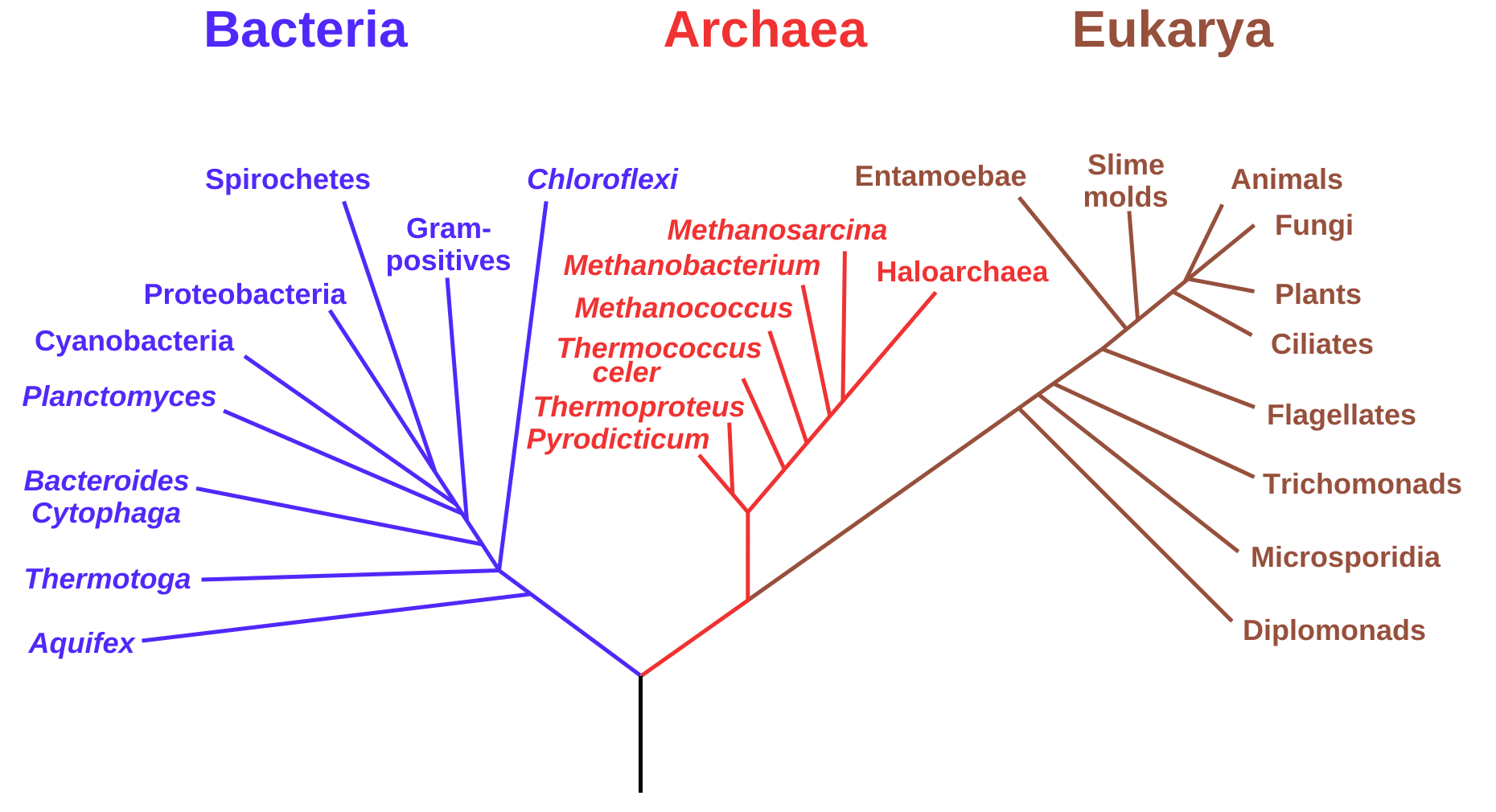
LUCA is the Last Universal Common Ancestor — the most recent organism from which every living thing descends. It is emphatically not the first life. There was life before it, and there were probably other lineages alongside it; they simply left no surviving descendants.
We cannot dig LUCA up, but we can reconstruct parts of it, and the method is straightforward. Anything present in bacteria, in archaea and in eukaryotes was almost certainly present in their common ancestor, because inventing the same complicated thing three times independently is far less likely than inheriting it once.
That reasoning tells us LUCA already had: DNA as its genetic material, the same genetic code we use, ribosomes of the same basic design, ATP as its energy currency, a lipid membrane, and proton-gradient-driven ATP synthesis. LUCA was already a sophisticated cell, which means a very great deal of evolution happened before it.
A 2016 analysis by William Martin's group tried to be more specific, looking for genes present across both bacteria and archaea in a pattern suggesting genuine inheritance rather than later swapping. They identified around 355 such genes, and the picture that emerged was of an organism that lived without oxygen, tolerated high temperatures, depended on hydrogen gas and carbon dioxide, and used metal-containing enzymes — in other words, something that would be entirely at home at a hydrothermal vent. The analysis has been criticised on methodological grounds and the number should not be treated as precise, but the general portrait has held up reasonably well.
After life: two events that made you possible

The Great Oxidation Event, about 2.4 billion years ago. Cyanobacteria — the organisms that build the mounds in the photograph — evolved photosynthesis that splits water and releases oxygen as a waste product. For hundreds of millions of years that oxygen was absorbed by dissolved iron in the oceans, which rusted and sank, laying down the banded iron formations that most of the world's iron ore comes from. Once the iron was used up, oxygen began accumulating in the atmosphere.
For almost everything alive at the time, this was a poisoning. Oxygen is chemically aggressive and destroys the metal-containing enzymes that anaerobic life depends on. It is often called the oxygen catastrophe, and it was probably the largest extinction in Earth's history, though it left no fossils to count.
It also made large, active life possible. Chapter 1.6 explained why: oxygen's strong pull on electrons makes it the best available terminal electron acceptor, and using it releases far more energy per glucose than any anaerobic alternative. Roughly 32 ATP against 2. No oxygen, no animals.
The endosymbiosis, somewhere between 2 and 1.6 billion years ago. One cell engulfed a bacterium capable of using oxygen efficiently and did not digest it. Chapter 1.5 laid out the evidence — the double membrane, the circular DNA, the bacterial ribosomes. The result was the eukaryotic cell, with an energy supply distributed across hundreds of internal power stations rather than confined to its outer membrane.
That is what removed the ceiling on cell size and complexity. A bacterium makes ATP only at its outer membrane, so its power output is limited by its surface area, which grows far more slowly than volume — a bigger bacterium is a worse-powered one. Mitochondria put membrane inside, so a cell can grow and add power stations at the same time. Every eukaryote, including you, is the descendant of that single merger.
What is honestly not known
The exact route. We have plausible chemistry for most steps and demonstrated chemistry for several, but not one continuous demonstrated path from simple molecules to a self-copying, compartmentalised system.
The origin of the code. Genuinely open.
Whether it happened once or many times. All surviving life descends from LUCA, but that does not mean life only started once — it means only one lineage survived. Other starts may have occurred and been outcompeted or wiped out. There is no way at present to tell.
And "it came from space" does not answer the question. Some material certainly arrived from space — the Murchison meteorite proves that ingredients did. But if life itself arrived ready-made, the question of how it originated has only been moved to a different address, not answered.
No one has made life from chemistry in a laboratory, and it is worth being clear about what has been done. In 2016 Craig Venter's institute produced JCVI-syn3.0, a bacterium running on a chemically synthesised genome stripped down to 473 genes. That is a remarkable achievement in engineering — but the synthetic DNA was inserted into an existing living cell, which supplied every membrane, ribosome and enzyme needed to read it. It is a genome transplant, not the creation of life. Notably, the function of about a fifth of those 473 essential genes is still not understood, which is a useful reminder of how much of even a minimal cell remains unexplained.
Why this matters to you and not only to historians
Because it is the reason medicine works across species. Every living thing uses the same DNA, the same genetic code, the same ATP, the same ribosome design, because all of it descends from LUCA. That single fact makes the whole of biomedical science possible.
Human insulin is manufactured by bacteria. The human gene is inserted into E. coli, and the bacterium reads it correctly and builds human insulin, because the code is the same in both. Before 1982 diabetics used insulin extracted from pig and cow pancreases, which was in short supply and caused allergic reactions in some people. Chapter 22.8.
A drug is tested in mice because mouse biochemistry is our biochemistry, in most respects that matter.
And antibiotics work because of where the tree branches. Chapter 1.5 explained that a bacterial ribosome is 70S and yours is 80S — different enough to be attacked separately, because bacteria and eukaryotes separated very early. Where the split is more recent, drugs are harder to design: fungi are eukaryotes like us, which is exactly why antifungal drugs are more toxic and more limited than antibacterials. The difficulty of treating a fungal infection is a direct consequence of the shape of the tree in the figure above.
What Part 2 does next
This Part built the cell from its molecules up. Everything in it depended on a set of instructions being read accurately, copied faithfully, and passed on — and that machinery has been referred to a dozen times without being explained. Part 2 opens the instruction set: what DNA is, how it is copied, how it is read into protein, how it is regulated, how it mutates, how it is inherited, and what happens when a single letter of it is wrong.