Appearance
12.3 — The Thyroid and Parathyroid Glands
The thyroid sets the speed at which every cell in your body runs. Too much and you are hot, thin, anxious and your heart races. Too little and you are cold, slow, heavy and exhausted. It is one of the very few organs whose failure changes a person's entire character, and one of the very few whose treatment reverses it completely.
Wrapped around its back are four glands the size of grains of rice, controlling your blood calcium — and therefore whether your nerves and muscles work at all.
The thyroid

A butterfly-shaped gland in the front of the neck, two lobes joined by an isthmus crossing the trachea, weighing 15 to 25 grams.
It moves upward on swallowing, because it is attached to the tracheal cartilages. This is diagnostically useful: a neck lump that moves on swallowing is thyroid, and a lump that also moves when the tongue is stuck out is a thyroglossal cyst, from the gland's descent during development (Chapter 9.2).
It has an extremely rich blood supply — one of the highest flows per gram of any organ — which is why thyroid surgery bleeds and why a very overactive gland can produce an audible bruit over it.
The recurrent laryngeal nerve runs immediately behind it (Chapter 3.6), which is the main surgical hazard.
Its microscopic structure is unique. The gland is made of hollow spheres called follicles, filled with a protein gel — colloid — in which hormone is stored outside the cells. This is the only endocrine gland that stores its hormone extracellularly, and in large quantity: there is enough stored to supply the body for two to three months.
That reservoir is why thyroid disease develops so slowly, and why treatment takes weeks to work.
Making thyroid hormone
Iodine is essential and it comes only from the diet.
The gland traps iodide from the blood against a steep gradient — concentrating it 20 to 40 times.
And that trapping mechanism has two important consequences.
It is how radioactive iodine treatment works. Give radioactive iodine and the thyroid concentrates it, delivering radiation to itself and almost nowhere else. It is one of the most selectively targeted treatments in all of medicine, and it long predates the modern idea of targeted therapy.
And it is why iodine tablets are distributed after a nuclear accident. Radioactive iodine-131 is a major fission product, and a thyroid that is already saturated with ordinary iodine will not take it up. Taking potassium iodide before or shortly after exposure blocks uptake and prevents the thyroid cancers that followed Chernobyl in large numbers, particularly in children.
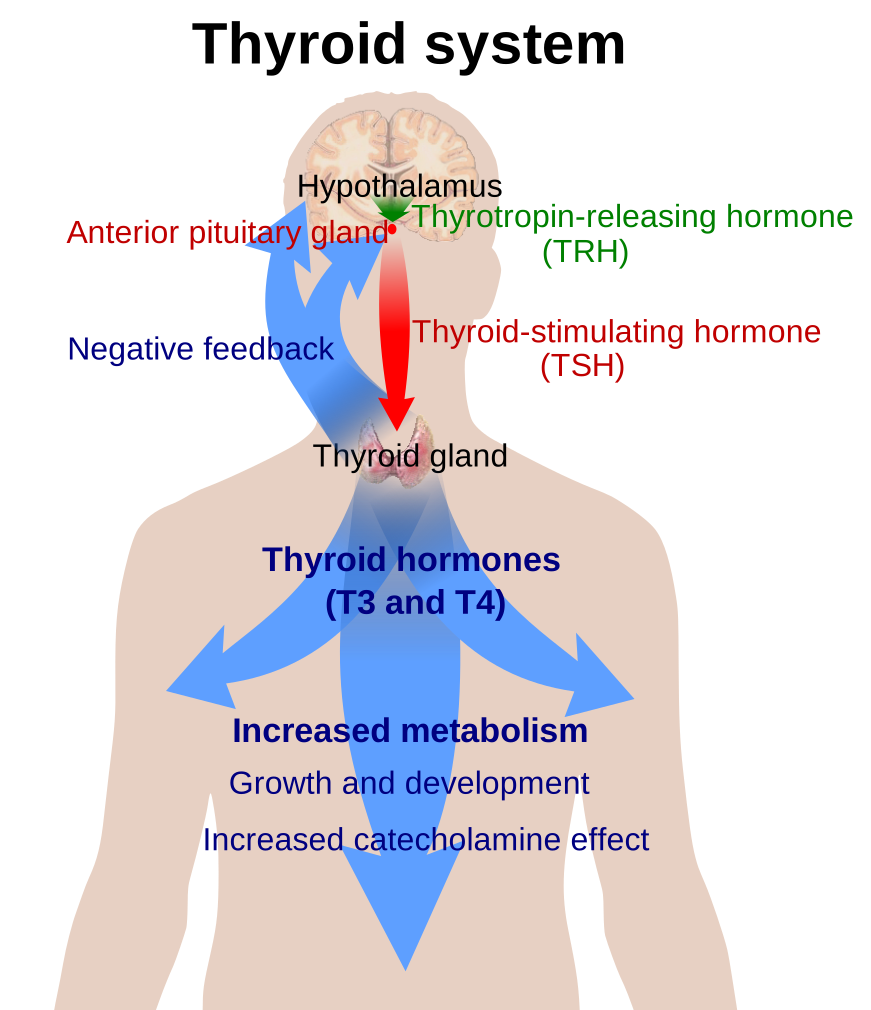
Two hormones are made: T4 (thyroxine, four iodine atoms) and T3 (three).
The gland produces mostly T4 — about 90 percent — and T4 is largely a prohormone. T3 is three to four times more potent, and about 80 percent of the body's T3 is made by removing one iodine from T4 in the peripheral tissues.
So the tissues control their own hormone activation, which is a genuinely elegant arrangement: the gland supplies a reservoir, and each tissue converts what it needs.
And conversion can be shut down. In serious illness, conversion shifts toward an inactive form instead — "sick euthyroid syndrome" — apparently to reduce metabolic demand. This is why thyroid tests are unreliable in acutely ill patients and are generally not done, since abnormal results reflect the illness rather than thyroid disease.
What thyroid hormone does
It acts on nuclear receptors, changing gene transcription (Chapter 12.1), which is why its effects are slow and sustained.
Increases basal metabolic rate in almost every tissue — more oxygen consumption, more heat production.
Increases the number and sensitivity of beta-adrenergic receptors, which is why hyperthyroidism looks so much like sympathetic overactivity — racing heart, tremor, sweating, anxiety. And it is why beta-blockers give such rapid symptomatic relief in an overactive thyroid, before any thyroid-specific treatment has had time to work.
Essential for brain development. This is the most important single fact about thyroid hormone in medicine.
Congenital hypothyroidism, untreated, causes severe irreversible intellectual disability. Treated within the first two weeks of life, development is normal.
Which is exactly why it is on the newborn heel-prick screening panel everywhere (Chapter 4.6). The test costs almost nothing and prevents profound lifelong disability, and it is one of the strongest arguments that screening programmes exist for.
Essential for growth, acting alongside growth hormone.
Increases gut motility, bone turnover, and the metabolism of drugs.
Hypothyroidism
Underactive thyroid — affects about 2 to 5 percent of adults, and around ten times more women than men.
Everything slows down, and the symptom list reads like a description of a person in decline: fatigue, weight gain, cold intolerance, constipation, dry skin, hair thinning, hoarse voice, slow thought, low mood, heavy periods, muscle aches, and slow reflexes — the relaxation phase of the ankle reflex is characteristically delayed and it is a genuine clinical sign.
And the symptoms are so non-specific that the diagnosis is frequently delayed for years, with people told they are depressed, or simply tired, or getting older.
Which is why a thyroid test is one of the most commonly and appropriately requested blood tests in medicine, and why it should be considered in almost anyone with unexplained fatigue.
Causes:
Autoimmune (Hashimoto's) thyroiditis — much the commonest in iodine-sufficient countries. Antibodies gradually destroy the gland. More common in women, and it clusters with other autoimmune conditions — type 1 diabetes, coeliac disease, vitiligo, pernicious anaemia — which is why finding one prompts consideration of the others.
Iodine deficiency — the commonest cause worldwide. And it is entirely preventable by salt iodisation, which is one of the great public health successes of the twentieth century. Iodine deficiency was, historically, the leading preventable cause of intellectual disability globally, and universal salt iodisation has reduced it enormously.
After treatment for hyperthyroidism — surgery or radioiodine. Frequently intended.
Drugs — lithium, amiodarone, and some immunotherapy drugs.
Diagnosis: high TSH with low free T4 (Chapter 12.1).
Subclinical hypothyroidism — raised TSH with normal T4. Whether to treat is a genuine and unresolved question, and the honest answer is that it depends on the TSH level, the presence of antibodies, symptoms, age and pregnancy plans. Treating everyone with a mildly raised TSH is not supported by evidence.
Treatment is levothyroxine — synthetic T4 — once daily, and it works extremely well.
Three practical points that determine whether it works.
Take it on an empty stomach, ideally 30 to 60 minutes before breakfast, because absorption is reduced by food.
Separate it by at least four hours from calcium, iron, and antacids, which bind it in the gut and can reduce absorption substantially. This is one of the commonest reasons a dose appears inadequate.
And retest after 6 to 8 weeks, not sooner, because the reservoir means levels take that long to stabilise.
Combination T4 and T3 treatment is requested by some patients who feel unwell on T4 alone. Trials have generally not shown benefit for the group as a whole, though a minority may genuinely convert poorly. The honest position is uncertainty, and it is an area where patient experience and trial evidence sit uncomfortably together.
Myxoedema coma is the extreme, and it is now rare: severe hypothyroidism with hypothermia, low sodium, low glucose, slow breathing and reduced consciousness, usually precipitated by infection or cold in an untreated elderly person. Mortality is high, and treatment includes steroids as well as thyroid hormone, because coexisting adrenal insufficiency must be covered.
Hyperthyroidism
Overactive thyroid — affects about 1 to 2 percent, again predominantly women.
Everything speeds up: weight loss despite a good appetite, heat intolerance, sweating, palpitations, tremor, anxiety, irritability, insomnia, frequent bowel motions, and light or absent periods.
Two features deserve emphasis.
Atrial fibrillation occurs in 10 to 15 percent, and considerably more in the elderly. Thyroid function is checked in anyone presenting with new atrial fibrillation, because treating the thyroid may resolve it.
And in older people the presentation is frequently the opposite of what is expected. "Apathetic hyperthyroidism" presents with weight loss, atrial fibrillation, depression and lethargy — no anxiety, no tremor, no hyperactivity. It is missed regularly, and considering thyroid disease in an apathetic elderly patient losing weight is a genuinely useful habit.
Causes:
Graves' disease — much the commonest. An autoimmune disease in which antibodies bind the TSH receptor and activate it, so the gland is driven continuously and is entirely deaf to feedback.
This is an unusual autoimmune mechanism: the antibody stimulates rather than destroys.
And Graves' has features no other cause has, because the antibodies also react with tissue behind the eyes and in the shins.
Thyroid eye disease — the tissue behind the eye swells, pushing the eyeball forward, giving the staring appearance, with gritty irritated eyes, double vision, and in severe cases pressure on the optic nerve threatening sight.
Crucially, eye disease can appear before, during or after the thyroid problem, and its course is largely independent of thyroid treatment. Smoking makes it substantially worse — several-fold — and stopping smoking is the single most effective thing a patient with thyroid eye disease can do.
Pretibial myxoedema — thickened skin over the shins. Uncommon, and specific to Graves'.
Toxic nodular goitre — one or more nodules producing hormone autonomously. Commoner in older people and in iodine-deficient regions.
Thyroiditis — inflammation releasing stored hormone. Temporary hyperthyroidism, often followed by a hypothyroid phase, then recovery. Includes the post-viral subacute form, which causes a painful tender thyroid, and postpartum thyroiditis, which affects around 5 percent of women after delivery and is frequently mistaken for postnatal depression.
Distinguishing thyroiditis from Graves' matters, because thyroiditis needs no anti-thyroid drug at all — the gland is not overproducing, it is leaking. A radioactive iodine uptake scan separates them: high uptake in Graves', low in thyroiditis.
Treatment options:
Anti-thyroid drugs — carbimazole or propylthiouracil, blocking hormone synthesis. Effective, and about half of Graves' patients remain in remission after a 12 to 18 month course.
Their one serious side effect must be known by every patient taking them. Agranulocytosis — a sudden severe drop in neutrophils — occurs in about 0.3 percent and can be fatal. Anyone starting these drugs is told: if you develop a sore throat, mouth ulcers or a fever, stop the drug and get a blood count the same day. It is a small risk with a simple and effective safety instruction.
Beta-blockers for immediate symptom control.
Radioactive iodine — a single oral dose, highly effective, and it usually results in hypothyroidism, which is then treated with thyroxine. This is an accepted trade: a controlled, easily treated underactive gland instead of an uncontrolled overactive one. It is avoided in pregnancy and can worsen eye disease.
Surgery — for large goitres, pressure symptoms, or when other treatments fail.
Thyroid storm is the emergency: extreme hyperthyroidism with fever above 40 °C, severe tachycardia or arrhythmia, agitation progressing to confusion and coma, and vomiting. Usually precipitated by infection, surgery or trauma in someone inadequately treated. Mortality is substantial and it requires intensive treatment.
Goitre and nodules
Goitre — an enlarged thyroid — can occur with normal, high or low function, and the function must be tested separately from the size.
Thyroid nodules are extremely common — palpable in about 5 percent of people, and found on ultrasound in up to 50 percent of adults.
And the overwhelming majority are benign — around 95 percent.
Which creates a real problem: scanning for something else and finding a thyroid nodule is common, and it generates anxiety and investigation out of proportion to the risk.
Features raising concern: rapid growth, hardness and fixation, hoarseness, enlarged lymph nodes, previous neck radiation, family history, and specific ultrasound characteristics.
Fine needle aspiration is the key test — a thin needle sampling cells, done in a clinic in minutes.
Thyroid cancer is one of the more encouraging cancers.
Papillary carcinoma — about 80 percent of cases, often in younger people. Ten-year survival is over 95 percent, and even with lymph node spread the outlook is excellent.
Follicular — also good prognosis.
Medullary — from the calcitonin-producing cells, and it can be part of an inherited syndrome, so a family history matters and genetic testing is offered.
Anaplastic — rare, aggressive, and the exception to everything above.
Treatment is usually surgery followed by radioactive iodine to destroy any remaining thyroid tissue, then thyroxine — at a dose high enough to suppress TSH, so that any remaining cancer cells are not being stimulated.
And there is an honest concern about overdiagnosis. South Korea's introduction of widespread thyroid ultrasound screening produced a fifteen-fold increase in thyroid cancer diagnoses with no change in mortality at all. Many small papillary cancers would never have caused harm. Active surveillance rather than immediate surgery is now offered for very small low-risk tumours, and this is one of the clearest examples in medicine of finding more disease without saving more lives.
The parathyroid glands
Four glands, each about the size of a grain of rice, embedded on the back of the thyroid.
Completely unrelated in function to the thyroid, despite the name and the position.
They produce parathyroid hormone (PTH), and they do one thing: they hold blood calcium constant (Chapter 5.1).
PTH raises calcium three ways: stimulating osteoclasts to release it from bone, making the kidney retain it and excrete phosphate, and activating vitamin D to increase gut absorption.
Hyperparathyroidism — too much PTH.
Primary — usually a single benign adenoma. Increasingly detected incidentally on routine blood tests, before any symptoms.
The classic description is "stones, bones, groans and psychiatric moans" — kidney stones, bone pain and thinning, abdominal pain and constipation, and depression, confusion or fatigue.
Most modern cases are mild and asymptomatic. Surgery to remove the adenoma is curative and is offered for higher calcium levels, kidney involvement, bone loss, or younger age.
Secondary — the glands respond appropriately to a low calcium, most often in chronic kidney disease, where vitamin D cannot be activated (Chapter 10.6).
Hypoparathyroidism — too little.
By far the commonest cause is surgical: the glands removed or their blood supply damaged during thyroid surgery.
And this is why calcium is checked after every thyroidectomy. Tingling around the mouth and in the fingers within the first day or two after neck surgery is hypocalcaemia until proven otherwise (Chapter 10.3), and it is treated promptly with calcium and activated vitamin D.
The two classic signs — facial twitching on tapping over the facial nerve, and carpal spasm when a blood pressure cuff is inflated — are looked for specifically.
What the next page fixes
Sitting on top of each kidney is a gland that is really two organs stacked together, producing the hormone that keeps you alive through illness and the hormone that prepares you for a fight in under a second. Chapter 12.4 covers the adrenal glands and the stress response.