Appearance
3.2 — Natural Selection: the Actual Mechanism
Natural selection needs exactly three things. It is not a law of nature in the sense that gravity is; it is what must happen whenever these three conditions are present, in the same way that if you shake a jar of mixed nuts the large ones must end up on top. It is closer to arithmetic than to a physical force.
1. Variation. Individuals in a population differ. 2. Heredity. Some of that difference is passed to offspring. 3. Differential reproduction. Some variants leave more surviving offspring than others.
If all three hold, the frequency of the more successful variants increases in the next generation. That is the whole mechanism. There is nothing else to it, and everything else in evolutionary biology is the consequences.
Darwin and Alfred Russel Wallace both arrived at it, and it was presented jointly in 1858 before On the Origin of Species appeared in 1859. Both had read Thomas Malthus on population, and the crucial observation came from him: organisms produce far more offspring than can possibly survive. A single cod lays millions of eggs; the population of cod is roughly stable. Almost every offspring dies before reproducing. Given that slaughter, any heritable feature that raises the chance of being among the survivors will spread.
What "fitness" means, and what it does not
Fitness in biology means reproductive success — the number of offspring that themselves survive to reproduce. Nothing else. Not strength, not health, not intelligence, not longevity, except insofar as those affect the count.
"Survival of the fittest" is a poor phrase and Darwin did not coin it — Herbert Spencer did, and Darwin adopted it later, somewhat to the confusion of everyone since. Survival is only the part of the story that gets you to reproduction. An organism that lives eighty years and has no children has a fitness of zero. A salmon that dies immediately after spawning has high fitness.
This resolves several things that look paradoxical.
Why does a peacock have a tail that makes it easier to catch? Because peahens choose males with larger tails, so the reproductive gain outweighs the survival cost. This is sexual selection, and Darwin devoted a whole book to it because he found the peacock's tail genuinely troubling — he wrote that the sight of a feather in one made him sick.
Why do organisms age and die at all? Because selection acts weakly on what happens after reproduction is over. A gene with a bad effect at 70 and a good effect at 25 will be favoured, because almost everyone has already reproduced by 70. This is the antagonistic pleiotropy idea, and it is one of the leading explanations of ageing (Chapter 24.8).
Why is there menopause? Human females stop reproducing decades before they die, which is unusual among mammals. The leading explanation is the grandmother hypothesis: at some point a woman's genes are propagated more effectively by helping existing children and grandchildren survive than by risking another high-mortality pregnancy. There is real evidence for it in historical demographic records, and it remains debated.
Why does anyone help anyone else? J. B. S. Haldane's remark — that he would lay down his life for two brothers or eight cousins — is the arithmetic. You share half your genes with a brother and an eighth with a cousin, so a gene promoting self-sacrifice can spread if the benefit to relatives outweighs the cost, weighted by relatedness. This is kin selection, formalised by William Hamilton in 1964, and it explains sterile worker bees, alarm calls, and a great deal of human family behaviour.
Three modes of selection
Take any measurable trait — height, beak depth, birth weight — and plot how common each value is. Selection can push that distribution three ways.
Directional selection favours one extreme, and the whole distribution shifts. Beak depth after the Galápagos drought. Antibiotic resistance rising under antibiotic use. Bacterial size, insect insecticide resistance, moth colour in industrial England.
Stabilising selection favours the middle and removes both extremes. Human birth weight is the standard example, and the numbers are stark. Babies much below about 2.5 kg have raised mortality from immaturity; babies much above about 4 kg have raised risk of obstructed labour, which before modern obstetrics was frequently fatal to both mother and child. Mortality is lowest around 3.5 kg, and that is where the distribution sits. This is the commonest kind of selection in nature — most of the time, most traits are already near their optimum and selection is keeping them there rather than moving them.
Disruptive selection favours both extremes and penalises the middle. Rarer, but it is one route to a population splitting in two, which is Chapter 3.4.
The eye: the objection Darwin raised against himself
Darwin wrote that supposing the eye could have been formed by natural selection seemed, he freely confessed, "absurd in the highest possible degree". The sentence is quoted constantly, always without the paragraph that follows, in which he explains why the absurdity dissolves.
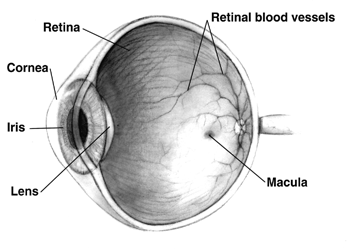
The objection is that half an eye is useless. The answer is that it is not, and this is not a philosophical reply — the intermediate stages are all alive today in different animals.
Stage 1: a light-sensitive patch. A few cells with a pigment that responds to light, on a flat surface. This tells the organism only whether it is light or dark, which is enough to know whether it is day, or whether a shadow just fell on you. Euglena and many flatworms have this. Immediately useful, and far better than nothing.
Stage 2: a shallow cup. Fold the patch into a depression and it now gives direction, because the walls shade some cells and not others. The organism can tell where the light is coming from, and therefore which way to flee. Limpets have this.
Stage 3: a deeper cup with a narrow opening. Narrow the opening enough and it becomes a pinhole camera, forming a real image with no lens at all. The trade-off is brightness: a smaller hole gives a sharper image and less light. The nautilus has exactly this today, an eye with no lens, and it works.
Stage 4: cover the opening with transparent tissue. Keeps out dirt and water. No optical improvement required, just protection — and there is no cost.
Stage 5: thicken that covering into a lens. Even a crude lens with the wrong shape gathers more light than a pinhole and can partly focus it. Improvements from there are gradual: adjustable shape, correction of colour fringing, an iris to control the aperture.
Every stage is an improvement on the one before, and every stage is functional. Nilsson and Pelger modelled this in 1994 with deliberately conservative assumptions, allowing 1 percent change per generation, and calculated that the whole sequence from flat patch to focused camera eye could be completed in about 364,000 generations — for a small animal with a one-year generation, under half a million years. Geologically that is instantaneous.
And eyes have evolved independently dozens of times. Camera eyes in vertebrates, camera eyes in octopuses, compound eyes in insects, mirror eyes in scallops. If eyes were nearly impossible, they would not keep appearing.
Why "irreducible complexity" fails, in general
The eye is a specific case of a general objection: some structures seem to require all their parts at once, so no gradual route exists. Three standard answers apply to essentially every proposed case.
Parts change function. A component that is now essential to one job may have been doing a different job before. The three tiny bones of your middle ear were jaw bones in your reptilian ancestors, and the fossil sequence showing them migrating is one of the best-documented transitions there is (Chapter 3.1). They were not useless while becoming ear bones; they were being useful as jaw bones.
Scaffolding falls away. A stone arch cannot stand while being built and cannot be built one stone at a time — yet arches are built, using supporting formwork that is removed at the end. Look at a finished arch and you would wrongly conclude it could not have been assembled gradually. Biological systems do the same: components that were necessary during assembly get lost afterwards, leaving a structure that looks unbuildable.
Duplication then divergence. Genes get duplicated. The spare copy is free to mutate, because the original still does the job. This is where new functions come from, and it is directly visible in your own genome — your colour vision depends on two pigment genes that are clearly recent duplicates of each other, sitting next to each other on the X chromosome, differing in only a handful of positions.
What selection cannot do
Being clear about the limits is what separates understanding the mechanism from treating it as magic.
It cannot plan. There is no goal, no anticipation of future need. Each step must be an improvement now. This is the most important constraint and it is the source of nearly all the bad design in Chapter 3.6.
It cannot start over. Selection modifies what exists. The vertebrate eye has its wiring in front of the photoreceptors, which is optically backwards and creates a blind spot where the nerve exits. The octopus, which evolved its eye separately, has the wiring behind and has no blind spot. Neither arrangement can now be swapped for the other, because there is no series of small improvements leading from one to the other.
It cannot act on what does not vary. No variation, no selection. This is why a population with low genetic diversity is vulnerable — cheetahs are famously inbred, and a new disease could take the species out.
It does not produce perfection, only "better than the alternatives that happened to be present". The result is always a compromise between competing demands: an immune system aggressive enough to clear infection but not so aggressive that it attacks you, a pelvis wide enough for childbirth but narrow enough for efficient walking.
And it is not the only process. Chapter 3.3 covers genetic drift, which changes populations by chance alone and is more powerful than selection when populations are small.
Where this is happening to you right now
In your gut and on your skin. Your microbiome is a population under selection, and what you eat and what antibiotics you take shifts it within days.
In any infection you have. A virus replicating in your body generates variants continuously, and the ones your immune system has not yet learned to recognise do better. This is precisely how HIV escapes single-drug treatment, and why HIV is treated with three drugs at once: the chance of a virus acquiring resistance to one drug is high, to three simultaneously is very low. Combination therapy is applied evolutionary reasoning, and it turned HIV from a death sentence into a managed condition. Chapter 17.9.
In a tumour, if you have one. Chapter 19.3.
And in the mosquitoes, bacteria and parasites around you, all of which are evolving resistance to the chemicals used against them, faster than replacements are being developed. Chapter 17.7.
What the next page fixes
Selection is not the only thing that changes allele frequencies, and in small populations it is often not even the main one. Chapter 3.3 introduces the arithmetic of populations — the Hardy–Weinberg equation and what it means when a population departs from it, genetic drift, founder effects and bottlenecks — which together explain why certain genetic diseases are concentrated in particular communities, and why the sickle cell allele stays common despite killing people.