Appearance
11.13 — Smell, Taste, Touch and Pain
Pain is not a measurement of tissue damage. Soldiers with severe battlefield wounds frequently report little or no pain at the time, while a paper cut can be agonising. Around 15 percent of people with a limb amputated feel pain in a limb that is no longer there. And a substantial proportion of people with disc herniations visible on scans have no back pain at all.
Pain is produced by the brain, in response to a judgement about threat, using tissue signals as one input among several. That is the most important idea in this chapter, and it is the one that changes how chronic pain is treated.
Smell
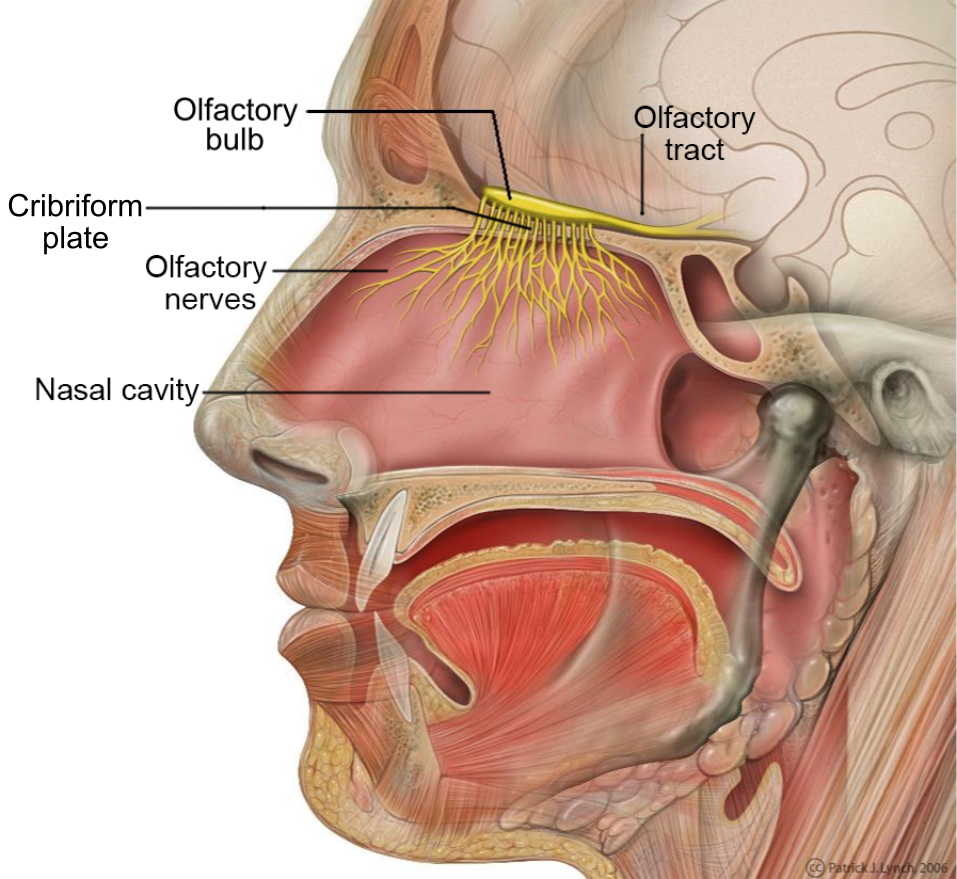
About 5 to 6 million receptor neurons in a patch a few square centimetres across in the roof of each nasal cavity.
Humans have around 400 functional olfactory receptor genes — the largest gene family in the genome. Each receptor neuron expresses only one of them, and each odour molecule activates a particular combination.
So smell works by combinatorial coding, and that is why the number of distinguishable odours is so large. A 2014 study estimated humans can discriminate over a trillion distinct odours; the methodology has been criticised and the exact figure is disputed, but the older textbook claim of about 10,000 is certainly far too low.
And the popular idea that human smell is poor is largely wrong. Humans outperform dogs on some odours and underperform on others, and the belief in general human inferiority traces to a nineteenth-century anatomist's assumption about brain proportions rather than to any measurement.
Olfaction is unique among the senses in three ways.
It bypasses the thalamus. Every other sense relays there before reaching the cortex (Chapter 11.4). Smell goes directly to the olfactory cortex and, from there, straight to the amygdala and hippocampus.
This is why smell triggers emotion and memory so immediately and so vividly. The connection is anatomically direct rather than metaphorical. A smell can produce a memory with an emotional intensity that a photograph does not, and the Proustian association is a real feature of the wiring.
Olfactory receptor neurons are replaced throughout life — every 30 to 60 days. They are among the very few neurons that regenerate in adult humans, which is why smell can recover after damage, unlike vision.
And they are directly exposed to the outside world. This is thought to be one route by which some viruses reach the brain, and it is why the olfactory pathway attracts attention as a possible entry point in neurodegenerative disease.
Anosmia — loss of smell (Chapter 11.7). It affects quality of life more than people expect: food becomes uninteresting, which leads to poor nutrition and weight loss, and there is a real safety cost — being unable to smell gas, smoke or spoiled food. Anyone with permanent anosmia should have smoke alarms and, where relevant, gas detectors.
Taste

Five established basic tastes, and they map onto what an animal needs to know about food.
Sweet — carbohydrate, energy. Salty — sodium, needed for everything in Chapter 10.3. Sour — acid, indicating unripe or spoiled food. Bitter — the largest receptor family, with about 25 types, because most plant toxins are bitter. Bitterness is detected at far lower concentrations than the others, which is exactly what a poison detector should do. Umami — glutamate, indicating protein. Identified by Kikunae Ikeda in 1908, and only widely accepted in the West decades later.
Fat is a strong candidate for a sixth, with receptors identified, and it is not yet universally accepted.
The tongue map is wrong. The diagram showing sweet at the tip and bitter at the back appears in countless textbooks and is a mistranslation of a 1901 German paper that reported only slight regional differences in threshold. All tastes are detected across the whole tongue. You can demonstrate it in ten seconds with a grain of sugar placed anywhere.
Most of "taste" is smell. Flavour is a combination of taste (five qualities), smell (thousands), texture and temperature, and the smell component dominates.
Hold your nose while eating and the difference is dramatic — coffee and cola become almost indistinguishable as sweet-bitter liquids. This is retronasal olfaction: volatile molecules travelling up from the back of the mouth to the olfactory receptors, and it is why food is tasteless with a cold.
Taste is carried by three cranial nerves — VII for the front of the tongue, IX for the back, X for the throat — so complete loss of taste is rare, since it requires damage to all three.
Genetic variation in bitter perception is real and measurable. The TAS2R38 gene determines sensitivity to a specific bitter compound, and about 25 percent of people are non-tasters, 50 percent tasters and 25 percent "supertasters". Supertasters have more taste buds and find brassica vegetables, coffee and grapefruit genuinely more bitter. So dislike of Brussels sprouts is, for a substantial minority, a real perceptual difference rather than fussiness.
Touch
The skin contains several receptor types, each specialised, and the specialisation follows a consistent logic: small receptive fields and slow adaptation give fine detail; large fields and fast adaptation give detection of change.
Merkel cells — small fields, slowly adapting. Fine detail, texture, edges. Densest in the fingertips.
Meissner corpuscles — small fields, rapidly adapting. Light touch and low-frequency vibration. These detect slip, and they are why you can hold an object with exactly enough force and no more.
Pacinian corpuscles — large fields, rapidly adapting, deep in the skin. High-frequency vibration. They are what let you feel the texture of a surface through a tool — a pen, a scalpel, a car through the steering wheel.
Ruffini endings — large fields, slowly adapting. Skin stretch, and therefore finger position.
Free nerve endings — pain, temperature, and itch.
Two-point discrimination measures the spatial resolution, and the range is enormous. On the fingertip, two points 2 to 3 millimetres apart are felt as two. On the back, they must be 40 to 50 millimetres apart.
And that maps exactly onto the cortical homunculus (Chapter 11.5) — the regions with the finest discrimination have the largest cortical representation.
Adaptation is why you stop feeling your clothes. Rapidly adapting receptors report change and fall silent when nothing is changing. This is efficient: constant information is not worth transmitting.
Proprioception — position sense — deserves to be called the sixth sense far more than anything usually given that title. Receptors in muscles, tendons and joints continuously report limb position, and you can touch your nose with your eyes closed because of it.
Its loss is devastating and rare. A small number of people have lost proprioception through nerve damage, and they must watch their limbs continuously to control them. Walking becomes a deliberate visual task, and in darkness they collapse. Ian Waterman, the best-documented case, relearned movement entirely under visual control over years — an extraordinary achievement that demonstrates exactly how much this sense normally does invisibly.
Pain
The International Association for the Study of Pain defines it as "an unpleasant sensory and emotional experience associated with, or resembling that associated with, actual or potential tissue damage".
The wording is careful and every part of it is deliberate. "Emotional" is in the definition. "Or resembling" allows for pain without damage. And nowhere does it say pain measures damage.
Nociception is the detection and transmission of potentially damaging stimuli. Pain is the conscious experience. They are not the same thing, and either can occur without the other.
Three receptor classes respond to mechanical, thermal and chemical stimuli. The capsaicin receptor, TRPV1, responds to both heat above about 43 °C and to capsaicin from chilli — which is why chilli genuinely feels hot. The same receptor family includes one activated by menthol and by cold, which is why mint feels cool. Neither substance changes temperature; both activate the temperature receptor directly.
Two fibre types produce the two-phase pain of Chapter 11.1 — fast sharp A-delta, then slow dull C.
Gate control
Ronald Melzack and Patrick Wall proposed in 1965 that the spinal cord contains a gate that can be opened or closed to pain signals, and it overturned the previous view of pain as a simple wire from injury to brain.
Large touch fibres (A-beta) entering the cord activate inhibitory interneurons that close the gate to pain signals.
This is why rubbing an injury helps, and it is not a distraction effect — the touch signal physically suppresses transmission of the pain signal at the spinal level. Everyone does it instinctively; the mechanism is real.
And it is the basis of TENS machines, which stimulate large touch fibres electrically to close the gate.
Descending control from the brain also opens and closes the gate, using endorphins and serotonin. This is how attention, expectation, mood and context change pain, and it is the anatomical route by which psychological factors produce genuinely different physical signalling — not imagined pain, but modulated transmission.
Why pain does not track damage
Several observations force this conclusion, and each is well documented.
Battlefield analgesia. Henry Beecher's observations of wounded soldiers in the Second World War found that a large majority of men with severe wounds requested no pain relief, while civilians with far smaller surgical wounds routinely did. The difference was context: for the soldier, the wound meant leaving the battlefield alive.
Phantom limb pain — pain in a limb that does not exist (Chapter 11.8).
Imaging findings and pain do not correlate well. A large proportion of people with no back pain at all have disc bulges, degeneration and even herniations on MRI. By age 50, disc degeneration is present on scans in the majority of pain-free people. This is one of the most important facts in musculoskeletal medicine, because telling a patient their scan shows degeneration frequently makes their pain worse by increasing threat.
And the reverse: severe pain with entirely normal imaging is common and real.
Congenital insensitivity to pain demonstrates the point from the other side. People born unable to feel pain — usually from a mutation in a sodium channel gene — do not live comfortably. They live briefly. Unnoticed injuries, joints destroyed by walking on fractures, tongues and lips bitten off, burns, and undetected appendicitis. Most die young. Pain is not an unfortunate side effect of injury — it is what keeps you alive.
Acute versus chronic
Acute pain is protective and resolves as tissue heals.
Chronic pain — persisting beyond about three months, or beyond normal healing — is a different condition, and treating it as prolonged acute pain is why so much treatment fails.
Central sensitisation is the key change. The spinal cord and brain become more responsive: pain thresholds fall, the painful area spreads, and ordinary touch becomes painful (allodynia). The nervous system has learned pain, and the pain becomes the disease rather than a symptom of one.
Around 20 percent of adults live with chronic pain, making it one of the largest health burdens there is.
And what works is not what people expect.
Opioids perform poorly in chronic non-cancer pain. They work well acutely, and long-term trials show limited benefit alongside substantial harms — tolerance, dependence, and opioid-induced hyperalgesia, in which the drug itself increases pain sensitivity. The opioid crisis originated substantially in prescribing for chronic pain on the assumption that acute effectiveness would carry over.
Exercise is one of the most effective treatments, though it must be graded carefully.
Pain education genuinely reduces pain, and this surprises people. Explaining how pain works — that hurt does not equal harm, that a scan finding may be irrelevant, that the nervous system has become sensitised — measurably reduces pain and disability in trials. The mechanism is that understanding reduces threat, and threat amplifies pain through descending control.
Cognitive behavioural therapy and acceptance-based approaches have good evidence.
And multidisciplinary programmes outperform any single treatment.
None of this means the pain is psychological. It means pain is produced by a nervous system that can be influenced through more than one route, and using only the tissue route wastes most of the available options.
The placebo response
Placebo analgesia is a real, measurable physiological event, not merely a reporting artefact.
It is partly mediated by endorphins, and it is blocked by naloxone — an opioid antagonist. Something that can be chemically blocked is not imaginary. Brain imaging shows changes in the pain-processing regions.
Placebo effects are larger for pain than for almost anything else, because pain is so heavily modulated by expectation.
And the nocebo effect is its mirror: negative expectation increases pain and produces side effects. This is why the way a treatment is described changes how well it works, and why warning about side effects in detail measurably increases their reporting — a genuine ethical tension in consent.
Itch
Not a mild form of pain — a separate system, with its own fibres and its own spinal pathway.
Histamine-dependent itch responds to antihistamines. Histamine-independent itch, which includes most chronic itch, does not — which is why antihistamines are so often disappointing in persistent itch.
Scratching relieves itch by producing a mild pain signal that inhibits the itch pathway — gate control again. And it sets up a vicious circle, because scratching damages skin, which produces inflammation, which produces more itch.
Itch without a rash points to systemic causes: liver disease with obstructed bile (Chapter 9.4), kidney failure, iron deficiency, thyroid disease, and lymphoma. Generalised itch with no visible skin disease deserves blood tests rather than more cream.
What Part 12 does next
The nervous system controls the body electrically, in milliseconds, over dedicated wires. Part 12 covers the other control system — chemical, slower, broadcast through the blood, and responsible for growth, metabolism, reproduction, the stress response and the daily rhythm of everything you do.