Appearance
11.2 — Synapses and Neurotransmitters
The gap between one neuron and the next is about 20 to 40 nanometres wide. Almost every drug that changes how you think, feel, sleep or move acts within that gap — antidepressants, antipsychotics, anaesthetics, opioids, alcohol, caffeine, nicotine, cocaine, and every recreational drug in existence.
There are around 100 trillion of these gaps in your brain, and what makes the nervous system capable of anything interesting is that each one can be strengthened or weakened by use.
Why a gap at all
Electrical synapses exist — direct channels between cells, used in cardiac muscle (Chapter 4.2) and in a few places in the brain where speed and synchrony matter. They are fast and they are stupid: the signal passes unchanged, and there is no capacity for modification.
Chemical synapses are slower — about 0.5 to 1 millisecond of delay — and they buy three things that make brains possible.
Amplification. A small presynaptic signal can release enough transmitter to produce a large postsynaptic response.
Integration. The receiving neuron can sum thousands of inputs, some excitatory and some inhibitory, and decide.
Plasticity. The strength of a chemical synapse can be adjusted, and that adjustment is what learning physically is.
A gap is not a design flaw. It is where the computation happens.
Transmission, step by step
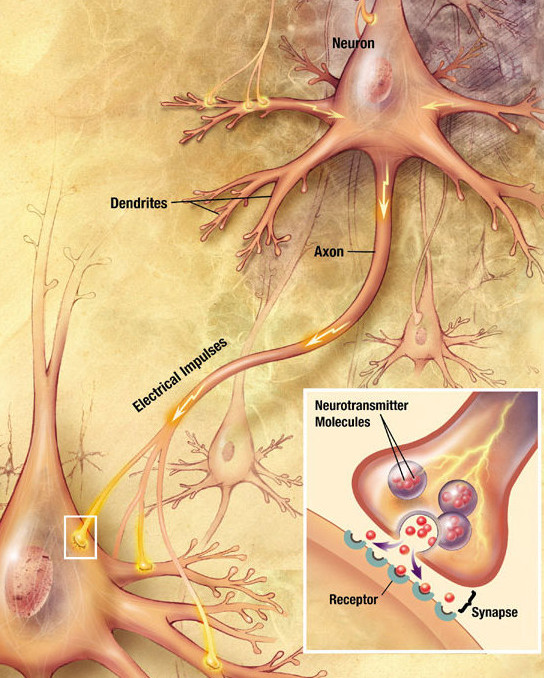
1. The action potential arrives at the terminal.
2. Voltage-gated calcium channels open, and calcium enters.
3. Calcium triggers vesicle fusion. Vesicles docked at the membrane fuse and release their contents. Each vesicle holds a few thousand transmitter molecules, and the release is quantal — you get one vesicle's worth or two, never a fraction.
4. Transmitter diffuses across and binds receptors.
5. The receptor produces an effect, of one of two kinds.
Ionotropic receptors are ion channels. Binding opens the channel directly. Fast — under a millisecond — and brief. These do the moment-to-moment signalling.
Metabotropic receptors are G-protein coupled (Chapter 1.8). Binding starts a second messenger cascade. Slow — tens of milliseconds to seconds — but amplified and long-lasting, and capable of changing gene expression. These do the modulation: mood, arousal, attention.
6. The signal is terminated, and this is where most drugs act.
Reuptake — the transmitter is pumped back into the presynaptic terminal by a specific transporter. This is the main route for serotonin, noradrenaline and dopamine.
Enzymatic breakdown — acetylcholinesterase for acetylcholine (Chapter 6.2), monoamine oxidase for the monoamines.
Diffusion away from the cleft.
Block the removal, and the transmitter stays in the cleft longer and its effect is amplified. This single sentence covers SSRIs, cocaine, amphetamines, MAO inhibitors and the drugs used in Alzheimer's disease.
Excitation, inhibition, and summation
An excitatory synapse opens channels that let sodium in, depolarising the membrane toward threshold. This is an excitatory postsynaptic potential (EPSP), typically only about 0.5 mV.
An inhibitory synapse opens channels that let chloride in or potassium out, hyperpolarising the membrane away from threshold. An inhibitory postsynaptic potential (IPSP).
A single EPSP is nowhere near enough to fire a neuron — it takes about 15 mV of depolarisation, so perhaps 30 EPSPs are needed.
So the neuron sums.
Temporal summation — several impulses from one input arriving in quick succession, before the previous potential has decayed.
Spatial summation — impulses from many inputs arriving at once.
And the sum is taken at the axon hillock, which is why that is where the decision is made.
A neuron is therefore not a relay. It is a small analogue computer — continuously summing thousands of positive and negative inputs, weighted by synaptic strength and by how far away each synapse is, and producing a digital output when the total crosses a line. This is exactly the model that artificial neural networks are built on (Volume I, Chapter 12), and the resemblance is not accidental.
The transmitters
About 100 are known. A dozen matter for understanding medicine.
Glutamate — the main excitatory transmitter
Used at the great majority of excitatory synapses in the brain.
Its two main receptor types have very different roles. AMPA receptors produce the fast ordinary response. NMDA receptors are the interesting ones: they are blocked by a magnesium ion at resting voltage, and the block is only removed when the membrane is already depolarised.
So an NMDA receptor only opens when the transmitter is present AND the receiving cell is already active. It is a coincidence detector, and this is the molecular basis of the rule that neurons which fire together wire together.
When it opens, calcium enters, and calcium triggers the changes that strengthen the synapse.
Too much glutamate is toxic — excitotoxicity. In a stroke, dying neurons release their glutamate, which over-activates NMDA receptors on neighbouring cells, flooding them with calcium and killing them. This is why the damaged area in a stroke expands over hours, and why so much research has gone into blocking it.
Ketamine blocks the NMDA receptor, which is why it is a dissociative anaesthetic. And at low doses it produces rapid antidepressant effects, within hours rather than weeks — one of the more significant recent findings in psychiatry (Chapter 20.7).
Memantine, used in Alzheimer's disease, is a mild NMDA blocker.
GABA — the main inhibitory transmitter
Used at most inhibitory synapses in the brain. GABA-A receptors are chloride channels; opening them makes the neuron harder to fire.
And an enormous number of drugs work by enhancing GABA.
Benzodiazepines increase the frequency with which the channel opens in response to GABA. They do not open it themselves, which is why they have a ceiling effect and are relatively safe in overdose alone.
Barbiturates increase how long the channel stays open, and at high doses open it directly without GABA — which is exactly why they have no ceiling and why they were so dangerous in overdose, and why benzodiazepines replaced them.
Alcohol enhances GABA and also blocks NMDA receptors.
And this explains the lethal combination. Alcohol plus benzodiazepines, or either plus opioids, produces respiratory depression far beyond the sum of the parts, because they act at different points on the same system. A dose of each that would be survivable alone can be fatal together, and this accounts for a large proportion of accidental overdose deaths.
Many general anaesthetics — propofol, most inhaled agents — act at GABA-A too.
Alcohol withdrawal is the mirror image and it is genuinely dangerous. Chronic alcohol suppresses the system, so the brain compensates by reducing GABA receptors and increasing glutamate receptors. Remove the alcohol abruptly and the brain is left in a state of unopposed excitation — tremor, then hallucinations, then seizures, then delirium tremens, which has a mortality of several percent even treated. Treatment is a benzodiazepine, tapered — replacing the missing GABA enhancement and withdrawing it slowly enough for the receptors to readjust.
Glycine is the main inhibitory transmitter in the spinal cord. Strychnine blocks glycine receptors, removing inhibition from motor neurons, so every muscle contracts at once — producing the violent convulsions and the arched back that make strychnine poisoning so distinctive.
Acetylcholine
At the neuromuscular junction (Chapter 6.2), throughout the parasympathetic system (Chapter 11.9), and in the brain for arousal, attention and memory.
Two receptor families: nicotinic (ion channels, fast, at muscle and in ganglia) and muscarinic (G-protein coupled, slower, at parasympathetic target organs and in the brain).
And the cholinergic neurons of the basal forebrain degenerate early in Alzheimer's disease, which is why cholinesterase inhibitors — donepezil, rivastigmine — are used. They produce modest symptomatic improvement and do not alter the disease (Chapter 20.4).
Anticholinergic drugs — many antihistamines, some antidepressants, bladder drugs, and others — block muscarinic receptors. The side effects are a memorable set: dry mouth, blurred vision, constipation, urinary retention, and — importantly — confusion in older people.
Anticholinergic burden is a genuine and under-recognised problem. An older person taking several drugs each with mild anticholinergic activity can accumulate enough to cause confusion, falls and cognitive decline, and reviewing that burden is one of the higher-yield interventions in geriatric prescribing.
The monoamines
Dopamine — three main systems, and their separation explains a great deal of psychiatry.
The nigrostriatal pathway controls movement. Its degeneration causes Parkinson's disease (Chapter 20.3), and symptoms appear only after about 60 to 80 percent of these neurons are lost — a striking demonstration of the brain's reserve.
The mesolimbic pathway is central to reward and motivation. All addictive drugs increase dopamine here, by different routes.
The mesocortical pathway is involved in cognition and executive function.
And this is why antipsychotics have the side effects they do. They block dopamine receptors, which helps the mesolimbic overactivity thought to underlie psychosis — but the same drug blocks the nigrostriatal pathway, producing Parkinsonian side effects, and blocks a fourth pathway that normally suppresses prolactin, causing breast enlargement and milk production. The drug cannot tell the pathways apart. Newer antipsychotics reduce this by binding less tightly or by acting on additional receptors.
Dopamine's popular characterisation as "the pleasure chemical" is wrong in an interesting way. The evidence indicates it signals wanting rather than liking — anticipation, motivation and the prediction of reward, rather than the enjoyment itself. Animals with dopamine depleted still show pleasure responses to sweet tastes; they simply will not work to obtain them. This distinction is central to understanding addiction, where wanting escalates while liking often does not.
Serotonin (5-HT) — mood, sleep, appetite, gut motility, and pain modulation.
About 90 percent of the body's serotonin is in the gut, not the brain, where it regulates motility — which is why gut side effects are so common with serotonergic drugs and why ondansetron, a serotonin blocker, is such an effective antiemetic.
SSRIs block its reuptake. And a genuinely important point: the reuptake block happens within hours, but the clinical effect takes 2 to 6 weeks. So the simple "low serotonin causes depression" model cannot be the whole story — if it were, the drug would work the same day. The delay suggests downstream adaptations, and the honest position is that the mechanism of antidepressant action is not fully understood. Chapter 20.7.
Serotonin syndrome is the danger of excess — agitation, fever, muscle rigidity, overactive reflexes and clonus. Usually caused by combining serotonergic drugs: an SSRI with tramadol, with an MAO inhibitor, with linezolid, or with St John's wort. It can be fatal.
Noradrenaline — arousal, attention, and the sympathetic nervous system.
Histamine — wakefulness in the brain, and inflammation in the periphery. This is why first-generation antihistamines cause drowsiness — they cross the blood–brain barrier and block the brain's wakefulness system. Second-generation ones do not cross it, which is the entire design improvement.
The others
Endorphins and enkephalins — the body's own opioids, acting on the same receptors as morphine, modulating pain and reward.
Substance P — carries pain signals. Capsaicin, from chilli peppers, initially releases it and then depletes it, which is why capsaicin cream, after an unpleasant burning phase, reduces pain.
Nitric oxide — a gas, made on demand, diffusing straight through membranes rather than being stored in vesicles. It breaks every rule for a transmitter and is one anyway (Chapter 1.8).
Adenosine — accumulates in the brain during waking and promotes sleep. Caffeine blocks its receptors, which is precisely how it keeps you awake: it does not add energy, it blocks the signal that you are tired. The tiredness is still accumulating, which is why it arrives all at once when the caffeine wears off.
Plasticity
Synaptic strength changes with use, and this is how learning is stored.
Long-term potentiation (LTP) — repeated strong activation strengthens a synapse, sometimes for hours to months. The NMDA receptor's coincidence detection starts it, calcium entry triggers the changes, and the synapse ends up with more AMPA receptors and often a physically larger spine.
Long-term depression (LTD) — weaker or uncorrelated activity weakens a synapse. Equally important, because a system that could only strengthen would saturate.
Structural plasticity — synapses form and are eliminated continuously. The developing brain massively overproduces synapses and then prunes them, and the pruning is guided by use. A child has substantially more synapses at age two than as an adult.
And plasticity is why rehabilitation after brain injury works. Surviving circuits take over function, and repetitive task-specific practice drives that reorganisation. It is also why the recovery window is not as narrow as once believed — improvement continues for years with the right training, and the old teaching that recovery plateaus at six months has been substantially revised.
What the next page fixes
Neurons and synapses are the components. Chapter 11.3 assembles them into the first level of the nervous system — the spinal cord, its ascending and descending tracts, and the reflexes that let you withdraw your hand from a hot surface before you know it is hot.