Appearance
9.1 — The Mouth, Teeth and Swallowing
Digestion is the process of taking molecules that are too large to cross a membrane and cutting them into ones that can. Every step from here to the small intestine is hydrolysis — the reaction from Chapter 1.2 that adds water across a bond and breaks it.
The tube itself is about 9 metres long from mouth to anus, and it is worth noticing at the start that its contents are technically outside your body. The gut lumen is continuous with the outside world at both ends. Nothing has entered you until it has crossed the epithelium lining it, and that crossing is what absorption means.

The mouth
Mechanical breakdown first. Chewing reduces particle size, and the reason it matters is arithmetic: enzymes act on surfaces, so halving the diameter of a food particle roughly doubles the surface available. Chewing multiplies the surface area many times over before any chemistry starts.
Saliva — about 1 to 1.5 litres a day, from three pairs of glands.
Parotid — in front of the ear, the largest, producing watery enzyme-rich saliva. This is the gland that swells in mumps, giving the characteristic face.
Submandibular — under the jaw, producing most of the resting volume.
Sublingual — under the tongue, producing thick mucus-rich saliva.
What saliva does, and it is more than most people think:
Lubrication, so food can be swallowed. Try swallowing dry crackers with a dry mouth and the point is obvious.
Digestion begins. Salivary amylase starts breaking starch into shorter chains. This is why bread tastes sweeter the longer you chew it — you are producing maltose in your own mouth. Amylase works at neutral pH and is destroyed by stomach acid, so it stops as soon as the food arrives there, but it acts on the inside of the bolus for some minutes before the acid penetrates.
Lingual lipase begins fat digestion, and it is more important in infants than adults.
Protection. Saliva contains lysozyme, which digests bacterial cell walls; lactoferrin, which sequesters iron bacteria need; and antibodies (IgA). It also washes the teeth and buffers acid.
Taste. Molecules must dissolve to reach taste receptors, and saliva is the solvent.
Dental protection. Saliva is supersaturated with calcium and phosphate, so it continuously remineralises enamel. This is why a dry mouth causes rapid tooth decay — losing the constant remineralisation tips the balance permanently toward loss.
Dry mouth (xerostomia) is therefore more consequential than it sounds. Causes include hundreds of drugs — antihistamines, antidepressants, antipsychotics, diuretics, opioids — as well as radiotherapy to the head and neck, dehydration, and Sjögren's syndrome, an autoimmune disease attacking the glands. The consequences are decay, oral thrush, difficulty speaking and swallowing, and altered taste, and the treatment is saliva substitutes, sugar-free gum to stimulate flow, and rigorous dental care.
Salivary stones can block a duct, most often the submandibular. The characteristic symptom is pain and swelling under the jaw that comes on with eating and settles afterwards, because the gland is stimulated to produce saliva that cannot escape.
The teeth

Chapter 5.2 covered the structure. The important points for digestion and for daily life:
Enamel is the hardest substance in the body and cannot repair itself, because it contains no cells.
Dental caries is a bacterial disease, not simply "sugar rots teeth". Bacteria in dental plaque — particularly Streptococcus mutans — ferment sugars and produce acid. Enamel begins to dissolve below about pH 5.5, and each exposure to sugar drops the plaque pH below that for roughly 20 to 40 minutes.
This is why frequency matters more than quantity, and it is the single most useful thing to know about preventing decay. One chocolate bar eaten at once produces one acid attack. The same bar eaten in ten pieces across a day produces ten. Sipping a sugary drink through an afternoon is worse than drinking it in one go. Grazing is the problem, not the total.
And this is why brushing before bed is the most important brushing of the day — saliva flow falls to almost nothing during sleep, so anything left on the teeth has all night with no protection.
Fluoride works by chemistry (Chapter 5.2): it forms fluorapatite, which dissolves at a lower pH than hydroxyapatite, so it takes more acid to damage.
Periodontal disease — inflammation of the gums and the supporting bone — is the leading cause of tooth loss in adults, ahead of decay. Bleeding gums when brushing are not normal, and they are the earliest sign.
And there is a genuine and well-supported link between gum disease and general health. Chronic periodontitis is associated with cardiovascular disease and with worse diabetic control, and the association is at least partly causal in the diabetes direction — treating gum disease measurably improves blood sugar control. The mechanism is chronic low-grade inflammation and bacteraemia.
Swallowing
Chapter 6.3 covered the three phases and the danger of aspiration. Here is the mechanics.
The tongue is the most versatile muscle in the body, and unusual in structure: it has muscles running in three planes with no bone attachment for most of them, which is why it can change shape in ways no other muscle can.
It shapes the food into a bolus, positions it between the teeth, senses when it is adequately chewed, and pushes it back to trigger the swallow.
The swallow reflex is triggered by receptors at the back of the mouth and pharynx, and once triggered it cannot be stopped. It is coordinated by a centre in the brainstem, and over 30 muscles fire in a fixed sequence.
The airway is protected by four mechanisms in sequence: the soft palate rises to seal the nose, the larynx moves upward and forward, the epiglottis folds back over it, and the vocal cords close. Breathing stops for about a second.
You can feel the second of those — put a finger on your Adam's apple and swallow, and it lifts. The upward movement is what tucks the airway under the base of the tongue, and it is the movement that fails in many neurological swallowing disorders.
The oesophagus
A muscular tube about 25 centimetres long running from the pharynx, through the chest behind the trachea and heart, through the diaphragm, into the stomach.
Its muscle changes along its length — striated (voluntary) in the upper third, mixed in the middle, smooth in the lower third. So the beginning of a swallow is voluntary and the rest is not.
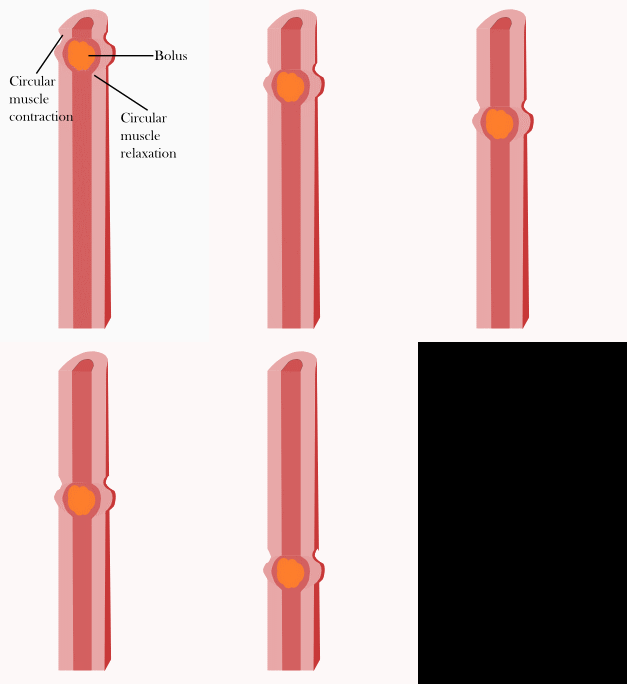
Peristalsis carries the bolus down in about 8 to 10 seconds. The wave, not gravity, does the work — which is why you can swallow while lying down, upside down, or in weightlessness.
Two sphincters:
The upper oesophageal sphincter is normally closed, preventing air entering the oesophagus with each breath and preventing reflux into the airway.
The lower oesophageal sphincter is a zone of increased pressure rather than a distinct anatomical ring, reinforced by the diaphragm's muscular sling around it. It prevents stomach contents refluxing upward.
And its failure is one of the commonest conditions in medicine.
Reflux
Gastro-oesophageal reflux disease (GORD) — stomach contents entering the oesophagus. The oesophageal lining has no protection against acid, unlike the stomach's, so it burns.
Heartburn, an acid taste, and a cough or hoarseness, typically worse lying down or bending over, and after large or fatty meals.
What worsens it, and each has a mechanism. Anything raising abdominal pressure — obesity, pregnancy, tight clothing. Anything relaxing the sphincter — fat, chocolate, caffeine, alcohol, smoking, peppermint, and several drugs including calcium channel blockers and nitrates. Large meals, and lying down within three hours of eating.
Hiatus hernia — part of the stomach pushing up through the diaphragm — removes the diaphragm's contribution to the sphincter and makes reflux more likely. Very common, and often symptomless.
Treatment starts with the mechanics and it works better than people expect. Weight loss, smaller meals, avoiding trigger foods, not lying down after eating, and raising the head of the bed by 15 to 20 centimetres — not extra pillows, which bend the body at the waist and increase abdominal pressure, but blocks under the bed legs so the whole body slopes.
Then antacids, then H2 blockers, then proton pump inhibitors such as omeprazole, which block the acid-producing pump directly and are highly effective (Chapter 22.9).
Barrett's oesophagus is the one complication to know about. Chronic acid exposure causes the lining to change from its normal type to an intestinal type — a protective adaptation, since the new lining tolerates acid better. But it carries an increased risk of oesophageal cancer, so it is monitored by periodic endoscopy. The absolute annual risk is low, around 0.1 to 0.5 percent, which is worth stating plainly because a diagnosis of Barrett's is frequently and unnecessarily frightening.
The alarm symptoms
These are the ones that mean endoscopy rather than a trial of treatment, and they are worth knowing for yourself:
- Difficulty swallowing, especially progressive — solids first, then liquids.
- Unintended weight loss.
- Vomiting blood, or passing black tarry stool.
- Persistent vomiting.
- A new onset of symptoms over the age of 55.
- Anaemia (Chapter 7.1).
Simple heartburn responding to treatment in a 30-year-old needs no investigation. New difficulty swallowing with weight loss in a 60-year-old needs an endoscopy within two weeks. That distinction is the whole of the referral guidance, and it exists because oesophageal cancer caught early is treatable and caught late is not.
Achalasia is the opposite problem — the lower sphincter fails to relax, so food cannot pass into the stomach. The nerve cells controlling it are lost. Both solids and liquids are difficult from the start, which distinguishes it from a narrowing, where solids come first. Treated by stretching or cutting the sphincter.
Oesophageal varices — dilated veins in the lower oesophagus, caused by portal hypertension in liver disease (Chapter 9.4). They can bleed catastrophically, and this is one of the true emergencies of gastroenterology.
What the next page fixes
The bolus arrives in a chamber holding acid at pH 1.5 — strong enough to dissolve metal — which somehow does not digest itself. Chapter 9.2 covers the stomach: how it makes that acid, why it needs it, how it avoids destroying its own wall, and how a bacterium discovered in 1982 overturned everything that was believed about ulcers.