Appearance
12.1 — How Hormones Work
The amount of thyroid hormone circulating in your blood at any moment is measured in micrograms per litre. The amount of thyroid-stimulating hormone controlling it is measured in milliunits — a concentration so low that if you dissolved the entire body's supply in an Olympic swimming pool, it would be a plausible dilution.
And that tiny quantity controls the metabolic rate of every cell you have. How so little does so much is the subject of this chapter, and the answer — amplification and specificity — explains why endocrine diseases are so dramatic and why hormone treatments must be dosed so carefully.
Nerves versus hormones
Two control systems, and they divide the work sensibly.
| Nervous | Endocrine | |
|---|---|---|
| Signal | Electrical, then chemical | Chemical |
| Route | Dedicated wires | Bloodstream |
| Speed | Milliseconds | Seconds to hours |
| Duration | Brief | Sustained |
| Target | Precise | Any cell with the receptor |
| Best for | Rapid, specific action | Widespread, sustained change |
The nervous system sends a private message down a wire. The endocrine system broadcasts to everyone and lets the receivers decide.
Which raises the obvious question: if a hormone reaches every cell, how does it act on only some?
Because only cells with the matching receptor can hear it. Specificity is in the receiver, not the message.
This is worth pausing on, because it explains a great deal. Thyroid hormone reaches every cell in your body, and essentially every cell responds, because almost all have receptors. Thyroid-stimulating hormone also reaches every cell, and only the thyroid responds, because only the thyroid has that receptor. Same delivery system, completely different reach.
And the two systems overlap. The hypothalamus is nervous tissue that secretes hormones. The adrenal medulla is a modified sympathetic ganglion releasing adrenaline into the blood (Chapter 11.9). The distinction is a convenience rather than a real boundary.
The glands

Classic endocrine glands: pituitary, pineal, thyroid, parathyroids, adrenals, pancreatic islets, ovaries and testes, and the thymus.
And a great many organs turn out to be endocrine organs as well, which has been one of the more interesting developments in physiology.
The heart releases a hormone when its chambers are stretched, which makes the kidney excrete salt and water — a direct feedback loop from fluid overload to fluid removal. Measuring it is now a standard test for heart failure.
The kidney releases erythropoietin and renin (Chapter 10.1).
Fat tissue releases leptin, adiponectin and inflammatory signals — which is why obesity is a systemic inflammatory condition rather than inert storage (Chapter 4.2).
The gut releases more than twenty hormones controlling appetite, insulin release and digestion.
Bone releases a hormone regulating phosphate.
And muscle releases signalling molecules during exercise, which are a leading candidate for how exercise produces benefits in organs it does not touch mechanically.
Three chemical classes
A hormone's chemistry determines everything else about it — how it travels, how fast it acts, how long it lasts, and whether it can be swallowed.
Peptide and protein hormones — chains of amino acids. Insulin, growth hormone, most pituitary hormones.
Water-soluble, so they dissolve freely in plasma and travel unbound. They cannot cross cell membranes, so their receptors are on the cell surface.
Fast to act — seconds to minutes — and short-lived, with half-lives of minutes.
And they cannot be taken by mouth, because they are proteins and would be digested (Chapter 9.3). This is why insulin is injected, and why the development of oral peptide formulations has been such a long-running challenge. Some recent GLP-1 drugs have achieved oral delivery using absorption enhancers, which is a genuine advance.
Steroid hormones — made from cholesterol. Cortisol, aldosterone, testosterone, oestrogen, progesterone, and vitamin D.
Fat-soluble, so they cross membranes easily and their receptors are inside the cell. They must be carried in blood bound to transport proteins, because they do not dissolve well in plasma.
Slow to act — hours — because they work by changing gene transcription. And long-lasting, because the proteins they induce persist.
They can be taken by mouth, which is why steroid tablets, the contraceptive pill and hormone replacement therapy are all oral.
Amine hormones — derived from single amino acids. Thyroid hormones, adrenaline, dopamine.
Mixed properties. Adrenaline behaves like a peptide — water-soluble, surface receptor, fast. Thyroid hormone behaves like a steroid — fat-soluble, intracellular receptor, slow, and taken by mouth.
Bound and free hormone
A point that causes real confusion in interpreting blood tests.
Steroid and thyroid hormones travel mostly bound to carrier proteins. For thyroid hormone, over 99 percent is bound.
Only the free fraction is active — bound hormone cannot leave the capillary or enter a cell.
The bound fraction is a reservoir, buffering against sudden changes and extending the half-life.
And this is why free hormone is measured rather than total. Anything that changes the carrier protein level changes the total without changing the free level or the person's actual state.
Pregnancy and the oestrogen in the contraceptive pill both raise thyroid-binding protein, so total thyroid hormone rises while free hormone stays normal and the woman is entirely euthyroid. Measuring total hormone in a pregnant woman produces an apparently abnormal result in a normal person, and this has led to unnecessary treatment.
Amplification
This is how a picogram of hormone changes a whole organ, and it is the cascade of Chapter 1.8 applied.
One hormone molecule binds one receptor. That receptor activates many G proteins. Each activates an enzyme producing hundreds of second messenger molecules. Each of those activates a kinase, which phosphorylates many target proteins.
Multiply through and one hormone molecule produces something in the order of a hundred million product molecules.
Which is why the concentrations are so absurdly low, and why hormone doses are so small and so critical.
Feedback control
Almost all endocrine control is negative feedback (Chapter 4.7), and most of it runs through a three-level arrangement.
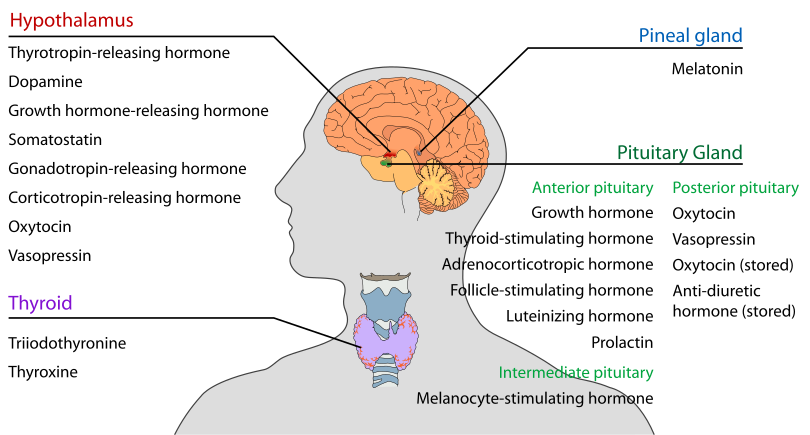
Hypothalamus → releasing hormone → pituitary → stimulating hormone → target gland → final hormone → feeds back to suppress both levels above.
And this arrangement is what makes endocrine diagnosis possible, because measuring two levels together tells you where the fault is.
Take the thyroid as the worked example.
Low thyroid hormone with a high TSH — the pituitary is shouting and the thyroid is not responding. The problem is the thyroid: primary hypothyroidism.
Low thyroid hormone with a low or normal TSH — the thyroid is not being told to work. The problem is the pituitary: secondary hypothyroidism.
High thyroid hormone with a suppressed TSH — the thyroid is producing independently of control. Primary hyperthyroidism.
High thyroid hormone with a high TSH — rare, and it means either a pituitary tumour secreting TSH or resistance to thyroid hormone.
Two numbers, four diagnoses. This pattern — measuring the hormone and its controller together — is the fundamental technique of endocrinology, and it applies to the adrenal, gonadal and growth hormone axes identically.
Positive feedback appears exactly once in the endocrine system, and it is the LH surge that triggers ovulation (Chapter 15.4). Rising oestrogen, which normally suppresses LH, switches to stimulating it above a threshold sustained for about two days, producing an explosive surge. As with all positive feedback, it has a definite end point — ovulation itself.
Rhythms
Hormone levels are not constant, and this matters for when blood is taken.
Circadian. Cortisol peaks just before waking and is lowest around midnight, varying several-fold. So a cortisol level is meaningless without knowing the time it was taken, and the standard is 8 to 9 a.m.
Growth hormone is released in pulses, mostly during deep sleep, which is where the association between sleep and growth in children comes from.
Melatonin rises in darkness and is suppressed by light — particularly blue light (Chapter 24.7).
Pulsatile. Many hormones are released in bursts rather than continuously, and the pulse pattern carries information.
GnRH from the hypothalamus is the clearest case, and it produces a genuinely counter-intuitive therapeutic result. Pulsatile GnRH stimulates the pituitary. Continuous GnRH shuts it down, because the receptors downregulate.
So a GnRH agonist — a drug that mimics it constantly — is used to suppress sex hormone production, in prostate cancer, endometriosis and precocious puberty. Giving more of a stimulating hormone switches the system off, because the pattern is wrong.
Monthly. The menstrual cycle (Chapter 15.4).
Lifetime. Growth hormone falls from adolescence. Sex hormones rise at puberty and fall at menopause.
When it goes wrong
Endocrine disease comes in a small number of forms, and recognising the form organises the whole subject.
Too much hormone. Usually a tumour of the gland, or an autoimmune process stimulating it.
Too little. Autoimmune destruction (much the commonest in wealthy countries), surgical removal, radiation, infection, infarction, or a genetic defect.
Resistance. Normal or high hormone with no effect, because the receptor or the pathway is faulty. Type 2 diabetes is the largest example (Chapter 18.7).
And a fourth, worth naming because it explains so many strange presentations: ectopic production. A tumour that is not endocrine tissue at all starts making a hormone. Small cell lung cancer producing ADH, causing severe hyponatraemia; squamous lung cancer producing a parathyroid-like hormone, causing high calcium. These paraneoplastic syndromes sometimes appear before the cancer itself is detectable, which is why an unexplained endocrine abnormality in an older smoker prompts a chest scan.
Testing
Three principles that make endocrine testing understandable.
Measure the hormone and its controller together, as above.
Suppress when you suspect too much. If you think a gland is overproducing, try to switch it off and see if it obeys. The dexamethasone suppression test gives a steroid that should suppress cortisol; failure to suppress means the production is autonomous.
Stimulate when you suspect too little. The short synacthen test gives a dose of synthetic ACTH; a healthy adrenal responds with a cortisol rise, and a failed one does not.
Dynamic tests exist because single measurements are so often uninterpretable in a system with rhythms, pulses and feedback.
Hormone treatment, and where the caution belongs
Replacement works extremely well where a hormone is genuinely missing. Thyroxine for hypothyroidism and insulin for type 1 diabetes are among the most successful treatments in medicine — conditions that were fatal or profoundly disabling and are now managed with a daily tablet or injection.
The difficulty is that the body's control is far more sophisticated than any dosing schedule. A healthy adrenal gland varies cortisol output continuously; a person on steroid replacement takes two or three fixed doses, and matching physiological patterns is genuinely hard.
And long-term steroid treatment produces a specific and predictable set of consequences, because it is giving a stress hormone continuously to someone who is not under stress: weight gain with a characteristic distribution, thin skin and easy bruising, raised blood sugar, osteoporosis, cataracts, and increased infection risk.
Most importantly, exogenous steroid suppresses the axis. The hypothalamus and pituitary stop signalling, and the adrenal cortex atrophies.
So stopping long-term steroids abruptly can cause an adrenal crisis — the body has no cortisol of its own and the tablets have been withdrawn. This is why steroids taken for more than a few weeks must be tapered, and why patients on them carry a steroid card and are told to increase the dose during illness. Chapter 12.4.
The area where caution is most warranted is hormone supplementation in people who are not deficient. Growth hormone, testosterone and thyroid hormone are all marketed for anti-ageing, energy and performance. The evidence of benefit in people with normal levels is weak, and the harms are real — growth hormone causes joint pain, fluid retention, insulin resistance and probably raises cancer risk; unnecessary thyroxine causes atrial fibrillation and bone loss.
Testosterone replacement in men with genuinely low levels and symptoms is legitimate and helpful. Testosterone given to men with normal levels for vague symptoms of ageing is not, and the distinction is frequently blurred by clinics selling it.
What the next page fixes
Everything above ran through a gland the size of a pea, hanging beneath the brain on a stalk. Chapter 12.2 covers the hypothalamus and pituitary — the master controllers, what each of the eight pituitary hormones does, and why a tumour there classically presents with a visual field defect rather than an endocrine symptom.