Appearance
2.10 — Why Fingerprints Are Unique, and How DNA Identifies a Person
Identical twins have identical DNA. They do not have identical fingerprints, and the difference between those two statements contains everything worth knowing about how patterns in a body are made.
What a fingerprint is, physically
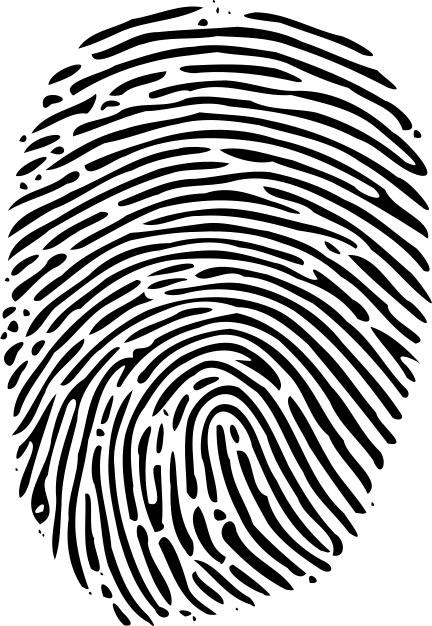
The ridges are called friction ridges, and they are not a surface feature. They are formed by the boundary between the epidermis and the dermis underneath, which is why a superficial burn or abrasion heals with the pattern intact — the template beneath was untouched. Damage deep enough to destroy the dermis produces a permanent scar in the pattern, which is why the pattern remains a lifelong identifier while still being destructible.
Their function is grip and touch. The ridges increase friction on smooth surfaces and, more subtly, they amplify the vibrations produced when a fingertip is dragged across a texture, feeding the touch receptors underneath. They also channel sweat, keeping the skin at the right moisture for grip.
Fingerprints form between about weeks 10 and 16 of gestation and never change afterwards. They grow with the finger, but the pattern of ridge endings and forks stays fixed from before birth until decomposition after death.
Why they are unique — the actual mechanism
Fingerprints are not specified gene by gene. They are the frozen record of a physical buckling process.
At around the tenth week, small pads of tissue called volar pads swell on the fingertips, and the growing epidermis is compressed against the dermis beneath. Under compression, the tissue buckles into ridges, and the ridge pattern forms perpendicular to the direction of greatest stress — the same physics that puts regular wrinkles in a drying apple or ripples in wind-blown sand.
The overall pattern class is genetically influenced. Whether you get a loop, a whorl or an arch depends heavily on the shape and height of those volar pads, which is inherited. Family members and especially identical twins often share pattern class, and identical twins' prints are similar enough that untrained observers frequently confuse them.
The detail is not inherited, and cannot be. Where each individual ridge happens to end or fork depends on the exact local geometry at the moment of buckling: the precise pad shape at that hour, how the finger was positioned, the amount of amniotic fluid pressure, the local growth rate of a patch of tissue a fraction of a millimetre across. These are not encoded anywhere. They are the outcome of a process that amplifies tiny differences, and no genome could specify them because a genome does not have that much information to spare.
So identical twins have identical genes, near-identical pattern classes, and completely different minutiae. Even the two hands of one person differ, and each of your ten fingers is a separate pattern. That is the clearest possible demonstration of the general principle: an organism's form is the product of genes plus development, and development contains genuine randomness.
How did we conclude they are unique? Honestly, not by proof. Nobody has compared all the fingerprints that have ever existed. The claim rests on two things: the mechanism above, which makes exact repetition of a random buckling pattern astronomically unlikely; and empirical experience, in which since Francis Galton's systematic study in 1892 no two prints from different fingers have ever been shown to match on full detail. That is strong evidence, and it is not mathematical proof, and a forensic scientist testifying accurately says the former rather than the latter.
The limits are real and were exposed publicly. In 2004 the FBI matched a fingerprint from the Madrid train bombings to Brandon Mayfield, an American lawyer, with three examiners independently confirming it. He was detained. Spanish police then matched the same print to an Algerian national. The FBI's own review concluded the error came from a poor-quality partial print and from confirmation bias among examiners who knew their colleagues had already declared a match. Partial prints from crime scenes are a completely different problem from full prints taken under controlled conditions, and the confidence appropriate to one is not appropriate to the other.
DNA fingerprinting
Alec Jeffreys, at the University of Leicester, developed the technique in 1984 — by accident, while studying a gene in seal myoglobin. He noticed regions where a short sequence was repeated a variable number of times between individuals, and realised within minutes that this could identify people. He later described it as happening in a single morning.
Its first use was not a criminal conviction but an immigration case, settling whether a Ghanaian boy was the son of a woman living in Britain. Its first criminal use, in 1986, is more instructive: it exonerated a young man who had confessed to two murders in Leicestershire, then identified the actual killer, Colin Pitchfork, after a mass screening of local men. The first thing DNA evidence ever did in a criminal case was prove someone innocent, and that has remained one of its most important uses — the Innocence Project in the United States has used DNA to overturn hundreds of convictions.
What is actually measured
Modern DNA profiling does not sequence anything. It measures short tandem repeats (STRs) — short sequences, typically two to five bases long, repeated a variable number of times at specific known locations. At a given location one person might have 11 repeats on one chromosome and 14 on the other; another person 9 and 12.
These locations are deliberately chosen to be in non-coding DNA with no known function, so a profile carries no information about health, appearance or ancestry beyond identity. That is a design choice with a privacy purpose.
The standard systems examine 20 or more such locations plus a sex marker. The measurement is done by PCR — the amplification described in Chapter 2.1 — followed by separating the products by length, so a profile is a list of about forty numbers.
The arithmetic behind "one in a billion"
Each location is only moderately informative on its own. A particular combination at one site might occur in perhaps 1 in 10 people. What produces the enormous figures is multiplying across independent locations.
If the locations are on different chromosomes, they assort independently (Chapter 2.6), so the probabilities multiply. Suppose each of twenty locations gives a match probability of 1 in 10:
\left(\tfrac{1}{10}\right)^{20} = 10^{-20}
That is one in a hundred billion billion — far more than the number of humans who have ever lived. Real systems give figures in the range of one in a quintillion for a full profile.
Four cautions, all of which have caused real miscarriages of justice.
The random match probability is not the probability of innocence. They are different questions, and confusing them is called the prosecutor's fallacy. "The chance a random person matches is one in a billion" does not mean "the chance the defendant is innocent is one in a billion", because that second number depends on all the other evidence and on how many people could plausibly have been involved. Courts have been misled by this repeatedly, and appeals have succeeded on it.
Relatives are not random people. Siblings share far more DNA than strangers, so the match probability against a brother is orders of magnitude higher than against an unrelated person. A calculation assuming a random population does not apply when a relative is a plausible alternative.
Partial and mixed samples are much weaker. A degraded sample may give only eight usable locations rather than twenty, and the discriminating power falls by many orders of magnitude. A sample containing DNA from three people can often be interpreted several ways, and interpretation of mixtures is where forensic DNA is genuinely contested.
Contamination and transfer are real. Modern PCR is sensitive enough to profile a few cells, which means it can profile cells transferred by a handshake, or carried in on equipment. In 2012, a man in California was arrested for a murder committed while he was in hospital; his DNA had been carried to the crime scene on the equipment of the paramedics who had treated him earlier that evening. The profile was correct and the inference from it was completely wrong.
Sensitivity is not the same as reliability, and it is exactly the sensitivity that creates the problem.
Other identity uses
Paternity testing compares the child's profile with the alleged father's. A child must have one allele at each location from each parent. Exclusion is certain: if the child has an allele present in neither the mother nor the alleged father, he is not the father, full stop. Inclusion is probabilistic — a probability of paternity, usually quoted above 99.99 percent, and the same relative-caveat applies since a brother of the true father may also fit.
Disaster victim identification. DNA is often the only method available after fire, explosion or long submersion. Identification is by comparison with a personal item, or with relatives' profiles.
Ancient DNA. Sequencing has been recovered from remains hundreds of thousands of years old. Richard III's skeleton, found under a car park in Leicester in 2012, was confirmed by mitochondrial DNA matched to living descendants of his sister's female line — the maternal inheritance of Chapter 1.5 put to work on a five-hundred-year-old question. Ancient DNA also established that non-African modern humans carry Neanderthal sequence, which is Chapter 3.5.
And the loose ends are ethical rather than technical. National DNA databases hold profiles from millions of people, in some countries including people arrested but never charged. Genealogy databases can identify a person from a third cousin's uploaded data, which means a person's genetic privacy is determined by choices made by relatives they may never have met. There is no established framework for consent that works across a family, and the technology arrived long before the framework.
What Part 3 does next
You now have the code, how it is read, how it is copied, how it varies and how it is inherited. What Part 2 has not explained is why — why these particular genes, why a body built this way, why a molecule that repairs itself in one place and fails in another.
Part 3 answers that with the only mechanism that can: evolution. The evidence for it, how selection actually works step by step, why populations change and species split, where humans came from, and why a body assembled by four billion years of incremental modification is full of arrangements no engineer would ever choose — including the ones that are actively killing you.