Appearance
3.6 — Why the Human Body Is Badly Designed
Your windpipe and your food pipe cross. Air goes down one and food down the other, and the only thing stopping food from entering your lungs is a flap that has to close at exactly the right moment, several times a minute, for your entire life. When it fails, you choke — and choking on food kills thousands of people every year in a way that no engineer would ever have permitted.
That is not an unfortunate detail. It is a summary of what selection is and what it is not. Selection cannot redesign. It can only modify what is already there, one small improvement at a time, and every step has to work. The result is a body full of arrangements that make no sense as designs and perfect sense as histories.
The back
You have a spine built for a horizontal animal, turned vertical.
A quadruped's spine works like a suspension bridge: it is a horizontal beam with the organs slung beneath it and the load distributed along its length. Stand that beam on end and every vertebra now carries the weight of everything above it, with the lowest ones carrying the most.
The adaptations are visible and incomplete. The human spine has an S-curve — cervical curving forward, thoracic back, lumbar forward again — which acts as a spring and absorbs shock. The lumbar vertebrae are much thicker than the thoracic ones. But the intervertebral discs, which are pressurised gel cushions, are now loaded in compression continuously rather than in bending intermittently.
The consequence is that around 80 percent of people experience significant back pain at some point, and disc herniation — where the soft centre of a disc pushes out through a weakened ring and presses on a nerve root — is one of the commonest causes of disability worldwide. The lower lumbar discs, L4/L5 and L5/S1, carry the most load and are where the great majority of herniations occur. Chapter 5.3.
Sitting is worse than standing, and the reason is measurable: pressure inside a lumbar disc is higher when seated leaning forward than when standing upright, because the pelvis rotates and the lumbar curve flattens, moving the load forward onto the disc's front edge.
Childbirth
This is the most severe compromise in the human body and it is a direct collision between two consequences of standing up.
Walking upright requires a narrow pelvis. The hip joints have to sit close to the body's midline so that the centre of mass can be shifted over one leg without swaying enormously with each step. A wide pelvis makes walking energetically expensive and unstable.
A large brain requires a large head. Human neonatal brain volume is around 400 cm³ — larger than an adult chimpanzee's.
Those two demands are in direct opposition, and the result is that human birth is unusually difficult and dangerous. The fetal head passes through the pelvis with only millimetres to spare, and it must rotate during descent because the pelvic inlet is widest side to side while the outlet is widest front to back. No other primate's infant has to do this.
The consequences follow from that geometry.
Human babies are born extremely immature. A newborn horse walks within an hour; a newborn human cannot support its own head for months. Comparing brain growth curves, a human infant would need roughly 18 to 21 months of gestation to be born at the developmental stage of other primates. We are all born about a year early, because waiting any longer would make the head too big to pass. The long helpless infancy that follows is not a separate fact about humans — it is the direct price of the pelvis.
Human birth normally requires assistance. Almost every other mammal gives birth alone. Human females are the exception, and this is thought to be why attended birth appears to be universal across human cultures.
And maternal mortality was, and where care is poor still is, appallingly high. Before modern obstetrics, roughly 1 to 2 percent of births killed the mother, and with several births per woman that compounds into a lifetime risk of several percent. Obstructed labour, where the head simply will not pass, was uniformly fatal to both without caesarean section. This is the single strongest argument that selection does not produce optimal designs — it produced an arrangement that killed a substantial fraction of the people carrying it, because the alternative arrangements available were worse.
The eye's backwards retina
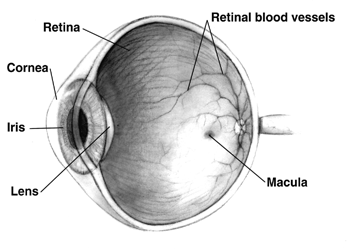
The vertebrate retina is installed backwards. The photoreceptors — the cells that actually detect light — sit at the very back, facing away from the incoming light. In front of them lie the nerve cells that process the signal and the blood vessels that feed the retina. Light must pass through all of that before reaching the detectors.
Two consequences.
The blind spot. Because the nerve fibres run across the front of the retina, they must at some point punch back through it to leave the eye. At that hole there are no photoreceptors, so there is a genuine gap in your visual field, about 5 to 6 degrees across, in each eye. Your brain fills it in from surrounding context so convincingly that most people never notice it. You can find it easily: close your right eye, look at a fixed point with your left, and move a small object slowly to the left — it will vanish and reappear.
Retinal detachment. The photoreceptor layer is not firmly anchored to the layer behind it; it is held in place largely by pressure. A tear allows fluid behind it and it peels away, taking its blood supply with it. This is a surgical emergency — untreated it causes permanent blindness in that area, and the sudden appearance of floaters, flashes or a curtain across the vision is the warning sign that means go to an eye department today. Chapter 21.7.
The octopus eye evolved independently and has the wiring behind the receptors. No blind spot, no detachment risk from this cause. Neither arrangement can be converted into the other, because no series of individually beneficial small steps connects them. This is Chapter 3.2's constraint made visible: selection cannot start over.
The shared airway
The pharynx is a single tube used for both breathing and swallowing, with the two paths crossing. The epiglottis, a cartilage flap, folds over the larynx during swallowing to divert food into the oesophagus.
In fish, from which this arrangement descends, there is no conflict — water enters the mouth and exits through the gills, and there is no lung to protect. The crossing appeared when lungs evolved from an outpouching of the gut, and it has never been fixed.
The human version is worse than other mammals', because our larynx sits lower in the throat. A human infant can breathe and swallow nearly simultaneously, with the larynx high enough to lock into the nasal passage. That arrangement descends during the first two years. The descended larynx makes the vocal tract able to produce the full range of speech sounds, and it makes choking possible.
The trade is speech for safety, and the death toll is real: choking is a leading cause of accidental death, particularly in children under four and adults over 65. Chapter 23.2 is the response, and it is one of the chapters worth reading before you need it.
The recurrent laryngeal nerve

The nerve supplying the larynx starts in the brain. The larynx is a few centimetres below the brain. The nerve travels down the neck, into the chest, hooks underneath the aortic arch on the left, and returns up the neck to reach it. In a human this detour is about 30 centimetres for a destination a few centimetres away.
Why? In fish, the equivalent nerve runs to the corresponding gill arch, and it takes a direct route past a blood vessel. As the neck lengthened over evolutionary time and the heart descended into the chest, the nerve stayed hooked around the vessel and was dragged down with it. At no point could it detach and re-route, because there is no way to get from one arrangement to the other in small steps that each work.
In a giraffe the same nerve is over four metres long. The same detour, in an animal with a two-metre neck.
And this is not merely a curiosity — it is a surgical hazard. The nerve runs immediately behind the thyroid gland, and injury during thyroid surgery causes hoarseness, or if bilateral, airway obstruction. Surgeons identify and protect it explicitly in every thyroidectomy, and injury rates are a standard quality measure. Chapter 12.3.
The rest of the list
The appendix is a narrow blind-ended tube with a very small opening. When that opening blocks, bacteria multiply inside a closed space, pressure rises, the wall's blood supply is cut off, and it perforates — spilling gut contents into the abdomen. Lifetime risk of appendicitis is around 7 to 8 percent, and before surgery it was frequently fatal. It does appear to serve as a bacterial reservoir, but the risk-to-benefit ratio is poor.
Wisdom teeth. Human jaws have shortened, partly because cooked and processed food requires less chewing. The teeth have not been reduced by the same amount, so the last molars frequently have nowhere to go, becoming impacted and infected.
The inguinal canal. In male development the testes form inside the abdomen near the kidneys and descend through the abdominal wall into the scrotum, leaving a weak point behind. That weakness is why inguinal hernias are roughly eight times commoner in men, with a lifetime risk around 27 percent for men and 3 percent for women. Chapter 15.1.
The knee. A hinge joint bearing the body's full weight while permitting rotation, stabilised largely by ligaments rather than by bone geometry. Anterior cruciate ligament ruptures are one of the commonest serious sports injuries, and the ligament heals poorly because its blood supply is minimal.
The sinuses. The maxillary sinus, in the cheek, drains through an opening near its top. In a quadruped with a horizontal head that is the low point. In an upright human it is the high point, so the sinus must clear fluid upward against gravity by ciliary action alone. This is why maxillary sinusitis is so common and so persistent. Chapter 21.7.
Vitamin C. We cannot make it, because of the broken GULO gene from Chapter 3.1 — a mutation that was harmless in a fruit-eating ancestor and became lethal on long sea voyages.
Why bodies never evolved to survive swords and bullets
This is a question that comes up naturally and it has a precise answer.
Selection can only act on causes of death that were common enough, for long enough, to leave a differential in reproduction. Human beings have made blades for perhaps 5,000 years in serious quantity and firearms for about 600. Given a generation time of 20 to 25 years, that is roughly 200 generations for blades and 25 for firearms — and evolution needs both time and heritable variation in the relevant trait.
And there is no available variation for it. Meaningful protection against a blade would need something like thickened dermal armour, and no human has a variant giving it. There is nothing for selection to select. Selection cannot invent a solution; it can only increase the frequency of one that already exists in the population.
More decisively, the cost would be enormous. Skin thick enough to resist a blade would have to sacrifice touch sensitivity, heat loss through sweating, and flexibility — all of which are worth far more, far more often, than protection against a weapon most humans historically never faced.
What we did evolve is the thing that actually works: a brain that makes armour. The human response to blades was shields, mail, plate and now ceramic plate carriers, and the response to disease was medicine. Cultural evolution operates thousands of times faster than genetic evolution, and for the last few tens of thousands of years it has done essentially all the adapting. A species that can change its behaviour in a generation does not need to change its skin over a hundred thousand.
And what has changed since our ancestors? Less than people expect. Height and body composition have shifted with nutrition, which is environmental rather than genetic. Genuine genetic changes in the last 10,000 years are real but narrow: lactase persistence, malaria resistance alleles, high-altitude adaptation, some changes in starch-digesting enzyme copy number, and skin pigmentation adapted to latitude (Chapter 3.5). Your body is essentially a Pleistocene hunter-gatherer's body, running in an environment of abundant calories, minimal physical demand, and almost no infectious pressure. Most of the chronic disease in Parts 18 and 24 is that mismatch.
What this means practically
It reframes several conditions from personal failings to structural inevitabilities.
Back pain is not usually a sign you did something wrong. It is the expected behaviour of a horizontal spine held vertical for decades.
Obesity is not primarily a failure of willpower. A body tuned to store every available calorie, in an environment where calories are unlimited and effortless to obtain, does exactly what it was built to do. That does not make it untreatable, and Chapter 18.8 covers what actually works, but it does change what the problem is.
And knowing where the weak points are tells you what to watch for. The five-minute version: sudden severe back pain with leg weakness or loss of bladder control is an emergency; a curtain across your vision is an emergency; food inhaled into the airway is an emergency; and a lump in the groin that appears on straining is a hernia that should be assessed before it strangulates.
What the next page fixes
Part 3 has been almost entirely about animals and mostly about us. The rest of life has been named without being described, and a reader who has followed the argument this far should know what else is out there and what it does for and against them. Chapter 3.7 surveys the rest of the tree compactly — bacteria, archaea, protists, fungi, plants and animals — with plants covered for what actually matters: photosynthesis, the food chain, and the medicines that came out of them.